GAF machine
Member
"so he built an empire" -- emperor Kaz Hirai
An epic feat that saw the near improbable defeat of Nintendo and Sega at the height of their power, forever changed gaming's landscape and with it, Sony Group Corp.'s fortunes. So influential was his empire, that it drew in ~60% of Sony's revenue at one point; but Kutaragi's tale isn't just one about how he led a small cadre into lands ruled by Nintendo and Sega to wage a vengeful war for console supremacy. His is also a tale of him making legacy provisions before passing the scepter to Hirai that continue to guide the empire's direction and sustain the empire's vigor across various interests:
Hardware -- After witnessing System G's real-time brilliance, Kutaragi embraced a real-time philosophy for 3D CG that his PS1 would be first to establish in the industry as "Graphics Synthesis". For PS2, he extended the philosophy to simulated emotions/real-world physics; which he dubbed "Emotion Synthesis". His PS3 unified the two concepts (actually three concepts; "Sound Synthesis" came first in the late '80s, PS3 rendered sound as a 3D object) with stereoscopic 3D and presented it as "Reality Synthesis"; which brought about the prospect of VR on PS4. Kutaragi's emphasis on real-time performance drove him to architect radical hardware. None more radical and special than PS3. It was first to embody all four real-time concepts and has been the source of inspiration behind PS hardware customization ever since. He took a big risk when he traded ease of development for a chip faster than Moore's Law, but that trade handed PS3 an ingenious weapon of war. The weapon (i.e., the SPU Runtime System enhanced with STM) was forged in the fire of CELL's asynchronous compute engine architecture. More specifically, in the fire of SPU direct memory access (DMA). Such was the weapon's effectiveness that ranger Mark Cerny (he helped forge it, knows it well) sought to arm PS4's GPU with it. SIE struck a deal with AMD's merchants to equip PS4, and in exchange AMD got to market SPURS as 'ACE' for their GPU line. A fair deal, but AMD's GPUs can't "replicate the SPU Runtime System (SPURS) of the PS3" in the same way that PS4, PS4 Pro and PS5's GPUs can. That's because AMD GPUs lack a hardware implementation of STM. The SPU task manager (STM) makes SPURS highly efficient (entries [0012], [0015] and [0016] explain what and why; [0070], [0071] and [0072] touch on non-CELL implementations and STM results). It allows an SPU to treat it's local store (i.e., scratchpad memory) like cache, and select only the tasks that match its current program code as a way to minimize costly context switching/"cache flushing". PS4/PS4 Pro's GPUs imitate this process by means of a "volatile bit" that selectively invalidates cache lines to reduce cache flushing when L2 is used for compute and graphics at the same time. PS5 keeps with the volatile bit process and has a similar process for its I/O complex. Coherency engines in the complex tell cache scrubbers on the GPU which address ranges to scrub away so as to avoid full cache flushes when the SSD is read. With SPURS/STM, PS4, PS4 Pro and PS5 are forces to be reckoned with. Without it, they're easy marks that have no effective counter against One X and Series X's brute-force GPU asynchronous compute or Series X's Velocity architecture. That despite D3D12's Multi-engine Resource/Enhanced Barrier hindering both Xbox GPUs by requiring excessive cache flushes after they complete their work. The popular opinion is that PS3 was a failure, but profitability and market share aren't the only measures of success. The unpopular fact is that PS3 was a triumph of engineering and has become the saving grace of current/future PS consoles. They are Kutaragi's standard-bearers. His due honor for attempting to make CELL a fixture in the world of computing, which unintentionally yet consequently gave Cerny/SIE the privilege of putting certain CELL related features on AMD's GPU roadmap for the benefit of AMD, SIE and industry. 'The Road to' began with CELL. It continues to prove itself a valuable resource and wise expenditure of the empire's treasure.
Software -- Kutaragi's crucible (i.e., a precursor CPU that's GPU-like) tested the mettle of PS Studios' ranks and steeled them for battle in the age of GPU asynchronous compute programming years before the dawn. For two generations, Redmond's assaults have been repelled by happy warriors (e.g., the ICE Team) highly skilled in the art of PS3. Mastery of Packing fp16 shader operations on SPUs and checkerboard MLAA on SPUs were trials for fp16 'Rapid Packed Math' usage and checkerboard rendering on PS4 Pro. PS3 pushed PS Studios' elite to be the most cunning at their craft. The evidence of history gives credence to the claim. Kutaragi is the only CEO (or system architect for that matter) to ever assure SIE's hardware and programmer competence ahead of future trends. The grateful warriors salute him.
Network -- As SCEI's emperor with broad authority inside Sony Group Corp.'s larger empire, Kutaragi the Great commissioned the PSNP's construction to commune PS users, traffic e-commerce and provide a foothold in network services across platforms for generations to come. It was his long-held vision brought to emperor Jim Ryan's remembrance in later years: "I think he foresaw the network era and was talking about the network era many, many years before it became reality"... "he talked about this before we could really comprehend what he was saying". His visionary leadership and persistence (he tried with PS BB in Japan, but it failed to gain traction; then he tried with PSN) are why PSN appeared on SIE's timeline when it did. PSN has generated billions in profit since inception and has been vital to SIE's expansion into cloud, PC and soon mobile; which will generate billions more in coming years. In the Web3 era, PSN will host P2P transactions and records of interoperable distributed ledgers (i.e., interoperable blockchains). The latter is an inevitability that Kutaragi didn't foresee; but he conceived CELL to be "a bus for peer-to-peer computing" (translated by DeepL) on a network, which ties into the latter. A scribe's account of the network was 'a peer-to-peer web that would transform every home into a kind of domestic (and legal) Napster'. Kutaragi had an uncanny intuition about the future of PS3's tech, but seven years wasn't enough time for that future to emerge. Nevertheless, he still speaks of P2P computing; but as it relates to blockchain and NFTs. It now rests with a future PS console (PS6?) to take up PS3's mantle.
Multimedia-as-a-Service/Transmedia -- As a point of clarity, Kutaragi declared SCE/SIE an entertainment company and laid out a '21st Century Entertainment' strategy that draws from all corners of Sony Group Corp. to widen PlayStation's appeal. His vision was to wield popular entertainment as an instrument to further spread PS's influence, under the declaration that PlayStation is for entertainment, not just games. A scribe privy to Kutaragi's declaration noted 'games and other services for PlayStation. His goal is to establish the PlayStation as a separate brand, not part of a dedicated Sony network for the online distribution of music, movies, and TV shows'. SIE's latest proposal to transition PS Plus to "Services 3.0" and scale it out in partnership with leading subscription service providers is testament to his declaration and a re-commitment to his entertainment strategy. It's also part of a larger aim to transform SIE into a transmedia superpower through inter-company collaboration, in accordance with his strategy.
GaaS/Live Service -- As the scribe noted, GaaS was an objective of Kutaragi's entertainment services ambition. SIE's live service pursuit was always a matter of when, not if.
GaaS/Game Streaming -- Kutaragi saw 'the Cloud' gathering from afar and readied PS3 for a ubiquitous game streaming future before it made sense to the masses. Prior to PS2's US launch, he riddled that PS3 would "totally disappear as a console, as a shape". At 9:51 - 9:52 Tokyo time (2:51 - 2:52 BST if Tokyo time isn't shown) of his final keynote as emperor, he justified PS3's engineering as necessary to take advantage of a future network that he predicted would be fast enough to reliably stream video for services in "ten years time" (i.e., by 2016, ten years after his 2006 keynote). PS Now launched in major territories from 2014 - 2016 as a nebulous PS3 requiring a 5mbps connection speed for 720p streaming. As it turns out, one SPU can encode a 720p stream at 5mbps. By this metric, every PS Now subscriber is a credit to him. Plus Premium's entire game streaming platform is as much a credit to him as it is to David Perry, Steve Perlman and the noble scout, Eric Lempel. SIE was first to act on Gaikai (streamed games to any webpage/browser), OnLive (used perceptual tweaks to mask latency) and iSIZE (used an AI-based perceptual pre-encoder to mask latency) because Kutaragi was first to know: "In the future, broadband will connect all appliances - console, TV, phone, PC, everything. Then exclusivity means nothing".
PC -- Kutaragi considered PC neither friend nor foe to PS consoles. His notion that PS exclusives would come to PC via streaming in the then-future means he knew that PC would have a role in the empire's scheme to seize greater mind share at some point. The eventuality of letting Plus Premium members stream first-party titles they purchase for PC (e.g., Helldivers 2 via Steam Cloud Play developer opt-in) to a TV, phone, tablet or PS Portal follows his logic. If followed to its logical conclusion, then Steam will eventually have a role in SIE's scheme, too. The titan in Santa Clara may have to defend against Geforce Now falling to Plus Premium's sword one day.
Mobile -- With the threat of mobile's march into gaming looming large on the horizon, Kutaragi began fashioning a shield for PS consoles to use in the inevitable fight. Scrolls reveal that before he relinquished the throne, a PSP DualShock dock and remote play controller (under his name) that serviced music, movies, TV shows, mini games (possibly PS Mobile for Android games) and e-mails were contemplated. The remote play controller arose out of his suspicion that mobile phones would eventually be an 'enemy' of PS consoles. In his absence, the device went lost to time in the archives; until it was publicized as a new USPTO filing in 2019. Four years later, it was pared-down and launched as 'PlayStation Portal'. For now it's touted as just a remote player, but despite having ~6GB storage (guessing here, I think it's that small because SIE plans to update Portal with a machine learning downloader that "cloud delivers"/auto deletes individual mobile game levels and areas as necessary for continuous local play or resumption of local play; hence Portal's rumored codename: 'Q' 'Lite'), it's only a few approved media/VoWifi apps away from also being the single entertainment/communications device he spoke of in the '90s (emperor Andrew House recalled: "I remember him talking about there was going to be a convergence between all forms of media and entertainment into a single communications device"). The head smith Hideaki Nishino and his smithsmen hammered Portal into existence from a DualSense, but Kutaragi hammered out the details of Portal's remote play, cloud, mobile (touch input) and motion sensing features years in advance.
AI -- Long before LLMs and autonomous AI were hot topics, Kutaragi's take was that "one Cell or cluster of Cells can also function as a server; but whereas the present Internet mainly handles characters, applications on the Cell network will also handle semantics and reasoning". He always thought ahead and occasionally pushed to do more than necessary for the glory of the empire. CELL was one such push, made in part to spark an AI revolution within SIE. A couple years after PS3's launch, SIE's once-brother in arms IBM presented its approach to training neural networks on CELL processors and a workaround for SPEs to compute training functions when bandwidth is limited. The work didn't yield anything for PS3 games, but that doesn't negate the fact that CELL foreshadowed AI accelerators. Its array of SPEs are SIMD dataflow units with support for 8-bit operations and SRAM connected to a high-bandwidth on-chip network (four ring EIB) that facilitates SPE to SPE processing. These are attributes of dedicated AI accelerators from IBM, Graphcore and others (last paragraph). "Enormous applications that require image processing and large-volume computing" were other workloads he posited for CELL acceleration. The neighboring empire Toshiba had a similar thought for their SpursEngine derivative. They used it for Super Resolution video up-conversion in the image processing domain. Almost two decades later, here comes PS5 Pro with talk of 8-bit computation for ML Super Resolution. PS5 Pro's AI acceleration hardware is still a mystery, but if "past is prologue" then the hardware will be Tempest Engine-like; which means its design will also hark back to the new age chip Kutaragi envisioned.
Metaverse -- Ryan saw PS Home as "a very early manifestation of a platform metaverse". Kutaragi saw it as "only the beginning of what will come". What was yet to come (and still is) was a realm of "make.believe-as-a-service" illusions and spectacles to enchant the people. This realm wasn't a metaverse experience, it was a blended 'Cyber Society' experience. A mixed reality experience that "combines the real and the imaginary" with music, movies, games and other entertainment. PetaFLOP class server room CELL supercomputers bound together with PS3s distributed across the land were to form a CELL network that would harness the mixed realm's alchemy. In effect, the CELL network's function was to muster fantastical MR scenery and present a variety of entertainment within cyberspace for the Cyber Society's delight. Decades on, emperor Kenichiro Yoshida's perception of the so-called "metaverse" and Sony's approach to it (Q2., Q3. and Q4) now align with Kutaragi's grand vision of a Cyber Society. Time has shown that Kutaragi wasn't "krazy". He was clairvoyant and well-versed in his interests. One of his earliest insights into a MR cyberverse was recorded by a scribe who wrote that while Kutaragi was waving his arm, he said: "This, this is the real broadband interface" (last sentence of the article Onslaught posted). Reality interfaces and the scenes they manipulate have come in phases throughout the empire's existence. Phase 1 was EyeToy for Play, Groove, Chat and Kinetic, PS Eye/Move controllers for EyePet in S3D (i.e. Stereoscopic 3D rendered in real-time by PS3's SPUs and RSX) and the PS3 provided VR testbed that gave rise to PS VR. PS Camera and its associated Asobi/AR Bots, PS HD Camera with PS VR2/Sense controllers and social VR experimentation were Phase 2. Phase 3 is in follow ups to these peripherals and experiences. In particular, the next PS HMD (Portal XR?) which the Sony XR HMD already solves for. In the Phase 3 era, Kutaragi's 'Cyber Society' will no longer be a concept of his imagination; rather a mixed reality that his consoles (PS2, PS3) encouraged Magic Lab's magicians and Sony Electronics' wizards to formulate.
Frankly, Kutaragi was wise beyond his years on the throne. The passage of time, brand/IP maturation and tech advancement across industries have affirmed his sweeping vision; and have allowed his successors to see what he saw decades earlier as they look to further build on the foundation he laid, while moving to extend the empire's reach into areas of interest he identified beyond the traditional pillars set in place during his rule.
His greatest success is that he made the success of every SCE/SIE ruler before (Toshio Ozawa, Shigeo Maruyama, Teruhisa Tokunaka, etc.) and after him possible. Those who came before are beneficiaries of his gamble to usher in real-time entertainment. Those who came/come after are inheritors of provisions he made to ensure the empire's survival and competitiveness.
Past and present SIE emperors (Kutaragi included) can say they cut costs, streamlined operations, consolidated silos, improved communications, avoided pitfalls, made exclusive deals, entered partnerships, approved major acquisitions and led the empire through challenging circumstances on the way to greater expansion and wealth during their tenure; but Kutaragi's tenure as emperor defined PlayStation's past, present and future.
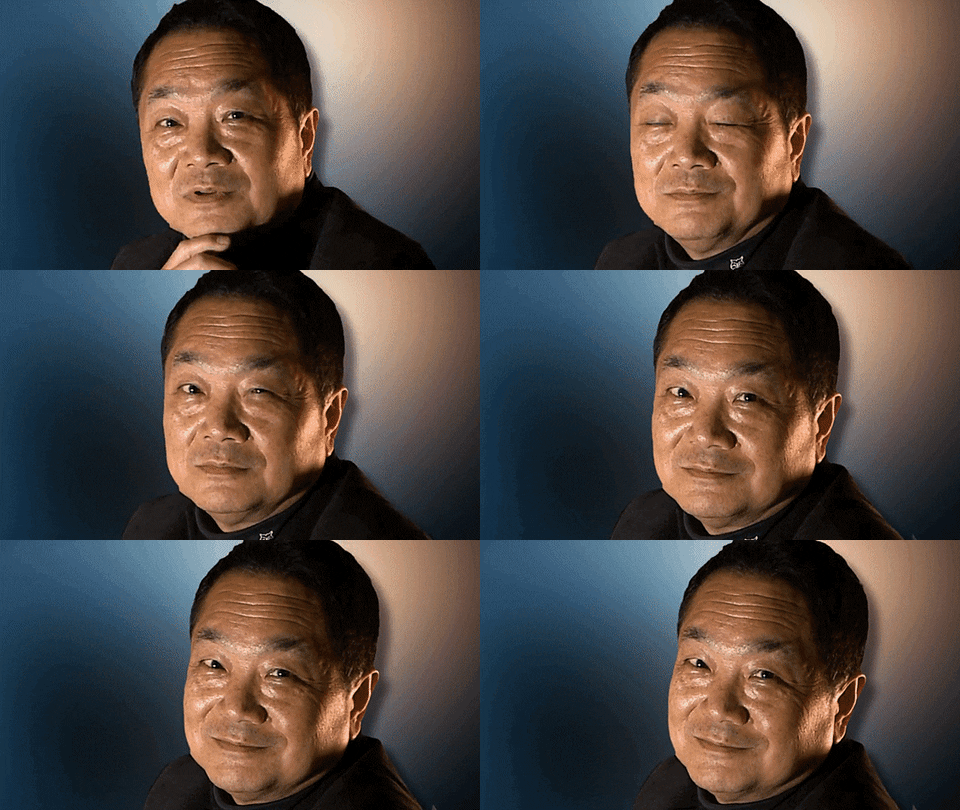
So for that, here's to Ken Kutaragi. The man, the myth, the legend, the visionary, "the Oracle", The G.O.A.T. May he continue to live long.
Long live the empire.

An epic feat that saw the near improbable defeat of Nintendo and Sega at the height of their power, forever changed gaming's landscape and with it, Sony Group Corp.'s fortunes. So influential was his empire, that it drew in ~60% of Sony's revenue at one point; but Kutaragi's tale isn't just one about how he led a small cadre into lands ruled by Nintendo and Sega to wage a vengeful war for console supremacy. His is also a tale of him making legacy provisions before passing the scepter to Hirai that continue to guide the empire's direction and sustain the empire's vigor across various interests:
Hardware -- After witnessing System G's real-time brilliance, Kutaragi embraced a real-time philosophy for 3D CG that his PS1 would be first to establish in the industry as "Graphics Synthesis". For PS2, he extended the philosophy to simulated emotions/real-world physics; which he dubbed "Emotion Synthesis". His PS3 unified the two concepts (actually three concepts; "Sound Synthesis" came first in the late '80s, PS3 rendered sound as a 3D object) with stereoscopic 3D and presented it as "Reality Synthesis"; which brought about the prospect of VR on PS4. Kutaragi's emphasis on real-time performance drove him to architect radical hardware. None more radical and special than PS3. It was first to embody all four real-time concepts and has been the source of inspiration behind PS hardware customization ever since. He took a big risk when he traded ease of development for a chip faster than Moore's Law, but that trade handed PS3 an ingenious weapon of war. The weapon (i.e., the SPU Runtime System enhanced with STM) was forged in the fire of CELL's asynchronous compute engine architecture. More specifically, in the fire of SPU direct memory access (DMA). Such was the weapon's effectiveness that ranger Mark Cerny (he helped forge it, knows it well) sought to arm PS4's GPU with it. SIE struck a deal with AMD's merchants to equip PS4, and in exchange AMD got to market SPURS as 'ACE' for their GPU line. A fair deal, but AMD's GPUs can't "replicate the SPU Runtime System (SPURS) of the PS3" in the same way that PS4, PS4 Pro and PS5's GPUs can. That's because AMD GPUs lack a hardware implementation of STM. The SPU task manager (STM) makes SPURS highly efficient (entries [0012], [0015] and [0016] explain what and why; [0070], [0071] and [0072] touch on non-CELL implementations and STM results). It allows an SPU to treat it's local store (i.e., scratchpad memory) like cache, and select only the tasks that match its current program code as a way to minimize costly context switching/"cache flushing". PS4/PS4 Pro's GPUs imitate this process by means of a "volatile bit" that selectively invalidates cache lines to reduce cache flushing when L2 is used for compute and graphics at the same time. PS5 keeps with the volatile bit process and has a similar process for its I/O complex. Coherency engines in the complex tell cache scrubbers on the GPU which address ranges to scrub away so as to avoid full cache flushes when the SSD is read. With SPURS/STM, PS4, PS4 Pro and PS5 are forces to be reckoned with. Without it, they're easy marks that have no effective counter against One X and Series X's brute-force GPU asynchronous compute or Series X's Velocity architecture. That despite D3D12's Multi-engine Resource/Enhanced Barrier hindering both Xbox GPUs by requiring excessive cache flushes after they complete their work. The popular opinion is that PS3 was a failure, but profitability and market share aren't the only measures of success. The unpopular fact is that PS3 was a triumph of engineering and has become the saving grace of current/future PS consoles. They are Kutaragi's standard-bearers. His due honor for attempting to make CELL a fixture in the world of computing, which unintentionally yet consequently gave Cerny/SIE the privilege of putting certain CELL related features on AMD's GPU roadmap for the benefit of AMD, SIE and industry. 'The Road to' began with CELL. It continues to prove itself a valuable resource and wise expenditure of the empire's treasure.
Software -- Kutaragi's crucible (i.e., a precursor CPU that's GPU-like) tested the mettle of PS Studios' ranks and steeled them for battle in the age of GPU asynchronous compute programming years before the dawn. For two generations, Redmond's assaults have been repelled by happy warriors (e.g., the ICE Team) highly skilled in the art of PS3. Mastery of Packing fp16 shader operations on SPUs and checkerboard MLAA on SPUs were trials for fp16 'Rapid Packed Math' usage and checkerboard rendering on PS4 Pro. PS3 pushed PS Studios' elite to be the most cunning at their craft. The evidence of history gives credence to the claim. Kutaragi is the only CEO (or system architect for that matter) to ever assure SIE's hardware and programmer competence ahead of future trends. The grateful warriors salute him.
Network -- As SCEI's emperor with broad authority inside Sony Group Corp.'s larger empire, Kutaragi the Great commissioned the PSNP's construction to commune PS users, traffic e-commerce and provide a foothold in network services across platforms for generations to come. It was his long-held vision brought to emperor Jim Ryan's remembrance in later years: "I think he foresaw the network era and was talking about the network era many, many years before it became reality"... "he talked about this before we could really comprehend what he was saying". His visionary leadership and persistence (he tried with PS BB in Japan, but it failed to gain traction; then he tried with PSN) are why PSN appeared on SIE's timeline when it did. PSN has generated billions in profit since inception and has been vital to SIE's expansion into cloud, PC and soon mobile; which will generate billions more in coming years. In the Web3 era, PSN will host P2P transactions and records of interoperable distributed ledgers (i.e., interoperable blockchains). The latter is an inevitability that Kutaragi didn't foresee; but he conceived CELL to be "a bus for peer-to-peer computing" (translated by DeepL) on a network, which ties into the latter. A scribe's account of the network was 'a peer-to-peer web that would transform every home into a kind of domestic (and legal) Napster'. Kutaragi had an uncanny intuition about the future of PS3's tech, but seven years wasn't enough time for that future to emerge. Nevertheless, he still speaks of P2P computing; but as it relates to blockchain and NFTs. It now rests with a future PS console (PS6?) to take up PS3's mantle.
Multimedia-as-a-Service/Transmedia -- As a point of clarity, Kutaragi declared SCE/SIE an entertainment company and laid out a '21st Century Entertainment' strategy that draws from all corners of Sony Group Corp. to widen PlayStation's appeal. His vision was to wield popular entertainment as an instrument to further spread PS's influence, under the declaration that PlayStation is for entertainment, not just games. A scribe privy to Kutaragi's declaration noted 'games and other services for PlayStation. His goal is to establish the PlayStation as a separate brand, not part of a dedicated Sony network for the online distribution of music, movies, and TV shows'. SIE's latest proposal to transition PS Plus to "Services 3.0" and scale it out in partnership with leading subscription service providers is testament to his declaration and a re-commitment to his entertainment strategy. It's also part of a larger aim to transform SIE into a transmedia superpower through inter-company collaboration, in accordance with his strategy.
GaaS/Live Service -- As the scribe noted, GaaS was an objective of Kutaragi's entertainment services ambition. SIE's live service pursuit was always a matter of when, not if.
GaaS/Game Streaming -- Kutaragi saw 'the Cloud' gathering from afar and readied PS3 for a ubiquitous game streaming future before it made sense to the masses. Prior to PS2's US launch, he riddled that PS3 would "totally disappear as a console, as a shape". At 9:51 - 9:52 Tokyo time (2:51 - 2:52 BST if Tokyo time isn't shown) of his final keynote as emperor, he justified PS3's engineering as necessary to take advantage of a future network that he predicted would be fast enough to reliably stream video for services in "ten years time" (i.e., by 2016, ten years after his 2006 keynote). PS Now launched in major territories from 2014 - 2016 as a nebulous PS3 requiring a 5mbps connection speed for 720p streaming. As it turns out, one SPU can encode a 720p stream at 5mbps. By this metric, every PS Now subscriber is a credit to him. Plus Premium's entire game streaming platform is as much a credit to him as it is to David Perry, Steve Perlman and the noble scout, Eric Lempel. SIE was first to act on Gaikai (streamed games to any webpage/browser), OnLive (used perceptual tweaks to mask latency) and iSIZE (used an AI-based perceptual pre-encoder to mask latency) because Kutaragi was first to know: "In the future, broadband will connect all appliances - console, TV, phone, PC, everything. Then exclusivity means nothing".
PC -- Kutaragi considered PC neither friend nor foe to PS consoles. His notion that PS exclusives would come to PC via streaming in the then-future means he knew that PC would have a role in the empire's scheme to seize greater mind share at some point. The eventuality of letting Plus Premium members stream first-party titles they purchase for PC (e.g., Helldivers 2 via Steam Cloud Play developer opt-in) to a TV, phone, tablet or PS Portal follows his logic. If followed to its logical conclusion, then Steam will eventually have a role in SIE's scheme, too. The titan in Santa Clara may have to defend against Geforce Now falling to Plus Premium's sword one day.
Mobile -- With the threat of mobile's march into gaming looming large on the horizon, Kutaragi began fashioning a shield for PS consoles to use in the inevitable fight. Scrolls reveal that before he relinquished the throne, a PSP DualShock dock and remote play controller (under his name) that serviced music, movies, TV shows, mini games (possibly PS Mobile for Android games) and e-mails were contemplated. The remote play controller arose out of his suspicion that mobile phones would eventually be an 'enemy' of PS consoles. In his absence, the device went lost to time in the archives; until it was publicized as a new USPTO filing in 2019. Four years later, it was pared-down and launched as 'PlayStation Portal'. For now it's touted as just a remote player, but despite having ~6GB storage (guessing here, I think it's that small because SIE plans to update Portal with a machine learning downloader that "cloud delivers"/auto deletes individual mobile game levels and areas as necessary for continuous local play or resumption of local play; hence Portal's rumored codename: 'Q' 'Lite'), it's only a few approved media/VoWifi apps away from also being the single entertainment/communications device he spoke of in the '90s (emperor Andrew House recalled: "I remember him talking about there was going to be a convergence between all forms of media and entertainment into a single communications device"). The head smith Hideaki Nishino and his smithsmen hammered Portal into existence from a DualSense, but Kutaragi hammered out the details of Portal's remote play, cloud, mobile (touch input) and motion sensing features years in advance.
AI -- Long before LLMs and autonomous AI were hot topics, Kutaragi's take was that "one Cell or cluster of Cells can also function as a server; but whereas the present Internet mainly handles characters, applications on the Cell network will also handle semantics and reasoning". He always thought ahead and occasionally pushed to do more than necessary for the glory of the empire. CELL was one such push, made in part to spark an AI revolution within SIE. A couple years after PS3's launch, SIE's once-brother in arms IBM presented its approach to training neural networks on CELL processors and a workaround for SPEs to compute training functions when bandwidth is limited. The work didn't yield anything for PS3 games, but that doesn't negate the fact that CELL foreshadowed AI accelerators. Its array of SPEs are SIMD dataflow units with support for 8-bit operations and SRAM connected to a high-bandwidth on-chip network (four ring EIB) that facilitates SPE to SPE processing. These are attributes of dedicated AI accelerators from IBM, Graphcore and others (last paragraph). "Enormous applications that require image processing and large-volume computing" were other workloads he posited for CELL acceleration. The neighboring empire Toshiba had a similar thought for their SpursEngine derivative. They used it for Super Resolution video up-conversion in the image processing domain. Almost two decades later, here comes PS5 Pro with talk of 8-bit computation for ML Super Resolution. PS5 Pro's AI acceleration hardware is still a mystery, but if "past is prologue" then the hardware will be Tempest Engine-like; which means its design will also hark back to the new age chip Kutaragi envisioned.
Metaverse -- Ryan saw PS Home as "a very early manifestation of a platform metaverse". Kutaragi saw it as "only the beginning of what will come". What was yet to come (and still is) was a realm of "make.believe-as-a-service" illusions and spectacles to enchant the people. This realm wasn't a metaverse experience, it was a blended 'Cyber Society' experience. A mixed reality experience that "combines the real and the imaginary" with music, movies, games and other entertainment. PetaFLOP class server room CELL supercomputers bound together with PS3s distributed across the land were to form a CELL network that would harness the mixed realm's alchemy. In effect, the CELL network's function was to muster fantastical MR scenery and present a variety of entertainment within cyberspace for the Cyber Society's delight. Decades on, emperor Kenichiro Yoshida's perception of the so-called "metaverse" and Sony's approach to it (Q2., Q3. and Q4) now align with Kutaragi's grand vision of a Cyber Society. Time has shown that Kutaragi wasn't "krazy". He was clairvoyant and well-versed in his interests. One of his earliest insights into a MR cyberverse was recorded by a scribe who wrote that while Kutaragi was waving his arm, he said: "This, this is the real broadband interface" (last sentence of the article Onslaught posted). Reality interfaces and the scenes they manipulate have come in phases throughout the empire's existence. Phase 1 was EyeToy for Play, Groove, Chat and Kinetic, PS Eye/Move controllers for EyePet in S3D (i.e. Stereoscopic 3D rendered in real-time by PS3's SPUs and RSX) and the PS3 provided VR testbed that gave rise to PS VR. PS Camera and its associated Asobi/AR Bots, PS HD Camera with PS VR2/Sense controllers and social VR experimentation were Phase 2. Phase 3 is in follow ups to these peripherals and experiences. In particular, the next PS HMD (Portal XR?) which the Sony XR HMD already solves for. In the Phase 3 era, Kutaragi's 'Cyber Society' will no longer be a concept of his imagination; rather a mixed reality that his consoles (PS2, PS3) encouraged Magic Lab's magicians and Sony Electronics' wizards to formulate.
Frankly, Kutaragi was wise beyond his years on the throne. The passage of time, brand/IP maturation and tech advancement across industries have affirmed his sweeping vision; and have allowed his successors to see what he saw decades earlier as they look to further build on the foundation he laid, while moving to extend the empire's reach into areas of interest he identified beyond the traditional pillars set in place during his rule.
His greatest success is that he made the success of every SCE/SIE ruler before (Toshio Ozawa, Shigeo Maruyama, Teruhisa Tokunaka, etc.) and after him possible. Those who came before are beneficiaries of his gamble to usher in real-time entertainment. Those who came/come after are inheritors of provisions he made to ensure the empire's survival and competitiveness.
Past and present SIE emperors (Kutaragi included) can say they cut costs, streamlined operations, consolidated silos, improved communications, avoided pitfalls, made exclusive deals, entered partnerships, approved major acquisitions and led the empire through challenging circumstances on the way to greater expansion and wealth during their tenure; but Kutaragi's tenure as emperor defined PlayStation's past, present and future.
So for that, here's to Ken Kutaragi. The man, the myth, the legend, the visionary, "the Oracle", The G.O.A.T. May he continue to live long.
Long live the empire.
Last edited: