• Hey Guest. Check out your NeoGAF Wrapped 2025 results here!

Could Intel+Nvidia/ATI do a console...

Nightbringer

Don´t hit me for my bad english plase
... and become a danger for Sony?

In the next september Intel will launch the VIIV ("Vive") platform for PC, a standard plataform for making Media Centers with an aspect like the MacMini.

Now Imagine an Intel VIIV focused only on gaming with more power than PS3 and 360 being marketed at CES 07 and using development tools from Linux and an huge marketing impact on the society.
 
Intel will do a console with someone. they have a new SUPER chip in development that sounds like it could blow Cell out of the water.

actually a family of super chips.


stolen from B3D

______________________________________________________________________
DemoCoder said:
I like CELL, but CELL is not the future IMHO, it is 1/2 of the future. I think the future is the combination of throughput style designs like the Niagara chip, and "SPE farm" approach of CELL, that is, lots of additional TLP combined with a large pool of functional units. If you're going to go the route of dropping OoOE and ILP scalability, you need TLP to make up for stalls.


That will hold us over until we get RSFQ and nanorod based designs. :)


I agree. Cell is just a step to that future.


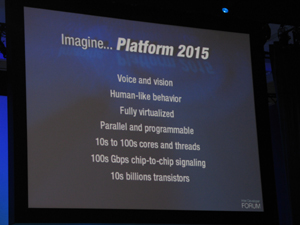
I like Intel's 'Platform 2015' outline where chips will reach many billions of transistors - have several full fledged cores - many multi-purpose cores / functional units - and specialized units; some for 3D rendering. They were talking about tens or hundreds of cores on a single chip, capable of hundreds or thousands of threads. Of course they couldn't be hundreds of full fledged CPU cores, but maybe units that are more like the SPE in Cell or the unified shader ALUs in Xenos. sounds like Intel is working on a family of true 'super chips' that are CPU, GPU and more in one. All of that is pure vaporware at the moment though.


I am trying to find some choice quotes about Intel's Platform 2015 efforts.

http://www.intel.com/technology/techresearch/idf/platform-2015-keynote.htm
The Trend to Many-Core
Rattner introduced the "many-core" concept, explaining that Intel researchers and scientists are experimenting with "many tens of cores, potentially even hundreds of cores per die, per single processor die. And those cores will be supporting tens, hundreds, maybe even thousands of simultaneous execution threads."

http://www.itnews.com.au/newsstory.aspx?CIaNID=18036&r=hstory
Intel's 10-year technology vision includes the ability to put hundreds of cores on one processor, which would permit the creation of scores of "arrays" on a chip devoted to separate functions like video, graphics or VoIP, one of the chip giant's top technologists said this week.


Since the chips are designed to hold hundreds of cores, "we fully expect these [core] arrays to be partitioned," Rattner said to reporters and analysts after his speech. Processors then could allocate scores of cores and threads for improved performance in specific applications, including graphics and media. A hundred cores "could be used over a range of applications," he said.


http://www.intel.com/technology/magazine/computing/platform-2015-0305.htm
1. Chip-Level Multiprocessing (CMP)
Intel continues pioneering in one of the most important directions in microprocessor architecture—increasing parallelism for increased performance. As shown in Figure 1, we started with the superscalar architecture of the original Intel® Pentium® processor and multiprocessing, continued in the mid-90s by adding capabilities like "out of order execution," and most recently introduced Hyper-Threading Technology in the Pentium 4 processor. These paved the way for the next major step—the movement away from one, monolithic processing core to multiple cores on a single chip.

Intel is introducing multi-core processor-based platforms to the mainstream. These platforms will initially contain Intel processors with two cores, evolving to many more. We plan to deliver Intel processors over the next decade that will have dozens, and even hundreds of cores in some cases. We believe that Intel's chip-level multiprocessing (CMP) architectures represent the future of microprocessors because they deliver massive performance scaling while effectively managing power and heat.


Figure 1. Driving increasing degrees of parallelism on Intel® processor architectures.


In the past, performance scaling in conventional single-core processors has been accomplished largely through increases in clock frequency (accounting for roughly 80 percent of the performance gains to date). But frequency scaling is running into some fundamental physical barriers. First of all, as chip geometries shrink and clock frequencies rise, the transistor leakage current increases, leading to excess power consumption and heat (more on power consumption below).

Secondly, the advantages of higher clock speeds are in part negated by memory latency, since memory access times have not been able to keep pace with increasing clock frequencies. Third, for certain applications, traditional serial architectures are becoming less efficient as processors get faster (due to the so-called Von Neumann bottleneck), further undercutting any gains that frequency increases might otherwise buy. In addition, resistance-capacitance (RC) delays in signal transmission are growing as feature sizes shrink, imposing an additional bottleneck that frequency increases don't address.

Therefore, performance will have to come by other means than boosting the clock speed of large monolithic cores. Instead, the solution is to divide and conquer, breaking up functions into many concurrent operations and distributing these across many small processing units. Rather than carrying out a few operations serially at an extremely high frequency, Intel's CMP processors will achieve extreme performance at more practical clock rates, by executing many operations in parallel². Intel's CMP architectures will circumvent the problems posed by frequency scaling (increased leakage current, mismatches between core performance and memory speed and Von Neumann bottlenecks). Intel® architecture (IA) with many cores will also mitigate the impact of RC delays³.

Intel's CMP architectures provide a way to not only dramatically scale performance, but also to do so while minimizing power consumption and heat dissipation. Rather than relying on one big, power-hungry, heat-producing core, Intel's CMP chips need activate only those cores needed for a given function, while idle cores are powered down. This fine-grained control over processing resources enables the chip to use only as much power as is needed at any time.

Intel's CMP architectures will also provide the essential special-purpose performance and adaptability that future platforms will require. In addition to general-purpose cores, Intel's chips will include specialized cores for various classes of computation, such as graphics, speech recognition algorithms and communication-protocol processing. Moreover, Intel will design processors that allow dynamic reconfiguration of the cores, interconnects and caches to meet diverse and changing requirements.

Such reconfiguration might be performed by the chip manufacturer, to repurpose the same silicon for different markets; by the OEM, to tailor the processor to different kinds of systems; or in the field at runtime, to support changing workload requirements on the fly. Intel® IXP processors today provide such capability for special purpose network processing. As shown in Figure 2, the Intel IXP 2800 has 16 independent micro engines operating at 1.4 GHz along with an Intel XScale® core

pl2015_g2.gif

my note: an example of a current Intel chip with one main core and 16 'micro engines' - I guess used as an example to show where Intel is going with so called 'many core' single die processors.


2. Special Purpose Hardware
Over time, important functions once relegated to software and specialized chips are typically absorbed into the microprocessor itself. Intel has been at the forefront of this effort, which has been the driving force behind our business model for over 35 years. By moving functions on chip, such capabilities benefit from more-efficient execution and superior economies of scale and reduce the power consumption drastically. Low latency communication between special purpose hardware and general purpose cores will be especially critical to meet future processor architecture performance and functionality expectations.

Special-purpose hardware is an important ingredient of Intel's future processor and platform architectures. Past examples include floating point math, graphics processing and network packet processing. Over the next several years, Intel processors will incorporate dedicated hardware for a wide variety of tasks. Possible candidates include: critical function blocks of radios for wireless networking; 3D graphics rendering; digital signal processing; advanced image processing; speech and handwriting recognition; advanced security, reliability and management; XML and other Internet protocol processing; data mining; and natural language processing.


platform2015.jpg


now that *sounds* alot cooler than Cell, in my opinion.
_________________________________________________________________________
 
In terms of collaboration, er, isn't that sort of indirectly happening anyway? Intel is involved in all the console CPUs and Nvidia and ATI is involved with PS3 and X360/Rev respectly.
 
HomerSimpson-Man said:
In terms of collaboration, er, isn't that sort of indirectly happening anyway? Intel is involved in all the console CPUs and Nvidia and ATI is involved with PS3 and X360/Rev respectly.

ATI and Nvidia are only graphic processor designers and they don´t have their own fabs. Intel can pay to one of them a quantity of money for an exclusive GPU or a variation of an existing GPU.
 
Midas said:
If they could? Yeah. McDonalds and Coca Cola could make one too!

Intel is the most great (in size, manufacturation and sales) microprocessor company of the world. We are talking about a company that can do a lot of damage to Sony and Microsoft if its decide to enter.
 
Nightbringer said:
Intel is the most great (in size, manufacturation and sales) microprocessor company of the world. We are talking about a company that can do a lot of damage to Sony and Microsoft if its decide to enter.

Yeah, but they'd be getting envolved with the worst part of game industy for the big three, the hardware. Son¥ and M$, and in many cases Nintendo lose money on hardware production to make that money up on software. Why would Intel want to get in on the hardware side of the business when there is little to no money to be made there. The money is in the software. How much did Intel make on software last fiscal year? Compare that to M$, Nintendo, and Son¥

The Dark One
 
No doubt with resources they have, Intel can easily make the best CPU. The main / bigget reason they can't is backward compatible. It's not like consoles where you can start totally new / different every cycle. Plus, their current CPU are design for general computing and not games.


On the other hand, they haven't done much, if any, with software side of creating games. Could be just Microsoft part 2, where Intel is reverse of M$ (knows software, but not hardware).
 
Why would they want to? There's a lot more to the industry besides hardware.

elostyle said:
Intel has the largest gpu marketshare. They could make a console all by themselfs.

True. So what if it's integrated.
 
DaCocoBrova said:
Why would they want to? There's a lot more to the industry besides hardware.
There is also a lot more to it than OS and office software - didn't stop microsoft ;)
 
HomerSimpson-Man said:
In terms of collaboration, er, isn't that sort of indirectly happening anyway? Intel is involved in all the console CPUs and Nvidia and ATI is involved with PS3 and X360/Rev respectly.


No. Intel has been shut out of all the new consoles:


Xbox 360 Xenon CPU (IBM, Microsoft)
PS3 Cell CPU (Sony Toshiba IBM)
Revolution CPU (IBM)

Intel is out of game consoles with the original Xbox being phased out.


edit: ok I see that you thought it read IBM :) nevermind.
 
Intel would probably never make a console of its own - but would be one of the major partners in someone elses console (i.e. Apple)


read this:

Battlelines of the Digital Living Room (A Musing)

In a previous article, this author pointed out that the CELL processor appears to be the cornerstone of STI’s strategy in winning the battle of the digital living room. That is, the CELL processor will form the foundation of Sony’s renewed gambit to bypass the traditional personal computer and capture the digital hub of household communications and entertainment, a lucrative market that is also targeted by Microsoft, Intel, and Apple. Interestingly enough, Microsoft is well positioned regardless of whether the traditional personal computer or the game console wins the battle for the heart of the digital hub. Microsoft can adjust and retain relevance regardless of the outcome of the battle of the digital living room. However, the strategic alliances formed by Microsoft with IBM, and Sony with Toshiba and IBM leaves Intel and Apple out in the cold if the game consoles gain ascendancy as the hub of the digital living room. With the battlelines as given, it seems natural that Apple and Intel would seek to create a third alliance, one that can deliver both the silicon and the software stack to compete for the digital living room against the MI (Microsoft-IBM) alliance and the STI alliance. With the shocking announcements of Apple’s transition from PPC to x86, pundits have espoused various theories and reasons behind the switch. While the short term justifications of the PPC970FX failing to reach 3 GHz, chronic PPC processor shortages from both IBM and Motorola (Freescale), or higher than desired processor prices may all have some validity, the long term justification may be as simple as the formation of the strategic alliance in the battle for the digital living room for players left out by the previous alliances.
A long time ago, before Steve Jobs returned to his role as Apple’s CEO, he was asked what he would do it he was placed in charge of reviving Apple’s flagging fortunes. Steve Job’s answer at the time was that he would keep the Macintosh alive as long as necessary to move on to the next big thing. Following this theme in the years after Steve Job’s return, Apple has positioned itself as the manufacturer of a digital hub where a Macintosh computer is the center of activity for various digital appliances such as a DV camcorder or a music player. In this sense, Sony’s gambit to capture the hub of the digital living room most directly threatens Apple’s future. More ominously, Apple would find that if it were ever pitted against Sony in a battle for the center of the digital hub, the prospect of using the CELL processor in the battle against Sony would be one that is highly unpalatable. That is, if Apple should adopt the CELL processor, it would become a de facto junior partner in the STI alliance. Then, if the battle of the digital living room materializes along the computer-game console battleline, Apple could find itself having to compete against Sony on a processor that Sony co-specified with IBM, a processor that has an unusual programming model with the tool chains being co-developed by Sony, and a processor that Sony plans to manufacture on a massive scale in its own fabrication plant.

The implication is that Apple would find the CELL processor to be undesirable from both technical and strategic perspectives. Steve Job’s ambiguous statements that “Intel has a good roadmap” may be a simple statement that expresses his belief that Intel has a roadmap that is better suited to Apple’s long term strategic plans. However, despite the drawbacks of a CELL-like processor on traditional computer centric applications, it seems clear that a heavily multi-threaded CELL-like approach to multimedia applications is the correct approach. The question then is if Intel will soon embark on or has already secretly embarked on the development of a CELL-like processor that will enable Apple and Intel to challenge the MI and STI alliances. From Apple’s perspective, a roadmap filled with low power mobile processors, cheap Celeron processors, and enhanced with the promise of new types of devices that can enable it to adjust more rapidly to changing market trends would be a roadmap that is ideal to its continued development as a corporate entity and continued battle to win the digital hub of future homes.

http://www.realworldtech.com/page.cfm?ArticleID=RWT072405191325

but if Apple-Intel does try again with another console (Apple Pippin was the first) they better do something more compelling than another multi-media device that lacks dedicated 3D graphics processing like Pippin, or that is just an opinimized Mac Mini with marginally better graphics chip. I don't want Pippin 3 (Pip2 was canned) or Mac Mini 2 or MacBox. I want something totally fresh that blows away X360 and PS3, and that can compete against Xbox 2010 and PS4. otherwise, don't bother.

a next-generation Intel CPU with many small cores and several main cores plus twin parallal (not SLi) next-next gen GPUs from Nvidia (NV5x or NV6x) or ATI (R6xx or R7xx)
plus at least 2 GB RAM would get developers very interested. 2009 indeed.
 
An Intel and a Nvidia chip is used in the Sega Lindbergh... I've said to much...

Oh come on, you didn't really think I was being serious in hinting at a Sega console return. Right? Right.
 
Eric_S said:
An Intel and a Nvidia chip is used in the Sega Lindbergh... I've said to much...

Oh come on, you didn't really think I was being serious in hinting at a Sega console return. Right? Right.

heh. Lindbergh is just a slightly modified PC as far as I know. it's more of a PC than even the original Xbox since it does not seem to have a custom GPU or memory architecture.

they should've at least tried something interesting like a quad GPU (non SLi) configuration with a dual core Intel or AMD CPU. Lindbergh isnt even remotely interesting.
i'm not saying Lindbergh games wont be good, just that its a step backwards (in approach not power) from things Sega has done in the past.
 
At this point, I see none of them having much of a chance creating their own console ... just too many factors against it.
 
Onix said:
At this point, I see none of them having much of a chance creating their own console ... just too many factors against it.

there were alot of factors against Microsoft having their own X-Box console, but it happened, and now its successor is out, and, Bill Gates said they'd have another one out even if 360 fails.
 
Intel's roadmaps and market predictions are a joke.

They really have no idea beyond what they'll be doing beyond the next 12 months.

"Imagine..." from that slide sums it up:
Imagination.

Simple fact is they won't be getting hundreds of cores on a single die in 2015.
Not with out a radical redesign of the microprocessor as we know it.

We're running into physical barriers at the sizes we deal with.

4 cores on a single die is tough - a couple more die shrinks and we could see 16, or 32 cores on a chip. But if we double the transistors (per area) every 18 months (Moore's law), then you've got the same problem. You can either have 32 current-day cores, or 8 modern (future) cores.


People are focusing WAY too much on hardware.

Software programmers are getting lazier, sloppier, and less educated.
This issue needs more R&D than hardware.
 
well to be fair i have no idea what fab process will be available in 2015, Intel is already ramping up .65nm and preparing .45 nm and its only 2k6. You have to remember that there are alot of multiple cpu chips out there today that incorporate many many programmable cores, they just dont get sold to regular consumers. Even SUN microsystems has an 8 core chip right now. It seems to me that intel is saying hundreds of cores is possible but they all wont be identical, so you may have a case of 4 fully functional cores then x amt of network cores, y amt of graphics cores, etc etc dedicated cores wouldnt need all the extra logic circuitry a standard intel pentium has now. You have to remember that by 2015 intel plans to be transitioning away from silicon so its hard to say they will have the problems they have now with fabbing chips if they arent even using the same materials. 9 years is an eternity in the hardware world.

Intel needs a new memory interface besides that crusty ole FSB before any of this would be worth it though.
 
myzhi said:
No doubt with resources they have, Intel can easily make the best CPU. The main / bigget reason they can't is backward compatible. It's not like consoles where you can start totally new / different every cycle. Plus, their current CPU are design for general computing and not games.


On the other hand, they haven't done much, if any, with software side of creating games. Could be just Microsoft part 2, where Intel is reverse of M$ (knows software, but not hardware).

Would it be better than the CELL?

Remember IBM/Sony/Toshiba

;)
 
choplifter said:
there were alot of factors against Microsoft having their own X-Box console, but it happened, and now its successor is out, and, Bill Gates said they'd have another one out even if 360 fails.

The situation is very different - not only in timing, but in 'gameplan'.

1) MS's presence makes it more difficult since there are now 3 potentially successful console lines already established. It is now even more difficult for someone else to enter the market.

2) MS has ‘grander plans’ than simply consoles. That is why they didn’t really blink at losing $4 billion last gen. Intel, NVidia, and ATI do not really have a grand design that makes risking such loses logical, and obviously, they do not have the reserves to lose anywhere near what MS did.
 
conker said:
Intel's roadmaps and market predictions are a joke.

They really have no idea beyond what they'll be doing beyond the next 12 months.

"Imagine..." from that slide sums it up:
Imagination.

Simple fact is they won't be getting hundreds of cores on a single die in 2015.
Not with out a radical redesign of the microprocessor as we know it.

We're running into physical barriers at the sizes we deal with.

4 cores on a single die is tough - a couple more die shrinks and we could see 16, or 32 cores on a chip. But if we double the transistors (per area) every 18 months (Moore's law), then you've got the same problem. You can either have 32 current-day cores, or 8 modern (future) cores.


People are focusing WAY too much on hardware.

Software programmers are getting lazier, sloppier, and less educated.
This issue needs more R&D than hardware.


Who says all of the dies need to be on one chip though? In the next 10 years, I wouldn't be suprised to see a quad processor setup. If you had 2 - 4 cores per chip you could get 8 - 16 cores total. The irony is, multicore configs have become popular because die shrinks are almost hitting the wall as it is practically speaking. Higher RPM's aren't the answer anymore because of public enemy #1- heat.

With multicore designs you spread that heat out more evenly across more surface area. As mult-proc configurations gain popularity, I wouldn't be suprised to see more specialization at the processor level. Instead of having everything on *one* chip, I think they'll break the elements up across chips to some degree.

JMO
 
Intel was talking about making its own game console when it looked like Microsoft was going to use an AMD processor in the Xbox...

Intel has the resources to make a game console, but it doesn't understand how to sell to directly to consumers. There's good reason why every attempt Intel has made to enter the consumer market has failed.

So, no. Not gonna happen.
 
SKOPE said:
Intel was talking about making its own game console when it looked like Microsoft was going to use an AMD processor in the Xbox...

I don't remember that.

Intel has the resources to make a game console, but it doesn't understand how to sell to directly to consumers. There's good reason why every attempt Intel has made to enter the consumer market has failed.

intel has the resources yes, to make a game console, but they have not the ability to produce highend graphics on their own like Nvidia or ATI. an Intel console without either ATI or Nvidia is dead in the water, unless Intel partners up with one of the other graphics companies that have a killer GPU waiting (PowerVR? not likely)

So, no. Not gonna happen.

I agree. not without other major hardware partners, and game developer commitments or buyouts.
 
HokieJoe said:
Who says all of the dies need to be on one chip though? In the next 10 years, I wouldn't be suprised to see a quad processor setup. If you had 2 - 4 cores per chip you could get 8 - 16 cores total. The irony is, multicore configs have become popular because die shrinks are almost hitting the wall as it is practically speaking. Higher RPM's aren't the answer anymore because of public enemy #1- heat.

With multicore designs you spread that heat out more evenly across more surface area. As mult-proc configurations gain popularity, I wouldn't be suprised to see more specialization at the processor level. Instead of having everything on *one* chip, I think they'll break the elements up across chips to some degree.

JMO


there probably would not be dozens of primary CPU cores on one chip. maybe 2, 4 or at most, 8. -- The dozens of 'cores' would be SPE-like cores (some other design though) and are basicly workhorse chips that are stupid but do a few tasks very fast.

of course we are talking about chips that we probably won't see until 2010 at the soonest, and Intel's public roadmap stretches out another 9 years, so, that is an eternity away. by 2015, PS4 will be on the market with a 2nd generation Cell, and STI will be working on a 3rd generation (not talking about Cell revisions like they are doing now with DD2, DD3)
or on some totally different architecture.
 
Top Bottom