
• Hey Guest. Check out your NeoGAF Wrapped 2025 results here!

positive news regarding CELL Processor Yields

xexex

Banned
http://www.joystiq.com/2006/02/09/good-news-for-ps3-launch-supply/

According to Warren Communications News, William Zeitler, Senior Vice President of IBM’s Systems & Technology Group, told a news conference yesterday that "yield learning" on the Cell processor that forms the core of Sony's PlayStation 3 console has been "faster than on any chip we’ve done." In English, that means that IBM is learning quickly how to produce more working Cell processors per batch of chips they cook up. This bodes well for supply of this critical component if factories contracted by Sony to produce components for the PS3 are able to crank out lots and lots of Cell processors in record time once the PS3 heads into full production.

This doesn't necessarily mean that the PS3 won't be scarce at launch, though. Consoles are made of many components. A shortage of any single component can disrupt an entire plan, as Microsoft learned during the launch of the Xbox 360. Plus, IBM's Zeitler notes that the company was able to ramp up their production of Xbox 360 parts quickly as well. What this tells us is that if the PS3 is delayed or is hard to come by, it probably won't be IBM's fault.


as said though, it doesn't mean there won't be a PS3 shortage.
 
Blu-ray, I think, more than RSX. Sony has a lot of experience at 90nm, and I think they'll be erring on the side of conservatism with it (well, relative to the wilder speculation out there). It'll have redundancy also, to give them some breathing room (according to Kutaragi).

An exec from Sony I think mentioned that Blu-ray players would be in tight supply starting off..but I'm kind of hoping that may be as much because Sony is stockpiling blue lasers for PS3 ;) Sony I think is one of only two suppliers in the world for those lasers.
 
I think Blu-Ray may be the achilles heal and also the reason why PS3 will be the must have item of 2006 and beyond.

If they can get the supply for that right they'll go along way to having a stellar Xmas 2006.
 
gofreak said:
Blu-ray, I think, more than RSX. Sony has a lot of experience at 90nm, and I think they'll be erring on the side of conservatism with it (well, relatively to the more wilder out there). It'll have redundancy also, to give them some breathing room (according to Kutaragi).

An exec from Sony I think mentioned that Blu-ray players would be in tight supply starting off..but I'm kind of hoping that may be as much because Sony is stockpiling blue lasers for PS3 ;) Sony I think is one of only two suppliers in the world for those lasers.
If they are one of two, that's what they should do - stockpiling blue lasers. But maybe there's a slight chance that other companies won't like that. :)
 
I told you guys over a month ago that the Cell wasn't going to be the problem with any potential supply issues. My friend at IBM told me the yields were great.
 
trmas said:
I told you guys over a month ago that the Cell wasn't going to be the problem with any potential supply issues. My friend at IBM told me the yields were great.

I can confirm this as well. A friend who is an engineer at IBM Fishkill tells me the yields for Cell are actually far better than they have been for XCPU. Suprising, perhaps. But those are the facts.

Sony's investment in Fishkill has been enormous - relative to MS - according to him.
 
MassiveAttack said:
I can confirm this as well. A friend who is an engineer at IBM Fishkill tells me the yields for Cell are actually far better than they have been for XCPU. Suprising, perhaps. But those are the facts.

Is that actually that surprising? I have no idea what the die sizes are for the two processors, but even if Cell is much larger the majority of it is extremely repetitive and redundant logic. There's only one PPE core which, if my understanding is correct, is much more complex logically than a single SPE (which are, judging by pictures of the die, mainly made up of memory). Whereas, XCPU has to get two complex PPE cores fault free, but CELL just has to get one and then can scale the resulting CELL for its application based on how many SPEs are functional.

Are your sources telling you the functionality of these great yields though? I mean, are the yields great only by considering a CELL that is used in a TV application that may only need one or two functions SPEs, or are the yields great based on the larger 8 SPE specification.
 
MassiveAttack said:
I can confirm this as well. A friend who is an engineer at IBM Fishkill tells me the yields for Cell are actually far better than they have been for XCPU. Suprising, perhaps. But those are the facts.
Well there's been a lot more investment in Cell development, between IBM, Sony and Toshiba I think they're looking at 2 billion+ for the architecture.
 
teiresias said:
Is that actually that surprising? I have no idea what the die sizes are for the two processors, but even if Cell is much larger the majority of it is extremely repetitive and redundant logic. There's only one PPE core which, if my understanding is correct, is much more complex logically than a single SPE (which are, judging by pictures of the die, mainly made up of memory). Whereas, XCPU has to get two complex PPE cores fault free, but CELL just has to get one and then can scale the resulting CELL for its application based on how many SPEs are functional.

According to my source at Fishkill, the die size for XCPU is significantly larger than CELL and he has been critical of the chip's size and heat issues. So yes, in that sense, it's not surprising.
 
MassiveAttack said:
According to my source at Fishkill, the die size for XCPU is significantly larger than CELL and he has been critical of the chip's size and heat issues. So yes, in that sense, it's not surprising.

Hmm, I wouldn't have thought the XCPU's die would have been larger, but i haven't really kept up with it. If that's true and CELL isn't having the heat issues the XCPU seems to have then maybe Sony actually doesn't need to worry about the VENTS!!!

Naaah, I'm sure Nvidia will provide a very hot running RSX to counter any heat gains made on the Cell side.
 
trmas said:
Isn't the 360 watercooled? I could have sworn I saw that in a video somewhere.

:lol

Uh, no. It's air cooled. Water cooled would be insane on MS's part.

It certainly wouldn't be so fargin loud if it was.
 
teiresias said:
Hmm, I wouldn't have thought the XCPU's die would have been larger, but i haven't really kept up with it. If that's true and CELL isn't having the heat issues the XCPU seems to have then maybe Sony actually doesn't need to worry about the VENTS!!!

Naaah, I'm sure Nvidia will provide a very hot running RSX to counter any heat gains made on the Cell side.

Yeah, wasn't one of Cell's design objectives to be a low-temp running processor? I think the PS3's cooling issues will consist of the RSX and BD-Drive.
 
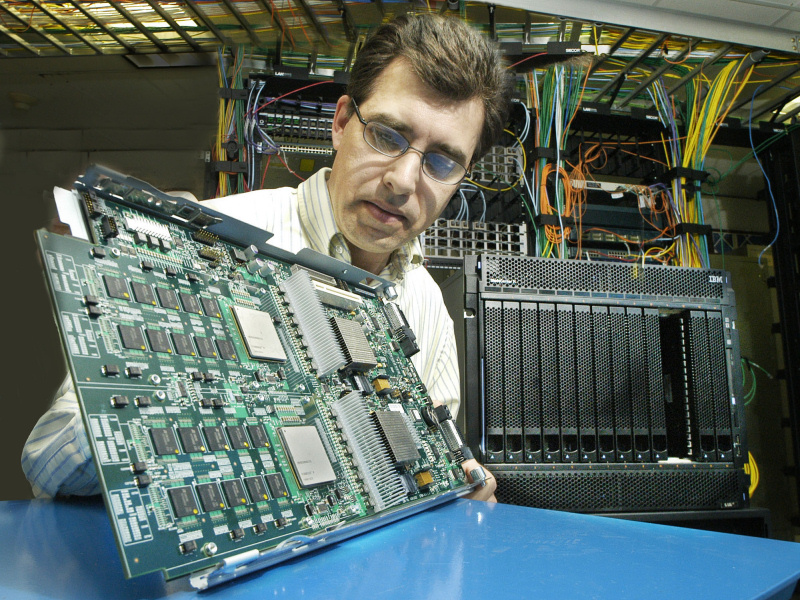
IBM's CELL based Blade Server

ibm.jpg


A nine-core IBM Cell blade
http://www-03.ibm.com/press/us/en/photo/19199.wss
 
DD2 Cell's die size is 235mm squared. I thought I read somewhere that Xenon was 168mm squared, but might be wrong on that.
 
I'll see if I can't find the video, but I remember seeing all this bronze-looking piping in the 360 when they showed it in pieces, and thinking DAMN this thing must give off massive heat. Mine works fine though so far, and isn't loud at all. (so far)
 
MassiveAttack said:
According to my source at Fishkill, the die size for XCPU is significantly larger than CELL and he has been critical of the chip's size and heat issues. So yes, in that sense, it's not surprising.

Interesting, the number's I've heard place XCPU as a bit smaller, but the near complete lack of redundancy hurts a lot.

It also wouldn't surprise me in the least to see Cell sucking less wattage (assuming that the transistor counts are true for both -- ~170 vs 230, it might be surprising to some). From what I've heard those PPE style cores are little firepits.
 
trmas said:
I'll see if I can't find the video, but I remember seeing all this bronze-looking piping in the 360 when they showed it in pieces, and thinking DAMN this thing must give off massive heat. Mine works fine though so far, and isn't load at all. (so far)

From XBOX.com

Xbox.com: What are the constraints of packing that power in a smaller case?

JR: Heat, for one. All that power generates a lot of heat, and you have to find a way to keep the unit cool. Fan size was interesting. We originally wanted to put in a single 80mm fan. But we couldn't fit it in the final form factor chassis.

We couldn't just go with one 60mm fan because it would not provide the required cooling—as the diameter of the fan increases the air flow performance per revolution increases exponentially. So we ended up putting in two 60mm fans, and we came up with a water-cooled heat sink as well for the CPU. We've actually applied for a patent on that one.

The water cooled term is being used loosely; actually it is a heat sink constructed of a copper base, aluminum stamped fins and copper heat pipe. The heat pipe contains water and a vacuum is pulled on the pipe prior to sealing.

Water under a vacuum boils at a lower temperature than at atmospheric pressure, so when the water boils and becomes steam, the steam rises and moves the heat higher into the fins where the air flow from the fans can extract the heat more efficiently. Once the steam is cooled it condenses and flows back down the pipe as water to the copper base of the heat sink, which is attached to the processor to continue the condensing and cooling processes cycle.
 
DenogginizerOS said:
From XBOX.com

Xbox.com: What are the constraints of packing that power in a smaller case?

JR: Heat, for one. All that power generates a lot of heat, and you have to find a way to keep the unit cool. Fan size was interesting. We originally wanted to put in a single 80mm fan. But we couldn't fit it in the final form factor chassis.

We couldn't just go with one 60mm fan because it would not provide the required cooling—as the diameter of the fan increases the air flow performance per revolution increases exponentially. So we ended up putting in two 60mm fans, and we came up with a water-cooled heat sink as well for the CPU. We've actually applied for a patent on that one.

The water cooled term is being used loosely; actually it is a heat sink constructed of a copper base, aluminum stamped fins and copper heat pipe. The heat pipe contains water and a vacuum is pulled on the pipe prior to sealing.

Water under a vacuum boils at a lower temperature than at atmospheric pressure, so when the water boils and becomes steam, the steam rises and moves the heat higher into the fins where the air flow from the fans can extract the heat more efficiently. Once the steam is cooled it condenses and flows back down the pipe as water to the copper base of the heat sink, which is attached to the processor to continue the condensing and cooling processes cycle.

Yeah, I figured it used heat pipes.
 
teiresias said:
Is that actually that surprising? I have no idea what the die sizes are for the two processors, but even if Cell is much larger the majority of it is extremely repetitive and redundant logic. There's only one PPE core which, if my understanding is correct, is much more complex logically than a single SPE (which are, judging by pictures of the die, mainly made up of memory). Whereas, XCPU has to get two complex PPE cores fault free, but CELL just has to get one and then can scale the resulting CELL for its application based on how many SPEs are functional.

Are your sources telling you the functionality of these great yields though? I mean, are the yields great only by considering a CELL that is used in a TV application that may only need one or two functions SPEs, or are the yields great based on the larger 8 SPE specification.


the Xbox 360 CPU has 3 PPE cores, so would they not have to get 3 PPE cores fault free ?
 
The XeCPU was delivered to 3rd parties after CELL based workstations were and the XeCPU development started after CELL and was wrapped up in a very speedy fashion (IBM was proud of the fact they managed to complete the XeCPU design so quickly [yet they had major difficulties with some MS imposed additions to their cores at least the rumors say]).

It seems that the decisions made by STI in terms of circuit design/optimization, manufacturing process, redundancy (the idea of disabling the 8th SPE is also another conservative idea that IMHO will pay off), etc... are paying off with good yields.
 
Top Bottom