The "Impossible" Engine is real, NASA says so!

Status
Not open for further replies.
I don't think NASA have claimed that. They just stated their results, and made no claim about how it might work, and did state that they got the same results on the control device.

I still think this will come to nothing.

While they of course haven't claimed anything definitive (because that would be a scientist unworthy), they did state:

Test results indicate that the RF resonant cavity thruster design, which is unique as an electric propulsion device, is producing a force that is not attributable to any classical electromagnetic phenomenon and therefore is potentially demonstrating an interaction with the quantum vacuum virtual plasma.

Which I find a rather questionable conclusion, based on their experimental setup.

Can I just say how much I hate these 'inventors' who create a black box and then shout "Look, guys, it's doing something". This smells LENR all over again.

 
That does seem the most likely outcome. When was the last time we discovered something that completely defied the classical laws of physics?

Well, I mean we discover that stuff all the time. Almost everything related to quantum mechanics violates "classical" physics in some way.

The last practical discovery that led to useful technology was for the creation of the transistor (unless someone can think of something more recent)
 
qtr9wvgsujidg5zri4im.gif
interstellar-teaserposter-full.jpg
 
I know how it works, flux capacitors!

Seriously though they should re-name it the flux engine as homage to the proverbial missing link in science fiction technology
 
Dumb question, but why do you need much fuel in space anyway? There's no atmosphere to slow you down, so the inertia from a single thrust should keep you going, no? Or is there tiny space debris that slows spaceships down?
 
Since I don't know enough about this to be pessimist, and I enjoy optimism more (well usually) I am going to be optimist about this working.
 
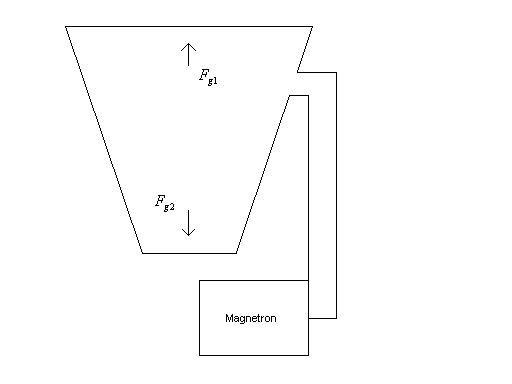
EM wave travelling in a tapered waveguide is bounced between two reflectors, with a large velocity difference at the reflector surfaces, the force difference will give a resultant thrust.

fig01.jpg


The inevitable objection raised, is that the apparently closed system produced by this arrangement cannot result in an output force, but will merely produce strain within the waveguide walls. However, this ignores Einstein’s Special Law of Relativity in which separate frames of reference have to be applied at velocities approaching the speed of light. Thus the system of EM wave and waveguide can be regarded as an open system, with the EM wave and the waveguide having separate frames of reference.
 
Well, I mean we discover that stuff all the time. Almost everything related to quantum mechanics violates "classical" physics in some way.

The last practical discovery that led to useful technology was for the creation of the transistor (unless someone can think of something more recent)

I think he just used the wrong word and is counting special relativity and quantum theory. All sorts of electronics tech violates Newtonian physics.
 
Dumb question, but why do you need much fuel in space anyway? There's no atmosphere to slow you down, so the inertia from a single thrust should keep you going, no? Or is there tiny space debris that slows spaceships down?

Addressed earlier in the thread but think constant acceleration vs constant velocity
 
will this end up like that japanese magnet motor

hope not as the benefits would be incredible, but it does sound too good to be true. hope the ESA test it.
 
I love that they cant/won't explain how it works as the physics seem impossible.. it's just incredible to think that not only are we potentially at the threshold for faster space travel, but are also knocking on the door of unexplored sciences and laws of physics that have yet to be discovered.

Kinda a neat feeling, actually... if it all works out, of course.
 
So like a perpetual ion engine?

Well, not really. It's converting solar energy into propulsion, so there is an energy conversion going on. If you were to run out of electricity (solar power) then the engine would lose it's "fuel".

Still, it could potentially be a huge discovery and breakthrough.
 
Well, I mean we discover that stuff all the time. Almost everything related to quantum mechanics violates "classical" physics in some way.

The last practical discovery that led to useful technology was for the creation of the transistor (unless someone can think of something more recent)

I don't think Quantum mechanics violates any "classical" law of physics.

And unlike this engine, the transistor was invented with good understanding of the physics behind it.
 
Sawyer's engine is extremely light and simple. It provides a thrust by "bouncing microwaves around in a closed container." The microwaves are generated using electricity that can be provided by solar energy. No propellant is necessary, which means that this thrusters can work forever unless a hardware failure occurs. If real, this would be a major breakthrough in space propulsion technology.

Hmmm.... Iwanttobelieve.gif
 
Dumb question, but why do you need much fuel in space anyway? There's no atmosphere to slow you down, so the inertia from a single thrust should keep you going, no? Or is there tiny space debris that slows spaceships down?

I think the amount of fuel we're currently capable of packing on a spaceship is only sufficient to accelerate the ship to a tiny fraction of the speed of light.
 
Dumb question, but why do you need much fuel in space anyway? There's no atmosphere to slow you down, so the inertia from a single thrust should keep you going, no? Or is there tiny space debris that slows spaceships down?

A single thrust will keep you going yes, but only at that speed.

If you thrust to 2mph, then you will only be going 2mph forever or till you hit something.

If you have this type of unlimited thruster you can keep it on, thus constantly be going faster and faster and faster.

With fuel, you can only go as fast as long as you still have fuel to burn, no more fuel = no more increase in speed.

The faster we can move in space = the further we can go in a lifetime.
 
I don't think Quantum mechanics violates any "classical" law of physics.

And unlike this engine, the transistor was invented with good understanding of the physics behind it.

Electrons are particles under classical physics. They shouldn't show interference in a double slit experiment.
 
F235RX1GXL6FHS4.MEDIUM.jpg


Checkmate physicists.

Ok I'll be the idiot that asks: Why wouldn't this work? Assume there is very little friction.
Edit: I guess because the magnet in the back will also be pulling the one in the front? And it doesn't matter if one is more powerful than the other, the force is equal in either direction?
 
Ok I'll be the idiot that asks: Why wouldn't this work? Assume there is very little friction.
Edit: I guess because the magnet in the back will also be pulling the one in the front? And it doesn't matter if one is more powerful than the other, the force is equal in either direction?

Pretty much.
 
It's not breaking any laws of thermodynamics, that's easy to see even from the sensationalist Gizmodo article.

It is taking energy in. The article says it's electricity which could be solar. Then the engine focuses that energy in a particular direction. How it does that is the mystery, I guess.

Is there a better source on this?
 
A single thrust will keep you going yes, but only at that speed.

If you thrust to 2mph, then you will only be going 2mph forever or till you hit something.

If you have this type of unlimited thruster you can keep it on, thus constantly be going faster and faster and faster.

With fuel, you can only go as fast as long as you still have fuel to burn, no more fuel = no more increase in speed.

The faster we can move in space = the further we can go in a lifetime.

Is that how they currently travel, accelerate to a certain velocity and then turn off the engines?
 
Remember when the chinese released this at the beginning of the year. If that works out, gamechanger would be an understatement.
 
So is this legit or not?

Additional independent testing needs to be done to either confirm or deny these claims. It'll be years before we get word of it being legitimate, but not nearly as long to hear back if this process is not replicable.
 
Every couple of years this thing pops up in the a news story. I'm always drawn to it. Partly because it seems impossible, partly from wishful thinking, and partly because I've always had a draw to the crazy cranks working on the fringes of science. People who try to make perpetual motion machines or try to trisect angles. It's just fun to follow.

I still doubt this will pan out to anything because, again, it seems like a violation of something fundamental in our models. So it'll take a lot of evidence. But I will watch nonetheless because it's fascinating.
 
Yeah it'll probably end up being wrong. Stupid AIAA, not letting me have full access to all publications even though I have a subscription.

And this is coming from someone who will have infinite demand for his job if this is real, so I'll still hope. :p
 
Status
Not open for further replies.
Top Bottom