I’m just about finished with the game… And quite frankly,
I love nearly everything about it. Here are my thoughts, based on recurring topics I’ve seen on this forum. This includes my take on the unconventional narrative structure, the twist and the themes, as well as other topics like the reviews, Quiet controversy and more.
A huge post for a huge game… I hope you don’t mind!
Reviewers vs. story: The way I see it, a 10/10 doesn’t mean a game is “perfect.” Some of the most glowing reviews still acknowledge shortcomings. It just means that for the reviewer, the experience as a whole was more than the sum of its parts. And MGSV is a very complex game with many parts. Some reviewers were able to separate the game from its marketing, any knowledge of cut content and any preconceived notions about how the narrative would play out, and look at it for what it is rather than what they think it was meant to be. And for those people, I can see it scoring high.
Where story is concerned, a game’s narrative is such a subjective thing. The heavy-handed storytelling in MGS4 actively undermined my enjoyment of that game, so I appreciate the approach here where the performances are more subtle, the cutscenes are more compact, and the bulk of the world-building is handled by cassette tapes you can enjoy at your leisure.
I’ve also come to appreciate the unconventional narrative structure. It’s essentially a standalone adventure in Ch. 1, and a more intimate epilogue in Ch. 2. The main conflict is resolved in the middle of the game — a sharp departure from how games usually handle conflict — and the second half of the game is like extended falling action, the characters wrestling with their lingering “phantom pains” across a series of incidents that are only loosely connected by theme. Ch. 2 is like a short story collection, then, giving us a look at how life at Mother Base went on after Skull Face, and how their peace was poisoned by a lack of fulfillment from their revenge, paranoia over spies and traitors, and the occasional tragedy. It’s a look at the life Venom achieved — a state of unrest — before learning at some point in the future he was living a lie.
I also like how the ending reframes the idea of “Big Boss” as not a man but a myth, and not one man, but two. And I like the tragic quality this lends to the second man, given everything he experienced throughout the game. But I’ll talk more about this in my analysis of the two chapters and the twist.
Gameplay variety: Yes, most missions and side ops can be described as extract/eliminate a target, retrieve resources, and infiltrate/exfiltrate the hot zone. And yes, there are many side ops with a number at the end, i.e. “Prisoner Extraction 05.” On paper, they would seem repetitive… but they never
felt repetitive to me, thanks to the tools and tactics available, the many ways to approach each level, and the varied enemy AI. The moment-to-moment gameplay continues to be fresh and fun even after completing the game. And the Mother Base meta-game makes the progression loop incredibly addictive. I’m still amazed at how utterly engrossing this game can be hundreds of hours later. I’ve experienced the story but I’m far from finished with the game.
The open world and ACC: I actually like how focused the open world feels. The lack of filler between checkpoints and installations made me realize how needlessly bloated many open-world games can be. The world in MGSV is “empty,” in a sense, but this works to the game’s advantage because it allows you to freely assess the situation and infiltrate from any direction, even tracking targets from one location to the next without being slowed down or sidetracked along the way. Maybe it’s more accurate to think of the game as a series of interconnected sandboxes… “Open world” might have the wrong connotation for what this game is trying to achieve.
The only downside is there are times when the lay of the land forces you to take “the long way” around mountains and valleys, and taking the chopper comes with the caveat of its arrival and departure time. You could boot straight back to the ACC, but I’m not sure if it saves your progress when you do this. There should be more fast-travel options. I doubt the game is masking much of a load time if the box travel exists. I think they were aiming for immersion, but sometimes it just inconveniences the player.
The bosses: Some people were disappointed in them, but I think they delivered. Both encounters with Sahelanthropus (hiding in Mission 12, and fighting in Mission 31) had an incredible sense of scale and felt like something out of Pacific Rim. With the other bosses, I like how there are alternate ways of dealing with them. You can sneak past the Skulls or run away, which made good use of the open levels. You can slow down the Man on Fire and escape, or OHKO him by running him off the cliff with the jeep, knocking him into the pool, etc. You can beat Eli without him even noticing you by sneaking up on him to bypass the cutscene and tranquilizing him when his back is turned. You can knock out Quiet in two hits by calling down supply drops.
The Skulls are especially cool. When you fight the armor Skulls and they’re ninja-dashing everywhere, it feels like something out of an anime. I like the concept of a boss that functions as a team. The sniper Skulls trying to sneak up on you and gut you with their machete is a nice touch. The Man on Fire battle was clever in how you have to turn the environment against him since he can repel any direct hits. And the Eli battle is like the opposite of the first Sahelanthropus battle — now it’s Venom who is the hunter. It’s a good number of fights spanning a variety of styles. They lack only the never-ending speeches of past MGS titles.
Progression: No grinding in my experience. For Chapter 2, I just did the new story missions and the important side ops (listed in yellow, under their own tab in the side ops menu) and returned to Mother Base on a regular basis, advancing the story without trouble. Sometimes I’d do a couple regular side ops first, like the Wandering Soldier side ops to advance the Paz subplot. There was no need to do any of the “challenge missions.” (Although I look forward to trying them!)
Quiet controversy: Yeah, the camera’s lust for her feels inappropriate. However, I had a harder time sympathizing with her because little is said to contextualize her life as a killer. She brutally murders the doctor and nurse at the beginning of the game and doesn’t appear remorseful for it. Maybe the idea is she’s a monster and for the first time she feels something akin to love when the man she tried to kill spares her multiple times. I don’t know, but it was hard to ever see her as “sweet.” Retrieving a necklace for the kids is nice and all, but driving a knife through someone’s teeth, choking them with wire, etc., is a bit much! At least give me a tragic backstory that explains why she became an assassin (but nothing like Drebin’s explanation of the B&B Corp in MGS4, please). Still, she has her moments and is one of the more compelling characters.
On a side note, I find it funny how Kaz is the only voice of reason regarding Quiet. She has direct ties to Cipher and tried to kill Big Boss twice. That would give pause to any reasonable person, but Big Boss and Ocelot just shrug it off and ignore him.
“But Kaz… She’s hot!”
THE STORY — Chapter 1: A simple and straightforward tale of revenge… and I think it’s stronger for it. Big Boss returns to the world to rebuild his army, his home and his legend, while trying to get leads on Cipher. Along the way he uncovers an ethnic cleansing operation and plans to escalate the Cold War. Skull Face is a villain’s villain — theatrical and verbose — who wants to end Western cultural imperialism by eliminating the English language. It’s an excuse to touch on how words shape our lives and the world around us. There’s also a bit of intrigue as you try to piece together discoveries like the invalids and the yellowcake — all part of a larger scheme that involves the Third Child and Man on Fire, Sahelanthropus, the Walker Gears, homegrown nukes, vocal cord parasites, and bacteria that can corrode metal and metabolize uranium… It’s so outlandishly convoluted that I can’t help but love it, lol.
The way I see it, Ch. 1 is the main narrative and a solid standalone story. Everything after Ch. 1 is a bonus rewarding fans with more character development and links to the rest of the mythos. An epilogue. Perhaps it was done this way to make the game more accessible to newcomers. I don’t think you need an intricate understanding of the entire series to enjoy this game.
I also think that
Ch. 1 could be divided into three acts and this would help the pacing. This is based on the story beats and boss battles. Act 1 would be Missions 1-12, ending with the first Sahelanthropus encounter and the rumor of “a weapon to surpass Metal Gear.” Act 2 would be Missions 13-20, beginning with the discovery of the parasite victims at the oilfield and ending with the discovery of more victims at the Devil’s House where you fight the Man on Fire. This stretch is where multiple schemes come to light and the plot is thickening. And Act 3 would be Missions 21-31, where the danger is clear and the villain must be defeated.
I think dividing Ch. 1 into three acts would’ve made for a stronger sense of forward momentum. Each act would also have a number of boss battles. Act 1 focuses on Afghanistan, Act 2 focuses on Africa, and Act 3 is a mix of both Africa and Afghanistan. The first two acts also introduce buddies — D-Horse and D-Dog in Act 1, and Quiet and D-Walker in Act 2. The third act has the outbreak and FOBs. Note that this changes none of the content — just the way the chapters are divided. Good variety overall, with a sense of progress when you realize, “Oh, now I’m on Act [X]!” It would help people to trace the shape of the story in their minds, making it feel more consistent. In its current state, Ch. 1 is a bit unwieldy.
THE STORY — Chapter 2: In some ways, Ch. 2 should be called “Epilogue.” That’s how I saw it — post-story content that completes the arcs of several characters (notably Huey and Quiet) while providing clarification on concepts like the parasites and Third Child (explained by Code Talker and Ocelot), with a bit of levity (Kaz’s burgers) and several gut punches, I.E. the massacre at Mother Base, Strangelove’s fate, Huey’s trial and exile, Quiet’s sacrifice — and the way I played it, the payoff to the Paz subplot. All of which add to the loss Venom experiences and perhaps explains why he began to change in the time between this game and MG1, a time where he struggled to come to terms with his role as a body double. I mean, if you learned “The Truth” after losing everything he lost, you’d rethink things, too!
If you rename Ch. 2 “Epilogue” and rename the new story missions “Epilogue 01,” “Epilogue 02,” etc., and if you include among them the side ops involving the AI pod and Man on Fire, you’d have a structure that feels more balanced and doesn’t over-promise. After all, when people see “Ch. 2,” they expect something to match “Ch. 1,” whereas if they call it “Epilogue,” it feels like they went above and beyond. It’s about managing people’s expectations. Still, both chapters are substantial. Ch. 1 favors gameplay over story, and Ch. 2 favors story over gameplay.
Themes: Thematically, I like how MGSV deals with the folly of revenge: How an eye for an eye (or a limb for a limb) does nothing to heal the soul. The loss of language and culture… The lack of closure for those who have been wronged… The restlessness you feel when your enemy is gone and your hate has nowhere to go… These are the lingering “phantom pains” the characters experience.
The game also grapples with the “parasitization” of war — mercenaries, arms dealers, child soldiers — but it only skims the surface. Likewise, it dances around the elephant in the room that is the cult at Mother Base. If you read between the lines, you can see the game hinting at the problematic nature of torture (Ocelot comes off reasonable but Kaz is skeptical of his “art”

and the brainwashing of new recruits. It’s something that could’ve been examined in-depth, but serves to merely season the dish.
But that’s fine. The concept of “phantom pain” is the main thrust for Ch. 2, and I think the game handles it well. Phantom pain is not an enemy with a name and a face, but a lack of fulfillment that is hard to pinpoint and harder to overcome. In this sense, the “vignette” approach of Ch. 2 works well, with its series of loosely connected incidents and a general drive to find a sense of peace amid the vacuum left by the villain. With Skull Face gone, they have peace in one sense — but in another sense, they do not.
For this reason, I actually think the Ch. 3 title, “Peace,” would work well with the Ch. 2 we got. Not sure why Ch. 2 is still named “Race” with the final form that the story took. The story was no doubt altered along the way, but changing the title card for Ch. 2 should’ve been simple to do. “Peace” — or rather the inability to find it, on a personal level — would’ve framed Ch. 2 with proper focus.
The twist: I think it’s great, if a bit out of nowhere. The more subdued nature of Big Boss at first seems like the after-effect of a nine-year coma, but then you learn he’s the medic made into a body double for Big Boss and realize
that’s the reason for his gentler, more benevolent spirit. It contrasts well with the “Type A” personality seen in Ishmael, a.k.a. the original Big Boss. And I think that Kiefer Sutherland did a good job differentiating the two characters with his tone. I really like the “broken” quality he brought to Venom. Venom tries to sound authoritative and hide his feelings, but I think the suffering of the world wears more on him than it ever did Big Boss.
Back to the twist… After the events of Ground Zeroes, where Skull Face destroyed Mother Base and nearly killed Big Boss, it was clear that the seemingly ubiquitous Cipher/XOF could strike from anywhere in the world. It left the real Big Boss “legit shook” and prompted the need for a decoy to draw out his enemies while continuing to build his legend around the world. He was no longer taking any chances.
I like how in “The Truth” scene, there’s a smirk that seems to suggest Venom likes hearing he’s one-half of the Big Boss legend — you can tell it’s important to his ego, to his sense of self. He’s in love with his own cult of personality. But fast-forward to MG1 (the time lapse when he turns the tape, and the Diamond Dogs logo in the background turns into Outer Heaven) and he now realizes he’s going to lose to an inexperienced rookie that neither he nor the real Big Boss expected to survive.
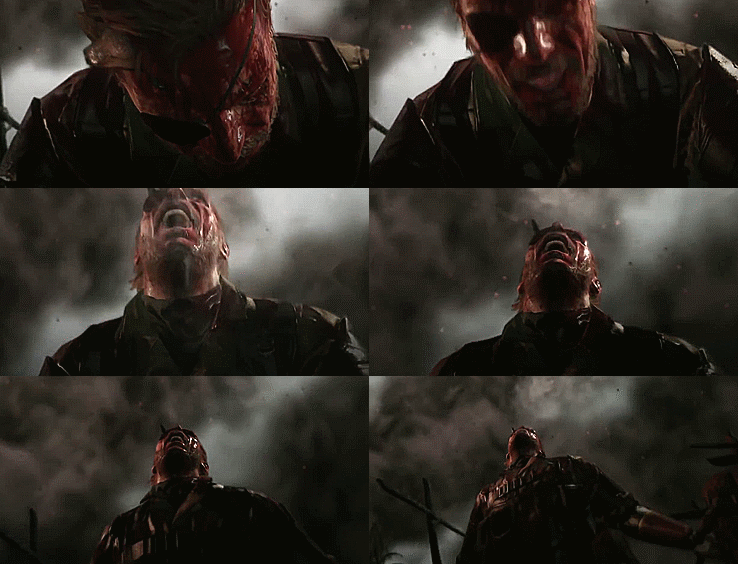
He’s covered in blood and his shrapnel horn has grown, a symbol of bad karma, suggesting the gradual unraveling that started in Ch. 2 has continued to erode him over 10 years, unleashing his inner demon. He realizes the hypocrisy of Big Boss, who swore to disavow governments that chewed up soldiers and spit them out, only to use Venom in precisely the same way. Perhaps Venom realizes that he himself is not much better than the man he once idolized. Venom’s men, after all, followed him to their deaths.
In its simplest form, it’s a way to explain how “Big Boss” cheated death so many times, but it also reinforces certain themes, like the use and abuse of soldiers by well-meaning people in power… and how anyone can rise to greatness through sheer force of will, regardless of origins… and how normal men can become legends but still fall from grace given the right set of circumstances. I think the repetition of such themes across the entire series is a theme in itself — how certain beliefs and behaviors are cyclical and transmit from one generation to the next.
I also like the subtle humanization of Venom that you only realize in hindsight, like the guilt he must’ve felt being unable to save Paz. Perhaps he still felt affection for her, despite her betrayal. A lot of people loved her back on Mother Base. If nothing else, it shows the medic was someone who cared about the people he tried to save. I thought the entire Paz subplot (spanning three cutscenes, 10 in-game scenes, and five cassettes) was incredible. Her last tape gave me goosebumps and made me tear up. It struck a similar note to Big Boss’ final words in MGS4. It’s his heart talking, pushing him toward a truer peace.
All in all, Venom is a character I just want to hug. I feel like he’s a gentle soul who was misled by the person he trusted most. He is given a great burden and put in extreme danger, but he still manages to save the world from Skull Face, grow the legend of Big Boss, and exercise mercy and compassion when everyone else is crying for blood. There’s a tragic element to how, even in the world of black ops, the true story of Venom is veiled in shadow. His tale is lost to history. Now when I see him in the ACC, lost in thought, I wonder what he’s feeling. A certain loneliness, perhaps… His body language and broken tone conveys a vulnerable spirit — someone who is searching for something.
Also: I don’t have a problem with the medic being a blank slate. The whole point is he’s a stand-in for the player and a fourth-wall-breaking way to say you contributed to the legend (with the caveat that he’s a male even if the player is female, to make the transformation more plausible — changing skin pigment from head to toe was already pushing it!). It’s a touching sendoff from Kojima to the fans. And someone can specialize as a medic and still be a soldier adept in combat, stealth, etc. The fact that he accompanied Big Boss on Ground Zeroes suggests to me he was a star soldier who learned from the best and had all the makings of a talented tactician, warrior and spy. Venom was to Big Boss as Big Boss was to The Boss, in other words.
Cut content and completeness: Every game has cut content. We just happen to know some of what was cut in this game. It’s true the story about Eli and the Third Child is left unresolved. They ran off with Sahelanthropus and the third English-language mating pair, and nothing came of it. Along with the underutilized Battle Gear and missing Camp Omega, it’s a striking omission. I don’t think it fundamentally changes the overall story — you can simply brush it off as “they dealt with it later” — but it’s missing all the same. As for Ch. 3, “Peace,” we don’t know what it would’ve entailed, or how early it was dropped in development. We can only trust the game was altered so it was no longer necessary.
That being said, if Konami wanted to contract Kojima and company for a “Director’s Cut,” I’d be all for it! Alternatively, I’ll gladly pay for DLC, although I don’t know who they still have on hand to develop it.
Final thoughts: This game is simply incredible. Consider the enormous complexity of its mechanics and systems, yet the elegance with which they’re executed. The balance of stance, cover, camouflage, proximity, movement speed, light and shadow… The variety of ways to infiltrate each area — in and out, over and under, thanks in part to the open world… The back and forth between combat and stealth, fight and flight… The meta-game at Mother Base and the loop it creates… The “friction” and “game feel” of every action, something that is so good I think it merits its own discussion… The gameplay is peerless for this genre (stealth) and it’s probably the most fun I’ve had in the campaign of an open-world game.
And the narrative, while lean in some respects, was still realized with a lavish attention to detail in the world-building and lore, in the subtle performances and themes. It’s more of a side story in the grand scheme of things, but I don’t think it needed to be anything else. Is there a compelling tale that could be told about what the real Big Boss was doing during this time? Probably. I’d still like to know everything leading up to the founding of Zanzibarland. But looking at what we got, I’m still satisfied with the overall tale. I would’ve preferred more character development with the supporting cast (Ocelot especially), and I would’ve liked to play Mission 51. But it’s nothing that diminishes my enjoyment of the game.
It might be better to think of this as “MGS
V” rather than “MGS
5.” It is Metal Gear Solid — Venom. It’s about phantom pain in the figurative sense, but also about the pain of a man who -is- a phantom. And Ch. 2 reinforces this with its vignette-based structure, where the characters continue to live out their life, searching for something, but with no fixed point like Skull Face to give them focus. The villain’s death, ironically, deprives the characters of closure. But life goes on.
In a way, MGSV is a character piece that errs heavily on “less is more,” saying more with what it doesn't say and leaving much to the viewer’s interpretation and self-insertion, which given the fourth wall break at the end, is all too fitting. And I think that’s a proper sendoff for a narrative told through the interactive medium of videogames.
A definite GOTY contender, and a once-in-a-generation sort of title. Picking between this and Bloodborne will be tough… I guess Metal Gear Online and The Old Hunters will be deciding factors.
-
N Has Come To
P.S. Mission 28 (“Code Talker”
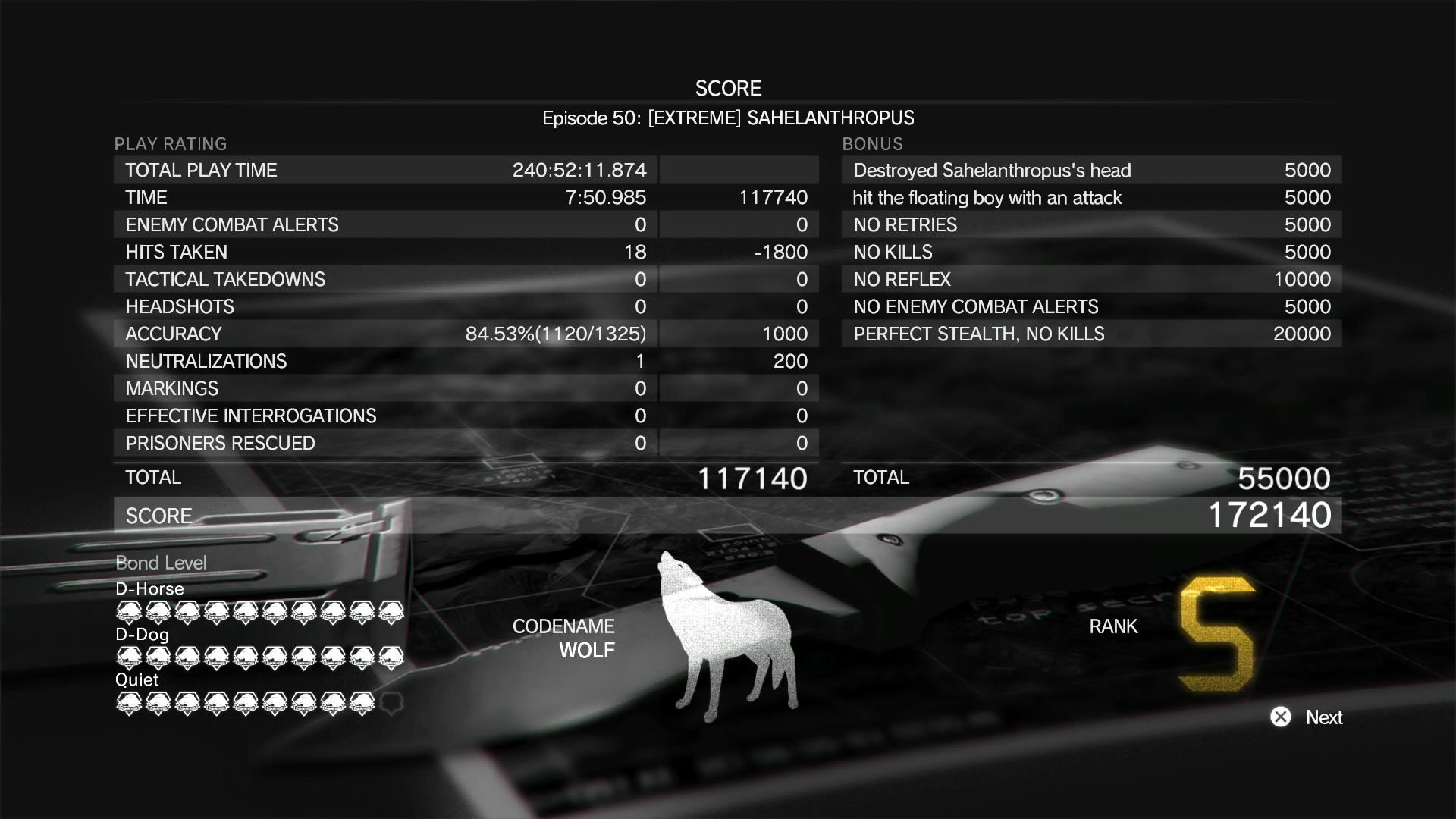
is probably one of my favorite levels in videogames. Perfect trifecta of boss battle, infiltration and extraction, with a nice exposition dump in the middle. The sniper Skulls are awesome and the level design is inspired. Very replayable. Love this level! I also keep replaying OKB Zero, attempting a perfect run, something I never felt compelled to do before in MGS.
P.P.S. The vocal cord parasites. Metallic archaea. Wolbachia. Copulation. Infertile. The Diné. Bilagáana. An ethnic liberator... burger?
P.P.P.S. Boss, get down! The enemy sniper...
P.P.P.P.S. You gonna extract him?
P.P.P.P.P.S. WHOOOOOOOOO?!