• Hey Guest. Check out your NeoGAF Wrapped 2025 results here!

Code Vein 2 has been Censored and uses translation for "Modern Audiences"

A literal translation is:

"Because I believe you're someone who can stop justice before it turns into madness."

So why did the official English use "bigotry" instead of "madness"?

狂器 (kyōki) is metaphorical here

In Japanese media, 正義が狂気に変わる is a common phrase meaning:

justice becoming fanaticism
righteousness turning zealous
moral conviction becoming dangerous/extremist


It often implies intolerance, judgment, or self-righteous cruelty, more than literal mental insanity. In other words, "madness" is literal, but the intended meaning is closer to:

zealotry
extremism
ideological intolerance
persecuting others in the name of justice


Which overlaps strongly with the English concept of bigotry.

ChatGPT is wildly off the mark here. I have no idea if its literal translation of the Japanese is correct, but assuming it is: "bigotry" is in no way an adequate English equivalent. Bigotry can range in expression from anything as severe as lynching a member of a group you oppose to as lukewarm as calling someone a mild ethnic slur. It is a very general term encompassing a range of attitudes, not just the extreme end of the spectrum described by the Japanese word kyōki.

Moreover, the popular understanding of a "bigot" is someone who discriminates or holds prejudices against others based on their race, religion, ethnicity, etc. Read again what the AI says:

Japanese "狂気 (kyōki)" in moral contexts is closer to:

fanatical extremism
losing sight of true justice
becoming cruel while thinking you're righteous

None of these descriptions imply an attitude of discrimination. If the King's Chief Magistrate decides to punish every single crime committed in the realm, no matter how insignificant or obscene, with death -- you would probably consider that pretty extreme, right? Cruel, certainly, perhaps even fanatical. But if he isn't biased in whom he selects for the executioner's axe - if anyone can be marked for beheading regardless of the color of their skin or their personal wealth or which god they believe in - then he would hardly be considered a bigot. What was the epithet given to Aerys II, who burned anyone and everyone whom he considered a conspirator? The Bigot King? No, I don't think that was quite it...

So, yeah, not exactly a great defense of the localization here. It doesn't seem like the AI really attempts to give an objective appraisal but rather makes pretty big leaps to arrive at its conclusion.
 
These days I question everything from social media, especially when I have to hunt down the trailers myself. Let's ask ChatGPT!

The part you're asking about is:

君はきっと正義が狂器に変わる前に止めることができる人だと思うから。

Word-by-word:
正義 (seigi) – justice
が – (subject marker)
狂器 (kyōki) – literally "madness," "insanity," or "fanaticism*"
に変わる前に (ni kawaru mae ni) – before it turns into
止めることができる人 (tomeru koto ga dekiru hito) – someone who can stop it
だと思うから – because I think so

A literal translation is:

"Because I believe you're someone who can stop justice before it turns into madness."

So why did the official English use "bigotry" instead of "madness"?

狂器 (kyōki) is metaphorical here

In Japanese media, 正義が狂気に変わる is a common phrase meaning:

justice becoming fanaticism
righteousness turning zealous
moral conviction becoming dangerous/extremist


It often implies intolerance, judgment, or self-righteous cruelty, more than literal mental insanity. In other words, "madness" is literal, but the intended meaning is closer to:

zealotry
extremism
ideological intolerance
persecuting others in the name of justice


Which overlaps strongly with the English concept of bigotry. English localization aims for theme, not strict literalness

The English script chooses words that:

fit the character's personality
fit the setting
sound natural in English dramatic dialogue
deliver the intended narrative theme


If the character is warning about "justice turning into persecution," "bigotry" conveys that moral corruption better than "madness," which sounds like mental breakdown.

"Madness" carries different connotations in English

In English, "madness" tends to sound like:

losing sanity
chaotic behavior
mental instability


Japanese "狂気 (kyōki)" in moral contexts is closer to:

fanatical extremism
losing sight of true justice
becoming cruel while thinking you're righteous


So the localization team likely selected "bigotry" to express:

justice that becomes intolerance or oppression.

Which matches the narrative tone.

Well, that makes all rather good sense, doesn't it? I mean, we can all agree that literal translations between languages can often sound confusing, especially something like Japanese, and especially without cultural connotation. But naturally, nuance is dead these days, so let's get those outrage YouTube videos going from the regular crowd!

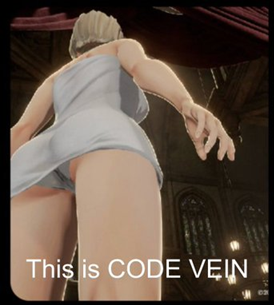
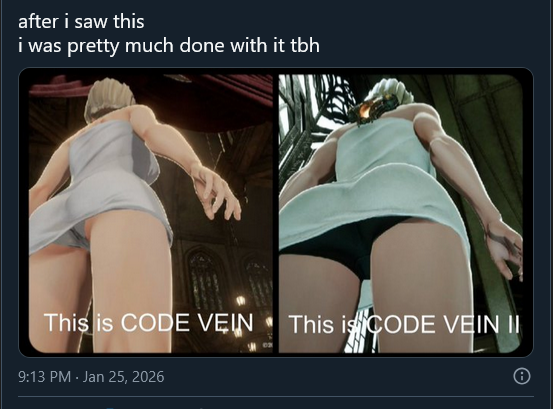
The panty stuff is dumb though, agreed on that.
Then they could have gone with fanaticism or zealotry, but they chose to modern audience it...

Easiest answer. Hubris and narcissism.

There is someone in a place of power and a echo chamber around them that convinced people above them that this would improve sales based on their own specific feels.

It does not. It would be far easier to keep things that work and not rock the boat.

They will defend this decision or downplay it if this blows up in their faces.

It takes failure after failure before things become dire and the culture is flushed out of the pubs and studios.
At this point I don't think it's hubris anymore ... all the signs point to wokeslopping as a money loosing practice, and I doubt producers and board members are so sheltered from the development process that they don't have any input in all of this. Basically if you have cultural control of almost all social media and media in general, education, tech and practically all institutions that even indirectly produce culture, then it's not hubris, it would in fact be a lost opportunity to not stomp around, shoving your politics down everyone's throats. What do they have to loose? Money? It's not their money, and if a studio closes down, there's always Blackrock, etc, to prop up another one or 10. In the end we're all consumers, that's what we've basically been turned into. There's only so much we can boycott before we resume engaging in the only activity that we're conditioned into anymore, consumption. We can cope about 'the pendulum swinging back' until we're blue in the face but, ultimately, there's nothing concrete that would actually turn that pendulum. Most people will fall in line, I've seen this happen countless times since 2013 when this shit began in full force.
 
Last edited:
I think the 'bigot' translation is a bit overblown, and I'm (one of 7 or 8 people) actually enjoying the game.

That said, the stupid safety shorts/spats is annoying. For some reason, leftist social nonsense is lagging behind in the Japanese videogame industry, by around 3-5 years. So it seems they'll now make the disastrous mistakes the West has already made. Hello Korean and Chinese gaming.

Japan needs to wake up.
 
Last edited:
These days I question everything from social media, especially when I have to hunt down the trailers myself. Let's ask ChatGPT!

The part you're asking about is:

君はきっと正義が狂器に変わる前に止めることができる人だと思うから。

Word-by-word:
正義 (seigi) – justice
が – (subject marker)
狂器 (kyōki) – literally "madness," "insanity," or "fanaticism*"
に変わる前に (ni kawaru mae ni) – before it turns into
止めることができる人 (tomeru koto ga dekiru hito) – someone who can stop it
だと思うから – because I think so

A literal translation is:

"Because I believe you're someone who can stop justice before it turns into madness."

So why did the official English use "bigotry" instead of "madness"?

狂器 (kyōki) is metaphorical here

In Japanese media, 正義が狂気に変わる is a common phrase meaning:

justice becoming fanaticism
righteousness turning zealous
moral conviction becoming dangerous/extremist


It often implies intolerance, judgment, or self-righteous cruelty, more than literal mental insanity. In other words, "madness" is literal, but the intended meaning is closer to:

zealotry
extremism
ideological intolerance
persecuting others in the name of justice


Which overlaps strongly with the English concept of bigotry. English localization aims for theme, not strict literalness

The English script chooses words that:

fit the character's personality
fit the setting
sound natural in English dramatic dialogue
deliver the intended narrative theme


If the character is warning about "justice turning into persecution," "bigotry" conveys that moral corruption better than "madness," which sounds like mental breakdown.

"Madness" carries different connotations in English

In English, "madness" tends to sound like:

losing sanity
chaotic behavior
mental instability


Japanese "狂気 (kyōki)" in moral contexts is closer to:

fanatical extremism
losing sight of true justice
becoming cruel while thinking you're righteous


So the localization team likely selected "bigotry" to express:

justice that becomes intolerance or oppression.

Which matches the narrative tone.

Well, that makes all rather good sense, doesn't it? I mean, we can all agree that literal translations between languages can often sound confusing, especially something like Japanese, and especially without cultural connotation. But naturally, nuance is dead these days, so let's get those outrage YouTube videos going from the regular crowd!

The panty stuff is dumb though, agreed on that.
First off, the word should be 狂気, not 狂器. I'm pretty sure 狂器 is not a word?
Second, Chat GPT is a dumb LLM that will make shit up (ie I'm pretty sure 正義が狂気に変わる is not a common phrase) and say different things depending on who is asking and how they are asking.
For example I asked chat gpt about the translation, and it said:
Nah, 「狂気」 is not "bigotry" in any normal, straight mapping.


  • 狂気 (きょうき) = madness / insanity / lunacy / derangement
    In story dialogue it often means "going off the rails," "crossing the line," "becoming unhinged."
  • bigotry = 偏狭 / 頑迷 / 偏見 / 差別的な信念 vibes — specifically prejudice/intolerance toward groups (race, religion, etc.). That's not what 狂気 means by default.

Your line:


君はきっと正義が狂気に変わる前に止めることができる人だと思うから。

Most natural read:


"Because I think you're the kind of person who can stop it before justice turns into madness."

If they wanted to capture the "justice becomes dangerous" nuance in a more local-y way, better English options than "bigotry" are:


  • "before justice turns into fanaticism"
  • "before justice becomes zealotry"
  • "before justice turns into extremism"
  • "before righteousness turns ugly"
  • "before 'justice' becomes insanity" (keeps the punch)

"Bigotry" only makes sense if the specific plot context is like: "justice" = a moral crusade that becomes targeted prejudice/discrimination (anti-something) — then a writer might pick it on purpose. But with just this sentence, it reads like they swapped in a different concept.


If you paste the surrounding 1–2 lines (or tell me what the "justice" is aimed at), I can tell you whether "bigotry" is a deliberate reframing or just… a weird choice.
Thirdly, as someone who understands Japanese, I don't think bigotry should be used there. Unless that is what Code Vein is about, then it might make sense given the context (I have no idea).
 
I think the 'bigot' translation is a bit overblown, and I'm (one of 7 or 8 people) actually enjoying the game.

That said, the stupid safety shorts/spats is annoying. For some reason, leftist social nonsense is lagging behind in the Japanese videogame industry, by around 3-5 years. So it seems they'll now make the disastrous mistakes the West has already made. Hello Korean and Chinese gaming.

Japan needs to wake up.

Naah in the orginal its fine. Its their western teams.

Anyway i canceled my copy. Fuck that.
 
Japanese words: "i love eating ass"
Im Back Amazon Prime GIF by Bombay Softwares
 
Loved the first game but with this and the removal of online play I just can't support it. I'll buy it off facebook market place for $20 in a month.
 
Easiest answer. Hubris and narcissism.

There is someone in a place of power and a echo chamber around them that convinced people above them that this would improve sales based on their own specific feels.

It does not. It would be far easier to keep things that work and not rock the boat.

They will defend this decision or downplay it if this blows up in their faces.

It takes failure after failure before things become dire and the culture is flushed out of the pubs and studios.
It does nothing positive for a company. Its nothing but bad press, people start ignoring your product, you screw over your workers that make a good product but have to include anti customer practices. You undermine your whole product, its so fkn stupid.
 
First off, the word should be 狂気, not 狂器. I'm pretty sure 狂器 is not a word?
Second, Chat GPT is a dumb LLM that will make shit up (ie I'm pretty sure 正義が狂気に変わる is not a common phrase) and say different things depending on who is asking and how they are asking.
For example I asked chat gpt about the translation, and it said:

Thirdly, as someone who understands Japanese, I don't think bigotry should be used there. Unless that is what Code Vein is about, then it might make sense given the context (I have no idea).
That's the phrase I pulled directly from the transcript. Not anything ChatGPT made up. And I believe it has do to with how Revenants and humans get along or something. The story is mostly bad allergory and nonsense.
 
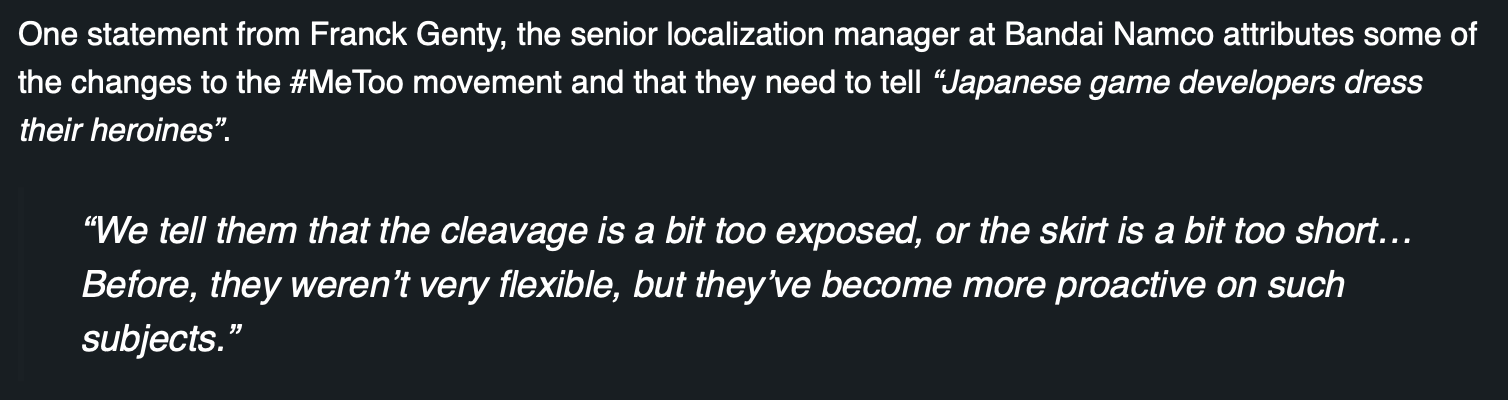
Bamco's localization team has been "educating" Japanese devs on these issues. I have been boycotting them for years now. lol.

This is from 2 years ago.

bW5oKe4XlMK31XxD.png


Their fucking job is to localize shit. What the hell.
 
Bamco's localization team has been "educating" Japanese devs on these issues. I have been boycotting them for years now. lol.

This is from 2 years ago.

bW5oKe4XlMK31XxD.png


Fucking activist clowns man.
 
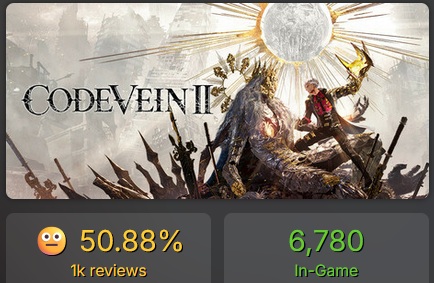
Numbers don't look too good. It's close to primetime in the West so the player numbers won't go much higher. It will probabaly go up to 15-18k on friday/saturday. the ccu are usually around 30% higher after Early Access + the weekend bonus. My prediction: 17k, which would half the ccu in comparison to their previous game (which reached 34k at launch). I hope it bombs. Fuck the devs/publishers/localizers who are reponsible for censorship and pandering to the imaginary 'modern audience'.
bfCivNHCALSKd6Iu.jpg
 
Last edited:
The translation choice is more likely ideologically motivated than not being so. It's not hard to believe that some leftist doesn't like the implication of the original line referring to their ilk. Radical leftists in America believe they are "on the right side of history" and morally superior social justice soldiers, when in reality, they are mostly just brainwashed useful idiots who have been socially conditioned to do whatever their tribal authority commands of them. A lot of their behavior and actions over the past decade are a prime example of what the actual Japanese line is clearly expressing. So the change to "bigotry" is redirection that's meant to deflect this expression onto their perceived enemies. After all, how else are they going to "own the bigots"?
 
If I was younger and had more will to try new things I'd start learning Japanese. These days I'm just to be ignoring more Japanese games.
 
These days I question everything from social media, especially when I have to hunt down the trailers myself. Let's ask ChatGPT!

The part you're asking about is:

君はきっと正義が狂器に変わる前に止めることができる人だと思うから。

Word-by-word:
正義 (seigi) – justice
が – (subject marker)
狂器 (kyōki) – literally "madness," "insanity," or "fanaticism*"
に変わる前に (ni kawaru mae ni) – before it turns into
止めることができる人 (tomeru koto ga dekiru hito) – someone who can stop it
だと思うから – because I think so

A literal translation is:

"Because I believe you're someone who can stop justice before it turns into madness."

So why did the official English use "bigotry" instead of "madness"?

狂器 (kyōki) is metaphorical here

In Japanese media, 正義が狂気に変わる is a common phrase meaning:

justice becoming fanaticism
righteousness turning zealous
moral conviction becoming dangerous/extremist


It often implies intolerance, judgment, or self-righteous cruelty, more than literal mental insanity. In other words, "madness" is literal, but the intended meaning is closer to:

zealotry
extremism
ideological intolerance
persecuting others in the name of justice


Which overlaps strongly with the English concept of bigotry. English localization aims for theme, not strict literalness

The English script chooses words that:

fit the character's personality
fit the setting
sound natural in English dramatic dialogue
deliver the intended narrative theme


If the character is warning about "justice turning into persecution," "bigotry" conveys that moral corruption better than "madness," which sounds like mental breakdown.

"Madness" carries different connotations in English

In English, "madness" tends to sound like:

losing sanity
chaotic behavior
mental instability


Japanese "狂気 (kyōki)" in moral contexts is closer to:

fanatical extremism
losing sight of true justice
becoming cruel while thinking you're righteous


So the localization team likely selected "bigotry" to express:

justice that becomes intolerance or oppression.

Which matches the narrative tone.

Well, that makes all rather good sense, doesn't it? I mean, we can all agree that literal translations between languages can often sound confusing, especially something like Japanese, and especially without cultural connotation. But naturally, nuance is dead these days, so let's get those outrage YouTube videos going from the regular crowd!

The panty stuff is dumb though, agreed on that.
Was looking forward to reading the post until I saw ChatGPT.
 
Was looking forward to reading the post until I saw ChatGPT.
Well, use any LLM of your choice. If you ask them to compare the transcripts it gives a broadly similar answer.

I don't know about you, but I'm certainly not going to go out and learn Japanese and cultural expressions in order to understand the context in a trailer.
 
There's only so much we can boycott before we resume engaging in the only activity that we're conditioned into anymore, consumption. We can cope about 'the pendulum swinging back' until we're blue in the face but, ultimately, there's nothing concrete that would actually turn that pendulum. Most people will fall in line, I've seen this happen countless times since 2013 when this shit began in full force.

Just say no bro.

Just Say No Stephen Colbert GIF by The Late Show With Stephen Colbert
 
These days I question everything from social media, especially when I have to hunt down the trailers myself. Let's ask ChatGPT!

The part you're asking about is:

君はきっと正義が狂器に変わる前に止めることができる人だと思うから。

Word-by-word:
正義 (seigi) – justice
が – (subject marker)
狂器 (kyōki) – literally "madness," "insanity," or "fanaticism*"
に変わる前に (ni kawaru mae ni) – before it turns into
止めることができる人 (tomeru koto ga dekiru hito) – someone who can stop it
だと思うから – because I think so

A literal translation is:

"Because I believe you're someone who can stop justice before it turns into madness."

So why did the official English use "bigotry" instead of "madness"?

狂器 (kyōki) is metaphorical here

In Japanese media, 正義が狂気に変わる is a common phrase meaning:

justice becoming fanaticism
righteousness turning zealous
moral conviction becoming dangerous/extremist


It often implies intolerance, judgment, or self-righteous cruelty, more than literal mental insanity. In other words, "madness" is literal, but the intended meaning is closer to:

zealotry
extremism
ideological intolerance
persecuting others in the name of justice


Which overlaps strongly with the English concept of bigotry. English localization aims for theme, not strict literalness

The English script chooses words that:

fit the character's personality
fit the setting
sound natural in English dramatic dialogue
deliver the intended narrative theme


If the character is warning about "justice turning into persecution," "bigotry" conveys that moral corruption better than "madness," which sounds like mental breakdown.

"Madness" carries different connotations in English

In English, "madness" tends to sound like:

losing sanity
chaotic behavior
mental instability


Japanese "狂気 (kyōki)" in moral contexts is closer to:

fanatical extremism
losing sight of true justice
becoming cruel while thinking you're righteous


So the localization team likely selected "bigotry" to express:

justice that becomes intolerance or oppression.

Which matches the narrative tone.

Well, that makes all rather good sense, doesn't it? I mean, we can all agree that literal translations between languages can often sound confusing, especially something like Japanese, and especially without cultural connotation. But naturally, nuance is dead these days, so let's get those outrage YouTube videos going from the regular crowd!

The panty stuff is dumb though, agreed on that.
Too many rounds around the fact that it's ok to leave it literal as it's clear enough anyway. If only other western translations didn't use english as base...
 
If I was younger and had more will to try new things I'd start learning Japanese. These days I'm just to be ignoring more Japanese games.
Bro it's never to late to learn things. I always thought I would never learn japanese and here I'm playing games in japanese without issues.
 
Yeah, it's pretty dumb. I don't trust for a minute the localizers made some honest mistake, they do stupid BS like this all the time with Japanese games, especially smaller changes like this because they don't think it will get noticed by the Japanese company, and you'll have people defend it with "not a big deal" arguments.

Simple solution for this if you still want to play the game, is just wait for a discount.
 
For everyone saying "it's not a big deal", let me ask you this: would you be saying the same thing if it was some lefty, progressive game being changed to be more gamer focused?

For example, would you be saying that if in The Last of Us 2 or Intergalactic they changed Ellie, Abraham, and Terry Crews to be big tittied, blonde bombshells? Would you be okay if Aloy was changed from a chipmunk faced feminist self insert to being an Ivy Valentine type looking character? What about if Ubisoft retroactively changed Yasuke to be a light skinned Japanese man? What if a game does the exact opposite of what Lords of the Fallen did where they change gender to Body Type A/B to appease to the alphabets slacktivists? What if they said "fuck women and what they like", and games that are primarily marketed towards women like Infinite Nikki and the Sims are now hardcore, dungeon crawlers with Ghosts N' Goblins level difficulty because men prefer more challenging games?

I find the whole "I don't care" shtick to be pretty disingenuous because it only applies to when a game goes from being pro gamer to pro lefty, but never the other way around.

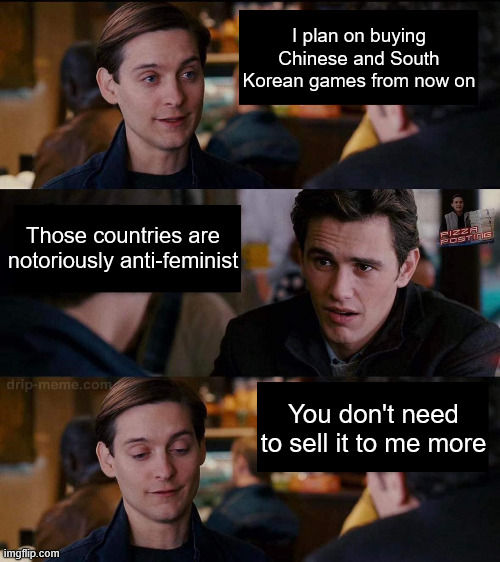
As far as Code Vein goes, I'm disappointed but not surprised. Japan has been unfortunately leaning hard into the slacktivist realm for a long time now, which is why I'm extremely wary of Japanese games coming out. It's why 90% of the games I'm looking forward to in the future are Chinese or South Korea. I genuinely hope that those two countries never capitulate to feminists and their little bitch male "allies" with censorship and performative ass kissing for demographics who actively hate video games and gamers.
aAowqZa86Wbh4YUq.jpg
 
Last edited:
No one in the western world would slap bigotry on there without trying to make a point.
They could've used more creative language, like the synonyms in that longass post: "oppression", "persecution" or even "hatred", and no one would've cared. "Bigotry" is a word that's loaded with context from this culture war shit, and yeah, they probably knew that.

I don't even care about this game, but it's annoying.
 
Last edited:
I think Code Vein II have bigger problem than this. They change the lore too, making it not connected to the first one (I heard the first one was connected to God Eater)
 
I think Code Vein II have bigger problem than this. They change the lore too, making it not connected to the first one (I heard the first one was connected to God Eater)
The connection to God Eater felt largely irrelevant, and put there because "why not". Would have been probably better without it because the game itself built a rich enough world, with a good story and lore.
 
Last edited:
etPvBPpxzQf88Y9f.png


Anyone who says shit like this was never really interested in the game in the first place, lol.
I agree. If your enjoyment falls apart because you can't zoom in on a female character's pants then that says more about you than the game. Go watch porn. I understand the censorship concerns but this is not it
 
I agree but what are we supposed to do buy woke stuff we do not agree with
Buy a third party key, third party/used disc (if on console), or buy on a deep sale post-fiscal report when your purchase doesn't matter anymore.

It is a matter of perspective. I guess for me personally I'm not going to suddenly not buy and play a video game because ~5% of it's content annoyed me.
 
Top Bottom