• Hey Guest. Check out your NeoGAF Wrapped 2025 results here!

ATI's CrossFire - Multi Graphics Processor announcement + FAQ + Features

http://apps.ati.com/ir/PressReleaseText.asp?compid=105421&releaseID=7...

ATI Defines The Next-Generation of Enthusiast Gaming With CrossFireT
Multi-Graphics Processor Platform
TAIPEI, Taiwan--(BUSINESS WIRE)--May 30, 2005--COMPUTEX

CrossFire combines the power of ATI's Radeon® Xpress chipsets and Radeon®
GPUs to deliver the best performance, image quality and game compatibility
in the industry

ATI Technologies Inc., (TSX:ATY)(NASDAQ:ATYT), a leader in graphics and
media processors, is revolutionizing gaming with the introduction of
CrossFireT, the ultimate gaming platform. The CrossFire platform has been
designed to give gamers the best performance and more flexibility and game
compatibility than any other multiple graphics processor platform. It
combines the power of ATI's Radeon® Xpress chipsets for Intel and AMD
processors, a standard Radeon® graphics processor and a Radeon® CrossFire
Edition graphics card to bring massive performance and image quality to
gamers.

When gamers add a CrossFire Edition graphics card, which includes the
CrossFire compositing engine, to their Radeon Xpress powered system they are
doubling their graphics rendering potential. With a variety of settings,
they can use the rendering horsepower to get up to twice the performance of
a single graphics card, or they can choose to put the horsepower to work
increasing the image quality of their games, making them look better than
ever before.

"ATI's CrossFire platform delivers the best gaming experience bar none,"
said Rick Bergman, Senior Vice President and General Manager, PC Business
Unit, ATI Technologies. "It is by far the most broadly compatible and
flexible multi-GPU platform and gives users the most options for enhancing
performance and visual quality. We believe this platform sets the stage for
outstanding gaming now and in the future, with systems powered by ATI's
graphics processors and chipsets."

The strength of ATI's CrossFire platform is its broad game compatibility.
ATI's unique multiple graphics processor implementation allows CrossFire to
automatically work with every game, new or old, without requiring special
game profiles or driver updates. Whether a customer is playing a game that
was released last night or last year, CrossFire can automatically make the
game run faster and look better.

For gamers purchasing or building a CrossFire system it couldn't be any
easier. The optimal CrossFire platform includes a motherboard powered by
ATI's Radeon Xpress 200 CrossFire Edition chipsets. These motherboards have
the two dedicated and balanced PCI Express® graphics ports needed to run
multiple graphics cards and are optimized for high-performance gaming.

Radeon Xpress 200 CrossFire ready motherboards from partners such as ASUS,
DFI, ECS, GIGABYTE, MSI, PC Partner, Sapphire and TUL are designed with
gamers in mind. They support both AMD and Intel platforms and have the
overclocking and enthusiast-class features that gamers want such as
high-definition audio, dual-core support as well as Gigabit Ethernet, SATA
II with NCQ and RAID over PCI Express and they offer the broadest
compatibility with high-performance system memory.

Customers will have plenty of options and flexibility in choosing graphics
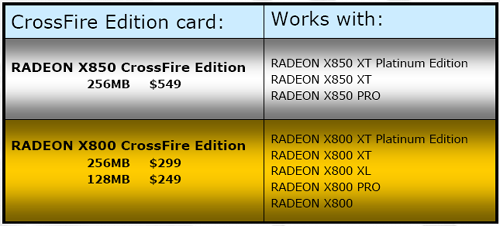
cards for their CrossFire systems. The Radeon X850 CrossFire Edition cards,
with 256MB of graphics memory can be paired with any standard Radeon X850
based graphics card. The Radeon X800 CrossFire Edition graphics cards, which
come with either 128 MB or 256 MB of graphics memory, can be paired with any
Radeon X800 series graphics card. The standard Radeon X800 and Radeon X850
cards can be purchased new or can be ones the customer already has.

The standard and CrossFire Edition cards will be available from ATI and ATI
graphics partners including ABIT, ASUS, Connect3D, Diamond, GeCube,
GIGABYTE, HIS, MSI, Pailt, Sapphire, TUL or VisionTek.

System builders such as ABS, Alienware, Cyberpower, Falcon Northwest,
Hypersonic, Ibuypower, Monarch PC, PC Club, Polywell, Velocity Micro,
VoodooPC, and ZT Group will also carry CrossFire systems for gamers wanting
pre-built systems.

With its amazing system and graphics performance, the resulting CrossFire
system is a dream machine for gamers. Whether they game professionally or
for fun, they are sure to be the envy of their friends. And with almost 1
million Radeon X800- and Radeon X850-based graphics cards already sold, many
gamers are already CrossFire ready!

CrossFire ready motherboards and CrossFire Edition graphics cards will begin
shipping in July. For more information on CrossFire please visit
www.ati.com.
 
http://www.ati.com/products/crossfire/index.html

Overview

CrossFire - Multi-GPU

Multiply & Conquer
CrossFire ignites an entirely new gaming experience by accelerating all your
games, all the time, with the power of multiple GPUs within a single PC.

* Unite and Dominate
Combined Multi-GPU power that soars into a new dimension of graphics
capability

* Divide and Conquer
High-performance GPU sharing that accelerates all games, all the time

* Render and Rule
The highest image quality and screen resolutions even with the most
demanding 3D titles

* Now and Future
Keep ahead of fast-moving gaming effects and technology changes with
CrossFire's advanced features.


How It Works
To build your own latest generation multi-GPU system, start with any
existing Radeon® X800 or Radeon® X850 graphics card and a CrossFire Ready
motherboard, such as those based on the ATI Radeon® Xpress 200 CrossFire
chipset. Then add a Radeon CrossFire Edition co-processor board and plug in
the external cable to unite multi-GPU power.

The result is multi-GPU power with maximum performance and game-conquering compatibility.

CrossFire - Features
ATI's CrossFire propels your gaming PC to a new pinnacle of performance with
the ultimate multi-GPU consumer graphics solution.

Enjoy the highest image quality modes and resolutions that you have always
wanted, even with the most demanding 3D titles. Get out-of-the-box
compatibility and afterburner acceleration for all your games without
special game software or patches.

Unite and Dominate
CrossFire's unique parallel processing technology has development roots
going back to ATI's multi-GPU Rage Fury MAXXT. Based on the same technology
used with ATI-based commercial flight simulators, CrossFire soars into a new
dimension of graphics capability with multiple Radeon® graphics processing
units (GPUs) working together in your PC.

Divide and Conquer
ATI's CrossFire speeds your gaming momentum with "supertiling,"
high-performance GPU sharing that evenly divides the processing and graphics
rendering workload.

How Supertiling Works:
*Think of your screen image divided into subsections like a
checkerboard, with alternating black and white "tiles."
* CrossFire's Supertiling intelligently alternates rendering duties of
these tiles to each Radeon GPU for consistent, efficient load balancing with
hassle-free compatibility.
CrossFire's options include a multiple load-sharing "scissor" mode and an
alternate frame-rate mode, combining optimal performance with
game-conquering compatibility.

Render and Rule
ATI's CrossFire boosts image quality along with rendering speed, eliminating
the need to crank down screen resolutions to get the high image quality you
want.

CrossFire ignites with the higher antialiasing, anisotropic filtering,
shading, and texture settings you desire. Adjust your display
configurations, experiment with your advanced 3D settings, and check the
effect with a real-time 3D-rendered preview within ATI's CatalystT Control
Center to rule your CrossFire system.

Now and Future
Keep ahead of fast-moving gaming effects and technology changes with
CrossFire's advanced features.
* Upgradeable components allow you to gradually improve your system
performance with the reliability and support that only ATI delivers.
* Free monthly on-line Catalyst software updates, ATI's one-click
comprehensive help system, and web-based online customer support are
available 24 hours per day.
Supporting a wide range of ATI-based graphics cards and motherboards, the
CrossFire platform offers flexibility and compatibility with all of today's
Radeon® X800 or Radeon® X850 graphics cards and the latest powerhouse
processors to make your next gaming experience the zenith of PC perfection.

1. What is the difference between ATI's CrossFire platform and the
competitor's solution?

A. The principal differences between the competitor's multi-GPU solutions
and ATI's CrossFire are:

* CrossFire can enable multi-GPU rendering on all applications.
* CrossFire supports more rendering modes . Supertiling offers good
performance and evenly distributes the workload between the two GPUs.
CrossFire can use multiple GPUs to improve image quality rather than
performance with Super antialiasing (AA) modes. Supertiling and SuperAA
modes are only supported on the CrossFire platform.
* CrossFire is an open platform that supports multiple chipsets and a
wide variety of graphics cards can be mixed and matched in a single system.
2. What graphics cards work with CrossFire?

A. CrossFire requires a CrossFire Edition graphics card and a standard
graphics card from the same series.

The Radeon® X850 CrossFire Edition card can be paired with any Radeon X850
graphics card (Radeon X850 PRO, Radeon X850 XT or Radeon X850 XT PE) from
ATI or any of its partners including cards previously sold.

The Radeon X800 CrossFire Edition cards can be paired with any Radeon X800
graphics card (Radeon X800, Radeon X800 XL, Radeon X800 PRO, Radeon X800 XT
or Radeon X800 XT PE) from ATI or any of its partners including cards
previously sold and including the All-In-Wonder X800.

Because of the backwards compatibility of the platform, there are already
almost a million people who are CrossFire-ready.

3. When will CrossFire graphics cards be available?

A. Radeon X850 CrossFire Edition cards will be in production end of June and
available mid-July. Radeon X800 CrossFire Edition cards will be available
early August.

4. Can you use All-In-Wonder cards in CrossFire?

A. You can use All-In-Wonder cards in combination with a CrossFire card if
they are in the same product family. For example, an All-In-Wonder X800 can
be paired with a Radeon X800 CrossFire Edition card.

5. What motherboard is required for a CrossFire system?

A. A Radeon Xpress 200 CrossFire edition motherboard is the optimal platform
for CrossFire. CrossFire is also compatible with Intel chipsets that offer
multiple x16 physical slots. Chipset support is affected by the level of
technical collaboration between the various vendors, and limited quality
assurance resources require that we prioritize bringing a particular
platform to market.

6. When will CrossFire Ready motherboards be available?

A. Radeon Xpress 200 CrossFire edition motherboards will be available from
our partners beginning in June.

7. Will CrossFire Edition cards work in an NForce 4 motherboard?

A. ATI is focused first on qualifying our chipsets with our GPUs. We'll
evaluate Nvidia solutions in the future.

8. What happens if customers have the wrong combination of products?

A. If a customer incorrectly configures their system they will not see the
performance benefits of CrossFire.

9. What happens when you pair a 12-pipe CrossFire Edition card with a
16-pipe card?

A. To ensure an optimal gaming experience, the two cards will both operate
as 12-pipe cards while in CrossFire mode.

10. When your CrossFire Edition card and your standard Radeon card have
different clock speeds what happens?

A. Both cards will continue to operate at their individual clock speeds.

11. Why can't you use Supertiling on OpenGL games or with 12-pipe cards?

A. The OpenGL games that are currently on the market are sufficiently
accelerated using scissor mode or AFR.

12. Will CrossFire Edition cards work with SurroundView?

A. Yes, the CrossFire platform will work with ATI's SurroundView
multi-monitor technology to enable up to 5 separate displays.

13. What games work with CrossFire?

A. CrossFire works with all 3D applications. The end-user is able to run any
game with multiple graphics cards cooperatively rendering the images. The
end user is able to take advantage of the additional graphics hardware for
all games, all the time.

Competitive solutions only work on a limited number of games that are
profiled in the driver. New games, older games, lesser known games, and even
some current popular titles are not supported, and the end user sees no
benefit with this system when running these applications.

14. Do all games see a benefit with CrossFire?

A. Games that stress the graphics sub-system will benefit most from the
additional performance offered by CrossFire. Most new games are designed for
advanced graphics, and end users will see large performance increases with
multi-GPU systems. Some applications that are more CPU intensive may not
scale well with CrossFire. For these applications, CrossFire offers extreme
image quality modes that take advantage of the additional graphics power,
and improves the overall gaming experience.

Customers using an enthusiast-class motherboard like those based on Radeon
Xpress 200 CrossFire edition chipsets will be able to take most advantage of
CrossFire because they are able to get the most performance from their
entire system.

15. Do you need a driver profile for CrossFire to work?

A No. CrossFire is enabled by default for all 3D applications. With
CatalystT A.I. enabled, the preferred rendering mode is selected for
targeted applications. For applications that are not identified in Catalyst
A.I., or when Catalyst A.I. is disabled, default multi-GPU rendering modes
are offered. For applications that are very graphics limited, and can not
benefit from multiple high-end graphics processors, the end user has the
option to disable multi-GPU rendering completely. In all scenarios the end
user has the option to adjust her/his system to best take advantage of
multi-GPU rendering.

16. What is the difference between regular graphics cards and CrossFire
Edition graphics cards?

A. CrossFire Edition graphics cards include a "compositing engine" chip
on-board. This chip takes the partially rendered image from the standard
graphics card, and merges it with the partially rendered image from the
CrossFire Edition graphics card. The result is a complete frame rendered at
up to twice the performance of a single graphics card. The CrossFire
compositing engine is a programmable chip that offers flexible support of
different graphics cards, allows a superior feature set (advanced
compositing modes), and enables further enhancements to be quickly
implemented on next generation products. The CrossFire compositing engine
also offers a performance benefit to other data transfer techniques, such as
peer-to-peer transfers over the PCIe® system bus.

17. What performance improvement does CrossFire bring?

A. Performance enhancements with CrossFire are application dependent.
Performance improvement varies from 1% to 100% performance increase. New,
graphics intensive applications will generally see over 80% performance
improvement at high resolutions and image quality modes.

18. How are the two graphics cards connected on a CrossFire system?

A. The two cards are connected by an external cable. The cable is attached
from the standard graphics cards' DVI connector to the CrossFire Edition
high density input connector. The partially rendered image is sent through
the DVI connection to the CrossFire Edition DMS input connector. The
partially rendered image from the cable input is combined with the CrossFire
Edition's partially rendered frame in the compositing engine. The
compositing engine combines the result of both cards to output a complete
image.

19. What rendering modes are used when?

A. By default either SuperTiling or Scissor modes are applied. Alternate
frame rendering mode is used for applications identified in Catalyst A.I.
(when enabled). When Catalyst A.I. is disabled, 16-pipe graphics processors
running D3D applications are accelerated by supertiling mode (other
configurations are accelerated by scissor mode). Super AA mode is enabled
through the control panel.

20. Can you run Super antialiasing (AA) mode in combination with another
rendering mode?

A. Users choose either a performance mode (SuperTiling, Scissor or AFR) or
Super AA mode. When users are running in SuperTiling Scissor or AFT modes
they can use ATI's existing AA modes (2x, 4x or 6x.)

CrossFire - Reviews
Will Harrris, Bit-Tech UK
"ATI, whilst later to market than its rival, appears to have put some
serious thought into remedying the deficiencies within SLI."

"Undoubtedly the biggest selling point for Crossfire is the universal game
support offered by super-tiling, which could prove outrageously popular with
a wide range of gamers."


--------------------------------------------------------------------------------

Anton Shilov, X-Bit Labs
"ATI CrossFire presents everything needed for a premium class graphics
solution: stunning image quality, broad compatibility and high performance,
three things that gamers not constrained by budgets would pay attention to.
Probably, ATI's finest 14x antialiasing, which is only available on the
company's multi-GPU solutions, is a thing that should be worth additional
money spent on an extra graphics card, as blazing image quality may be even
more important than extreme performance in currently available games."

--------------------------------------------------------------------------------

Lars Weinand, Toms Hardware Guide
"ATI did.a lot of things better: A choice of card configurations, the
ability to use existing X800 or X850 cards, more dual-rendering modes and
Super AA to improve picture quality. Furthermore CrossFire supports all
DirectX and OpenGL games."

--------------------------------------------------------------------------------

Hielko van der Hoorn, Tweakers Netherlands
"ATI's Crossfire technology looks promising."

"It is more flexible than nVidia's SLI, offers more features and has the
potential to offer higher performance."

--------------------------------------------------------------------------------

Dave Ross, Hexus, UK
"If they (deliver on time), then without doubt the Crossfire will be the
fastest gaming platform at launch. NVIDIA have done well, really well with
the deployment of 6800SLi, but what compelling message do they have if ATI's
CrossFire solution is indeed 60% faster in TWIMTBP titles? We look forward
to evaluating these impressive claims when we get the kit in our labs"

--------------------------------------------------------------------------------

Allan Campbell, DriverHeaven, UK
"It's safe to say ATI have hit the nail on the head again with their dual
card solution. Removing the driver application specific limitations imposed
by nVidia's SLI design and combined with the raw horsepower of the X8xx
series core, Crossfire is guaranteed to be driving force behind every
enthusiasts' gaming experience."

--------------------------------------------------------------------------------

James Morris, PC Plus UK
"CrossFire certainly looks like it could give SLI a good run for its money.
The flexibility of graphics card choice could well convince those who
thought SLI was too picky to try out multi-GPU. I can't wait to give it a
try!"

--------------------------------------------------------------------------------

Fuad Abazovic, Theinquirer.net, UK
" Compared with two 6800 Ultra SLI, ATI's Crossfire should end up about 10
per cent faster in 3Dmark05 benchmark, about 30 percent in Splinter Cell C.T
and more than 60 percent in Need For Speed Underground 2."

--------------------------------------------------------------------------------

Antal Tungler, PC World, Hungary
"ATI's CrossFire system has all the specs that could get their nose in front
of NVIDIA's SLI. We have seen the system only partially in action, but
should it stand up to what Richard told us about it. CrossFire could well
shoot itself right into first place of choices for gaming enthusiasts! -
We're really eager to get one into our test lab at any rate!"

--------------------------------------------------------------------------------

Paolo Corsini, Hardwareupgrade Italy
"ATI CrossFire when compared with NVIDIA SLI is surely more flexible thanks
to a lot of performance modalities, not demanding two perfectly identical
cards."

"The customer will have the opportunity to add a second graphic board in
order to not only go in search of greater performances, but also in order to
obtain a better image thanks to the never seen before Super AA modality."

"The choice to not to use an internal connector between the two boards, is
very smart and clever and will make happy all the end users owners of a
Radeon X800 and X850 PCI Express that we can actually consider as CrossFire
ready end users."

--------------------------------------------------------------------------------

Carsten Spille, Computerbase.de Germany
"CrossFire can and will be positioned as a serious competitor and even in
many situations a superior solution to Nvidias SLI. Advantages are: more
flexibility when choosing cards and most importantly the offered
"superior-IQ" modes. Also, we need to mention the gaming compatibility.
CrossFire has the advantage that under Direct3D, there is a fall back to the
SuperTiling-Mode."

--------------------------------------------------------------------------------

Oliver Haake, PC Games Hardware Germany
"ATI is fighting back."

"(CrossFire has) some very interesting ideas. There are two of the three
rendering processes at least on the paper more flexible than Nvidia's SLI.
Furthermore, the picture quality is improved through Super Anti Aliasing as
well as the upgrade idea which was created from necessity. If the by ATI
promised availability of CrossFire cards of the current generations stays
for longer, you can look into a secure future in regards to the upgrades.
You can buy now one CrossFire mainboard with only one Radeon card and add in
one or two years a CrossFire graphics card."

--------------------------------------------------------------------------------

Antonino Tumeo, Nextgame Italy
"It's clear that ATI is really serious about CrossFire: a valid, flexible,
feature rich and future proof solution that on paper seems to put much
pressure on NVIDIA's latest and much emphasized dual VPU technology, the now
well-known SLI."

--------------------------------------------------------------------------------

Levent Pekcan, Darkhardware
"It is very clear that ATI's CrossFire solution is offering more flexibility
and ease of use to the users and from a technical viewpoint, it is a pathway
to Multi-GPU graphic cards. The ability of using CrossFire to increase the
image quality is also an important aspect of this new technology."

--------------------------------------------------------------------------------

George Dragon, GameStar Hungary
" ATI proved that it was worth the extra wait - Crossfire delivers more
speed and reliability, and not only broadens, but speeds up the expectations
and sets a new graphics horizon..."

--------------------------------------------------------------------------------

Xander Hoose, PCM, Netherlands
" ...the red guys have done it again. CrossFire seems to make more sense
than SLI does as it's support for games isn't limited to the driver.
The four different rendering modes allow for more flexibility and quality.
If ATI manages to convince the customer of the superiority of its product
than nVidia might be in for some trouble..."

--------------------------------------------------------------------------------

Pierfrancesco Costantini, 3D Italia
"ATI Crossfire technology represents the currently best solution in the
market for enthusiast gamers and protects the end user investment since it
will be not necessary to change the own graphic board."

--------------------------------------------------------------------------------

Lambros Georgogalas, PC World Greece
"if half the features of Crossfire work (and I have no reason to believe
that the rest won't!) NVIDIA is in real trouble in the department of
multiple VPUs!

The stability of the platform and the performance advantage is something
that remains to be tested when the first samples arrive, but the flexibility
seems definitely better and the overall solution more practical and
appealing to the gamers. Considering the special quality enhancing mode, the
ability to drive up to 5 displays and to accelerate virtually every 3D game,
Crossfire can adapt to serve different needs."

--------------------------------------------------------------------------------

Nusret Erturan, PCNET.com.tr - Turkey
"Crossfire: ATI's courage under fire."
 
Couldn't be bothered reading all that.

so it's a motherboard with an ATI chipset, that when combined with an ATI vid card gives more performance?
 
Vormund said:
Couldn't be bothered reading all that.

so it's a motherboard with an ATI chipset, that when combined with an ATI vid card gives more performance?
no. its a secondary card of the same "family" as one you already have, eg x800 series, x850 series, that you plug into a Crossfire-supported mobo, OR even a dual pci-x16 motherboard. Connect the two with a cable, and BAM superfastawesomegraphicsmode.
 
crossfirelarge29cj.jpg
 
kIdMuScLe said:
so can anyone explain it in english?
get a crossfire compat mobo, a crossfire graphics card, and use an older ATI card and you have dual graphics cards. no bridge like SLI needs.

also it is a tile based system, instead of even/odd frames which SLI does.
 
will crossfire boards cost more than normal boards of the same model?

im interested, but since im only 1 6800gt short of SLI, I'll probably wait till next gen to figure out if I really need teh benefits of crossfire.
 
http://www.beyond3d.com/reviews/ati/mvp/

Introduction

Eleven months ago, NVIDIA announced the return of SLI, , a very familiar concept to those that remember 3dfx and, specifically, the Voodoo 2. Whilst NVIDIA's SLI had a reasonable gestation period before end users could adopt it, the concept has taken off fairly well since the release of NVIDIA's nForce4 SLI chipset platform.


With the "capture the flag" mentality surrounding performance 3D graphics it was inevitable that ATI would have to respond at some point because regardless of who has the highest single board performance, with two high end boards in a system the "who has the fastest solution" advantage was often going to go in NVIDIA’s favour by virtue of SLI. To that end ATI are now ready to announce their own multi-rendering graphics solution which they have dubbed "CrossFire".

ATI are keen to point out that, although they were behind NVIDIA in introducing a Multi-Board platform on current generations of technologies, they do have some heritage in this particular field. For starters, ATI produced the ill fated Rage Fury MAXX, which utilised two Rage 128 Pro chips on a single board; this was coupled with a rendering system that ATI called AFR (alternate frame rendering), a mode that NVIDIA also adopted for their SLI platform. More recently ATI have worked with Evens & Sutherland and SGI who produce graphics render-farms with numerous Radeon 9700 or 9800 chips inside a single system all assisting in rendering either very high resolution images or images with very high levels of FSAA - in their highest implementation Evans & Sutherland utilise up to 64 graphics chips in a single "RenderBeast" system. Desktop graphics processors built by ATI from R300 and upwards have a number of hardware elements that were specifically designed with scaleable, multi-chip rendering in mind, and the CrossFire system ATI have put in place for their multi-board desktop platform presses these into service, and even elements from MAXX are utilised.

Fundamentally, though, ATI’s CrossFire solution is similar to NVIDIA’s – in its initial form it uses a motherboard that supports two 16x PCI Express for graphics slots and couples two graphics boards together in order to increase the potential rendering performance over a single board. However, beyond that many of the details differ and we'll take a short look at the details here.
CrossFire Hardware
Platform

As with NVIDIA's SLI platform there are two elements to the hardware in order to support multi-board rendering: the platform and the graphics cards. Platform wise ATI themselves are introducing new chipset variants of the Radeon XPRESS 200 platforms, one for AMD and one for Intel systems, RD480 and RD400 respectively, known as the "Radeon XPRESS 200 CrossFire Edition". The platforms have been tweaked to support multiple 16x graphics slots, by splitting the 16 lanes from the primary 16x connector and distributing them across the two connectors with 8 lanes going to each, much the same as NVIDIA's nForce4 SLI platform. ATI's reference platforms use an electronic switch lane distribution so that the user doesn't have to reconfigure the motherboard to support two graphics boards by changing a selector card or reconfiguring jumpers; with an electronic switch the lane distribution can occur via software.


Both the new ATI's platforms for CrossFire have gone through a minor upgrade since the initial introduction of Radeon XPRESS 200 in that ATI now have their own Southbridge that supports Azalia High Definition Audio. As there have been no other alterations to the platforms, ATI are pushing their vendors to support GigaBit Ethernet chips, connected to the Northbridge via the PCI Express, and additional Silicon Image SATA II disk controllers with NCQ and RAID. ATI's own platforms face fairly stiff competition in the face of the feature rich nForce4 platform, however in conjunction with the extra functionality added to their chipsets that expect vendors to support, they are keen to stress the overclocking capabilities of their platforms, something that they are beginning to generate a bit of a name for themselves with - when so many game titles are CPU bound, having the capability to squeeze out a little extra performance from the platform is likely to be beneficial with two graphic boards in operation.

On this initial introduction, although somewhat evasive on an actual reply, ATI look to be initially making CrossFire applicable to their platforms only, something that we hope they will soon readdress and offer the capability on other platforms that can support splitting of the PCI Express graphics system into two 8x lanes. Ostensibly it would seem like there should be little stopping ATI from operating on nForce4 SLI platforms and there are far more of these already currently in use.

Graphics

On the graphics side there will be new "CrossFire Edition" graphics boards as well. There have been in the order of millions of X800, or above, class PCI Express graphics processors already sold, however unlike NVIDIA's SLI system they have no internal connector in order for them to be hooked up to a second board. In order to allow people with current PCI Express X800 and X850 boards to get the benefits of purchasing a second in order to increase the rendering performance ATI have come up with the concept of the master and slave boards, with the existing cards acting as the slave and the new CrossFire Editions acting as the master boards.

Click Image to Enlarge

Radeon X850 CrossFire Edition CrossFire Setup

In order to support multi-board rendering the CrossFire editions have two primary elements: a "DMS" input / output port and its own dedicated compositing engine. The DMS I/O is the method by which the image data is transferred from the slave board to the master - with no internal connectors by which the boards can communicate, other than the PCI Express bus which may not be optimal performance, ATI are pushing out a digital image from the DVI output of the slave card and sending that to the DMS connector on the master board. The DMS connector is a high density connector that allows for both the input from the slave board and an output from the master, so this port can still be connected to an output device. One thing to note, though, is that it does appear that the CrossFire Edition board loses its TV output capability because of the size the DMS connector needs to be.

The compositing engine that is used on the master boards is a separate imaging chip that performs the joining of the images between the two boards, as well as blending of images, which is one element to an additional rendering mode presently unique to CrossFire boards. The compositing engine is a programmable device, which enables it to join, merge or blend digital images in numerous fashions, allowing ATI to support various different methods rendering across multiple graphics. The device does also have some limited buffering available to it, so the actual compositing task is done independently of the rest of the rendering process.
CrossFire Process Overview

When the two graphics boards are placed in a supported platform the graphics drivers will split the memory a little differently than with a single card. In this instance each of the graphics boards will be assigned its own memory and Command Queue Buffers, enabling both boards to operate on independent instructions if needs be (which may be useful for doing things like distributing different Render To Texture operations across two boards), as well as having a shared pool of memory that both will access for synchronisation commands and other shared data such as textures. Once the two boards have finished rendering their sections of the screen they both output to the compositing engine on the master board (by virtue of the DMS connection on the slave board, and directly from the the graphics processor to the compositing engine on the master) such that the composting engine will perform the necessary function to get a single, correct image to send to the display. Note that as the frame data coming from either chip is effectively a digital representation of the display image, all the image resolving (such as FSAA down-sampling) has already occurred by this point, so the data being sent is only to the size of the display resolution.

With the master board requiring a new connector and the composite engine this means that there will need to be new board designs to facilitate the different components and that can also increase the price a little in relation to an equivalently performing standard board. Because of this, and the fact that the market for these boards are going to be fairly limited ATI have grouped up various current boards and are covering them with three different types of CrossFire Edition boards. These break down into the following groups:

process.jpg


*Note: we wanted to confirm the specification of these X800 boards with ATI and their reply was "Both X800 CrossFire cards are 16 pipe with XL clocks".

Seeing as there is a broader range of standard cards than CrossFire cards not all of them are going to be a like for like match, and as such some may need to be effected by the drivers dependant on the combination. For starters, only like RAM configurations will be used, so if you have a miss-matched card pairing in terms of the RAM quantities both support then the board with the least RAM will dictate the actual RAM use for the entire system - i.e. if you have a 256MB and 128MB board in the system the rendering will behave as though there is only 128MB. Also, some of the current chips have had pipelines disabled and in this instance, should you pair a board with 12 pipelines active and another with 16 the drivers will disable 4 of the pipelines on the 16 pipeline board.

In the cases of like for like in terms of configuration, but differing clockspeeds, both boards will operate at their native clocks, there will just be the instances where the faster board will end up waiting for the slower. However, the only X800 chips being produced now are R430 based chips (X800 XL) and so the master X800 boards will need to be based on that - the XL does actually have a 20% core clock deficit to the X800 XT and even greater to the X800 XT Platinum Edition, which can make for a reasonable difference in performance between them both. The X850 Crossfire board corresponds to X850 XT's clockspeeds. In the table above the like for like colourings in the respective rows indicate which board groupings are going to be the optimal in terms maximising the potential rendering capabilities of CrossFire.

http://www.beyond3d.com/reviews/ati/mvp/index.php?p=i03


he Rendering Modes

As with NVIDIA's SLI, ATI's CrossFire operates via a selection of different rendering modes, two of which will be fairly familiar from NVIDIA's SLI rendering modes. The first rendering mode is Alternate Frame Rendering (AFR) which has one board rendering one frame and the second board rendering the next. In this mode the slave and master graphics processor will send alternate frames to the compositing chip on the master board which will ready them for display in sequence. This rendering mode operates with one frame of latency as the image being rendered is one frame behind the frame the CPU is processing in order to correctly interleave the frames to gain performance. This mode is least effective where data (usually render to texture data) is rendered and then kept for a number of frames, commonly used in such effects as motion blur, as the data needs to be passed between each board each frame, slowing the potential rendering performance - in this case one of the other rendering modes is likely to be adopted. As both boards are dealing with entirely separate frames both geometry and fill-rate scales in this mode.

Click Image to Enlarge

Alternate Frame Rendering Scissor Mode

ATI are also using a rendering mode which they have dubbed "Scissor Mode", which bears similarities with NVIDIA's Split Frame Rendering mode. This mode has one board rendering a certain portion of the screen and the other rendering the rest. In this mode the each board effectively clips the screen at the crossover point so that geometry that has been transformed to screen-space and pixel fill-rate scales, however pre-transformed data isn't related to screen-space hence processing needs to be completed on board boards, ergo vertex shader processing will not scale.

ATI's scissor mode differs in two ways from NVIDIA's. First, although the split level can be adjusted such that each board renders a different quantities of the screen, dependant on how the load in the game is apportioned across the screen, ATI will not dynamically adjust the split on a per frame (or per multiples of frame) basis, instead having a default and per application split value that will stay at that level for the duration of the running a particular application - ATI believe that the CPU overhead in doing this calculation could reduce performance, especially since multiple rendering is going to be more CPU limited anyway. Also, ATI's scissor mode can either operate with a horizontal or vertical screen split.


Another mode of rendering over multiple boards ATI offer is the much talked of "Supertile" mode, and this mode is actually directly taken from the from the hardware within the R300/R420 line that enables them to operate in the likes of the Evans & Sutherland massively scalable RenderBeast image render-farms. As the name suggests the screen is divided into multiples of alternate tiles that are then distributed between each of the graphics boards in the rendering system (two in the case of current CrossFire implementations) and on completion of the frame both sets of tiles are sent to the composite engine in the master board which will correctly marry the two sets of tiles to generate a single image.

CrossFire Supertiling

As the tile sizes are fairly small, 32x32 pixels large in fact, load balancing of the image is effectively handled implicitly as objects that are more difficult to render, or regions of the screen that have more overdraw, will inevitably span multiple tiles which automatically results in the load being distributed across the two board. Without the need for any calculated load balancing on a per-frame basis, and the fact that the tiling mechanism is achieved by the graphics chips, effective load balancing should be achieved without much on an impact in terms of CPU overhead.

Although this mode may suggest that texture cache coherency will be reduced, it is not actually any worse than is already implicitly built into the rending pipelines of the R300/R420 series graphics processors as the quad rendering pipelines on these series are already MIMD and operating on their own separate 16x16 pixel tile anyway, so the texture cache coherency for Supertiling is no worse than is already the case for ATI's 12 or 16 pipeline single boards as they are. Supertiling has the same scalability properties as Scissor mode, with the rendering power increasing post screen space transformation.

ATI's preferred rendering mode is the Supertiled mode and in DirectX this is enabled by default when all the CrossFire elements are put into place, such that all titles will operate and ATI believe a default gain from between 10% to 60% over one board will be visible, under certain rendering scenarios. Supertiling takes a little more effort to get to work under OpenGL and as the majority of games utilise DirectX ATI have put most of their efforts into DirectX for the time being; one of the other modes should be enabled by default for OpenGL titles. For games that ATI have tested and see that they gain more performance or are more compatible in one rendering mode over another, ATI will hardcode that rendering mode in the drivers and it will not be user selectable, at present - hopefully ATI will alter this in the future to allow end users to try their own settings through the profiling mechanism.

All of these modes, however, are more or less subject to the same multiple-rendering issues that we outlined in our SLI article here.
 
the main advantage it has is that every game takes advantage of it.

with Nvidia's SLI, profiles need to be added for every game. so less popular games tend to be unsupported
 
Uh... wow

I'm glad I decided on holding off upgrading my graphics card until Elder Scrolls 4 comes out because based on what I've read here, my next system is definitely going to be built based on this. Being able to accellerate any 3d application would be awesome and I'm guessing it would even scale pretty well. Good job Ati
 
Top Bottom