Be happy you were born in our time

I have been reading about Europe before the black death turned everything into fucking hell on Earth.

This is from Europe in the 13th century. A lot of this stuff was normal until 1700-1800-ish when modern tools and medicine started to emerge.

- 85% to 95% of people were farmers. You made your own food to survive.
- Larger cities needed a large surplus of food in the region to develop, which was rare.
- One bad harvest meant starvation for months.
- Death and grief was constant companions.
- Childhood was brutal, 30% to 40% of all kids died.
- It was not uncommon that people would band together in small groups and raid each others farms.
- There was nothing comparable to our state, people were on their own in all things.
- To put fear into the common people, the ruling class would gather everyone in the town square and mutilate criminals.
- Almost no one could read or write, they didn't bathe (they had no hot water and just rubbed themselves with clothes), rotten food everywhere.
- With no sanitation, dying from infections was common. People witnessed horrible deaths all the time from infected wounds, kids were very vulnerable.
- A successful life would be getting kids and survive to 40 (before you die horribly from a petty wound infection).
- Everybody would know stories of families and villages getting wiped out by famine and disease.
- Women got on average 5 to 8 kids, and about half of the kids made it past 20 years old.
- Kids started to work when they were 6-7 years old.
- It was rare that people went more than 25 km (15.5 miles) away from their farms during their lives.
- It was unthinkable to be non-religious, it was ingrained in everyone and everything.
- About 20% reached 60 years old in peaceful times.
- 15% to 20% of women died because of childbirth.
- Without sugar, teeth would not degraded like ours, but their teeth broke down from eating hard food, and tooth problems and pain was common. They ripped them out with pliers.
- Everyone had head lice.
- It was common to sleep next to large farm animals like cows and pigs for warmth.
 
- It was common to sleep next to large farm animals like cows and pigs for warmth.
We are not so different after all.
the-game-awards-rps-verdict-01.jpg
 
- To put fear into the common people, the ruling class would gather everyone in the town square and mutilate criminals.
How is this a bad thing? We could use more of this in today's Europe. In general the Middle Ages are made out to be far worse than they were. Sure we have a lot to be grateful for now, but they really weren't the hellish times they'd have you think.
 
You also forgot...
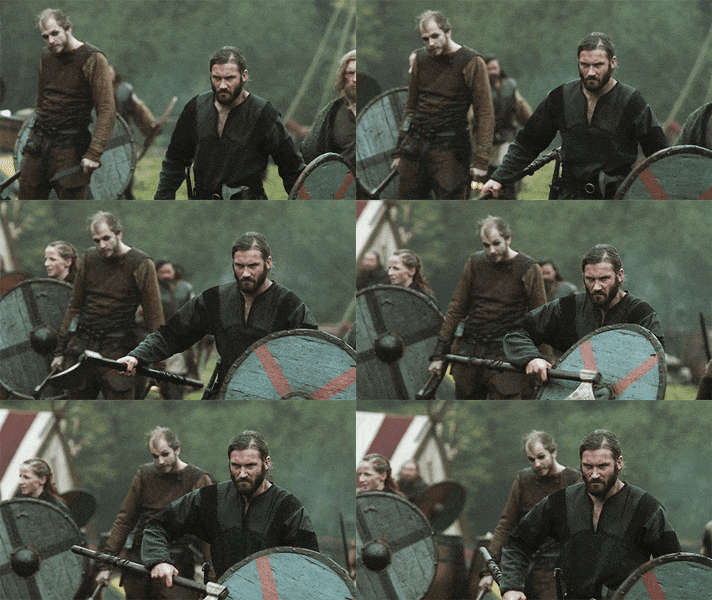
season 1 vikings GIF by HISTORY

Being anywhere near a coast or large river where the main settlements tended to be you also had to contend with these cunts coming and ruining your day with the odd bit of pillaging and rapin
 
Most definitely, but one thing has changed that back then everyone was in it together.
Now the gap between people who have it all and people who have below average makes you think you and your neighbor is not really together in this shit.

Today a farmer might be more happier than a corporate slave because he never dreams of attaining a standard other think is just out of reach. Like a dragon they can never catch.
I think we should focus more on Yoga and spiritual guidance more than Pokemons, just a tad bit more.
 
I think the worst part is the lack of sewage systems. A lot of towns just dumped it out a window into the streets.

Women had it worse, can't work, can't divorce, can't study.

Men had it pretty good though.
 
- To put fear into the common people, the ruling class would gather everyone in the town square and mutilate criminals.

Sounds like a more desirable alternative to releasing repeat offenders over and over again until they end up killing an innocent person like we have happening nowadays.

In Romania, the country's most famous poet ended one of his historical epics by pleading for Vlad the Impaler to return and cleanse the nation once more. His methods were cruel, sure, but he stamped out thievery, corruption, and all other manner of criminality like no other.
 
I think the worst part is the lack of sewage systems. A lot of towns just dumped it out a window into the streets.

Women had it worse, can't work, can't divorce, can't study.

Men had it pretty good though.
I suppose, so long as you didn't have anyone who felt like killing you.
 
How is this a bad thing? We could use more of this in today's Europe. In general the Middle Ages are made out to be far worse than they were. Sure we have a lot to be grateful for now, but they really weren't the hellish times they'd have you think.
It's a bad thing because the law was based on hearsay.
 
Being born at the correct time is good and all but i think place and status are even more important.

Even today it would suck to be born in some god forsaken, civil war riddled third world country, for instance. But being born in a noble, powerful family during the middle ages? Sounds good to me.
 
At least at that point in time violent criminals, rapists and other vermin would get executed in the town square for all to see.

Good times.
 
It's an interesting question: is there anything at all about living as a commoner back then that was better than lower/middle class living now?

I think part of the reason we aren't as happy as we should be, compared to them, is that expectations from life have also changed dramatically.

The flip side of quick progress is that we take so much for granted and continue to focus on what we don't have.
 
Last edited:
they didn't bathe (they had no hot water and just rubbed themselves with clothes), rotten food everywhere.
I don't care if there isn't hot water, but bath or shower I will do twice a day even if the water is ice cold. Cold water, being a Smash Bros. player or going to a Smash. Bros tournament is no excuse to not bathe or shower
 
Last edited:
I am always grateful for not having to deal with that kind of life. Which is why I hate that people have to overcomplicate things to feel alive and to make this bandwagon keep going at high speed forever. We have literally everything we could ever need. Just learn to enjoy it already.
 
If by "our time" you mean contemporary (20th century) I'd agree but if you mean being born in the last decade, I strongly disagree. The best period for the West was after the Second World War. An era of optimism and new renaissance. Today we are witnessing the fall of our civilization and it's going to end in a very ugly manner. Gen Z and Alpha are completely screwed.
 
There are a few misconceptions there.

- One bad harvest meant starvation for months.

Farming was not the only source of food in that time. Hunting was also an important source of food, tough several of the forests were controlled by the Lords or the Church, and they had laws against poaching.
Also, trade was already very wide spread in ancient and medieval times. So unless bad harvests were very wide spread, trade could mitigate it.
So although a bad harvest was a big problem, it wasn't the that bad. It will depend on how widespread it is.
The biggest problem though was hoarding. When there was even the slightest sign of a bad harvest, the Lords and Church would hoard most of the food in anticipation of the worst.
Very often it was unnecessary hoarding, that caused great harm to the lower classes.
Often, a simple an just distribution of the available food could have prevented many hungers.

- Death and grief was constant companions.
- Childhood was brutal, 30% to 40% of all kids died.

The common statistic for pre-modern times, is that 50% of all children would die before reaching 5 years old.

- It was not uncommon that people would band together in small groups and raid each others farms.
- There was nothing comparable to our state, people were on their own in all things.

This is not accurate. There was the rule of law, imposed by the Lords and the Church.
Only in times of great war, would a society collapse this badly. So this concept was not the rule, but the exception.

- To put fear into the common people, the ruling class would gather everyone in the town square and mutilate criminals.

I was also a form of entertainment for the masses.

- Almost no one could read or write, they didn't bathe (they had no hot water and just rubbed themselves with clothes), rotten food everywhere.

This is a big misconception. A lot of people knew how to read and write. And do basic math.
Even the peasants and serfs knew how to read most common words, for daily use, such as signs, trade, shops, etc.

The reason why this misconception exists is because for someone to be considered literate, in medieval times, they would have to understand Latin.
This meant only high Lords and the Church would fit that criteria.

- With no sanitation, dying from infections was common. People witnessed horrible deaths all the time from infected wounds, kids were very vulnerable.

This is half true. Only until the half of the XIX century did people start understanding what bacteria was.
But even before that, people had already realized that some things were good.
For example, all Roman Legionaries would carry a pouch of vinegar to make Posca. They understood that adding vinegar to their drinking water resulted in much lower risk of sickness, tough they didn't know that the alcohol in the vinegar was killing off bacteria.
The same thing for putting wine in wounds to clean it.
Also, there was a tendency for people to drink more wine, beer and mead at the time. Even children. In many situations, it was safer than drinking water.

- A successful life would be getting kids and survive to 40 (before you die horribly from a petty wound infection).

For pre-modern times, the average lifespan was around 35. But the main reason for this was the very high child mortality.
If someone survived childhood, there was a good change they would die of old age.
Work accidents and war were still a factor, especially for men, but living to old age was very common.
The dying of a petty wound infection is overstated. Even with limited knowledge about bacteria, those people knew how to clean up wounds, or amputate the affected limb.
Only in more extreme cases, would it cause death.

- Everybody would know stories of families and villages getting wiped out by famine and disease.

This would only happen in rare, extreme situations, such as the black death.
The medieval period spans for over 900 years. And there were many generations that never saw such situations.

- Kids started to work when they were 6-7 years old.

As soon as they could walk, most kids would start doing small farm chores. So this could be as low as 3 or 4 years old.
But even then, there was plenty of time for play.

- It was rare that people went more than 25 km (15.5 miles) away from their farms during their lives.

Another misconception. This could happen a lot with serfs, which were tied to their land.
It was very common for people to travel much farther than 25km, even peasants. The medieval period was full of sign posts and travel brochures for people to find their way around.
And a lot of people would travel to visit religious sites across the land, sometimes going to other countries in pilgrimage.
Many people would travel for trade. Others to visit family and friends in other villages and towns. And there was even a bit of tourism, for those with a bit of extra money to spend.

- About 20% reached 60 years old in peaceful times.

Anyone that survived childhood, had a good chance of reaching 60. After that, death rates would increase significantly again.
Also, there isn't precise statistics that would allow us to claim such a number as fixed number. At best, we could have a percentage range.

- 15% to 20% of women died because of childbirth.

The number is probably closer to 10%.
And the main reason was that women had a lot of children, which meant more chances for one of the child births to go wrong.

- Without sugar, teeth would not degraded like ours, but their teeth broke down from eating hard food, and tooth problems and pain was common. They ripped them out with pliers.

One consideration is that people in medieval times already washed their teeth. There were already toothbrushes made of horse mane.

- Everyone had head lice.

Very wrong. Though it was a lot more common at the time, people did took care to get rid of lice. And most people were clean of it.
There were several methods to get rid of it. From shaving their heads, comb the hair, immersion bathing, etc.

- It was common to sleep next to large farm animals like cows and pigs for warmth.

Another misconception. Although this would happen sometimes, the more often situation is that people would just sleep together.
Families would have only one room, where the parents and all the kids would sleep together.
With Lords, it was eve common for the servants to sleep in the lords room. The lord and his family would sleep on the main bed, and the servants on the floor.
Also, inns would have rooms with big beds where several travelers would sleep together. It was common for merchants to broke deals, while they lay in bed before sleep, for example.
Being relegated to the stables was more common for people who could not afford a room.
 
If by "our time" you mean contemporary (20th century) I'd agree but if you mean being born in the last decade, I strongly disagree. The best period for the West was after the Second World War. An era of optimism and new renaissance. Today we are witnessing the fall of our civilization and it's going to end in a very ugly manner. Gen Z and Alpha are completely screwed.

Yep, In US and Western Europe/Australia/Canada/NZ/Japan the best time to be born was probably just after WW2. For countries under Soviet Occupation... this one is hard, Poland is thriving now and I think the best time to be born was around when I was born (1989) but we still face the same problems rest of the world has (inflation, high rent prices, high energy prices, high food prices, wages increasing much slower than cost of living etc.). Communist Poland had some benefits:

- pretty much everyone had flat/house - where to live in general
- almost 100% of people that were able to work had work (people were forced to have work in general, lazy fucks were beaten by police)
- there were very few homeless and people that actually didn't have anything to eat
 
Yeh I think there's a tendency for people to downplay the benefits of modern life and romantise the past. I mentioned this in a similar thread a while back but modern medicine alone is a great reason to take the present over the past.

My grandfather was a coal miner, he was also incredibly intelligent. He was the community vet that farmers would go to when their animals were unwell, he could quickly learn any musical instrument he picked up and designed the conveyor belt system used at the mine where he worked, a system they later wanted to replicate at other locations. But, because of where he was born, he never had the opportunity to have a career as anything other than a coal miner. I've had far more opportunities in life than he ever had, both in terms of my career and other aspects of life, and I'm very grateful for that.
 
I don't know man, you could be a Naughty Dog employee on a 6 figure salary having to work overtime sometimes. Middle age peasants clearly had it better.
 
Back in the day, you'd have to slay a dragon and be rewarded by the king to see something like this


Nowadays it on YouTube, what a time to be alive.
 
There are a few misconceptions there.


Farming was not the only source of food in that time. Hunting was also an important source of food, tough several of the forests were controlled by the Lords or the Church, and they had laws against poaching.
Also, trade was already very wide spread in ancient and medieval times. So unless bad harvests were very wide spread, trade could mitigate it.
So although a bad harvest was a big problem, it wasn't the that bad. It will depend on how widespread it is.
The biggest problem though was hoarding. When there was even the slightest sign of a bad harvest, the Lords and Church would hoard most of the food in anticipation of the worst.
Very often it was unnecessary hoarding, that caused great harm to the lower classes.
Often, a simple an just distribution of the available food could have prevented many hungers.


The common statistic for pre-modern times, is that 50% of all children would die before reaching 5 years old.


This is not accurate. There was the rule of law, imposed by the Lords and the Church.
Only in times of great war, would a society collapse this badly. So this concept was not the rule, but the exception.


I was also a form of entertainment for the masses.


This is a big misconception. A lot of people knew how to read and write. And do basic math.
Even the peasants and serfs knew how to read most common words, for daily use, such as signs, trade, shops, etc.

The reason why this misconception exists is because for someone to be considered literate, in medieval times, they would have to understand Latin.
This meant only high Lords and the Church would fit that criteria.


This is half true. Only until the half of the XIX century did people start understanding what bacteria was.
But even before that, people had already realized that some things were good.
For example, all Roman Legionaries would carry a pouch of vinegar to make Posca. They understood that adding vinegar to their drinking water resulted in much lower risk of sickness, tough they didn't know that the alcohol in the vinegar was killing off bacteria.
The same thing for putting wine in wounds to clean it.
Also, there was a tendency for people to drink more wine, beer and mead at the time. Even children. In many situations, it was safer than drinking water.


For pre-modern times, the average lifespan was around 35. But the main reason for this was the very high child mortality.
If someone survived childhood, there was a good change they would die of old age.
Work accidents and war were still a factor, especially for men, but living to old age was very common.
The dying of a petty wound infection is overstated. Even with limited knowledge about bacteria, those people knew how to clean up wounds, or amputate the affected limb.
Only in more extreme cases, would it cause death.


This would only happen in rare, extreme situations, such as the black death.
The medieval period spans for over 900 years. And there were many generations that never saw such situations.


As soon as they could walk, most kids would start doing small farm chores. So this could be as low as 3 or 4 years old.
But even then, there was plenty of time for play.


Another misconception. This could happen a lot with serfs, which were tied to their land.
It was very common for people to travel much farther than 25km, even peasants. The medieval period was full of sign posts and travel brochures for people to find their way around.
And a lot of people would travel to visit religious sites across the land, sometimes going to other countries in pilgrimage.
Many people would travel for trade. Others to visit family and friends in other villages and towns. And there was even a bit of tourism, for those with a bit of extra money to spend.


Anyone that survived childhood, had a good chance of reaching 60. After that, death rates would increase significantly again.
Also, there isn't precise statistics that would allow us to claim such a number as fixed number. At best, we could have a percentage range.


The number is probably closer to 10%.
And the main reason was that women had a lot of children, which meant more chances for one of the child births to go wrong.


One consideration is that people in medieval times already washed their teeth. There were already toothbrushes made of horse mane.


Very wrong. Though it was a lot more common at the time, people did took care to get rid of lice. And most people were clean of it.
There were several methods to get rid of it. From shaving their heads, comb the hair, immersion bathing, etc.


Another misconception. Although this would happen sometimes, the more often situation is that people would just sleep together.
Families would have only one room, where the parents and all the kids would sleep together.
With Lords, it was eve common for the servants to sleep in the lords room. The lord and his family would sleep on the main bed, and the servants on the floor.
Also, inns would have rooms with big beds where several travelers would sleep together. It was common for merchants to broke deals, while they lay in bed before sleep, for example.
Being relegated to the stables was more common for people who could not afford a room.
Yeah, I am sure you are more right than me on these things. Only variance is that I was specifically reading about Scandinavia before the black death, which was a bit more remote than central Europe. I don't know how different it really was though.
 
Top Bottom