
• Hey Guest. Check out your NeoGAF Wrapped 2025 results here!

Sony to use 512MB XDR-DRAM?

Noticed this at the beyond3d forums and I hadn't seen any posting on this today. This was a continuation of an article regarding the possibility of the Nintendo revolution getting the same RAM as the PS3.


http://www.excite.co.jp/world/engli...83y%81%5B%83W%96%7C%96%F3&wb_lp=JAEN&wb_dis=2
President Sakamoto of Elpeda <6502.T><005930.KS>says the prospect that three companies (Elpeda, Toshiba, and the South Korea Samsung Electronics Co., Ltd.) supply DRAM for the next generation family-use game machines of Sony. President Sakamoto&#65378;Sony has the policy of adopting 512 large memory capacity Mbits XDR&#65381;DRAM that use the technology of U.S. Rambus. However, Sony will decide how to do the procurement ratio from three companies in the future. &#65379;It described. The contribution of Elpeda to the achievement was assumed to be dependence Sony's when on the next generation machine being put on the market.
 
Mbits, not Mbytes. And I think that's just talking about what type of memory module they'll use, not how many.
 
It's 512Mbit so 64MB modules.

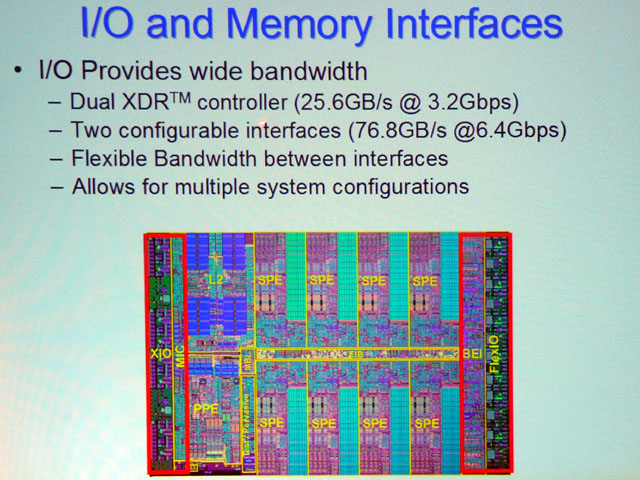
Assuming a 2 Cell PS3 CPU we could have 8 modules (4 per Cell) for a total of 512MB@ 50GB/s.
 
With the 25GB/sec memory bus (one PE) that would make 256MBytes of RAM for the CPU and if the GPU has it's own RAM, we could expect anything from 320Mbytes to 512MBytes combined.

Fredi
 
Marconelly said:
Doesn't PE have 50GB/s memory bus? Why there must be exactly four memory chips per one PE?

I'm confused by this too. We've had 50-100Gb/s numbers on the one hand, and then 25-75GB/sec numbers on the other. I'm very confused. Anyone care to break down the numbers and how they all fit together, from basics?
 
gofreak said:
I'm confused by this too. We've had 50-100Gb/s numbers on the one hand, and then 25-75GB/sec numbers on the other. I'm very confused. Anyone care to break down the numbers and how they all fit together, from basics?


I am totally confused also.


Is the ISSCC Cell bandwidth ~25 GB/sec or ~50 GB/sec or ~75 GB/sec or ~100 GB/sec

Panajev, please help us understand.
 
This is better:

kaigaip046.jpg
 
The End said:
512 is plenty, considering that Xenon will only have 256.
It's 512Mbits, which is 64MBytes, and it's just the size of one module.

We don't know how many memory modules the PS3 will have.
 
Interesting info, but why does Sony always have to come up with the weirdest hardware architecture? Just put a dual core AMD Athlon 64 in it with 2 gigs of dual channel DDR2 and 512MB of VRAM. :D

I got excited about PS2's hardware. I'm not so interested in PS3's... I realized last time that it isn't worth so much interest. Just worry about the games. Heh.
 
Aizu_Itsuko said:
It's 512Mbits, which is 64MBytes, and it's just the size of one module.

We don't know how many memory modules the PS3 will have.


Don't mind me, I'm just starting shit.
 
Diablos said:
Interesting info, but why does Sony always have to come up with the weirdest hardware architecture? Just put a dual core AMD Athlon 64 in it with 2 gigs of dual channel DDR2 and 512MB of VRAM. :D

I got excited about PS2's hardware. I'm not so interested in PS3's... I realized last time that it isn't worth so much interest. Just worry about the games. Heh.

dual core Athlon64 would not provide the kind of floating-point performance that SCEI wants. sure it would be better than Cell for general purpose processing, but PS3 isnt being designed to run general purpose apps (although it might be used to do that as a side benefit).. Sony wants to provide as close to CG-level graphics in games as it can. And while CELL in its current form is NOT going to get us all the way there, it will be a step in that direction. whereas AMD or Intel could not or will not provide that kind of a processor.
 
doncale said:
dual core Athlon64 would not provide the kind of floating-point performance that SCEI wants. sure it would be better than Cell for general purpose processing, but PS3 isnt being designed to run general purpose apps (although it might be used to do that as a side benefit).. Sony wants to provide as close to CG-level graphics in games as it can. And while CELL in its current form is NOT going to get us all the way there, it will be a step in that direction. whereas AMD or Intel could not or will not provide that kind of a processor.

I would agree with this up until the last sentence.. Current AMD/Intel CPUs can be quite efficiently used as (vertex) shaders for games, only, using the GPU is much easier and leaves the CPU for more important tasks. If you think CELL will be a powerhouse of graphical output, I think you'll be disappointed. If it was a reliable graphics processor Sony would not have needed nVidia's NV50 architecture.

As for the memory question, 512MBit is equal to 64MBytes. As for speculation towards how many there will be per CPU, I wouldn't think more than 6 or less than 2. 4 to each sounds reasonable, for a total of 512MB RAM for the CPU, unless they found the chips for real cheap.. because they aren't. Anyway, at 3.2Gbps that's hardly going to be truly impressive or overtake PCs..
 
well, i was not saying that Cell makes a good graphics processor. it doesn't. it's a CPU that could probably and will probably be used for geometry / vertex / lighting calculations, but would make a poor rasterizer. so obviously Sony went to Nvidia for reliable graphics processing.
 
doncale said:
dual core Athlon64 would not provide the kind of floating-point performance that SCEI wants. sure it would be better than Cell for general purpose processing, but PS3 isnt being designed to run general purpose apps (although it might be used to do that as a side benefit).. Sony wants to provide as close to CG-level graphics in games as it can. And while CELL in its current form is NOT going to get us all the way there, it will be a step in that direction. whereas AMD or Intel could not or will not provide that kind of a processor.


Not to mention that it would be more expensive, require a redesign of the memory controller/bus for the Athlons to work properly, and pose new thermal problems. There is also an issue with the Athlong64 not meeting their specific case pipelining needs.
 
Definitely more than 64 MB. Isn't that how much Xbox has? That would be along the same lines as PS2 have 4 MB of total RAM. Not going to happen.

Especially considering how relatively high end PS3 looks to be compared to PS2 at the time. PS3 has a processor that's theoretically way beyond current PC CPUs, while PS2 didn't. PS3 has Nvidia making a beefy GPU, PS2 had some custom stuff. That and we're bumping up resolutions, and that'll require more memory, unless you keep using low res textures and whatnot and that's just pointless.
 
teh_pwn said:
Especially considering how relatively high end PS3 looks to be compared to PS2 at the time. PS3 has a processor that's theoretically way beyond current PC CPUs, while PS2 didn't. PS3 has Nvidia making a beefy GPU, PS2 had some custom stuff.

Huh? do you not remember the hype behind the "Emotion Engine"? Some people were claiming it was going to replace desktop processors. It blew away CPUs at the time in several major areas that were relevant to graphics. People were talking about it like it was the second coming of Jesus. It still does a lot of things very well, and many things better than the xbox.
 
Really?

I wasn't paying attention too much to PS2 hardware...but how did the Gigaflops compare to PCs at the time? I think PC processors were like 1-2 GF, right? And EE is around 6?

This time it's 256 to 6-8.

I could be wrong in that respect, but I do think the GPU will be higher end relatively, with the jump to HD and all.
 
Diablos said:
Just put a dual core AMD Athlon 64 in it with 2 gigs of dual channel DDR2 and 512MB of VRAM.
Sure, and why not give those consoles away for free as well, while they're at it. :P
 
Phoenix said:
Not to mention that it would be more expensive, require a redesign of the memory controller/bus for the Athlons to work properly, and pose new thermal problems. There is also an issue with the Athlong64 not meeting their specific case pipelining needs.

I dont think it would be a problem for AMD to support DDR2 with thier memory controller, they are shying away from it even though it could be done because of DDR3 looming over the horizon. Sure they could support ddr2 out the box but if you have a memory controller that locks you to one type of memory and why bother forcing customers to buy DDR2 when it costs more and has more latency than DDR1? It wouldnt be efficient to have 2 diff flavors of each AMD64 chip either. If DDR2 gains mass support amd will do what it has to and it wont be a big deal its been in the news for quite some time, they just want to make sure the market is heading that way. With ddr3 having the bandwidth advantage of ddr2 and the latency advantage of ddr1 its in their best intrest to play the wait and see game as far as the memory market goes.

I am not aware of any thermal problems the A64 is having. Last time i check they have far better temperatures under load and idle than any current presscott or ibm ppc chip, and they sure as hell dont run as hot as cell is stated to run. From most accts i have read , alot of them from people touting their new AMD64 built systems on amdzone.com have gotten on avg 40 - 55 degrees C on their machines. Perhaps this has changed with the faster versions of the cpu I have not been keeping up with its thermal ratings since the first few rev of the chip ran so cool, so maybe its different now. I doubt it though their process is only improving.

Amd cpu's dont rely heavily on pipelines due to the latency involved with having a cache miss, basically it has to be cleared and repopulated this is probably the biggest source of wasted computing power along with waiting for main memory or a hdd to send a request/data to be executed. Wasting many cycles, the pipeline is a useful tool if successful but as the netburst architecture has shown us, relying on it too much leads to less than desired real world performance. For a single application they work well but for multiple task and app environments it can get messy. The prescott has an even larger pipeline than the northwood pentium core...and we all saw that happened to Intel's performance crown after the northwood.
 
Top Bottom