

-
Hey Guest. Check out your NeoGAF Wrapped 2025 results here!
You are using an out of date browser. It may not display this or other websites correctly.
You should upgrade or use an alternative browser.
You should upgrade or use an alternative browser.
New commit to DuckStation adds option to show graphics from older PS1 GPU
- Thread starter IbizaPocholo
- Start date
- Retro Platform


MooMilk2929
Junior Member
Thats a big difference.

diffusionx
Gold Member
soul vs soulless


Buggy Loop
Gold Member
wut
I wonder if I had old gpu all that time hahaha. Didn't know there was such a drastic difference.
I wonder if I had old gpu all that time hahaha. Didn't know there was such a drastic difference.


Kilau
Member
PSone ProHoly bananas! I did not know this was a thing.

Liopleurodon
Member


You very likely have the left PSX unless you were in a PAL region and got it late. Most people had the left one.Me... rushing to get the two PSXs I have out of the closet to check which models they are...

Tobimacoss
Banned
Why doesn't Sony run all the older GOW games via emulation instead of Streaming only? PS2 emulation is very doable.

From what I'm reading, the older GPU is only launch window 95/96 ps1's - by 97 all European and Japanese PS1s used this.
In looking this up I learned there were a TON of minor hardware revisions - where launch versions couldn't handle transparency well, and minor changes made in 96 improved frame rates with specific effects. You'd never get away with that these days
In looking this up I learned there were a TON of minor hardware revisions - where launch versions couldn't handle transparency well, and minor changes made in 96 improved frame rates with specific effects. You'd never get away with that these days

BlackTron
Member
to change ps1 graphics in anyway is the worse thing you can do in earth.
You heard me correctly !!!
What about PS1 to other PS1?

kevboard
Member
From what I'm reading, the older GPU is only launch window 95/96 ps1's - by 97 all European and Japanese PS1s used this.
In looking this up I learned there were a TON of minor hardware revisions - where launch versions couldn't handle transparency well, and minor changes made in 96 improved frame rates with specific effects. You'd never get away with that these days
I mean, that's certainly not true.
later consoles also had internal changes that affected game playback. some 7000 model PS2s had compatibility issues with games like Silent Hill 3 due to internal hardware changes.
the PS2 75003 for example apparently can not run Jak X and SOCOM 2... Sony published games!
the different storage options of Xbox 360 consoles lead to differences in load speeds and game compatibility (forced installs making any core/arcade system incompatible unless you add an HDD).
and then there's the Xbox One S, that was in theory a revision of the Xbox One, but ran the GPU 10% faster, which increased framerates in some games.
I would even bet that the PS5 Slim runs some games minimally faster than the PS5 FAT, due to the dynamic clock speeds the PS5 uses being tied to power draw. a die shrink usually comes with reduced power draw, which would suggest that the system doesn't have to downclock as often, or at all anymore.
Last edited:


Mownoc
Member
Only PS1's manufactured before December 1995 have this. They only had 5bit shading and slower transparency calculation that could result in slowdowns because of the VRAM they used.Da fuck is this shit, this is a bigger mind blow than Mario Cloud Bush. Literally never seen this mentioned anywhere before. How early or late in the gen was this "new GPU" swapped in?
PS1's after this had 8bit shading. Considering they only shipped 4.3m units by March 1996 there are very few of these PS1's with the inferior VRAM.
Last edited:


NeoIkaruGAF
Gold Member
If the difference is so pronounced, I guess literally zero reviewers of TR at the time had the older GPU. I read a bunch of those, and I'd never seen a photo of the lighting in the game acting like that, or that banding on the pillars. Possibly these effects aren't so visible on CRTs?
The very early PS1 models used dual ported VRAM, unfortunately this type of memory became more expensive and Sony switched to SGRAM to keep costs down (another format war Sony lost). Part of the change is they had to redesign the GPU to accommodate the SGRAM design which wasn't dual ported, Sony however also took the opportunity to fix a few chip bugs which is why there is colour banding on the VRAM consoles.
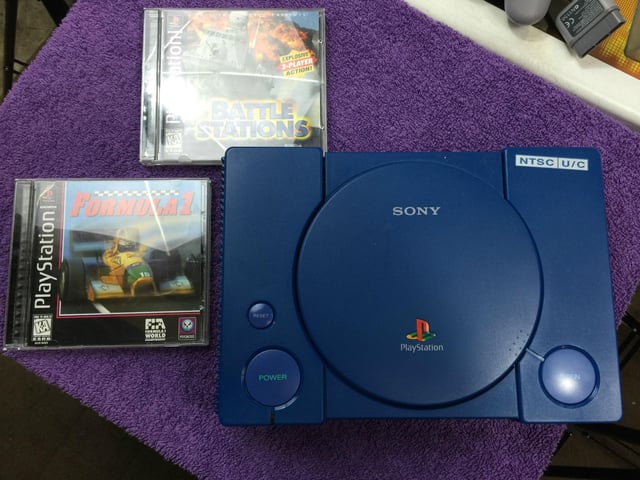
With this change, there is a potential for compatibility issues to occur, so Sony provided developers with two debug units to test their game with. The blue models had VRAM, whilst the green units came with SGRAM. Thankfully as the change was done early in the PSX's life, there were little to no compatibility issues. The change was done late 1995, so mostly likely you would have had the SGRAM model of the PSX. Aside from colour banding, some graphical effects were improved in the newer models.
It's worth noting that the term VRAM is usually referred to as video or graphics cards memory, but was actually a type of memory that was introduced in the early 90s for accelerated graphics cards. The dual ported nature of VRAM means it can be directly connected to the video encoder, which simplifies the circuit design.
There was another change in around 2002 with the PSone models, where Sony used 2MB of SGRAM instead of 1MB. However this wasn't intentional by Sony, 1MB SGRAM models were simply getting difficult to source and Sony opted to use 2MB instead. Now I'm not sure If this is accessible to games, but Sony did not advertise this as such.
With this change, there is a potential for compatibility issues to occur, so Sony provided developers with two debug units to test their game with. The blue models had VRAM, whilst the green units came with SGRAM. Thankfully as the change was done early in the PSX's life, there were little to no compatibility issues. The change was done late 1995, so mostly likely you would have had the SGRAM model of the PSX. Aside from colour banding, some graphical effects were improved in the newer models.
It's worth noting that the term VRAM is usually referred to as video or graphics cards memory, but was actually a type of memory that was introduced in the early 90s for accelerated graphics cards. The dual ported nature of VRAM means it can be directly connected to the video encoder, which simplifies the circuit design.
There was another change in around 2002 with the PSone models, where Sony used 2MB of SGRAM instead of 1MB. However this wasn't intentional by Sony, 1MB SGRAM models were simply getting difficult to source and Sony opted to use 2MB instead. Now I'm not sure If this is accessible to games, but Sony did not advertise this as such.

Drell
Member
You mean 3D graphics with dithering, textures zigzaging everywhere and every living creatures having parkinson while there's a constant earthquake? No thanks, duckstation is a benediction for me to appreciate the PS1 library.to change ps1 graphics in anyway is the worse thing you can do in earth.
You heard me correctly !!!
???Why doesn't Sony run all the older GOW games via emulation instead of Streaming only? PS2 emulation is very doable.

March Climber
Member
Because The GoW collection is technically a PS3 game, and so are GoW 3 and the GoW prequel.Why doesn't Sony run all the older GOW games via emulation instead of Streaming only? PS2 emulation is very doable.
7 series moved to fully emulated ps1 stack(until then, they emulated graphics but not cpu), which also affected ps2 games because the CPU was directly accessible to them also.some 7000 model PS2s had compatibility issues with games like Silent Hill 3 due to internal hardware changes.
the PS2 75003 for example apparently can not run Jak X and SOCOM 2... Sony published games!
But yea they swapped in a PPC chip and emulated all code that previously ran on r3000. This had some Performance implications(both positive and negative) but in rare cases also compatibility. No easy way to patch such issues back then.
Modern consoles are much more flexible in that regard

Yeah. The one thing to know about the PS2 is that devs had full access to nearly everything. Led to some of the hackiest, unintuitive coded shit imaginable. There wasn't a real standard on how to do things.7 series moved to fully emulated ps1 stack(until then, they emulated graphics but not cpu), which also affected ps2 games because the CPU was directly accessible to them also.
It's a large part of why PS2 emulation is/was so difficult. A ton of edge cases.


The_Observer
Member
This is crazy, never knew this was a thing.
There might be more visible difference between a launch ps1 and a psone, than between a ps5 and a ps5 pro
There might be more visible difference between a launch ps1 and a psone, than between a ps5 and a ps5 pro


GladiusFrog
Member

vodka-bull
Member
Slim ain't pro.Sony Playstation 1 Slim - SCPH-101


SomeNorseGuy
Gold Member
Been a "couple of years" but on my shitty crt with pack-in cables I feel like my EU PS1 experience was somewhere in between those photos. But time does fuck with our memories at times.

Gp1
Member
Sony Playstation 1 Slim - SCPH-101
By the way this sucker uses the new or the old GPU?

Mownoc
Member
New. Only PS1s manufactured in November 1995 or prior use the old GPU. So probably only around 3% of PS1's made.By the way this sucker uses the new or the old GPU?
NTSC/PAL models with the old GPU will be especially rare as only models in the first 3 months have it.

TigerBrown
Member
I remember being proud of having an early playstation model, due to the additional ports. I had no idea about a gpu revision.


Knightime_X
Member
This is interesting, but I can't see myself using a feature that makes the experience overall look and run even worse.
Maybe as a brief novelty overview, but wouldn't last longer than 5 minutes, tops.
Maybe as a brief novelty overview, but wouldn't last longer than 5 minutes, tops.
Last edited:

CamHostage
Member
If the difference is so pronounced, I guess literally zero reviewers of TR at the time had the older GPU.
Reviewers at the time would have been using debug units (although I'm not sure what the breakdown of hardware specs specific to those would have been, or if they ever had variations of debug hardware over the years?) These were different from the green developer units, so they had the same amount of RAM, nothing boosted, main difference was that they played burns. Eventually bootleg chips came out and so some reviewers were likely using their own modded unit (since debugs were in short supply) but for the most part, reviewers at different shops would have had the same hardware that Sony gave them all access to.
Debug units were usually late every generation(much later than devkits) so chances are they had newer hw.Reviewers at the time would have been using debug units (although I'm not sure what the breakdown of hardware specs specific to those would have been, or if they ever had variations of debug hardware over the years?)
Don't think they usually had variations though, on ps2 no 7xxxx or later series debug units existed IIRC.
It also led to some awesome creative stuff that's just amazing when it worksYeah. The one thing to know about the PS2 is that devs had full access to nearly everything. Led to some of the hackiest, unintuitive coded shit imaginable.

Yes lots of rope to hang yourself with but also ways to make amazing knots. I did find it fascinating just how bad some 'accepted' solutions were though.
I mean... sort of. It's not really different from cycle accurate SNES, hardware doesn't lie, and neither should the emulators.It's a large part of why PS2 emulation is/was so difficult. A ton of edge cases.

IAmRei
Member
I never knew if there is any different back then, but the difference are... there. interesting thanks for the info OP
I'm wondering if playing on a crt helped cover up the banding issue. I mean dithering looks better on a crt since the pixels merge together so I'm wondering if that happened here too. FWIW I had a release psx and never noticed it. (And later a psone when the first one stopped reading discs. )This is some Mandela Effect stuff. Had a launch PS1 in 1995 with very good CRT using S-Video, never saw banding like this, ever. Replaced with a 7501 model later and saw no difference.
This is a conspiracy!

alabtrosMyster
Member
The CRT and especially the NTSC signal hid some image problems, but dithering and color banding was still visible.I'm wondering if playing on a crt helped cover up the banding issue. I mean dithering looks better on a crt since the pixels merge together so I'm wondering if that happened here too. FWIW I had a release psx and never noticed it. (And later a psone when the first one stopped reading discs. )
Like, the lack of transparency support on the Saturn was obvious (especially when devs didn't bother taking advantage of the little it could do in that regard). Even the N64's atrocious texture filtering was an obvious problem, especially with the low resolution textures they had back then, hence the reputation for smudged images.
Back to the PSX, I think that the worst problem it had was texture wobble, but any upgrade would have been welcome, had I known about it.
Wikipedia has good info on the PSX revisions:
l
That seems like it came pretty early, most people probably had the good stuff back then.