• Hey Guest. Check out your NeoGAF Wrapped 2025 results here!

PS5 Pro is getting PSSR 2.0 between January and March 2026

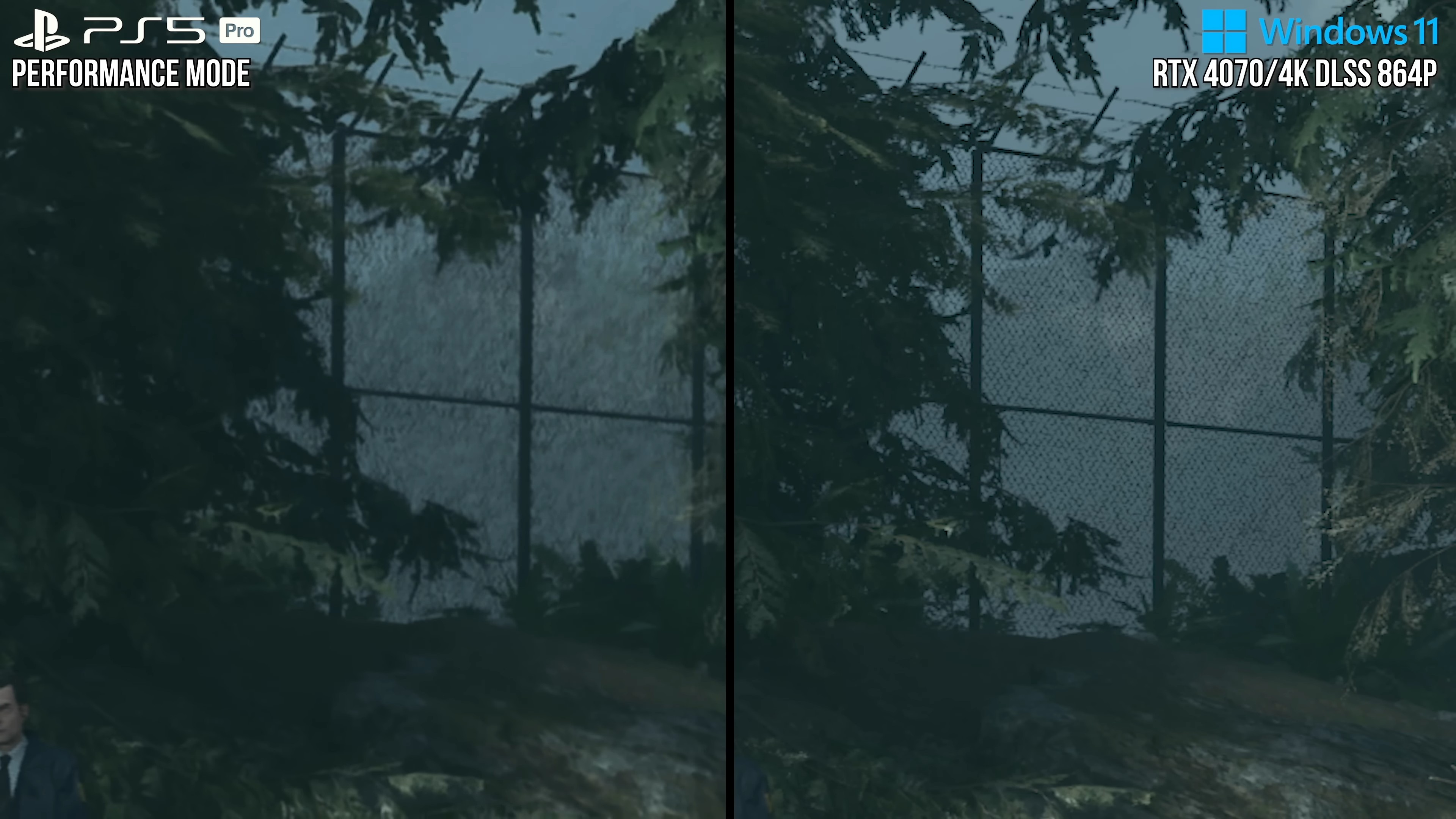
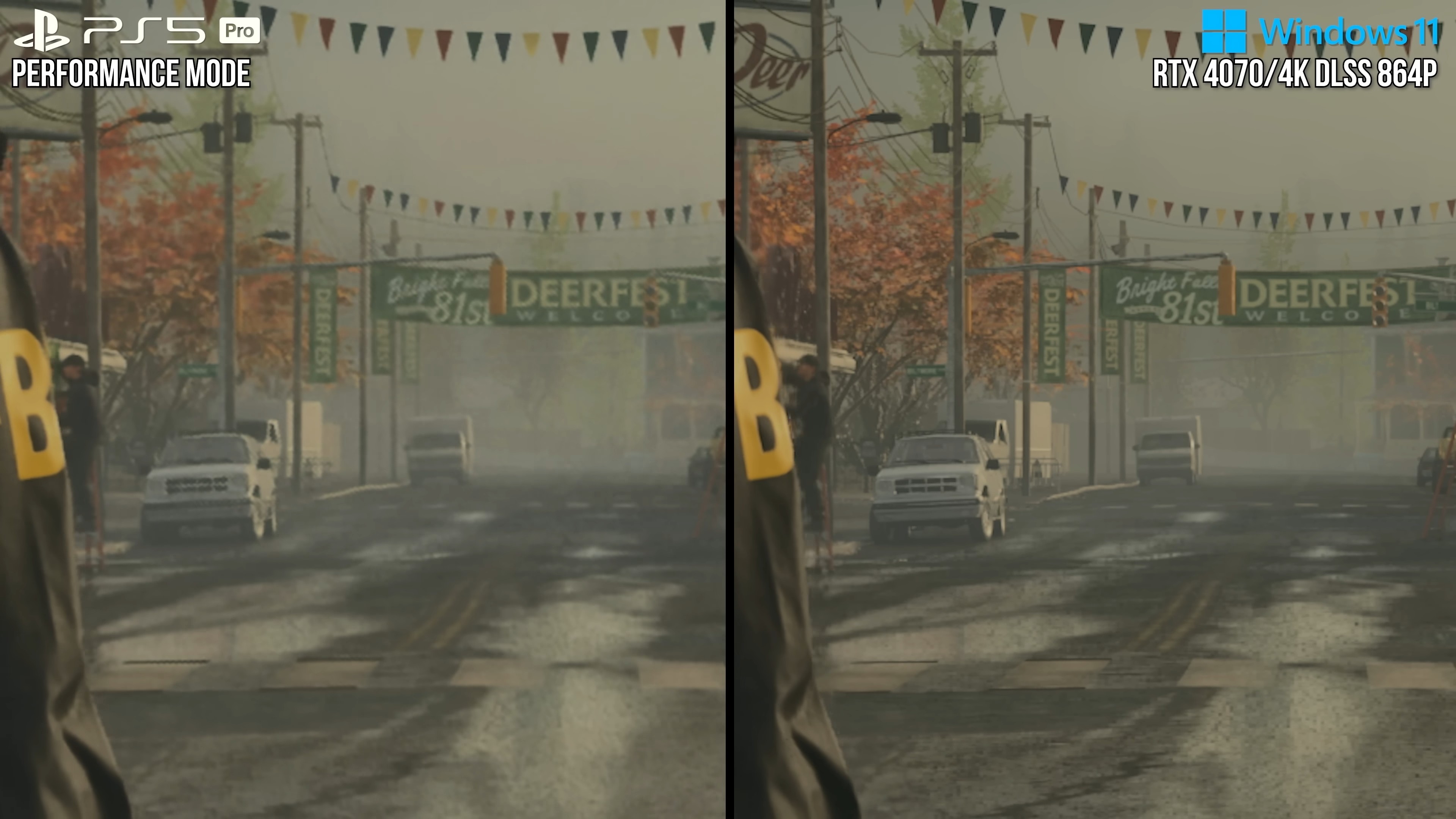
I completed it on PC. Game has a lot of areas with foliage (even a forest later). This was taken few hours in:

lXanDLZ.jpeg


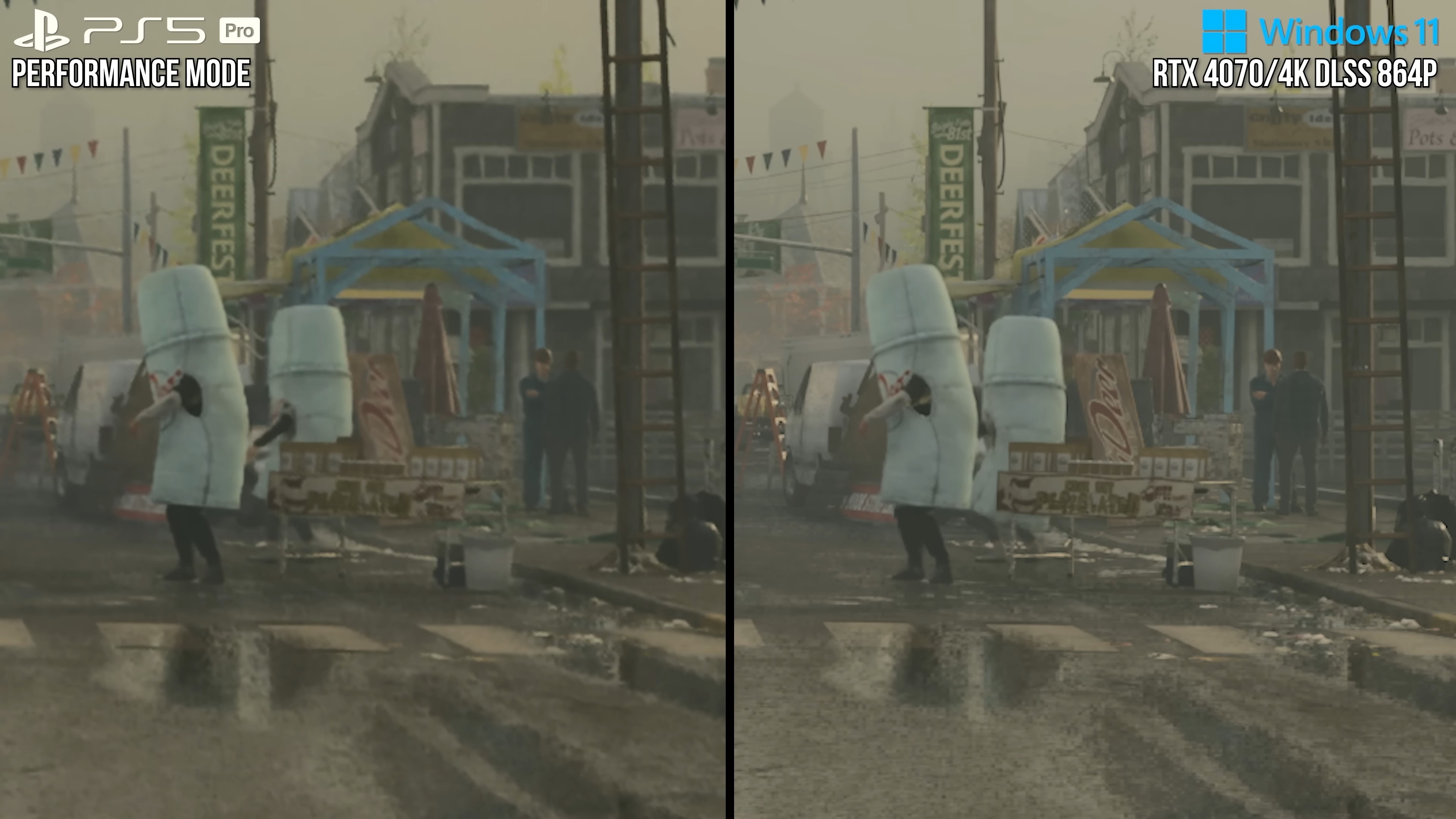
I have no idea how foliage looks in later areas looks on Pro, most of the footage is from the beginning.
Looks like a high resolution PS2 Pro game.
Not sure what Konami was 🤔
 
You know, every time i come across one of your posts, the first thought that comes to mind is: "Why is this dude so annoying"? Like clockwork, every time.

I gotta ask, is everything ok at home, with work, with life, with the family? What's causing you to be so insufferable?
Because can't be fair in any discussions without to be tragically hysterical when PS5Pro, Sony or PSSR are involved. I bet whatever you want when PSSR2 will be released it won't change a shit. I mean he said exactly the same stuff well before to own the ps5 pro, he is clearly biased and bought it just to lame who dare to say otherwise. I have to use the ignore list him for the exasperation because also he also like harassing you with lol reaction everytime you said something about the matter. He clearly doesn't care about the other opinion and he just want to take the point in everything, it's literally impossible to have a serious confrontation which not end in warring about the PSSR with him.

Precise like a clockwork 😏 get a therapist
 
Last edited:
Going to keep my eye on this. The only thing that prevents me from buying a Pro is how it's a mixed bag in regards to improvement.

Like GT7. Yeah it's in "4K" now but DF said that's at the cost of clear PSSR artifacting. Stuff like that makes me think it's better to just wait for PS6.
 
Like GT7. Yeah it's in "4K" now but DF said that's at the cost of clear PSSR artifacting. Stuff like that makes me think it's better to just wait for PS6.
You don't have to use PSSR. You can run the native 4k mode with added RT reflections in gameplay instead of just replays. Silent Hill F aside, I can't think of any other game that is not an improvement over the base version. Even games with no official pro support run much better.
 
Last edited:
Going to keep my eye on this. The only thing that prevents me from buying a Pro is how it's a mixed bag in regards to improvement.

Like GT7. Yeah it's in "4K" now but DF said that's at the cost of clear PSSR artifacting. Stuff like that makes me think it's better to just wait for PS6.
GT7, run at native 4k/120fps disabling PSSR and RT. I don't think GT7 have a good RT implementation to sacrifice both FPS and resolution
 
Last edited:
Going to keep my eye on this. The only thing that prevents me from buying a Pro is how it's a mixed bag in regards to improvement.

Like GT7. Yeah it's in "4K" now but DF said that's at the cost of clear PSSR artifacting. Stuff like that makes me think it's better to just wait for PS6.
I mean if for you is too expensive, forget about it. And if you don't like artifacts upscaler well it's the same. People continue to repeat DLSS4 is flawless but honestly I seen a couple of video about it and I found very similar artifacts on it but the thing is PSSR flaws are a lot more scrutinized and exposed than the DLSS by DF in my opinion.
Just to say I have the switch 2 and it was a relief go back to the PSSR 😆 because artifacts are far more present and annoying on handheld mode and impossible to ignore. But I can live with it.
 
Last edited:
People are pointing out the nitpick hypocrisy and hyperbole, nothing more. We all want it to be better, it makes it better for all of us, PC and consoles.
The battle of upscalers has always being about nitpicking.

You think the average casual who play fifa would even notice why fsr2 look like shit? They would probably think that it looks good enough.

It has always been a battle of zooming to see micro-flaws that most people are not gonna notice.
 
Looks like a high resolution PS2 Pro game.
Not sure what Konami was 🤔

It's a decent looking game, not ugly or anything but also not close to top UE5 visuals. SH2 looks superior despite being older.

You don't have to use PSSR. You can run the native 4k mode with added RT reflections in gameplay instead of just replays. Silent Hill F aside, I can't think of any other game that is not an improvement over the base version. Even games with no official pro support run much better.

MGS Delta had worse framerate before they patched it (after how much time? I'm not sure) but other than that most games just run better or with higher DRS values simple because GPU is more powerful (even if game don't have any Pro enhancements from devs).
 
The battle of upscalers has always being about nitpicking.

You think the average casual who play fifa would even notice why fsr2 look like shit? They would probably think that it looks good enough.

It has always been a battle of zooming to see micro-flaws that most people are not gonna notice.
True that, most people were fine with RDR2 on PS4 which was a smearing blur fest. Heck any game with TAA at 1080p was pretty much garbage to me but most people were fine with it. This upscaling shit is for us nerds who notice this shit, but like anything on Gaf it just becomes tribal shit flinging
 
Well worst AI upscaler. Even in Sony first party games it is outmatched by DLSS and FSR4. XeSS is more of a wash, but XeSS work well enough in UE5.

So yeah, PSSR can probably be labeled the worst AI based upscaling solution. Not that I'd agree with the claim it wasn't ready for third party devs. But it is disappointing in a fair number of games. Even first party ones. GT7 with RT and PSSR can sometimes be a really noisy mess, especially in cockpit view.
What about other console upscalers like say DLSS. Switch 2 'tiny' DLSS hasn't been pretty at all and used over "full fat" implementations more often than not due to performance targets. Nintendo themselves don't even use DLSS in any of their own games as far as I know.

Consoles have fixed settings and performance targets. People, especially DF, try to make a big deal of the artifacts on PS games but it's really not that big a deal when you have much better IQ overall most of the time at 60fps vs having to pick 30fps to achieve it.
On PC DLSS people set things and don't care much if they're now running at 46fps or whatever or they have more expensive/higher performance hardware in comparisons. DLSS on a console is the same mixed bag of compromises to hit performance targets though.
 
Should have delayed the Pro until this year when it will be ready for prime time. There was no rush, so I'm not sure why they kicked it out the door.
Should had Nvidia delayed the RTX 2000? DLSS 1.0 sucked and everyone was laughing back then in 2018 and how is DLSS now?
 
Last edited:
What about other console upscalers like say DLSS. Switch 2 'tiny' DLSS hasn't been pretty at all and used over "full fat" implementations more often than not due to performance targets. Nintendo themselves don't even use DLSS in any of their own games as far as I know.

Consoles have fixed settings and performance targets. People, especially DF, try to make a big deal of the artifacts on PS games but it's really not that big a deal when you have much better IQ overall most of the time at 60fps vs having to pick 30fps to achieve it.
On PC DLSS people set things and don't care much if they're now running at 46fps or whatever or they have more expensive/higher performance hardware in comparisons. DLSS on a console is the same mixed bag of compromises to hit performance targets though.
I don't know what exactly is it supposed to be that full FAT DLSS but from my personal experience every single game I tried has a lot of more artifacts than PSSR on switch 2. If that was the famous DLSS2 below 1080p is clearly worse than the first PSSR iteration without any kinda of doubt, especially in motion, in fact in the last Tomb Raider updated if I'm not wrong runs at native 1080p and scaled above with the DLSS; it's the best implementation I seen in all the games I tried. At least on switch 2, below 1080p DLSS2 doesn't work that well not at least to the same level of the PSSR.
 
Last edited:
Should had Nvidia delayed the RTX 2000? DLSS 1.0 sucked and everyone was laughing back then in 2018 and how is DLSS now?

It wasn't even ready at 2xxx launch, first game with DLSS appeared quite some time after GPU launch.
 
Last edited:
When camera moves most of the time you see in game motion blur, potential dynamic resolution drops and pixel blur if you have LCD screen. So that PSSR advantage in sharpness in motion could be completely eliminated in real life.


PSSR 1.0 sucks because Sony fucked up, they didn't need to release broken version to the public in 2024. Intel managed Xess to be ok on their first try in 2022, same with Nvidia and DLSS 2 (1.0 sucked more than PSSR) in 2020 and AMD with FSR4 in 2025. They improved their implementations over time of course but those never were in poor state that PSSR is showing in many games.

And between November 2024 and Now - zero fucking updates, good job Sony...
Then Nvidia should have delayed the launch of RTX 2000 series or DLSS 1.0 launch for 2020 right?
 
Last edited:
What about other console upscalers like say DLSS. Switch 2 'tiny' DLSS hasn't been pretty at all and used over "full fat" implementations more often than not due to performance targets. Nintendo themselves don't even use DLSS in any of their own games as far as I know.

Consoles have fixed settings and performance targets. People, especially DF, try to make a big deal of the artifacts on PS games but it's really not that big a deal when you have much better IQ overall most of the time at 60fps vs having to pick 30fps to achieve it.
On PC DLSS people set things and don't care much if they're now running at 46fps or whatever or they have more expensive/higher performance hardware in comparisons. DLSS on a console is the same mixed bag of compromises to hit performance targets though.
The standard DLSS model on Switch 2 is better than the current PSSR. The lite model is worse as it needs to run on a mere 27 TOPS of INT8 compute in portable mode while using as little as frametime as possible. That's simply due to a limitation of hardware.

PSSR runs on the 300 INT8 tops of the Pro, which is more than enough to run heavy AI models. It's the equivalent TOPS of a 3090. PSSR having issues with noise and such is not a hardware limitation but due to the upscaler itself. Which should be solved by the upcoming update.

And the artifacts can be a big deal, it just depends on the game. Some are worse than others. Thankfully almost all of the 1st party has been good.
 
Last edited:
It's crazy how much faith people have in PSSR 2.0 after the 1.0 debacle. What, exactly, do you guys think will be different this time? They didn't go back and update a ton of old games, a lot of the newer games that got it ended up with terrible implementation. Frankly the total amount of games that use it at all are abysmal.

Even if PSSR 2.0 comes out and is the Holy Grail of upscaling in terms of quality, unless it's an across the board, hardware level setting, it's going to be another huge disappointment we'll see the same shit again, with first-party titles implementing it well, and third-party (future) titles being a mixed bag.

Also, the PS5 Pro has no longevity either way. It's a test dummy for the PS6 and Sony will drop it like a rock when that console releases. There is no "future proof" for this machine.
Sure let's think about DLSS 1.0 and 2.0 same thing right? 1.0 sucks and 2.0 don't suck.
 
The standard DLSS model on Switch 2 is better than the current PSSR. The lite model is worse as it needs to run on a mere 27 TOPS of INT8 compute in portable mode while using as little as frametime as possible. That's simply due to a limitation of hardware.

PSSR runs on the 300 INT8 tops of the Pro, which is more than enough to run heavy AI models. It's the equivalent TOPS of a 3090. PSSR having issues with noise and such is not a hardware limitation but due to the upscaler itself. Which should be solved by the upcoming update.

And the artifacts can be a big deal, it just depends on the game. Some are worse than others. Thankfully almost all of the 1st party has been good.
Lol no absolutely.
 
It wasn't even ready at 2xxx launch, first game with DLSS appeared quite some time after GPU launch.
I remember wanting to play Metro Exodus back then with DLSS and it just looked like shit, so i just stopped playing until i had better hardware cause native was off the table with high FPS.
 
DLSS1 is completely different beast than all ML upscalers after that.

DLSS2 is better than PSSR1. DLSS3 destroys PSSR1:

6ICHCwCRDTszaaMW.jpg
r8dx4Bn4KIDbQHwB.jpg
LKEPHWpIkHCW5HNZ.jpg


It's the worst ML upscaler overall. And even worse when it presents issues in third party games.
Sure what about motion? I don't play still in a spot. Does PSSR need works? Of course they need to improve it specially in UE5 games.
 
Last edited:
Probably already been said in the thread, but GTA 6 60fps is still off the cards with this I'm afraid. The existing GPU in the PS6 could already handle such a frame rate with modest settings, that's not the problem - the ancient CPU is.
 
The standard DLSS model on the Switch 2 is DLSS 3.7, preset model E. It's the best CNN model Nvidia made. So yes.

The lite/tiny model is something entirely separate.
And I told you all the games I tried with resolution below 1080p show more artifacts than PSSR. I doubt all are lite version. But I guess it's normal? I don't think DLSS2/3 are thinking for resolution below 1080p.
 
Last edited:
The standard DLSS model on Switch 2 is better than the current PSSR. The lite model is worse as it needs to run on a mere 27 TOPS of INT8 compute in portable mode while using as little as Dreamtime as possible. That's simply due to a limitation of hardware.

PSSR runs on the 300 INT8 tops of the Pro, which is more than enough to run heavy AI models. It's the equivalent TOPS of a 3090. PSSR having issues with noise and such is not a hardware limitation but due to the upscaler itself.

And the artifacts can be a big deal, it just depends on the game. Some are worse than others. Thankfully almost all of the 1st party has been good.
I disagree about the results on Switch but let's ignore that for a minute and go to your point about TOPs. Does it matter if say a game is using the performance improvement for some other thing and trying to keep frametime for the upscale as low as possible? Hence why 'tiny' DLSS exists on Switch in the first place despite it having 'standard' DLSS. It's clearly capable of standard DLSS by your own admission so clearly it is not a hardware limitation but one of choice to achieve certain settings and framerate targets. Same is true of PS5 Pro just at a higher scale (60fps,higher settings/raytracing etc).
 
Last edited:
This is the exact issue I have been having with Death Stranding 2. I remember thinking the game looked amazing.


PSSR fizzle" refers to a reported shimmering or noise issue in the foliage and other detailed areas when playing Death Stranding 2: On the Beach in Performance Mode on the PS5 Pro.
This graphical artifact is attributed to the quiet implementation of PlayStation Super Spectral Resolution (PSSR) upscaling technology in a post-launch update, which some users find distracting, especially since there is no in-game option to disable it.

Key Details of the Issue
  • Platform Specific: The problem is primarily noted on the PS5 Pro version of the game when running in Performance mode.
  • Graphical Artifacts: Users report "major shimmering/noise issues," most noticeably in dense foliage and fine details, a common issue seen in other games utilizing PSSR without an off-switch.
  • Mandatory Upscaling: The issue stems from PSSR being a mandatory part of the performance enhancement, rather than an optional setting.
  • Resolution/Performance Modes: The game offers Quality (30fps) and Performance (60fps) modes. Digital Foundry notes that while the performance is generally exemplary, the PSSR upscaling artifacts are present, as the game internally renders at 1440p and upscales to 4K.
  • Potential Workarounds: Some users have reported that the issue lessens or disappears when running the game at a lower output resolution, such as 1440p/120Hz, in their console settings, suggesting the problem is tied to the 4K upscaling process.
Kojima Productions has not officially commented on this specific PSSR visual artifact, but players hope for a patch in the future.
 
And I told you all the games tried when below 1080p show more artifacts than PSSR. I doubt all are lite version.
What game? What rendering resolution? What output resolution?

Naturally games on the Switch 2 would always look worse than something on the PS5 Pro. The former would have games rendering at 540p and upscaling to 1080p, that later usually over 1080p upscaling to 4K. Of course the PSSR image would look better when it has over 4x the pixels to work with.
 
What game? What rendering resolution? What output resolution?

Naturally games on the Switch 2 would always look worse than something on the PS5 Pro. The former would have games rendering at 540p and upscaling to 1080p, that later usually over 1080p upscaling to 4K. Of course the PSSR image would look better when it has over 4x the pixels to work with.
Starwars Outlaw, Hitman 3 are the only I remind, but I tried many demo and honestly when the native resolution doesn't hit 1080p natively, IQ is filled of unstable artifacts. The only game with stable IQ tried is Tomb Raider, but I don't seen all this superiority to the PSSR if I can say, especially in motion. And again DLSS2/3 weren't AI based I guess it's normal they have more raw edges than PSSR at lower resolution than 1080p? Especially because hardly on pc you use DLSS to scale 900p or 720p. and at 30 fps. Maybe because 30 fps are only on console? There are all wild guesses.
 
Last edited:
Then Nvidia should have delayed the launch of RTX 2000 series or DLSS 1.0 launch for 2020 right?

But they didn't delay anything, that's the point. And while DLSS1 sucked there was nothing similar to compare it to, it was the best ML upscaler because it was the only ML upscaler at the time...

PS5 Pro could have launched with only first party games getting PSSR (it works correctly in them), and after resolving issues tools should be given to third party devs.
PSSR2 will update algorithm in all possible ways but even within PSSR1, all those noise+UE5 issues should be resolved months ago...

Sure what about motion? I don't play still in a spot. Does PSSR need works? Of course they need to improve it specially in UE5 games.

It looks worse in motion as well (timestamped):

 
Last edited:
This is the exact issue I have been having with Death Stranding 2. I remember thinking the game looked amazing.


PSSR fizzle" refers to a reported shimmering or noise issue in the foliage and other detailed areas when playing Death Stranding 2: On the Beach in Performance Mode on the PS5 Pro.
This graphical artifact is attributed to the quiet implementation of PlayStation Super Spectral Resolution (PSSR) upscaling technology in a post-launch update, which some users find distracting, especially since there is no in-game option to disable it.

Key Details of the Issue
  • Platform Specific: The problem is primarily noted on the PS5 Pro version of the game when running in Performance mode.
  • Graphical Artifacts: Users report "major shimmering/noise issues," most noticeably in dense foliage and fine details, a common issue seen in other games utilizing PSSR without an off-switch.
  • Mandatory Upscaling: The issue stems from PSSR being a mandatory part of the performance enhancement, rather than an optional setting.
  • Resolution/Performance Modes: The game offers Quality (30fps) and Performance (60fps) modes. Digital Foundry notes that while the performance is generally exemplary, the PSSR upscaling artifacts are present, as the game internally renders at 1440p and upscales to 4K.
  • Potential Workarounds: Some users have reported that the issue lessens or disappears when running the game at a lower output resolution, such as 1440p/120Hz, in their console settings, suggesting the problem is tied to the 4K upscaling process.
Kojima Productions has not officially commented on this specific PSSR visual artifact, but players hope for a patch in the future.


The reddit replies are saying there is nothing suggesting PSSR was even implemented in the game.
 
I disagree about the results on Switch but let's ignore that for a minute and go to your point about TOPs. Does it matter if say a game is using the performance improvement for some other thing and trying to keep frametime for the upscale as low as possible? Hence why 'tiny' DLSS exists on Switch in the first place despite it having 'standard' DLSS. It's clearly capable of standard DLSS by your own admission so clearly it is not a hardware limitation but one of choice to achieve certain settings and framerate targets. Same is true of PS5 Pro just at a higher scale (60fps,higher settings/raytracing etc).
Tiny DLSS exists because Nintendo needed an upscaler that could run within extremely tight performance budgets. The full DLSS model has a much higher frametime cost, which is why no 60 FPS Switch 2 titles use it, and even 30 FPS games struggle to afford it. The "tiny" model isn't the result of design limitations in DLSS itself, it's simply what's required to make DLSS viable on very low-power hardware. On PC you'll never see this tiny model, because the hardware is powerful enough that the cost of the larger model isn't an issue.

PSSR, on the other hand, isn't constrained by such limits. Current PlayStation hardware has compute throughput comparable to an RTX 3090 in terms of TOPS, so the problems people see with PSSR (noise, instability, artifacts) aren't the result of insufficient hardware. Sony can and is improving the model because it has the headroom to do so. Tiny DLSS will likely improve over time as well, but any gains will be inherently limited by the strict performance targets it must meet.
 
Last edited:
The reddit replies are saying there is nothing suggesting PSSR was even implemented in the game.

Yeah, there is no proof that it runs PSSR.

I heard that it looks worse right now but nothing was confirmed so far.

Tiny DLSS exists because Nintendo needed an upscaler that could run within extremely tight performance budgets. The full DLSS model has a much higher frametime cost, which is why no 60 FPS Switch 2 titles use it, and even 30 FPS games struggle to afford it. The "tiny" model isn't the result of design limitations in DLSS itself, it's simply what's required to make DLSS viable on very low-power hardware. On PC you'll never see this tiny model, because the hardware is powerful enough that the cost of the larger model isn't an issue.

PSSR, on the other hand, isn't constrained by such limits. Current PlayStation hardware has compute throughput comparable to an RTX 3090 in terms of TOPS, so the problems people see with PSSR (noise, instability, artifacts) aren't the result of insufficient hardware. Sony can and is improving the model because it has the headroom to do so. Tiny DLSS will likely improve over time as well, but any gains will be inherently limited by the strict performance targets it must meet.

Yep, PSSR is compared to big bois of ML upscaling because it runs on big GPU. Compare that to mobile chipset...
 
Starwars Outlaw, Hitman 3 are the only I remind, but I tried many demo and honestly when the native resolution doesn't hit 1080p natively, IQ is filled of unstable artifacts. The only game with stable IQ tried is Tomb Raider, but I don't seen all this superiority to the PSSR if I can say, especially in motion. And again DLSS2/3 weren't AI based I guess it's normal they have more raw edges than PSSR at lower resolution than 1080p? Especially because hardly on pc you use DLSS to scale 900p or 720p. and at 30 fps. Maybe because 30 fps are only on console? There are all wild guesses.
Star Wars Outlaws? Did you compare the PC and PS5 version? Or the Switch 2 version?

And again, you seem to be upscaling to 1080p. Star Wars Outlaws on PS5 Pro upscales to 4K. That's not a like for like comparison.
 
Believe it when I see it and also will likely be a half arsed version or whatever. Ps5 pro does not have the capability of RDNA4 for Fsr4 like upscaling.
 
Believe it when I see it and also will likely be a half arsed version or whatever. Ps5 pro does not have the capability of RDNA4 for Fsr4 like upscaling.

It has raw ML power to run FSR4 or DLSS3 (maybe even DLSS4), no problem. So it's on Sony/AMD deliver now.
 
Believe it when I see it and also will likely be a half arsed version or whatever. Ps5 pro does not have the capability of RDNA4 for Fsr4 like upscaling.

It only lacks FP8 support. But Turing and Ampere didn't support it as well and DLSS3 looked very good.
Even DLSS 4.0, using Int8 and a mixture of FP8 emulation, ran great on these old GPUs and looked amazing.
 
Tiny DLSS exists because Nintendo needed an upscaler that could run within extremely tight performance budgets. The full DLSS model has a much higher frametime cost, which is why no 60 FPS Switch 2 titles use it, and even 30 FPS games struggle to afford it. The "tiny" model isn't the result of design limitations in DLSS itself, it's simply what's required to make DLSS viable on very low-power hardware. On PC you'll never see this tiny model, because the hardware is powerful enough that the cost of the larger model isn't an issue.
Exactly and the same is true for PS5 Pro. That's the point. The fact that the PS5 pro has a 300TOPs theoretical performance limit doesn't change this because that still is limited by say implementing raytracing, requiring 60fps, whatever other thing the dev uses the performance for. It's the exact same issue but with tighter frametime budgets (16ms vs 33ms) and with other higher settings eating that performance (say things like raytracing enabled).

The cost of the larger model absolutely is an "issue" on weaker PC cards too but define "issue" here. I'm not sure why you think it bares no meaning. It is just never raised as an issue because on PC people are just enabling say FSR4 on a Steamdeck and being like hey my fps dropped 20% to 46fps but it looks nice. Same is even true for the RTX 30xx cards you have different framerate costs for different upscalers and nobody realy mentions or cares about the frametime cost because it's a vast sea of different configurations. they get some arbitrary figure or change some other setting to maintain a higher fps, or they have much higher end hardware and aren't really bothered by that frametime cost.
PSSR, on the other hand, isn't constrained by such limits. Current PlayStation hardware has compute throughput comparable to an RTX 3090 in terms of TOPS, so the problems people see with PSSR (noise, instability, artifacts) aren't the result of insufficient hardware. Sony can and is improving the model because it has the headroom to do so. Tiny DLSS will likely improve over time as well, but any gains will be inherently limited by the strict performance targets it must meet.
Of course it is. I'm not sure why you think it wouldn't be. Its limits are higher fps so even less frametime budget and other taxing features in games like raytracing using up that power.

Sony can and is improving the model not because the TOPs is going unused but because everything improves in efficiency. If you believe tiny DLSS is also improving despite what you believe is "insufficient hardware" why do you think PSSR is only improving due to some kind of unused "headroom"?
 
Last edited:
I'm sure the PS6 will benefit greatly from the work being done. But for the PS5 generation, if the console game doesn't employ PSSR already, they won't be injecting it without an enormous amount of work. Work they already would've done for the PS5 Pro if they were going to do it. That's not "feat monger", that's describing the technical limitations of the console space.
I think that if the game has FSR4 support on PC and if PSSR 2.x has matching API to it practically speaking we may see PSSR 2.x used in those titles when running on PS5 Pro as you are essentially swapping only the internal implementation and can expect similar output as before; this would be true if the title has PSSR 1.x support or not.
I think from the rumours it looks like PSSR 2.x is being developed to be essentially an "easy" drop-in replacement for FSR4 even more so than PSSR 1.x.
 
Tiny DLSS exists because Nintendo needed an upscaler that could run within extremely tight performance budgets. The full DLSS model has a much higher frametime cost, which is why no 60 FPS Switch 2 titles use it, and even 30 FPS games struggle to afford it. The "tiny" model isn't the result of design limitations in DLSS itself, it's simply what's required to make DLSS viable on very low-power hardware. On PC you'll never see this tiny model, because the hardware is powerful enough that the cost of the larger model isn't an issue.

PSSR, on the other hand, isn't constrained by such limits. Current PlayStation hardware has compute throughput comparable to an RTX 3090 in terms of TOPS, so the problems people see with PSSR (noise, instability, artifacts) aren't the result of insufficient hardware. Sony can and is improving the model because it has the headroom to do so. Tiny DLSS will likely improve over time as well, but any gains will be inherently limited by the strict performance targets it must meet.
Complete nonsense. Cerny has stated it is allocated about 1ms - of which I did a massive post on, verifying the maths - meaning the TOPs available to PSSR in 1ms are far less than DLSS' latency hiding on an RTX 3090, a latency hiding, giving all modes of PC DLSS more milliseconds on hardware that already has more TOPs.
 
Exactly and the same is true for PS5 Pro. That's the point. The fact that the PS5 pro has a 300TOPs theoretical performance limit doesn't change this because that still is limited by say implementing raytracing, requiring 60fps, whatever other thing the dev uses the performance for. It's the exact same issue but with tighter frametime budgets (16ms vs 33ms) and with other higher settings eating that performance (say things like raytracing enabled).

The cost of the larger model absolutely is an "issue" on weaker PC cards too but define "issue" here. I'm not sure why you think it bares no meaning. It is just never raised as an issue because on PC people are just enabling say FSR4 on a Steamdeck and being like hey my fps dropped 20% to 46fps but it looks nice. Same is even true for the RTX 30xx cards you have different framerate costs for different upscalers and nobody realy mentions or cares about the frametime cost because it's a vast sea of different configurations. they get some arbitrary figure or change some other setting to maintain a higher fps, or they have much higher end hardware and aren't really bothered by that frametime cost.

Of course it is. I'm not sure why you think it wouldn't be. Its limits are higher fps so even less frametime budget and other taxing features in games like raytracing using up that power.

Sony can and is improving the model not because the TOPs is going unused but because everything improves in efficiency. If you believe tiny DLSS is also improving despite what you believe is "insufficient hardware" why do you think PSSR is only improving due to some kind of unused "headroom"?
The full DLSS model literally cannot run on 27 INT8 TOPS at the required resolution and latency. Hence, no 60fps games use DLSS 3.7. This is why Nvidia had to design a downsized, low-capacity network for Switch. The hardware determines the maximum possible model size. That's not the case on PS5 Pro. PS5 Pro's 300 INT8 TOPS is enough to run a full-scale model, similar in size to what DLSS uses on PC. Whatever issues PSSR has today aren't because the hardware forced Sony to cut the model down, they're simply the result of early model design, training data, or implementation choices. That's why Sony can meaningfully improve PSSR with updates, because the hardware is more than powerful enough. PSSR, like DLSS, can have better models that don't require additional processing time. It doesn't mean the PS5 Pro Hardware wasn't fully utilized, it's just that the newer iteration of PSSR can use that much larger compute to run a better model. I said that the Switch model can potentially also improve, but I was pretty clear in that any gains would be limited as it is so heavily constrained by hardware. Yes, PS5 Pro games still have frametime budgets, ray tracing costs, etc. But that's a different type of constraint than what Switch faces. Frametime budgets restrict how fast a model can run, not how big the model is allowed to be. On Switch, tiny DLSS was created because the full model is physically not viable for all scenarios. On PS5 Pro, PSSR is not facing issues because the hardware is the bottlenecks. The difference is PS5 Pro's constraints aren't forcing a reduced-capacity neural network, while Switch's constraints are. Hence, why comparing PSSR to tiny DLSS in terms of "both are limited by budgets" misses the key point, that one is a hardware-mandated downscaled model while the other is not.

 
The full DLSS model literally cannot run on 27 INT8 TOPS at the required resolution and latency. Hence, no 60fps games use DLSS 3.7. This is why Nvidia had to design a downsized, low-capacity network for Switch. The hardware determines the maximum possible model size. That's not the case on PS5 Pro. PS5 Pro's 300 INT8 TOPS is enough to run a full-scale model, similar in size to what DLSS uses on PC. Whatever issues PSSR has today aren't because the hardware forced Sony to cut the model down, they're simply the result of early model design, training data, or implementation choices. That's why Sony can meaningfully improve PSSR with updates, because the hardware is more than powerful enough. PSSR, like DLSS, can have better models that don't require additional processing time. It doesn't mean the PS5 Pro Hardware wasn't fully utilized, it's just that the newer iteration of PSSR can use that much larger compute to run a better model. I said that the Switch model can potentially also improve, but I was pretty clear in that any gains would be limited as it is so heavily constrained by hardware. Yes, PS5 Pro games still have frametime budgets, ray tracing costs, etc. But that's a different type of constraint than what Switch faces. Frametime budgets restrict how fast a model can run, not how big the model is allowed to be. On Switch, tiny DLSS was created because the full model is physically not viable for all scenarios. On PS5 Pro, PSSR is not facing issues because the hardware is the bottlenecks. The difference is PS5 Pro's constraints aren't forcing a reduced-capacity neural network, while Switch's constraints are. Hence, why comparing PSSR to tiny DLSS in terms of "both are limited by budgets" misses the key point, that one is a hardware-mandated downscaled model while the other is not.

Exactly, right now PSSR is limited by software (the first iteration model) not by the hardware specs

It's called Machine LEARNING because you need a lot of data to LEARN from, so it always improves with time

The partnership with AMD just accelerated things a lot
 
Last edited:
Complete nonsense. Cerny has stated it is allocated about 1ms - of which I did a massive post on, verifying the maths - meaning the TOPs available to PSSR in 1ms are far less than DLSS' latency hiding on an RTX 3090, a latency hiding, giving all modes of PC DLSS more milliseconds on hardware that already has more TOPs.
Cerny stated that where exactly? And what calculations?

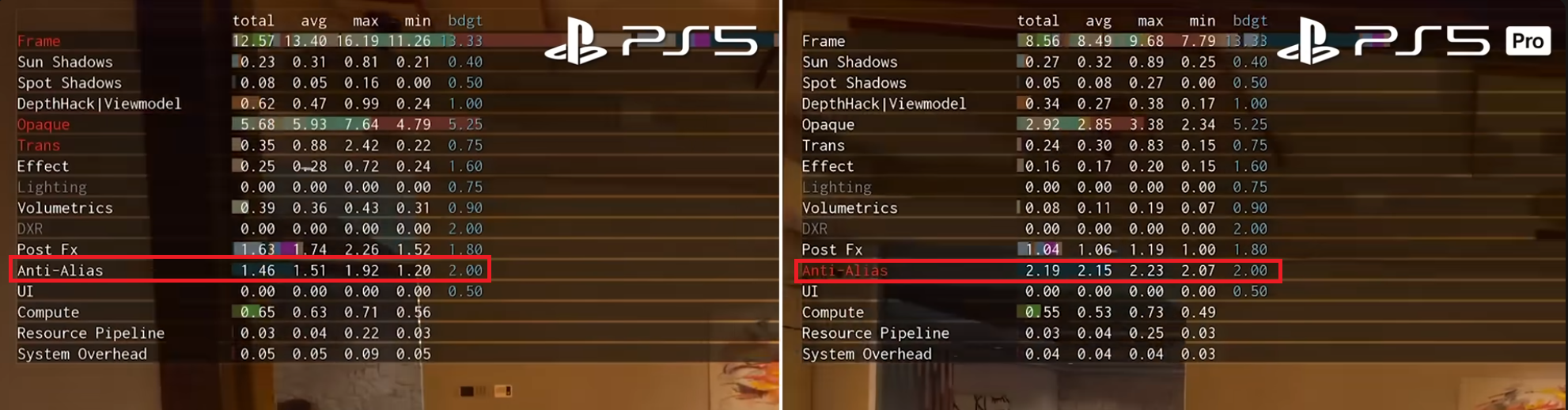
We have screenshots from developer builds confirming the 2ms cost:

RvMH9URg4btzboAD.png


PSSR is still slower than FSR:

B35xHd57x3CKfZk3.png


Much heavier vs TAA:

NbsVhJQvzoQEhOM6.png


cL239ja7Dd2xfWoD.png
 
Cerny stated that where exactly? And what calculations?

We have screenshots from developer builds confirming the 2ms cost:

RvMH9URg4btzboAD.png


PSSR is still slower than FSR:

B35xHd57x3CKfZk3.png


Much heavier vs TAA:

NbsVhJQvzoQEhOM6.png


cL239ja7Dd2xfWoD.png
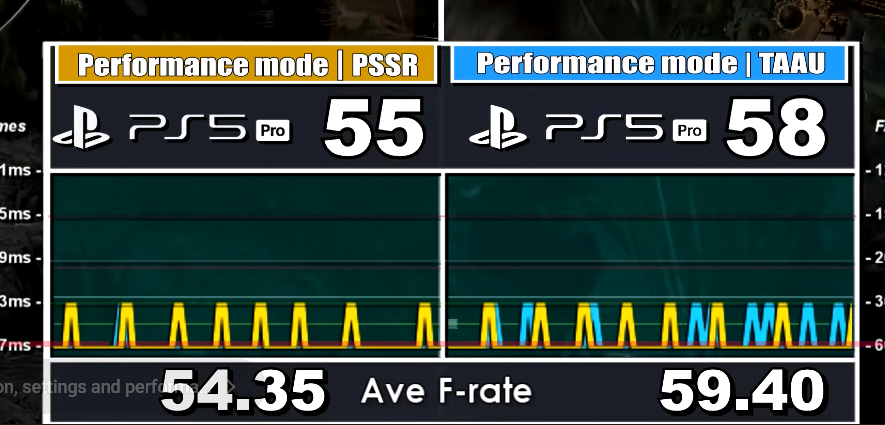
Compared to TAA / TSR and FSR2 in those titles and in motion, which has the best motion clarity and the least artefacts though? We are not talking about miles away in terms of costs there.
 
The reddit replies are saying there is nothing suggesting PSSR was even implemented in the game.

Yeah I'm so confused by this weird fizzle and strange look to the foliage and lights sometimes.

Does no one else have the issue? Lots of visual noise on foliage.
 
Compared to TAA / TSR and FSR2 in those titles and in motion, which has the best motion clarity and the least artefacts though? We are not talking about miles away in terms of costs there.
Oh, I agree, the visual gains are worth the slight drop in performance. That goes with any AI model over FSR/TAAU, be it PSSR, DLSS, FSR4, etc... I just don't see PSSR only having a cost of only 1ms. FSR2 is already over 1ms, and PSSR is heavier than that. The current model, that is.
 
The reddit replies are saying there is nothing suggesting PSSR was even implemented in the game.

Yeah I'm so confused by this weird fizzle and strange look to the foliage and lights sometimes.

Does no one else have the issue? Lots of visual noise on foliage.
It's been like that since day 1 for me (perf mode). There was always something "odd" to my eyes when driving around.
I could be wrong but I don't think it's PSSR.
 
Last edited:
GT7, run at native 4k/120fps disabling PSSR and RT. I don't think GT7 have a good RT implementation to sacrifice both FPS and resolution
Nah, keep the RT so the reflections are 60fps and not 30fps cubemaps of the base game. That is more jarring.

RT mode, PSSR off if you use bonnet or chase cam, PSSR on if you are strictly cockpit for the better interior lighting and reflections.

As for the SSR cubemaps, that is precisely why I said in the past devs get "lazy" when RT options are in their games. Remedy is guilty of this the most (with Control). They don't upgrade the rasterized effects, or even do any of them at all times like they used to (black solid PS2 level textures for office glass anyone?), and rely on (sometimes heavy) RT. Thankfully RT is not heavy in GT7, but there is no excuse why the cubemaps are 30fps still on the Pro other than "they can just toggle RT so why bother."
 
Last edited:
The full DLSS model literally cannot run on 27 INT8 TOPS at the required resolution and latency. Hence, no 60fps games use DLSS 3.7. This is why Nvidia had to design a downsized, low-capacity network for Switch. The hardware determines the maximum possible model size. That's not the case on PS5 Pro. PS5 Pro's 300 INT8 TOPS is enough to run a full-scale model, similar in size to what DLSS uses on PC.
you seem to think it's about some hard cutoff when it isn't. The 27 INT8 TOPs is enough to run a full scale model at 30fps correct? Meaning those 27 INT8 TOPS is enough to run that full scale model.
How does the "maximum possible model size" decrease or increase in this case when you switch to 60fps? It doesn't, it's not a hard cutoff like that. It's just a frametime cost to an upscaler based on a spectrum of different hardware configurations. PSSR was also specifically designed with the PS5 Pro limits. You keep mentioning 300TOPs but again this isn't a useful metric in determining frametime cost of an upscaler in a game. The game is using that theoretical max performance for other things in the game like raytracing and it's not able to use 300TOPs for upscaling. Based on that, all games should be seeing a difference in framerate proportional to the max FLOPS difference of PS5Pro vs PS5 too. You know that isn't the case because it is theoretical and you are limited by other things and what you use that power on improving. ie raytracing.


Yes, PS5 Pro games still have frametime budgets, ray tracing costs, etc. But that's a different type of constraint than what Switch faces.
It's the same constraint. Yes the model can improve too and it will but the PS5 Pro has the same constraints and its model was developed specifically for it. It's a little older but it was still built on hardware constraints and frametime budgets in games using the hardware available to it.
Frametime budgets restrict how fast a model can run, not how big the model is allowed to be. On Switch, tiny DLSS was created because the full model is physically not viable for all scenarios.
Not sure what you're getting at here but it doesn't make sense. Why is the full model "physically" not viable?
Define "physically" here because the full model physically can run on a switch 2 it just takes too much of the frametime budget/hardware to do it especially at 60fps, although there are games like SF6 that do even at 60. There is literally no difference to what you're describing, frametime budget (how fast a model runs) and "physical viability" are the exact same thing.
On PS5 Pro, PSSR is not facing issues because the hardware is the bottlenecks. The difference is PS5 Pro's constraints aren't forcing a reduced-capacity neural network, while Switch's constraints are. Hence, why comparing PSSR to tiny DLSS in terms of "both are limited by budgets" misses the key point, that one is a hardware-mandated downscaled model while the other is not.
so where does this so called "hardware mandate" not apply anymore? 67 TOPs, 90 TOPS, 100TOPS? Where does this "hardware-mandate" to downscale begin? There is no cutoff. Switch 2 can physically run full DLSS. Tiny DLSS only exists to try to meet framerate targets like any other hardware.

How would a hardware mandate to downscale even apply to PSSR, when it was designed specifically for that single hardware.

There is no "hardware-mandate", there are only frametime budgets in games and hardware power and they apply to both consoles. Yes the PS5 Pro is a lot more powerful than a Switch 2 but it faces the same frametime budget issues as I said just at a higher scale. ie 60/120fps games and higher settings/resolution/raytracing. The only difference is that these consoles usually have set performance targets and you can't have the upscaler increasing frametime by 4ms and dropping your framerate by 10%, 20% or whatever. This doesn't fly on consoles. Despite these decisions to try and maintain as low a cost as possible to frametime on these console upscalers we still had PS5 Pro modes that looked pretty good and ran at a lower framerate than the PS5 port and people obviously complained. On PC nobody really gives a shit about this frametime cost differences due to the sea of configuration differences and arbitrary framerates that people tweak on their own, but it exists on the same spectrum of hardware differences, not on a cutoff where a "hardware mandate" applies or doesn't.
 
Last edited:
you seem to think it's about some hard cutoff when it isn't. The 27 INT8 TOPs is enough to run a full scale model at 30fps correct? Meaning those 27 INT8 TOPS is enough to run that full scale model.
How does the "maximum possible model size" decrease or increase in this case when you switch to 60fps? It doesn't, it's not a hard cutoff like that. It's just a frametime cost to an upscaler based on a spectrum of different hardware configurations. PSSR was also specifically designed with the PS5 Pro limits. You keep mentioning 300TOPs but again this isn't a useful metric in determining frametime cost of an upscaler in a game. The game is using that theoretical max performance for other things in the game like raytracing and it's not able to use 300TOPs for upscaling. Based on that, all games should be seeing a difference in framerate proportional to the max FLOPS difference of PS5Pro vs PS5 too. You know that isn't the case because it is theoretical and you are limited by other things and what you use that power on improving. ie raytracing.

It's the same constraint. Yes the model can improve too and it will but the PS5 Pro has the same constraints and its model was developed specifically for it. It's a little older but it was still built on hardware constraints and frametime budgets in games using the hardware available to it.

Not sure what you're getting at here but it doesn't make sense. Why is the full model "physically" not viable?
Define "physically" here because the full model physically can run on a switch 2 it just takes too much of the frametime budget/hardware to do it especially at 60fps, although there are games like SF6 that do even at 60. There is literally no difference to what you're describing, frametime budget (how fast a model runs) and "physical viability" are the exact same thing.

so where does this so called "hardware mandate" not apply anymore? 67 TOPs, 90 TOPS, 100TOPS? Where does this "hardware-mandate" to downscale begin? There is no cutoff. Switch 2 can physically run full DLSS. Tiny DLSS only exists to try to meet framerate targets like any other hardware.

How would a hardware mandate to downscale even apply to PSSR, when it was designed specifically for that single hardware.

There is no "hardware-mandate", there are only frametime budgets in games and hardware power and they apply to both consoles. Yes the PS5 Pro is a lot more powerful than a Switch 2 but it faces the same frametime budget issues as I said just at a higher scale. ie 60/120fps games and higher settings/resolution/raytracing. The only difference is that these consoles usually have set performance targets and you can't have the upscaler increasing frametime by 4ms and dropping your framerate by 10%, 20% or whatever. This doesn't fly on consoles. Despite these decisions to try and maintain as low a cost as possible to frametime on these console upscalers we still had PS5 Pro modes that looked pretty good and ran at a lower framerate than the PS5 port and people obviously complained. On PC nobody really gives a shit about this frametime cost differences due to the sea of configuration differences and arbitrary framerates that people tweak on their own, but it exists on the same spectrum of hardware differences, not on a cutoff where a "hardware mandate" applies or doesn't.
I'm not sure how much simpler this can be. Tiny DLSS is limited so that it can run on only ~27 TOPS of INT8 compute, especially in 60 fps games. That's why its image quality is worse. Something had got to give. PSSR's issues on PS5 Pro are not because the hardware is weak, the Pro has over 300 TOPS. The noise/artifacts people sometimes see are just early-model or training issues, not hardware limits.
 
Nah, keep the RT so the reflections are 60fps and not 30fps cubemaps of the base game. That is more jarring.

RT mode, PSSR off if you use bonnet or chase cam, PSSR on if you are strictly cockpit for the better interior lighting and reflections.

As for the SSR cubemaps, that is precisely why I said in the past devs get "lazy" when RT options are in their games. Remedy is guilty of this the most (with Control). They don't upgrade the rasterized effects, or even do any of them at all times like they used to (black solid PS2 level textures for office glass anyone?), and rely on (sometimes heavy) RT. Thankfully RT is not heavy in GT7, but there is no excuse why the cubemaps are 30fps still on the Pro other than "they can just toggle RT so why bother."
I play strictly on cockpit view and the RT mode was simply not worth it atm. With PSSR on, it boils too much, the jaggies on the road side details are quite visible and distracting AND the LoD is scaled back so there is noticeable pop-in. And without PSSR, the RT doesn't do much at all in cockpit mode, but still causes LoD to be scaled back.

Until 2.0 fixes all of those (hopefully), I just couldn't be bothered. Been playing with both RT off and PSSR off, which is basically the base version.

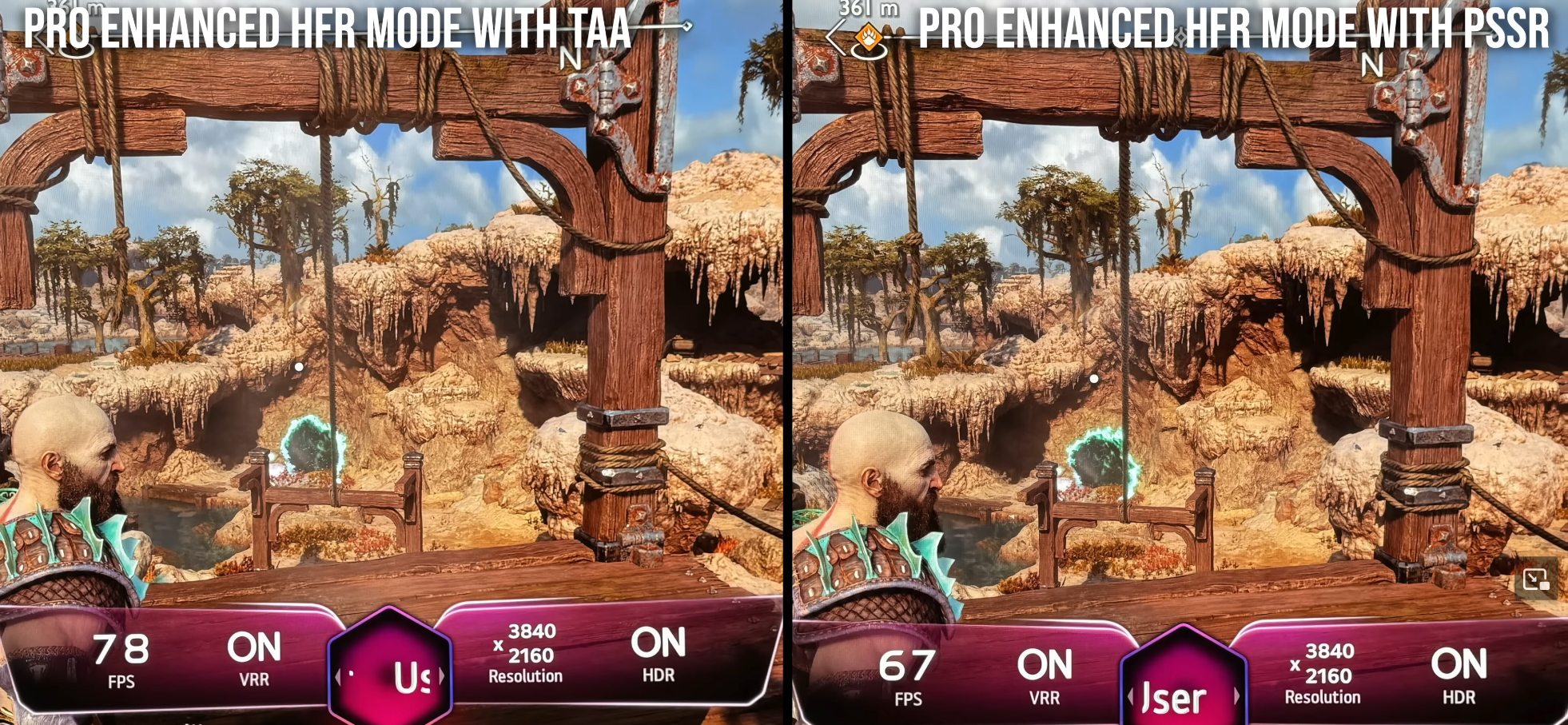
GoW:R was the other disappointing update for me. For all the hype it got after the update, it actually drops below 60 with PSSR on. Had to turn it back to TAA
 
Last edited:
Top Bottom