I think this is my first actual movie post in one of these threads. I'll try to make it a habit just to stay game for this year's challenges. I still haven't decided if I'm doing 50 or 500 films.

Anyway, I started the year with And Then There Were None (1945)
Ten strangers are brought to an island mansion, and one after another, they're murdered. The dwindling survivors each wonder who the asshole is. (An adaptation of Agatha Christie's "Ten Little Indians.")
It's an overall straightforward and cliche whodunnit. The only peculiar thing here is how effective it is—especially in regard to the cast. You'll want to believe that each guest is both innocent AND guilty of the killing the others. It helps that the script and the camera both favor the mystery rather than the grisly killings (which mostly occur just offscreen). The result is that the film gets better as the cast dies off, and the drama heightens in a way that similar films almost never manage. Pretty good!

The Agony and the Ecstasy
Charles Heston plays another suffering believer, Michelangelo, as Pope Julius II suckers him into painting the Sistine Chapel. (Adapted from the Irving Stone novel)
I've been putting this film off for years and years, only because I love "artist movies" and I've exhausted most of the classics. I finally watched it to get fired up for the new year.
I enjoyed it of course, but I wasn't sure that I had until the end.
Agony's trouble is that there's not a single meaningful supporting character. My preference is usually for a small cast, but a pseudo-epic needs texture, and Agony has none (save for Michelangelo's silly "love interest"—a thread that mercifully goes nowhere). As a result, Agony's main course—the love-hate relationship between Michelangelo and the Pope—is left alone to endure a full 2+ hours, so their passive-aggressive bitchfest cycles over a few times too many. It's nevertheless the best part of the film, and it reaches a nice enough place by the end that I forgive the whole damn thing. I also forgive most of the historical exaggerations, because I'm already close with the history, and I realize that this is a fucking movie.
The photography let me down a bit; 1965 is about the time that color design went south. But the production design within the chapel was well-executed, and it was nice to think of those frescos before they were irrevocably ruined by the "restoration."
Overall, I'm biased, but I thought it was pretty good.

Good shit all around. But this week's winner is Black Sunday (1960)
A dead witch with holes in her face torments a family of aristocrats at their castle in scenic Italy. (Adapted from Gogol)
This is my first Mario Bava film, and I think also my first Italian horror. And a fine place to start, because LORD! Does Bava know how to stage a beautiful image. He's a truly visual director, similar to von Sternberg in his obsessive cinematograpy.
Like Sternberg, he takes crazy shapes and textures, lights them just enough to give them form, but still keeps them organized by value. Then he puts them into action with (or against) the interest of the shot. His values aren't as painterly as von Sternberg's, but this only means that everything looks sharp and wicked in the contrast. They're equally rich.
THIS is how you make a low budget look generous:

Set Designer: "I did the best I could, Mr. Bava. We only had like ₤10."
Bava: (laughs) "₤9 too many:"
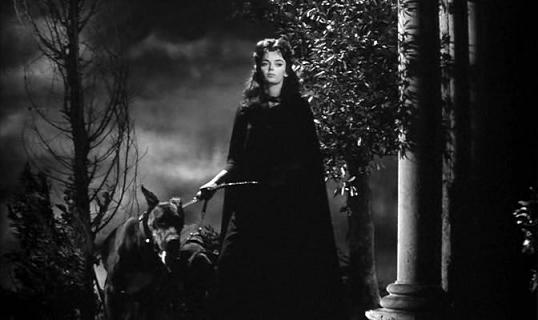

Bava could sell you a backwards photograph of your own SHIT.
Seeing the way he lights a face, or frames a coffin, or puts distance between a tree and a grave, it makes me want to draw on my walls with charcoal. It's almost arousing like a good painting, and I have to bite my lip and smile because I can tell Bava's getting excited by the same things. He's just a guy who's eager tell the world what he's in love with.
What's more, it's amazing that he shows any restraint at all when he has what I call the "horny eye." Lots of directors even without horny eyes will shoot too much, but Bava only shoots what he has to. The way he gets off is by staging a mood to match the scene, and by the preciousness of how he does it, you can tell that he's turning himself on. There are several types of horny eyes, but Bava's in particular are perfect for scenic horror.
He's my kind of guy.
I really hope Bava's other films share these aesthetics, because I'm lining them up on Netflix. Black Sabbath is next. I want to see how horny Bava gets with color!
EDIT: the movie itself was pretty great too
EDIT 2: letterboxd is fun
Anyway, I started the year with And Then There Were None (1945)
Ten strangers are brought to an island mansion, and one after another, they're murdered. The dwindling survivors each wonder who the asshole is. (An adaptation of Agatha Christie's "Ten Little Indians.")
It's an overall straightforward and cliche whodunnit. The only peculiar thing here is how effective it is—especially in regard to the cast. You'll want to believe that each guest is both innocent AND guilty of the killing the others. It helps that the script and the camera both favor the mystery rather than the grisly killings (which mostly occur just offscreen). The result is that the film gets better as the cast dies off, and the drama heightens in a way that similar films almost never manage. Pretty good!
The Agony and the Ecstasy
Charles Heston plays another suffering believer, Michelangelo, as Pope Julius II suckers him into painting the Sistine Chapel. (Adapted from the Irving Stone novel)
I've been putting this film off for years and years, only because I love "artist movies" and I've exhausted most of the classics. I finally watched it to get fired up for the new year.
I enjoyed it of course, but I wasn't sure that I had until the end.
Agony's trouble is that there's not a single meaningful supporting character. My preference is usually for a small cast, but a pseudo-epic needs texture, and Agony has none (save for Michelangelo's silly "love interest"—a thread that mercifully goes nowhere). As a result, Agony's main course—the love-hate relationship between Michelangelo and the Pope—is left alone to endure a full 2+ hours, so their passive-aggressive bitchfest cycles over a few times too many. It's nevertheless the best part of the film, and it reaches a nice enough place by the end that I forgive the whole damn thing. I also forgive most of the historical exaggerations, because I'm already close with the history, and I realize that this is a fucking movie.
The photography let me down a bit; 1965 is about the time that color design went south. But the production design within the chapel was well-executed, and it was nice to think of those frescos before they were irrevocably ruined by the "restoration."
Overall, I'm biased, but I thought it was pretty good.
Good shit all around. But this week's winner is Black Sunday (1960)
A dead witch with holes in her face torments a family of aristocrats at their castle in scenic Italy. (Adapted from Gogol)
This is my first Mario Bava film, and I think also my first Italian horror. And a fine place to start, because LORD! Does Bava know how to stage a beautiful image. He's a truly visual director, similar to von Sternberg in his obsessive cinematograpy.
Like Sternberg, he takes crazy shapes and textures, lights them just enough to give them form, but still keeps them organized by value. Then he puts them into action with (or against) the interest of the shot. His values aren't as painterly as von Sternberg's, but this only means that everything looks sharp and wicked in the contrast. They're equally rich.
THIS is how you make a low budget look generous:
Set Designer: "I did the best I could, Mr. Bava. We only had like ₤10."
Bava: (laughs) "₤9 too many:"
Bava could sell you a backwards photograph of your own SHIT.
Seeing the way he lights a face, or frames a coffin, or puts distance between a tree and a grave, it makes me want to draw on my walls with charcoal. It's almost arousing like a good painting, and I have to bite my lip and smile because I can tell Bava's getting excited by the same things. He's just a guy who's eager tell the world what he's in love with.
What's more, it's amazing that he shows any restraint at all when he has what I call the "horny eye." Lots of directors even without horny eyes will shoot too much, but Bava only shoots what he has to. The way he gets off is by staging a mood to match the scene, and by the preciousness of how he does it, you can tell that he's turning himself on. There are several types of horny eyes, but Bava's in particular are perfect for scenic horror.
He's my kind of guy.
I really hope Bava's other films share these aesthetics, because I'm lining them up on Netflix. Black Sabbath is next. I want to see how horny Bava gets with color!
EDIT: the movie itself was pretty great too
EDIT 2: letterboxd is fun


 ) and I agree with him on that film.