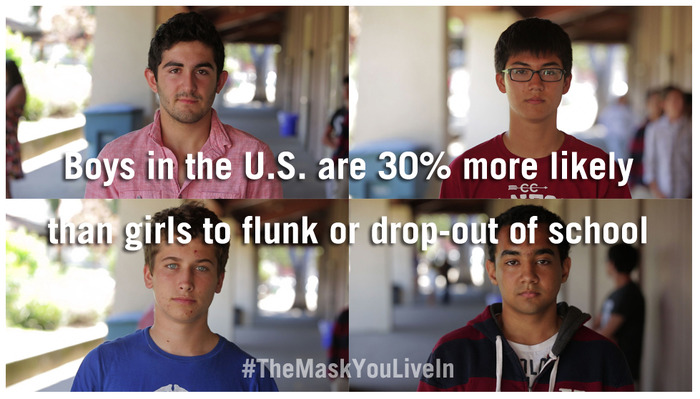
Compared to girls, research shows that boys in the U.S. are more likely to be diagnosed with a behavior disorder, prescribed stimulant medications, fail out of school, binge drink, commit a violent crime, and/or take their own lives.
Jennifer Siebel Newsom's new documentary film, The Mask You Live In, asks: As a society, how are we failing our boys?
Why This Film Matters
At a young age, boys learn that to express compassion or empathy is to show weakness. They hear confusing messages that force them to repress their emotions, establish hierarchies, and constantly prove their masculinity. They often feel compelled to abide by a rigid code of conduct that affects their relationships, narrows their definition of success and, in some cases, leads to acts of violence resulting in what many researchers call a boy crisis. Our societys failure to recognize and care for the social and emotional well-being of our boys contributes to a nation of young men who navigate adversity and conflict with an incomplete emotional skill set. Whether boys and later men have chosen to resist or conform to this masculine norm, there is loneliness, anxiety, and pain.
The Mask You Live In documentary will examine how gender stereotypes are interconnected with race, class, and circumstance, and how kids are further influenced by the education system, sports culture, and mass media- video games and pornography in particular. The film also highlights the importance of placing emphasis on the social and emotional needs of boys through healthy family communication, alternative teaching strategies, conscious media consumption, positive role modeling and innovative mentorship programs.
Our Goal
To make a film that sparks a national conversation around masculinity and ultimately creates a more balanced, equitable society for all.
The Mask You Live In film will target youth, families, caregivers, coaches, and mental health professionals. But we are confident the film will speak to the masses.
Our previous film, Miss Representation, has proven that there is demand for this kind of storytelling. Further, weve seen the impact that documentary filmmaking, accompanied by social action campaigns, can have in shifting consciousness, changing behavior, and ultimately transforming culture. As a result, we are confident in our ability to do it again with The Mask You Live In documentary. But we need your help.