...... Spherical Harmonics Lighting Support
.
Cold Shadow:
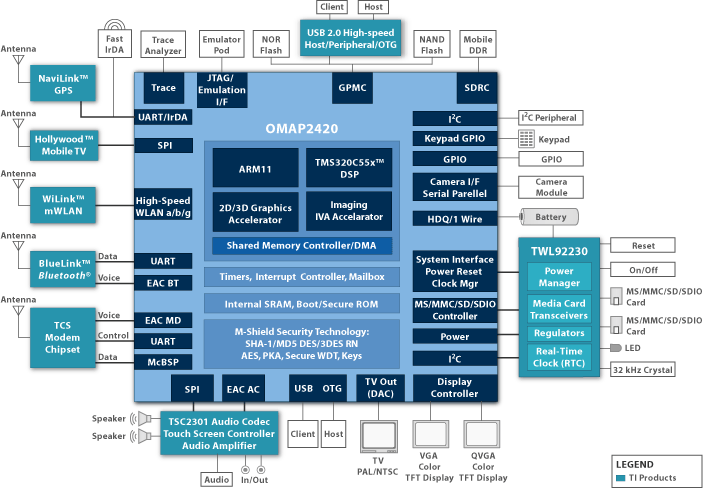
Full OMAP compatibility means that Nokia could make this compatible with N-Gage1 games as well as games for other systems based on any derivative of this technology.
It's a processing system that fits on a single chip and has been around for about a year (the graphics core has been around even longer), so it's not going to be too expensive to manufacture.
Its precision when rendering will reduce the amount of color dithering and banding sometimes seen in games. This won't make a huge difference, but it will make an appreciably noticeable one at times.
The graphics will have extra smoothness/definition to them because the system can make supersampling FSAA standard in all games. The difference will again be nice but not life changing.
It supports the necessary math for lighting effects where some textures can look bumpy or highly 3D detailed:
The abrupt changes in blurriness of textures going out into the distance will occasionally be eliminated in games that use the anisotropic texture filtering.
The system's programmability makes it flexible for complex animation and graphical looks:
It supports curved surfaces which can help mobile platforms store complex objects without using a lot of memory, and it can render them without glitches forming when changing the scene or manipulating them:
Polygon counts will be noticeably lower than Dreamcast, but way above the Saturn/PS/N64 generation:
Ultimately, the graphics will look as bad or as good as the level of development support the machine gets. As it is, it won't compare closely to the PSP because it won't get as much premier support.
gofreak:
That's a meaty chip, right?
It's stronger than the Lite implementations of MBX, but it's not as robust as some of the Renesas chips which actually compare well against this generation's home consoles.
neptunes:
Similar to the dreamcast?
They share some of the same kind of technology, but they're not exactly the same in performance.
xexex:
the actual fillrate of 360Mpixels is lower than that of PSP: 664Mpixels. but with 2x overdraw the PowerVR MBX in Ngage 2 is higher.
The average overdraw for Quake III: Arena was a little over 3. A custom Dreamcast game tended to have similar and even somewhat higher overdraw than that.
Shompola:
It also has the co T&L chipset on that MBX link? This chipset is closer to what naomi 2 offers than Dreamcast.
Feature wise, this platform is beyond both the PowerVR Series 2 Dreamcast and the Series 2 Naomi2, as MBX was actually based from the next generation after those. It does come with a geometry engine like Naomi2, though, but with more flexibility for skinning, skeletal animation, etc and not nearly as much T&L speed as Naomi2's 10M-tri/sec & 6 full lights.
COCKLES:
NGAGE should have been a standard, not a machine in itself.
With OMAP2 available to multiple manufacturers and new price/battery sensitive OMAP2 scaled chips on the way, it might be possible for the game platform to span several manufacturers' devices.