
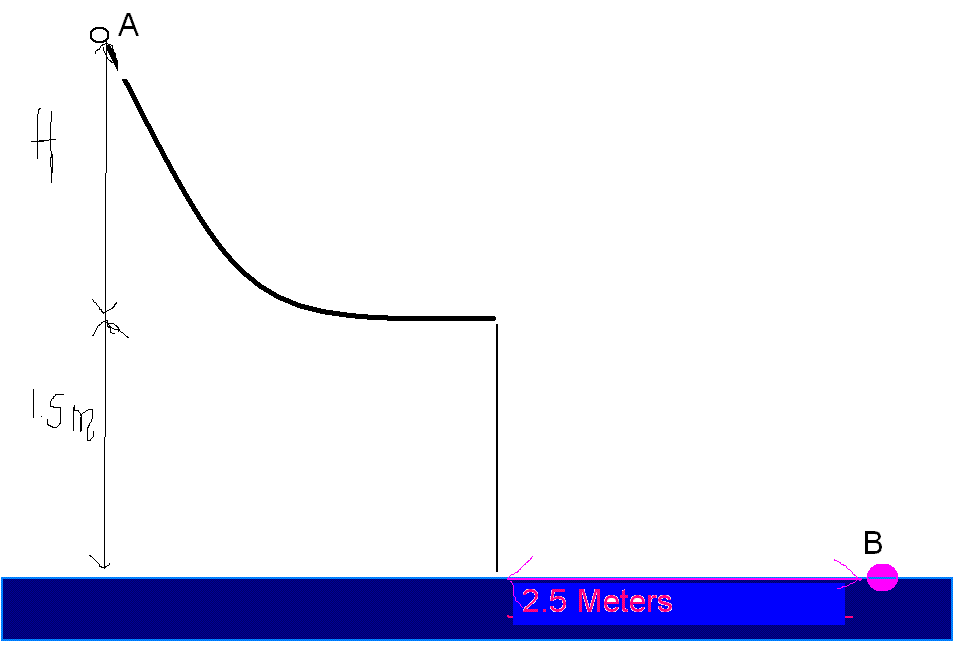
So, the story is, that crude drawing I made is supposed to be a waterslide. It ends at a height 1.5 meters above a swimming pool. A person who starts on the slide at point A is initially at rest, and hits the pool at point B, 2.5 meters horizontally from the edge of the water slide. Assuming the water slide is frictionless, I'm supposed to find h, the height of the waterslide.
m = mass of the person
g = acceleration due to gravity
height above the pool = 1.5 + h
v(e) = velocity at the end of the water slide
v(f) = velocity when the person hits the pool at point B
According to the Law of Conservation, I know the following holds true
mg(1.5 + h) = .5m[v(e)^2] + 1.5mg = .5m[v(f)^2]
But I have NO clue how to find h. I know it'll probably involve setting one of the above equal to Work, which is equal to Force * displacement, but there's far too many unknowns for me to know what to do. I know I can eliminate m from the equation since every part has the m variable, but I'm still stuck. Can anyone help?
