
• Hey Guest. Check out your NeoGAF Wrapped 2025 results here!

Quick Physics Question (Energy, Work, Power, Conservation of Energy)

Status
Not open for further replies.

GaimeGuy

Volunteer Deputy Campaign Director, Obama for America '16
Physics.gif


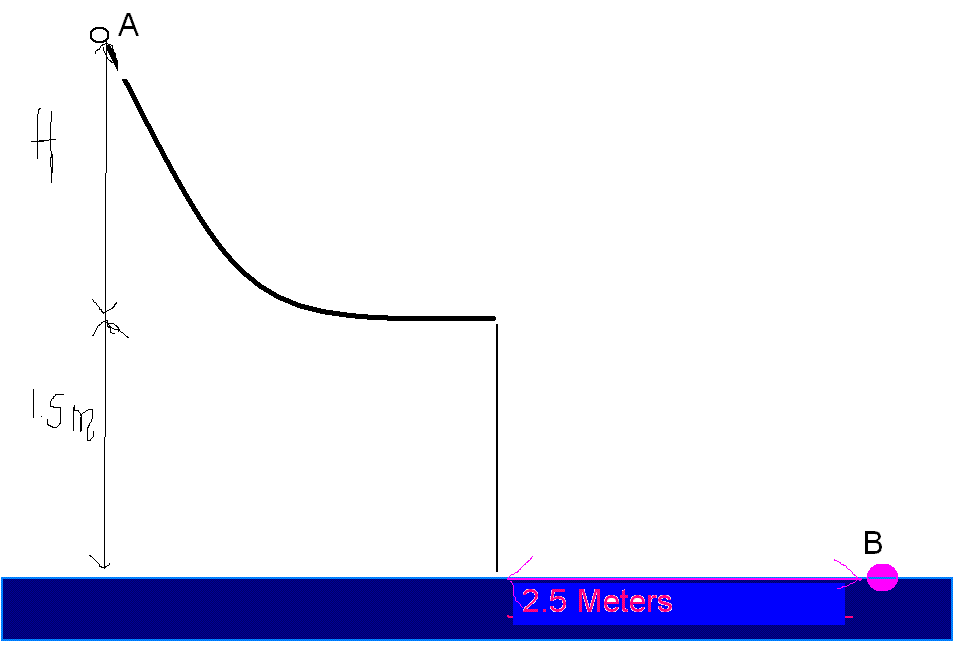
So, the story is, that crude drawing I made is supposed to be a waterslide. It ends at a height 1.5 meters above a swimming pool. A person who starts on the slide at point A is initially at rest, and hits the pool at point B, 2.5 meters horizontally from the edge of the water slide. Assuming the water slide is frictionless, I'm supposed to find h, the height of the waterslide.


m = mass of the person
g = acceleration due to gravity
height above the pool = 1.5 + h
v(e) = velocity at the end of the water slide
v(f) = velocity when the person hits the pool at point B

According to the Law of Conservation, I know the following holds true

mg(1.5 + h) = .5m[v(e)^2] + 1.5mg = .5m[v(f)^2]

But I have NO clue how to find h. I know it'll probably involve setting one of the above equal to Work, which is equal to Force * displacement, but there's far too many unknowns for me to know what to do. I know I can eliminate m from the equation since every part has the m variable, but I'm still stuck. Can anyone help?
 
find the horiztonal velocity to make it go 2.5 meters while dropping 1.5 meters only due to gravity. When it comes off the slide, it will only have horizontal velocity. Once you find that, you can do potential energy at top of slide = kinetic energy at bottom of slide.

PS. Can someone make Matlock change that atrocious avatar?
 
Trident said:
find the horiztonal velocity to make it go 2.5 meters while dropping 1.5 meters only due to gravity. When it comes off the slide, it will only have horizontal velocity. Once you find that, you can do potential energy at top of slide = kinetic energy at bottom of slide.
it still have potential energy at the bottom of the slide? Is it ok to use the bottom of the slide as the zero level since no calculations have been made involving the work and ener
PS. Can someone make Matlock change that atrocious avatar?
Hmm... your post makes sense, but doesnt' gy variables?

Edit: NM, I see what you mean.

Edit 2: Got it. 1.04 meters. Thanks for the help.
 
Trident said:
find the horiztonal velocity to make it go 2.5 meters while dropping 1.5 meters only due to gravity. When it comes off the slide, it will only have horizontal velocity. Once you find that, you can do potential energy at top of slide = kinetic energy at bottom of slide.

PS. Can someone make Matlock change that atrocious avatar?

QFT

Don't use that fucking monstrosity of an equation you have up there.

You only have potential energy at the start of the whole ordeal correct? Let's call this mghmax

At the point where the... whatever the fuck that is... flies off the slide, the energy = mgh-slide + 1/2mv², right? Which is mg(1.5) + 1/2mv².

Calculate the time it takes for the thing to hit the ground, assume it's an object in freefall from the h= 1.5m Of course, use your choice of the basic kinematic formulas

v² = vo² + 2*a (y)
y = yo + vo*t + 1/2 a*t²
v = vo + at

I forget the other one.

After you get the time you can figure out xo as the thing flies off the slide.

that is your velocity for 1/2m*v² + mg(1.5).

Remember that 1/2m*v² + mg(1.5) = mgh-max.

m cancels out.

1/2v² + g(1.5) = gh-max. Solve for h-max.

Edit: DAMMIT
 
I knew there was some concept I was missing, and that was the Vx = V at the end of the slide. It's been a few weeks since I used those formulas involving projectiles. :lol
 
GaimeGuy said:
Hmm... your post makes sense, but doesnt' gy variables?

Edit: NM, I see what you mean.

Edit 2: Got it. 1.04 meters. Thanks for the help.

No problem. Now if you have any control over Matlock's avatar...
 
Status
Not open for further replies.
Top Bottom