• Hey Guest. Check out your NeoGAF Wrapped 2025 results here!

Scottish Independence Referendum |OT| 18 September 2014 [Up: NO wins]

Where do you stand on the issue of Scottish independence?


Results are only viewable after voting.
Status
Not open for further replies.
Doing a wee bit of study today to firm up my voting intention.

One thing I'm surprised hasn't come up more is that as per the ONS's own figures when allocated a geographical share of it's oil and gas revenue Scotland has actually ran a surplus over the last 32 years (as far back as the ONS's records goes). Of course it's been in running a deficit since 2002 but one far less than the UK average.

NOq7Jh.jpg


That puts a slightly different spin on the notion of accepting the debt.

Is 1980 just an arbitrary starting date for this analysis? Edit: Sorry, I see it's when the ONS figures start. My point was really that this is a very short-term consideration when the Union has lasted 300+ years.
 
Doing a wee bit of study today to firm up my voting intention.

One thing I'm surprised hasn't come up more is that as per the ONS's own figures when allocated a geographical share of it's oil and gas revenue Scotland has actually ran a surplus over the last 32 years (as far back as the ONS's records goes). Of course it's been in running a deficit since 2002 but one far less than the UK average.

NOq7Jh.jpg


That puts a slightly different spin on the notion of accepting the debt.


Saw this linked on Reddit; was an inset on the Daily Record:
http://imgur.com/d6ty5eD

Which of course references this:
http://www.independent.co.uk/news/u...-oil-and-the-betrayal-of-scotland-518697.html
 
The entire counting process is likely very different to here in Germany. So that might be why I have a misconception about how it is done in the UK.
The one time I helped in the counting and election process we were done in 30 minutes, declared so for our area of town and called it a day. That happens all over at the same time. There are always areas that don't get their shit together and take all night. Nevertheless the results start coming in and are published within 15 Minutes of the polls closing.
 
The entire counting process is likely very different to here in Germany. So that might be why I have a misconception about how it is done in the UK.
The one time I helped in the counting and election process we were done in 30 minutes, declared so for our area of town and called it a day. That happens all over at the same time. There are always areas that don't get their shit together and take all night. Nevertheless the results start coming in and are published within 15 Minutes of the polls closing.

You are German. Anything you Germans do it takes us British 10 times longer to do.
 
How are the results going to be announced? Will it be like election night? Will it just be a simple yes/no announcement?

Any advice? I'd like to follow it through live and maybe take the next day off work

From what I've seen (because I want to work from home on Friday to follow this).. the first results should be in by 1am, and the overall result should be known at around 7am.

However, I suspect there will be drama and recounts. But it will be an all-nighter given some geographical considerations to be made re ballot boxes.
 
Yes, and a system can compensate to a degree for asymmetrical geographic distributions, as is done in Norway and other Scandanvian countries to a degree. Again, go up to Wick in the north, you will somewhere as degraded, depressing as anywhere in England. You make it seem as a given, but providing worse services in more geographically isolated places is a choice, sure and economically sound choice, but a choice nonetheless. Technical capacity is there to provide excellent services even at the periphery. That should be the aim, to maximise the benefits of modern technology to integrate even outlying regions.

I'm always torn on this issue. On the one hand, you're right, public services should be about need and we should mitigate things like geography as much as possible. On the other hand, there are benefits and drawbacks to wherever you live, and that's sort of part of the choice on where one lives. Even within tiny areas like just taking the middle of London into account (and I say that due to my familiarity - I'm sure it's the case everywhere), the places you can get with the same money near tube stations are so much smaller than those that are relatively out of the way. You just get far more for your money. This is obviously also true nationally - deliveries and broadband might not be so good, but you can get much nicer, larger housing for less money than more well connected areas. Generally speaking, housing - whether it's rent or a mortgage - is one of the single largest outgoings of a families budget (behind tax obviously, trololol) so this is a huge equaliser in that respect; The solution to the problem of poor infrastructure in rural or far-flung parts of a country involve taking tax money from those that pay far more for their housing to make the lives of those who pay far less for their housing better. In short, to what extent should the people of Edinburgh be willing to put up with higher housing costs and higher taxes to subsidise those who live in cheaper areas?

Like I said, I'm torn on the issue.

 
The entire counting process is likely very different to here in Germany. So that might be why I have a misconception about how it is done in the UK.
The one time I helped in the counting and election process we were done in 30 minutes, declared so for our area of town and called it a day. That happens all over at the same time. There are always areas that don't get their shit together and take all night. Nevertheless the results start coming in and are published within 15 Minutes of the polls closing.
Oh man, we need to introduce you to Tower Hamlets.
 
I'm always torn on this issue. On the one hand, you're right, public services should be about need and we should mitigate things like geography as much as possible. On the other hand, there are benefits and drawbacks to wherever you live, and that's sort of part of the choice on where one lives. Even within tiny areas like just taking the middle of London into account (and I say that due to my familiarity - I'm sure it's the case everywhere), the places you can get with the same money near tube stations are so much smaller than those that are relatively out of the way. You just get far more for your money. This is obviously also true nationally - deliveries and broadband might not be so good, but you can get much nicer, larger housing for less money than more well connected areas. Generally speaking, housing - whether it's rent or a mortgage - is one of the single largest outgoings of a families budget (behind tax obviously, trololol) so this is a huge equaliser in that respect; The solution to the problem of poor infrastructure in rural or far-flung parts of a country involve taking tax money from those that pay far more for their housing to make the lives of those who pay far less for their housing better. In short, to what extent should the people of Edinburgh be willing to put up with higher housing costs and higher taxes to subsidise those who live in cheaper areas?

Like I said, I'm torn on the issue.
Hmm, isn't the whole point of globalisation to overcome geographical barriers? This should be considered part of the process. I don't mean make all the country into a kind of suburbia - far, far from it. Rather give people in rural areas high quality services to make them feel more integrated into wider society and make living in rural areas more attractive. Young people leave ruralities mainly for jobs and education, but also because they perceive countryside regions as backwards. It doesn't need to be so. But I think this is part of a much bigger discussion, which also pertains to the greater process of centralisationa and urbanisation.
 
Hmm, isn't the whole point of globalisation to overcome geographical barriers? This should be considered part of the process. I don't mean make all the country into a kind of suburbia - far, far from it. Rather give people in rural areas high quality services to make them feel more integrated into wider society and make living in rural areas more attractive. Young people leave ruralities mainly for jobs and education, but also because they perceive countryside regions as backwards. It doesn't need to be so. But I think this is part of a much bigger discussion, which also pertains to the greater process of centralisationa and urbanisation.

Sure, but inarguably the flip side of that goal - delivering rural areas high quality services - is the goal of giving inner city areas access to high quality housing. Both are lacking, and one isn't obviously a more significant problem than the other, I think. Both could benefit from government subsidy (and that's basically what better quality services are - a subsidy to help overcome the geography of an area) so I'm not entirely convinced that either one demonstrates a lack of action or care from the relevant governments.
 
Also, being English I'm going to Center Parcs this weekend, which will really fuck up my ability to keep up with the coverage on thursday evening. I *am* off work on Friday, as a result, but I'll be cycling and going in the Subtropical Swimming Paradise™ all day so I need my rest.

So inconvenient.

Who gives a shit? You're in the Subtropical Swimming Paradise™. Time folds in itself on the White Water Rapids.
 
As an Englishman who has supported Scottish independence since I learned of the West Lothian question when studying politics at 16 I can only give all my hope to Yes winning. Both nations will be better for it.
 
So why wasn't an English Parliament established when the devolution train started rolling?

It seems like it would have been a no-brainer.

Because nothing was devolved to England (and different things were devolved to Scotland, Wales and NI too - they're all different). Plus, England being such a huge part of the Union, there's just never been any clamouring for English Independence or an English parliament. The unofficial policy of the three major parties with regards to the West Lothian Question has always been "don't talk about it". This vote, whatever it's outcome and even whatever the margin, was always going to make that policy untenable, so we'll see what the proposed solutions end up being from the various parties. There's an Election between now and any possibly future independent Scotland, so I imagine that an answer to the WLQ will form a part of the manifestos, again, irrespective of Thursday's result.
 
So why wasn't an English Parliament established when the devolution train started rolling?

It seems like it would have been a no-brainer.

The English already have essentially have their own parliament by sheer virtue of numbers so there's never been a real pressing need for one from their point of view.
Ultimately once devolution to NI, Wales and Scotland occurred then it's either federalisation or eventual breakup. The current system cannot accommodate second class MP's which is the only way to keep the status quo. The big issue is how you accommodate federalisation if there's ever a desire for it with a monarchy, the easy way around democratising a federal system is to make the head of state and elected president who is the executive for the federal government. If you have to elect a federal executive then frankly having a monarch is an even bigger waste of money than it currently is.
 
Because nothing was devolved to England (and different things were devolved to Scotland, Wales and NI too - they're all different). Plus, England being such a huge part of the Union, there's just never been any clamouring for English Independence or an English parliament. The unofficial policy of the three major parties with regards to the West Lothian Question has always been "don't talk about it". This vote, whatever it's outcome and even whatever the margin, was always going to make that policy untenable, so we'll see what the proposed solutions end up being from the various parties. There's an Election between now and any possibly future independent Scotland, so I imagine that an answer to the WLQ will form a part of the manifestos, again, irrespective of Thursday's result.
The English already have essentially have their own parliament by sheer virtue of numbers so there's never been a real pressing need for one from their point of view.
Ultimately once devolution to NI, Wales and Scotland occurred then it's either federalisation or eventual breakup. The current system cannot accommodate second class MP's which is the only way to keep the status quo. The big issue is how you accommodate federalisation if there's ever a desire for it with a monarchy, the easy way around democratising a federal system is to make the head of state and elected president who is the executive for the federal government. If you have to elect a federal executive then frankly having a monarch is an even bigger waste of money than it currently is.

Gotcha.

I definitely think the UK would benefit from a more straightforward federalist system. Granted, our American federalist system isn't without flaws - there are pretty huge disparities between states because of ass-backward states (almost all conservative) that gleefully fuck over their own citizens - but at least it's pretty clear what powers are given to each state, and the powers are relatively uniform from state to state.

That said, a federalist system would probably work better in the UK if England were carved up into a handful of different "states." Perhaps England could become more of a ceremonial jurisdiction made up of several regional governments.
 
Gotcha.

I definitely think the UK would benefit from a more straightforward federalist system. Granted, our American federalist system isn't without flaws - there are pretty huge disparities between states because of ass-backward states (almost all conservative) that gleefully fuck over their own citizens - but at least it's pretty clear what powers are given to each state, and the powers are relatively uniform from state to state.

That said, a federalist system would probably work better in the UK if England were carved up into a handful of different "states." Perhaps England could become more of a ceremonial jurisdiction.

There are 9 English regions as defined by central government for reporting purposes, those could be used I suppose but it would be a horrible kludge. Add that to the 3 other 'regions' and it would give you 12.

Each 'region' could elect 2 representatives to a federal parliament, with the leader of the executive decided by direct vote. But that wouldn't really deal with the different population numbers in each region (the us congress kind of does while the senate ensures that the most populous states don't control the whole shebang), but I don't see how anyone could justify 12 regional parliaments + a federal lower and upper house + executive + monarch. That just seems like a recipe for creating politicians who are generally held in low esteem in this country.
 
There are 9 English regions as defined by central government for reporting purposes, those could be used I suppose but it would be a horrible kludge. Add that to the 3 other 'regions' and it would give you 12.

Each 'region' could elect 2 representatives to a federal parliament, with the leader of the executive decided by direct vote. But that wouldn't really deal with the different population numbers in each region (the us congress kind of does while the senate ensures that the most populous states don't control the whole shebang), but I don't see how anyone could justify 12 regional parliaments + a federal lower and upper house + executive + monarch. That just seems like a recipe for creating politicians who are generally held in low esteem in this country.


Indeed. There is little appetite in England
(outside of Cornwall perhaps, with it's own national minority)
for splitting up the English polity in that way.
 
Don't say that, I can imagine Yorkshire would push for independence.

(I know there's more Northern places, but... Yorkshire would.)

Most people have forgotten already, but we had a referendum for a Yorkshire parliament.

The general consensus was that while we'd like teh Tories to stop treating us like servants, scroungers and simpletons, the downside of having another parliament of politicians more politicians outweighed any benefits.
There was no sense of what powers would get devolved. It's be little more than diverting some public spending from existing quangos to a new parliament. Maybe there's be enough funds to put up some signs around Ilkley Moor to tell people to wear hats. They wouldn't even get started on solving the trouble at mill.
I was surprised that there was over 70% No voters on a 50% turnout, since you'd expect the people who turn up to vote to be biased towards those wanting change.

Of course, back in my day we had to walk all the way to the polling station, in the driving rain, uphill both ways, and if Westminster demanded the sacrifice of only our first-born sons then we'd thank Christ for his heavenly mercy. But you try telling that to these Scotsmen...
 
Speaking as an Irish person I find it somewhat odd that almost all of the discussion in the last 5 or so pages of this thread is centred around economic/geopolitical ramifications of an independence vote. I understand that the nationalist argument is a major player among the general public but it seems fairly absent on GAF. Do Scottish members here feel that the desire for independence on the basis of shared cultural identity and history does not have its own merits? Certainly from my perspective as someone who sees the continued negative effects of historical events on Ireland and Irish culture (or lack of it) even now it would make sense to vote yes purely for reasons of reclaiming self determination under a Scottish identity. What do Scots here think of this?
 
Speaking as an Irish person I find it somewhat odd that almost all of the discussion in the last 5 or so pages of this thread is centred around economic/geopolitical ramifications of an independence vote. I understand that the nationalist argument is a major player among the general public but it seems fairly absent on GAF. Do Scottish members here feel that the desire for independence on the basis of shared cultural identity and history does not have its own merits? Certainly from my perspective as someone who sees the continued negative effects of historical events on Ireland and Irish culture (or lack of it) even now it would make sense to vote yes purely for reasons of reclaiming self determination under a Scottish identity. What do Scots here think of this?

I'm not scottish, but I think this opinion poll (EDIT:fix'd, right link this time)indicates that for the "yes" voters this doesn't really seem to be about identity politics.
 
Speaking as an Irish person I find it somewhat odd that almost all of the discussion in the last 5 or so pages of this thread is centred around economic/geopolitical ramifications of an independence vote. I understand that the nationalist argument is a major player among the general public but it seems fairly absent on GAF. Do Scottish members here feel that the desire for independence on the basis of shared cultural identity and history does not have its own merits? Certainly from my perspective as someone who sees the continued negative effects of historical events on Ireland and Irish culture (or lack of it) even now it would make sense to vote yes purely for reasons of reclaiming self determination under a Scottish identity. What do Scots here think of this?

Well, I think from that perspective, Ireland and Scotland are very different. Ireland was basically a victim of the British Empire, where as Scotland was as rambunctious a participant in our world-wide colonisations as any other part of the UK (save, at the time, Ireland) throughout it's course.
 
Another question: Has the Scottish independence debate caused any discussion about the UK finally writing and adopting a constitution?

Some but very little. I think there's an underlying understanding, though, that any future changes to rUK (such as federalisation) would necessarily require it.
 
Speaking as an Irish person I find it somewhat odd that almost all of the discussion in the last 5 or so pages of this thread is centred around economic/geopolitical ramifications of an independence vote. I understand that the nationalist argument is a major player among the general public but it seems fairly absent on GAF. Do Scottish members here feel that the desire for independence on the basis of shared cultural identity and history does not have its own merits? Certainly from my perspective as someone who sees the continued negative effects of historical events on Ireland and Irish culture (or lack of it) even now it would make sense to vote yes purely for reasons of reclaiming self determination under a Scottish identity. What do Scots here think of this?

It's a great point, but YES adherents are likely to avoid it because it sounds "romantic" and would undermine the seriousness of the other causes and arguments. NO voters would love to have that as an angle of attack, so strategically I think downplaying that aspect was clever.
 
It's a great point, but YES adherents are likely to avoid it because it sounds "romantic" and would undermine the seriousness of the other causes and arguments. NO voters would love to have that as an angle of attack, so strategically I think downplaying that aspect was clever.

There's also no real need to make that argument: the people that would be swayed by identity/determination politics are likely already on board. It's the people who would vote Yes, but not at any cost, that the Yes campaign needs/needed to convince.

Put another way, I doubt any No voter is going to suddenly think "Hey, wait a minute. I'm Scottish, I should be voting Yes!". They know they're Scottish, they just prefer the union (see Rory Bremner's article about being a "Scottish Unionist").
 
And there is no way England would be allowed to fly apart at the seams. It's an absurd idea. Renewed interest in devolution for those regions is the most that'll happen.

Depends on how bad the economic fallout from this is.

Less than a month ago the notion that scotland would leave the union was equally absurd. Earlier this year the thought that kiev and russia would be shelling each other was ludicrous.

Nations lacking in Asabiyyah (of which i'd absolutely class England) seem to fall apart in rapid order.
 
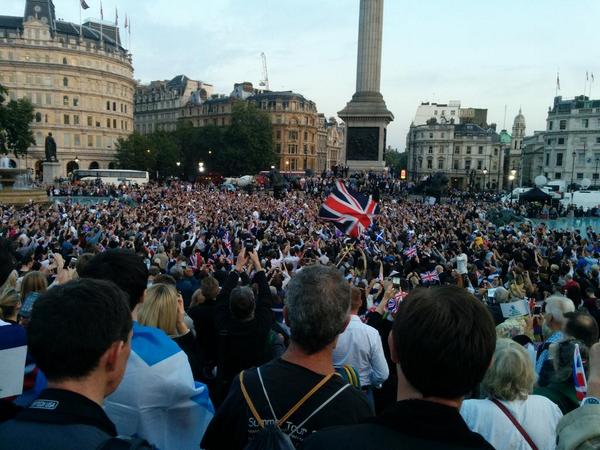
Hohoho I'm going to the pro-indy rally thing in Trafalgur Square later.

My girlfriend wants to go and doesn't want to go on her own - she's paying me in Burritos.

I'll go Celeb spotting.
 
By the way, I know it is possible there'd be a backlash against Cameron if Scotland voted for independence, but wouldn't a UK without Scotland shift quite significantly to the right? Labour would lose over 1 million votes, the Tories about 400k. The UKIP would lose almost none. The net result would be a nearly 10% swing to right.
 
By the way, I know it is possible there'd be a backlash against Cameron if Scotland voted for independence, but wouldn't a UK without Scotland shift quite significantly to the right? Labour would lose over 1 million votes, the Tories about 400k. The UKIP would lose almost none. The net result would be a nearly 10% swing to right.

Perhaps, but that's just something we'll have to deal with. I hate Cameron and Farage et al with a passion... but I truly believe that we deserve to have a government that's closer to us. In Scotland's case that proximity increase is huge. In England's case it's smaller.

What I find a little obscene though, is the idea among some in the English left that Scotland should act as our counterweight to our perceived national right-of-centre stance.
 
Status
Not open for further replies.
Top Bottom