
They did. They ran a top of the line modern Obama style campaign against him. The big problem was that, with both candidates having favorables in the negatives, the race hinged on public perception as shaped by the media. And the media was more focused on Clinton's emails than on treating Trump as anything resembling a potential President of the United States.The Clinton Campaign should still have taken Trump more seriously. He was the sole opposition and at times they still behaved like people on forums who go "lol Trump". I know it's easier for me to use hindsight to say this, but I'm not any of the most likely well paid advisers on the campaign staff who got things terribly wrong.
-
Hey Guest. Check out your NeoGAF Wrapped 2025 results here!
You are using an out of date browser. It may not display this or other websites correctly.
You should upgrade or use an alternative browser.
You should upgrade or use an alternative browser.
Donald J. Trump elected 45th President of the United States
- Thread starter Greatest Ever
- Start date
- Status
- Not open for further replies.
I said "or maybe this was the last grand stand" to highlight that it was a hypothetical. With shifting demographics maybe Democrats can overcome an acceptable amount of apathy just to raw numbers? Again, that's purely hypothetical. I don't know.
I'm just saying Trump won with a strategy many even on the right didn't think was winnable. Was it a fluke? These are questions the Democratic party has to be asking.
My bad, I misread you.
The things that stick out to me about this election.
1) Hillary, afaik, has the lowest votes of any single major candidate in the past few elections. That says disinterest in her, which isn't surprising; her campaign's messaging felt, to me, at least, like... "do it because she deserves this chance." Like... we look at Obama campaigning or, well, anyone else, and it's like "I'm doing this amazing stuff for you," and the Clinton messaging felt very "it's my turn," which is what happened during the Obama election, and why I preferred him to her back then. I read a great analysis of the Democratic party earlier this year that basically said "the party works like a corporation; it didn't want Bernie because he was a 'new' Democrat. Hillary had been there the longest, so the party was basically just giving her a promotion. It doesn't really perceive the American people as having a say in what it does; it's a business." That... kinda seems appropriate. The Republicans made the SAME assumption with Jeb. The difference is that the Republicans somehow realized Trump would win and the dynasty wouldn't. The Democrats didn't, and that's why I believe they lost.
2) People keep saying this is about racism, but like I said in my previous post, if it were, we'd see a swell of support for Trump. What we actually see is less support for both candidates. I could be wrong, but I believe this is actually a record for people not voting. You'd think if racists were mad at Obama, they'd be out in droves. But they weren't.
3) Exit polls show that the poorest demographics voted blue, and the richest demographics voted red, but if we look at who won which counties, the richest counties in the nation all seem blue, and the poorest counties all seem red. Based on anecdotal evidence, most of the poorer people I know were very against Clinton, but I also live in traditionally red areas. I recently moved to a richer county, and, yup, it tends to vote blue.
Ultimately, I think this is about the issue of America's overall economic decline and the unrest from it. People say "but wait, the economy is growing," but... like... if you look at where that growth is, it's in essentially three areas (NY, LA, SF), which are all historically blue and remain blue. See here and here.
This is why I expressed frustration back when Bernie backed out of the race; you have one person who basically is rich and seems entitled to the position, and then you have another person who is the same thing, except they're saying "I'll make it better for you." It doesn't... really seem surprising to me that this election turned out the way it did.
It's also why I think a bunch of people going "you're a hateful racist" isn't going to fix things. You've got all these people upset about jobs and stuff, and these people who live on the coasts being out of touch and going "you suck." I think this election could be characterized as a rebellion of sorts, and people NEED to learn from this. They need to realize that going around dissing people who feel awful already is only going to create enemies.
Trying to understand what is happening to prevent it from happening again is what we need, not this moronic moral highgrounding.
For an outsider it is really strange to see Trump winning when your only source is Neogaf. Is it just that neogaf is really not represent of America or are we all caught off guard? Trump winning was impossible if I believe the Dutch media.
Cheers to the poster who chose to say he voted trump and took the time to explain it. You will get a lot of hate but for an outsider like me it is really helpfull to learn the how and what.
Like I dont want to trust our 'propaganda' media in The Netherlands but always want my own view on things and the next few weeks is trying to see the other side of things and why everything happened as it did because surely if this guy is the next hitler (media words here) he could no way become president
Everyone was caught off guard. Every poll had him losing. He didn't even win the popular vote.
Gotdatmoney
Member
I guess I will put this out there and see what happens but I voted for Donald Trump.
I will tell you exactly why I did it and why I didn't vote for Hillary Clinton and my reasons have nothing to do with racism or any of that bull crap that people seem to keep trying to make Trump voters turns out to be.
I'm a 26 year old white male. And I make around $20,000 a year. I consider myself to be a hard-working 20 something year old guy with a lot of my future but there were a few things in the end of Obama's administration that absolutely destroyed me, mainly Obamacare.
I fall into this small Gap that Obamacare absolutely did nothing for but destroy my wallet while giving me subpar health care that I not only didn't want but offered almost virtually no benefit to me.
Because I made too much to not be considered to be in poverty in my state I was not offered any subsidies on any kind of health care plan. My options are pretty much to buy a healthcare plan with extremely high deductibles that are almost like car insurance for a couple hundred bucks a month. He offered absolutely no real benefit to me medical wise.
But the thing that really set me off was that he basically bullied me into healthcare. It was pretty much either buy health care or be fine so suddenly I'm in the situation when ObamaCare got passed that my monthly budget was cut by a couple hundred dollars for something I only didn't want but I didn't need.
When you only make $20,000 a year and suddenly twelve to fourteen hundred dollars out of it is just proof gone for something you don't want it's extremely frustrating.
But this small Gap that Obamacare doesn't cover of this group people that make too much to be considered not in poverty but too little to actually afford any kind of Obamacare plans. It represents many people my age just trying to get out into the workforce and trying to figure out something that they want to do with their lives.
When you combine that with more and more companies cutting any kind of health care plans for their employees that are not full time, which I am one of, suddenly in the whole Obamacare health care problem became a huge headache for me and I literally had nothing I can do except either pay the fine or buy health insurance I didn't want.
Obamacare was a huge problem for me because it fundamentally changed my life for no real reason. It didn't benefit me in any single way.
That was one major reason why I voted for Trump because Obamacare needs to be repealed it's just that simple, but that's my opinion.
When you combine that with Obama's foreign policy which I just don't agree with, and also his endless fight against gun control which I think was always in pointless battle that didn't actually solve any problems, you have a president I just didn't agree with.
I don't dislike Obama I think he was doing what he thought was right but at the end of the day I just didn't agree with any of his policies and then his health care plan was something that affected me personally in a negative.
Enter Hillary Clinton,
She literally was an Obama 2. And I just don't see any way that could have benefited and not only me but many people that I associate with and even friends and family that were caught in the same exact predicament with Obamacare.
I voted for Donald Trump because I do want change I want to different foreign policy I want alternative to Obamacare and frankly I just want change I don't want another Obama.
I have nothing against people of other races and in fact my best friend is Latino. And I have dated black women.
Donald Trump comments that he made during that Infamous video definitely shook me up a little bit in terms of his character, but when you look at the other side and all you see is Hillary Clinton who has a lifelong history of making extremely selfish choices to line her pocketbook and give her and her husband power over anything else and I really didn't see that as an issue anymore it basically became a wash.
I'll tell you right now if Bernie Sanders would have been on that ballot there is absolutely no way I could have taken Donald Trump has my vote. Bernie Sanders represented somebody who I actually thought was truthful and not only did he not give off that sense of just sleeping is that both Trump and Clinton had, I actually felt like he was fighting for people even if it meant that I didn't agree with what he was fighting for.
I respect you thought about this some. But you really believe Democrats would have done nothing to adjust Obamacare?
Actually given Republican obstruction maybe you're right.
I hope when the Republicans go ham on social security and issues, you at least weigh that seriously against what you voted for though.
EatinOlives
Member
I'm honestly not a fan of absolving the campaign of responsibility here and placing the blame squarely on bad polling. For starters, you should probably never take anything for granted. In an election where polling was all over the map, it's probably not best to just assume it's right. Further, aggregate sites like FiveThirtyEight often had it as far from a lock.
Also, even if the intel was actually good at the time, you can still recognize that making a play at longshots is a risk. I mean, sure, it's brilliant if it works. A blowout victory would have done wonders not only for establishing her own mandate but helping down ballot races as well. But what if your firewall isn't as strong as you think it is? Not considering that is arguably a mistake and deferring blame to the pollsters doesn't absolve you from the choices made.
Mind you, I'm not arguing that she necessarily fucked up here. Some decisions are just coin flips. You win some, you lose some. But the post mortem here can't just be "pollsters cost us the election!"
Sorry, I just don't agree. Campaigns operate on the data that they receive. If the data's bogus, they're completely blind and left stabbing in the dark. Even worse if you're blinded and don't even realize it.
I don't see how it's anything but the pollsters' fault.
Wut?
Vandalism is still vandalism. Swastikas are still a symbol of racism. We didn't just enter bizzaro world.
yes we did
Zen_Arcade
Banned
It's not just Twitter shit, it spilled over into the real world. And even if it were limited to the internet, it's idiotic to propose that just because something is said on the internet that it doesn't carry weight. Especially if it's something you're bludgeoned with over and over by a bunch of different people.You think that is what pushed traditionally blue states red? Twitter shit?
If you were undecided and are constantly bombarded with people essentially calling you a scumbag because you aren't wholly on their side you're probably eventually going to side up with the group of people who aren't going out of their way to call you a dickhead. Even if you think the people you're grouping with are assholes too.
Shit, I'm liberal, voted for Hillary and still got insulted because I don't agree with 100% of what Democrats have had to say in the past few years. And I know for a fact that I'm not even close to being the one who has gotten the brunt of that attitude around here. It's become a "You're either fully with us or you're fully against us." to A LOT of people. It's not remotely surprising that people who leaned more to the center were put off by that mentality and sided with the other guy.
This doesn't even get into how fucking hard Hillary supporters turned on Sanders supporters. They openly insulted people in their own fucking corner because they dared to say that the person picked might not be the right person for the job.
I'm not saying these attitudes are 100% the reason this election turned out the way it did. There were way more factors. But you seriously have your head in the sand if you think the attitudes of Democrats didn't push at least a noticeable amount of people away. They picked an unimpressive candidate and then many of them openly insulted people who didn't like her.

Quote
Member
I don't want to be the bearer of bad news but... things will not go well for that industry.Thanks for actually being respectful.
I work in retail management.
I don't by any means feel like Donald Trump is my savior or going to some help fix things that are completely wrong with this country but I just didn't see any way that a Clinton campaign would actually benefit anyone based on what I have experienced.
DontBeThatGuy
Member
In all the despair, I never payed much attention to the fact that Maine has legalized weed. That's at least something.
dglavimans
Member
Jeah just thought about this today. I never believe he will be our leader here but maybe anything is possible right now...Good luck with Geert Wilders. Sigh.
GAF represents a subset of a subset of a subset of a niche. But everyone didn't see this coming.
But how can pre election polls be so off... like not a bit but by a large margin? Is that maybe the propagandad way the media is today, I ask myself and we just see a situation where we fell flat on the face?Everyone was caught off guard. Look at every pre-election poll. Every one of them treated a Clinton victory as an inevitability.
It's really got nothing to do with so-called GAF "insularity".

RPGCrazied
Member
"Hundreds of high school students stage walk out to protest Donald Trumps presidential election win"
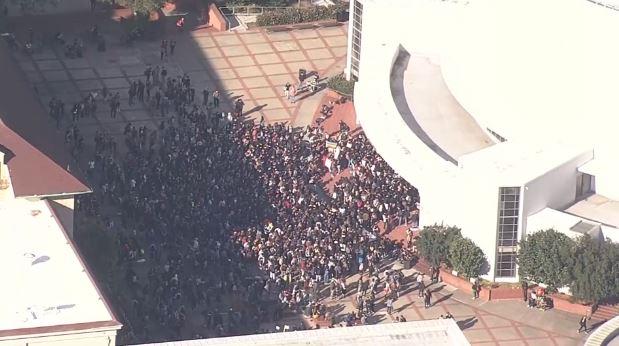
Good to see
Hope we see more and more civil protests.
"Hundreds of high school students stage walk out to protest Donald Trumps presidential election win"
Good to see
This is who will be most affected, and I wouldn't be surprised to see this at my uni. If gridlock doesn't hit the Senate and House under his control, the country will probably gridlock itself.
But how can pre election polls be so off... like not a bit but by a large margin? Is that maybe the propagandad way the media is today, I ask myself and we just see a situation where we fell flat on the face?
National polls were closer this year than in 2012.

Audioboxer
Member
I agree, they absolutely did not take him seriously. But I'm talking about the reason why. They didn't take him seriously because every piece of data that was coming in was telling them not to take it seriously.
Fair enough, but it's a hard pill to swallow. Hindsight does nothing to help a lost campaign.
They did. They ran a top of the line modern Obama style campaign against him. The big problem was that, with both candidates having favorables in the negatives, the race hinged on public perception as shaped by the media. And the media was more focused on Clinton's emails than on treating Trump as anything resembling a potential President of the United States.
They were baited into lots of his trolling, and also tried to use his outrageous statements as evidence he wouldn't win. That did not work. It was evidence he was an asshole, not evidence he wasn't winning votes.

Green Yoshi
Member
"Hundreds of high school students stage walk out to protest Donald Trump’s presidential election win"
Good to see
A little late. Students that protested against the Vietnam war and for other important matters didn't need "safe zones".
Who were the students protests as people got shot by policemen just because of the skin of their color? Too busy fighting for transgender bathrooms?
RPGCrazied
Member
Dow closes at or near record highs. Market loves Trump after all apparently.
While middle class suffers.
Its like fuck you got mine thing.

BFIB
Member
Dow closes at or near record highs. Market loves Trump after all apparently.
Its all empty promises. There is no way he can force those jobs back here, they are gone. He said what he had to say to get the job, that's it.
Quote
Member
He's not in office yet and nothing is implemented.Dow closes at or near record highs. Market loves Trump after all apparently.
Darryl M R
Member
I don't want to be the bearer of bad news but... things will not go well for that industry.
We are going to automate the hell out of retail management right?
A little late. Students that protested against the Vietnam war and for other important matters didn't need "safe zones".
Who were the sudents protests as people got shot by policemen just because of the skin of their color? Too busy fighting for transgender bathrooms?
Maybe they were being high school students?
Waldo Lydecker
Member
I think the only way to get rid of the right populists is to let them try to govern themselves instead of ignoring them or use a condon sanitaire. Otherwise the people who vote on them and irrationaly hate the left will never see them fail and will still believe they can do magic.
By the way, is Cory Booker not an ideal frontrunner who should head the Democratic Party?
By the way, is Cory Booker not an ideal frontrunner who should head the Democratic Party?

But how can pre election polls be so off... like not a bit but by a large margin? Is that maybe the propagandad way the media is today, I ask myself and we just see a situation where we fell flat on the face?
Nah. The polls were exactly on point in all but one case in the primaries. The one case where the polls were wrong was telling, though. It was Mitchigan. It's not like Trump won the popular vote in either case, he just got people in the right areas of the rust belt.
I think the only way to get rid of the right populists is to let them try to govern themselves instead of ignoring them or use a condon sanitaire. Otherwise the people who vote on them and irrationaly hate the left will never see them fail and will still believe they can do magic.
By the way, is Cory Booker not an ideal frontrunner who should head the Democratic Party?
He lacks experience. But he's charismatic. But voters don't seem to care about experience, so fuck it.
This is literally penny wise pound foolish, I wouldnt be surprised if this line of thinking was quite prevalent among the voters.I guess I will put this out there and see what happens but I voted for Donald Trump.
I will tell you exactly why I did it and why I didn't vote for Hillary Clinton and my reasons have nothing to do with racism or any of that bull crap that people seem to keep trying to make Trump voters turns out to be.
I'm a 26 year old white male. And I make around $20,000 a year. I consider myself to be a hard-working 20 something year old guy with a lot of my future but there were a few things in the end of Obama's administration that absolutely destroyed me, mainly Obamacare.
I fall into this small Gap that Obamacare absolutely did nothing for but destroy my wallet while giving me subpar health care that I not only didn't want but offered almost virtually no benefit to me.
Because I made too much to not be considered to be in poverty in my state I was not offered any subsidies on any kind of health care plan. My options are pretty much to buy a healthcare plan with extremely high deductibles that are almost like car insurance for a couple hundred bucks a month. He offered absolutely no real benefit to me medical wise.
But the thing that really set me off was that he basically bullied me into healthcare. It was pretty much either buy health care or be fine so suddenly I'm in the situation when ObamaCare got passed that my monthly budget was cut by a couple hundred dollars for something I only didn't want but I didn't need.
When you only make $20,000 a year and suddenly twelve to fourteen hundred dollars out of it is just proof gone for something you don't want it's extremely frustrating.
But this small Gap that Obamacare doesn't cover of this group people that make too much to be considered not in poverty but too little to actually afford any kind of Obamacare plans. It represents many people my age just trying to get out into the workforce and trying to figure out something that they want to do with their lives.
When you combine that with more and more companies cutting any kind of health care plans for their employees that are not full time, which I am one of, suddenly in the whole Obamacare health care problem became a huge headache for me and I literally had nothing I can do except either pay the fine or buy health insurance I didn't want.
Obamacare was a huge problem for me because it fundamentally changed my life for no real reason. It didn't benefit me in any single way.
That was one major reason why I voted for Trump because Obamacare needs to be repealed it's just that simple, but that's my opinion.
When you combine that with Obama's foreign policy which I just don't agree with, and also his endless fight against gun control which I think was always in pointless battle that didn't actually solve any problems, you have a president I just didn't agree with.
I don't dislike Obama I think he was doing what he thought was right but at the end of the day I just didn't agree with any of his policies and then his health care plan was something that affected me personally in a negative.
Enter Hillary Clinton,
She literally was an Obama 2. And I just don't see any way that could have benefited and not only me but many people that I associate with and even friends and family that were caught in the same exact predicament with Obamacare.
I voted for Donald Trump because I do want change I want to different foreign policy I want alternative to Obamacare and frankly I just want change I don't want another Obama.
I have nothing against people of other races and in fact my best friend is Latino. And I have dated black women.
Donald Trump comments that he made during that Infamous video definitely shook me up a little bit in terms of his character, but when you look at the other side and all you see is Hillary Clinton who has a lifelong history of making extremely selfish choices to line her pocketbook and give her and her husband power over anything else and I really didn't see that as an issue anymore it basically became a wash.
I'll tell you right now if Bernie Sanders would have been on that ballot there is absolutely no way I could have taken Donald Trump has my vote. Bernie Sanders represented somebody who I actually thought was truthful and not only did he not give off that sense of just sleeping is that both Trump and Clinton had, I actually felt like he was fighting for people even if it meant that I didn't agree with what he was fighting for.
Quote
Member
That industry lives off the economy. It's the first to cut off the fat. It has nothing to do with automation.We are going to automate the hell out of retail management right?
Inferno313
Banned
Should I go to a protest tonight? Got a Facebook invite to one that has been slowly building steam all day.

Chaplain
Member
I think the following quote is full of wisdom.
"We just got beat. We just got proven wrong about a great many things. We should model the humility we think Trump does not have. We are not selling out our principles by wishing Trump well and hoping for the best. We are not selling out our principles by giving him a chance and the benefit of a doubt — a benefit we did not give him when we turned out to be wrong about the election. The American people disagreed with us. Be humble and recognize it was not because of racism or bigotry or bad motives. It was because people are fearful of the future and think no one in Washington has listened to them. Donald Trump has." (#NeverTrump Must Model The Humility They Claim Trump Does Not Have)
dglavimans
Member
This is interessting to hear because we keep hearing stuff like the polls where way of etc... will do myself some reading up and following this the coming days because it will affect us for some yearsNah. The polls were exactly on point in all but one case in the primaries. The one case where the polls were wrong was telling, though. It was Mitchigan. It's not like Trump won the popular vote in either case, he just got people in the right areas of the rust belt.
 sorry for my misinformation
For an outsider it is really strange to see Trump winning when your only source is Neogaf. Is it just that neogaf is really not represent of America or are we all caught off guard? Trump winning was impossible if I believe the Dutch media.
Cheers to the poster who chose to say he voted trump and took the time to explain it. You will get a lot of hate but for an outsider like me it is really helpfull to learn the how and what.
Like I dont want to trust our 'propaganda' media in The Netherlands but always want my own view on things and the next few weeks is trying to see the other side of things and why everything happened as it did because surely if this guy is the next hitler (media words here) he could no way become president
You have to remember that the loud, unfiltered Trump supporters are quickly modded out of the NeoGAF community.
actually trump has said he is for raising minimum wage... to like $10 and then having the states go on a case by case basis beyond that.
it was one of only a handful of things that didn't sound horrible when i was reading his political views to figure out what was in store for us.
Erm... the same Donald Trump who said wages are too high?
https://youtu.be/VRmi28fjNOs?t=26s
Honest question, my wife was thinking about becoming a U.S. citizen next year as she's a Mexican citizen/legal perm resident. Is she at risk and is it worth converting still or should she keep her Mexican citizenship as a backup plan to escape this mess when it turns for the worse?
While middle class suffers.
Its like fuck you got mine thing.
The Middle Class has 401k's.
But how can pre election polls be so off... like not a bit but by a large margin? Is that maybe the propagandad way the media is today, I ask myself and we just see a situation where we fell flat on the face?
Nationally they were likely more accurate than 2012. On a state level they were less accurate in places because of wild swings in the voting demographics and partisan voting tendencies in certain states.
My bad, I misread you.
The things that stick out to me about this election.
1) Hillary, afaik, has the lowest votes of any single major candidate in the past few elections.
Not to contest your larger points, but she received more votes than her opponent and could potentially still exceed Romney's 2012 total.
Should I go to a protest tonight? Got a Facebook invite to one that has been slowly building steam all day.
Yes.
This is interessting to hear because we keep hearing stuff like the polls where way of etc... will do myself some reading up and following this the coming days because it will affect us for some years
Nah, it's fine.
You have to remember that the loud, unfiltered Trump supporters are quickly modded out of the NeoGAF community.
C'mon not even staffers from the Trump campaign saw something like this happening. All the data pointed to this not happening. This wasn't an echo-chamber problem.
RPGCrazied
Member
You have to remember that the loud, unfiltered Trump supporters are quickly modded out of the NeoGAF community.
I hope it stays that way. I hope just cause Chump got elected isn't going to give them free reign here.
Audioboxer
Member
Should I go to a protest tonight? Got a Facebook invite to one that has been slowly building steam all day.
You should always do what you feel is right to protest and not care too much about what others think, as long as you're doing nothing illegal.
However for what its worth protesting hours after he has won doesn't do much to aid the fact serious protest should have happened long before now. And I know it did, but even protesters obviously bought into the media and polling that Trump would lose, so didn't take his threat seriously. A lot of the protests that basically revolved around stopping traffic or pissing people off, have done jack shit.

-Plasma Reus-
Service guarantees member status
I feel like we need clarification here between what is middle class and what is working class.
People shouldn't protest. An election was held Trump won fair and square. If you wanted to protest you should have protested earlier.
People shouldn't protest. An election was held Trump won fair and square. If you wanted to protest you should have protested earlier.
ClosingADoor
Member
It's high school, not college. You expect 14-year olds to get to the streets protesting police violence when they should be in school?A little late. Students that protested against the Vietnam war and for other important matters didn't need "safe zones".
Who were the students protests as people got shot by policemen just because of the skin of their color? Too busy fighting for transgender bathrooms?
DontBeThatGuy
Member
Should I go to a protest tonight? Got a Facebook invite to one that has been slowly building steam all day.
I would, fuck it, just to let off some steam with like-minded people.
My bad, I misread you.
The things that stick out to me about this election.
1) Hillary, afaik, has the lowest votes of any single major candidate in the past few elections.
Dude, she won the popular vote. How can you not know this?
For an outsider it is really strange to see Trump winning when your only source is Neogaf. Is it just that neogaf is really not represent of America or are we all caught off guard? Trump winning was impossible if I believe the Dutch media.
Cheers to the poster who chose to say he voted trump and took the time to explain it. You will get a lot of hate but for an outsider like me it is really helpfull to learn the how and what.
Like I dont want to trust our 'propaganda' media in The Netherlands but always want my own view on things and the next few weeks is trying to see the other side of things and why everything happened as it did because surely if this guy is the next hitler (media words here) he could no way become president
NeoGAF is extremely liberal and relatively small, in any situation like that you run the risk of creating an echo chamber. If you only get your news from FOX News Obama looks pretty bad, the reverse is true here. It's important to pull from multiple sources, the truth is usually somewhere in the middle.
I'm not minimalizing Trump, he's pretty bad, but there was some issues like low enthusiasm for Clinton that either nobody saw or people willfully ignored. I'm guilty of it, but now it's critical that we do more than just say "racism won" and pinpoint exactly why there was low turnout.
Saying the racists won, while true, also ignores the real issues Clinton had as a candidate. The real issues the DNC had by propping her up and pushing so hard for her. If we just blame it all on the racists we're going to end up right back here next election.
BFIB
Member
Honest question, my wife was thinking about becoming a U.S. citizen next year as she's a Mexican citizen/legal perm resident. Is she at risk and is it worth converting still or should she keep her Mexican citizenship as a backup plan to escape this mess when it turns for the worse?
Does she love this country? If she does, then yes, she should stay and fight for what she believes in. Its going to be a tough 4 year battle, but now is not the time to cut your losses.
Comfort Jones
Banned
I think the following quote is full of wisdom.
http://www.neogaf.com/forum/showthread.php?t=1311210
What are we hoping he "succeeds" at? You realize his plans run counter to anything his opposition could want, like this shit isn't just basic "oh I don't know if I agree with his views on economics" stuff.
Trying to act like the bigger and better man now is fucking ridiculous. Half the country didn't vote. Fuck us all.
EatinOlives
Member
But how can pre election polls be so off... like not a bit but by a large margin? Is that maybe the propagandad way the media is today, I ask myself and we just see a situation where we fell flat on the face?
We got Karl Rove'd. We fell into believing low-rent punditry disguised as impartial political analysis, and reality came crashing down yesterday when it became clear that the sources we listened to actually were far from accurate or honest about their predictions.
Hopefully enough of these hacks lose their jobs and start overhauling from the ground up the polling effort and sampling methods.
dglavimans
Member
Jeah that is a feeling I got for the second time now. Brexit was another shock because when you only have so much sources like me for example it is just really weird when you go to bed with... Well he sure won't be president or well Brexit is never happening and then waking up..You have to remember that the loud, unfiltered Trump supporters are quickly modded out of the NeoGAF community.
@the above jeah and that was why I gave the dutch media as example we never hear about a possible brexit or an Trump candidate possibility because the media doesnt want us too...
- Status
- Not open for further replies.