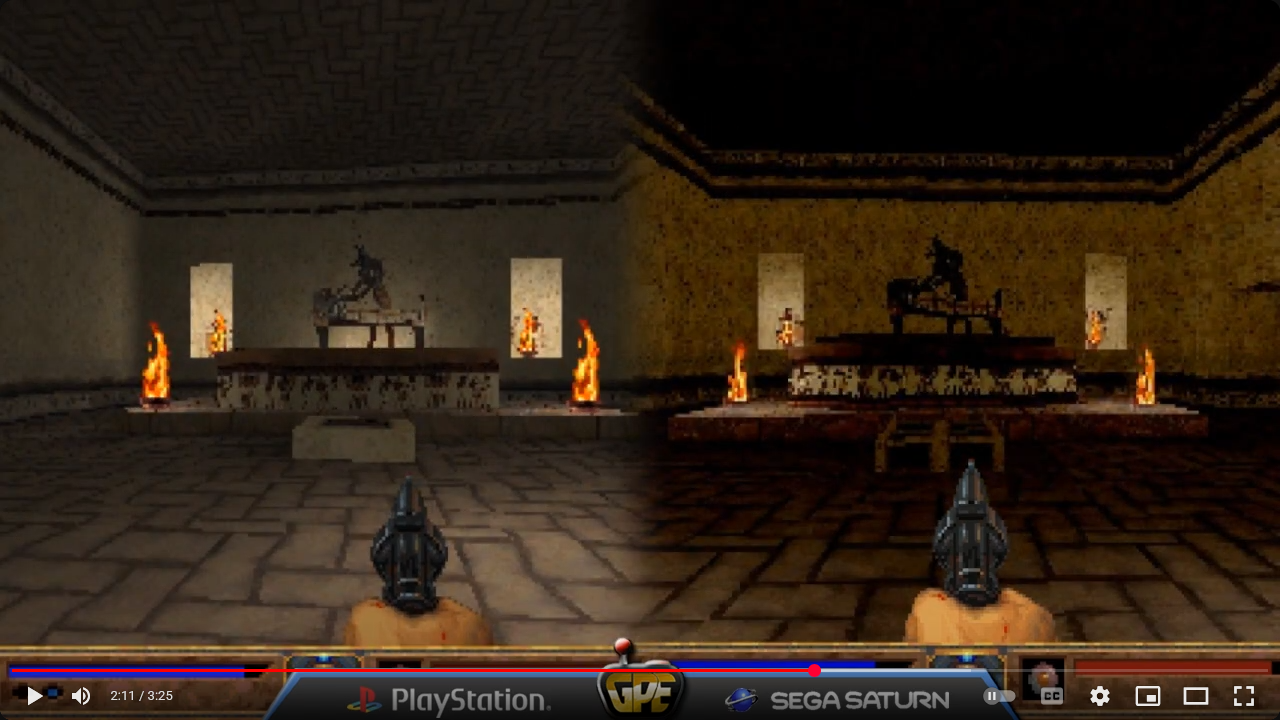
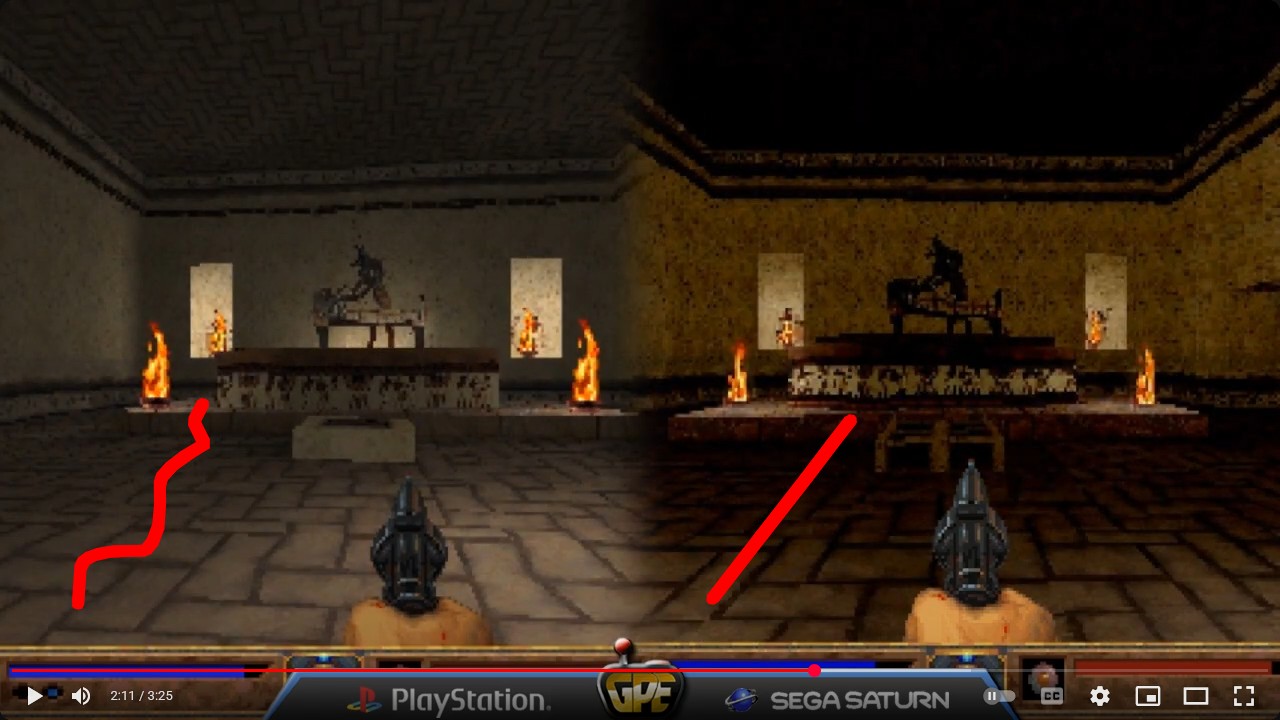
Looks good, tho the colors are kind of garish palette-wise. Although, I think I'm getting a better understanding as to why that may be.
Saturn has 4 KB of programmable on-chip CRAM (Color RAM), but it's located on VDP2. So palettes are shared with VDP1, and usually you can mirror the palettes. From what I've noticed you have a maximum of 2048 palette entries of either 2048 word-length (16-bit) or long word (24-bit, tho it takes up 8 extra bits so 32-bit or double word) organized colors, with 16-bit or 24-bit color options. 8-bit color (256 Mode) is also supported but I don't know much about it.
PS1 doesn't have any CRAM but you can program software-based CLUTs in the VRAM. Which is slower to access (higher latency), but technically you can make it as small or big as you want. So there's flexibility in size not necessarily present with Saturn. On Saturn you can cycle the palettes every Hblank in theory, but in practice more like mid-frame, or even swap out the old palette completely with a new one. I wonder if any games reserved a portion of the VRAM for other palette info, or if the palette data had to be loaded by the SH-2s into VDP2 through registers directly? Although even there I'm still gonna assume they'd put the palette info in VDP2's VRAM first.
Also from what I've read PS1 supported multiple color depths in a frame (or better to say, multiple graphical elements at different color depths); not sure if Saturn did. I could have just not come across the info. From a quick Google search it says that VDP1 supported 8-bit or 16-bit (15-bit RGB, 1-bit alpha) color modes; the 24-bit color mode was exclusive to VDP2. And that might just in large part explain why colors in ports of 3D games between the two systems look so different. Well, that and PS1 having baked-in features for lighting and shadows, whereas Saturn didn't (though you could implement software-based versions no problem).
Core always said that Tomb Raider 1 was a multi-platform game. But the first media shown for the game was for the Sega Saturn. The Sega Saturn version was the lead console for TR1, due to the way the maps were constructed for quads, the game was designed within the limitations of the Saturn.
I am pretty sure some of the very first media for TR1 appeared in November or November 1995 issue of Game Fan Magazine with early Saturn beta screenshots.
Hot off the digital press, get it before Dave shows up.
archive.org
Tomb Raider II's engine was redesigned to take advantage of the PS1, and the Playstation one became the lead development system for Tomb Raider II to Chronicles. Tomb raider II was originally planned for the Saturn, and I think Core even had a playable version of it at some trade show. But Tomb Raider 1 sold like like crazy on the PS1 (and PC), and Sony paid for every numbered sequel to be PS1 exclusive.
Yeah, that's the general history of Tomb Raider on Saturn & PS1. To be fair as well, SEGA themselves killed any chance of Tomb Raider 2 coming to Saturn when Stolar said "The Saturn is not our future" at E3 '97.
Still one of the worst lines from any gaming CEO in history. Terribly timed, basically just conceded SEGA's entire Western market and pushed them to limp by for TWO YEARS with little to no retail presence outside of Japan & parts of Asia (and maybe Brazil), until Dreamcast in late '99. They made every single mistake Atari made going from the 7800 & Lynx to the Jaguar, including the worst one of just being absent at retail for an extended period of time.
That was entire distribution channels and retail partners just closing up for SEGA, and became very difficult if not impossible to reignite once Dreamcast was a thing.
total.
Sega Saturn has significantly inferior 3D technology to the PlayStation, but it's not because of quads, complexity or anything like that, the Saturn's 3D chip doesn't have the same HP as the PS1's GPU that's the reason.
You're using terminology that doesn't even make sense. Console power isn't measured in hit points.
Saturn has more MIPs processing between the 2x SH-2 CPUs (~ 74 MIPs combined) and SCU DSP (86 MIPs) than the PS1 (30 MIPs for the R3000A CPU; 66 MIPs for the GTE). It has more VRAM (1.5 MB vs 1 MB), and a much larger texture cache for the 3D engine (512 KB 17 ns latency SDRAM (as VRAM) for VDP1 vs. 2 KB on-chip texture cache for PS1's renderer since the 60 ns EDO-DRAM was too high latency).
VDP2 has upwards 17:1 tiled "compression" ratio and can push roughly 500 Mpixels/second doing 2x 3D rotation planes. No other console could match that in terms of polygon equivalents until the Dreamcast in 6th gen.
That's your 'HP' for you. Yes it was harder to harness all that power in Saturn fully synchronously vs PS1, especially when budgets and timelines were tight, but the power
IS there.
Translation: Sony paid us millions of pounds for exclusive rights to Tomb Raider just like they done with Namco & Squaresoft as they can't make a decent game themselves to save their lives
Sony didn't have to pay Namco to avoid supporting Saturn; Namco themselves chose that after seeing what Sony were doing with the PS1. That's why they decided to make the System 11 board in collaboration with Sony.
As for Squaresoft; they like many other Japanese 3P that gen wanted to move away from Nintendo after Famicom/SFC days, Sony just happened to be in the best position to offer them what they needed. SEGA were too busy hastily redesigning Saturn from late '93 into early '94, and falling behind on devkits & API support to 3P, to really impress SquareSoft with much.


 cireza
want you to believe no one cares about PS1 anymore, I think they're on a different planet.
cireza
want you to believe no one cares about PS1 anymore, I think they're on a different planet.


 To be this Good takes SEGA