• Hey Guest. Check out your NeoGAF Wrapped 2025 results here!

What makes a device a PC to you?

Wouldn't that make some of those tight mini ITX prebuilds not PCs? Don't think you can build them yourself and change parts.

Kinda. Most Macs also fall into this category. They are treated much more like consoles though. A PC implies general, multi-usage whereas consoles are locked down. It's hard to make the distinction between that and jailbroken consoles that have just "different hardware" once you get past the software limitations. Does that make them a PC? I'd say no, even though you can do general computing on them.
 
It looks too limiting to be used as a PC, IMO.
You can literaly do everything a desktop can do except change parts other than the SSD.

But there are actual budget PCs that can't run PC games, and there are things like android phones that can run PC games.

So you'd be making PCs not PCs and phones into PCs.
What budget PC can't run a PC game and what android phone can run PC games natively??
 
Last edited:
You can literaly do everything a desktop can do except change parts other than the SSD.


What budget PC can't run a PC game and what android phone can run PC games natively??

For the first point, find any PC without a dedicated GPU, like your budget HP special, complete with 4-8GB of total RAM, and try to run a new PC game like Alan Wake 2 - which won't even launch the game without a dedicated GPU, let alone be playable. So not a PC then, it doesn't play Alan Wake 2. Or you could look at something like the MacBook Neo I guess, that certainly is incapable of playing a wide variety of games, hundreds of thousands of games I'd imagine, and still we'd probably call it a PC.

For the second point, running PC games, natively wasn't mentioned in the requirement. If you add that in, depending on how you add it, once again, there are many PCs (macs, etc) which would be incapable of running a PC game like Alan Wake 2 natively, so I guess they're not PC either. Or if you want to define it as a PC if it can run any PC game at all natively, that really begs the question of what counts and doesn't count.

Because I'm not sure many PCs could run older PC games natively, especially DOS ones, anymore. Without an emulator. Which is the same thing as my Android point, the phones can run lots of PC games with emulators afaik.

 
For the first point, find any PC without a dedicated GPU, like your budget HP special, complete with 4-8GB of total RAM, and try to run a new PC game like Alan Wake 2 - which won't even launch the game without a dedicated GPU, let alone be playable. So not a PC then, it doesn't play Alan Wake 2. Or you could look at something like the MacBook Neo I guess, that certainly is incapable of playing a wide variety of games, hundreds of thousands of games I'd imagine, and still we'd probably call it a PC.

For the second point, running PC games, natively wasn't mentioned in the requirement. If you add that in, depending on how you add it, once again, there are many PCs (macs, etc) which would be incapable of running a PC game like Alan Wake 2 natively, so I guess they're not PC either. Or if you want to define it as a PC if it can run any PC game at all natively, that really begs the question of what counts and doesn't count.

Because I'm not sure many PCs could run older PC games natively, especially DOS ones, anymore. Without an emulator. Which is the same thing as my Android point, the phones can run lots of PC games with emulators afaik.
No one calls Macs by PC They are personal computers just like consoles and calculators are too. But the "term" PC is not used for them and the devices that use are what the thread is about. For the Alan Wake 2 example is a matter of minimum requirements (power and features). Like I said before here:

16 and 32 bits PC games don't run natively on 64bit OSs on PCs.
Things are not just 8 or 80.
...things are not so simple.16, 32 and 64 bit "PCs" are all PCs too but with some technical differences. The same way different consoles are all consoles despite some technical differences too.
 
Last edited:
haha, the damn engineer of the console is calling it a console. Maybe its you thats struggling :)
"Just how awesome is to play Mass Effect 2 console version in your definitively console Helix?"
CTTgFw4vkfoETbeM.jpeg

We wouldn't be here with Moore in XBox.
 
It's sort of complicated for me as somebody that uses a Mac for 95% of my "personal computing" needs. My windows desktop is used almost entirely for gaming. I would say literally 98% gaming and the other 2% is me browsing the internet on it because I'm already sitting there and haven't gotten up yet. It would be such a broad answer being a computer running MacOS, Windows, or Linux and used primarily with a keyboard and mouse/trackpad so because of that...

Project Helix would fall more into the console category for me. While we don't know much about it I would have to imagine it's going to be a living room/tv focused device that is meant to be used with/navigated with a controller. It seems obvious that it will use "Xbox Mode" for Windows 11 which feels more like a console OS then Windows.

Also I know it's quite literally a PC but the upcoming Steam Machine (if it ever comes out) falls into the console category for me as well because of the same reasons as stated above for Project Helix.

So I guess my answer is about usage and how you use/navigate the device.
 
The original definition was definitely tied to the common hardware interfaces the PC/XT, ISA bus. Then until Linux took hold it was associated more strongly with Microsoft OSs.
 
If you take away the multitasking aspect, to me a PC is about freedom… I choose where I buy my games, what settings I use, what controller I use, etc., without a paywall or some manufacturer-imposed BS. If the next Xbox doesn't offer that kind of freedom, I'd say it's closer to a traditional console
 
Kinda. Most Macs also fall into this category. They are treated much more like consoles though. A PC implies general, multi-usage whereas consoles are locked down. It's hard to make the distinction between that and jailbroken consoles that have just "different hardware" once you get past the software limitations. Does that make them a PC? I'd say no, even though you can do general computing on them.
If it's locked down it's a different story but the need to be able to change parts makes less sense imo. If a mini ITX is running standard Windows and standard PC programs, would you not call that a PC? What about a laptop?

For me it's about what you can run natively. The box can look any way imaginable.

If it can run a standard console OS and native console games with special hardware not available on PC, then it's definitely a console.

If it can run standard Windows and native PC programs without any strange extra conversation hurdles, then it's a PC.

If it can run both console and PC stuff natively, then it's a hybrid.
 
Last edited:
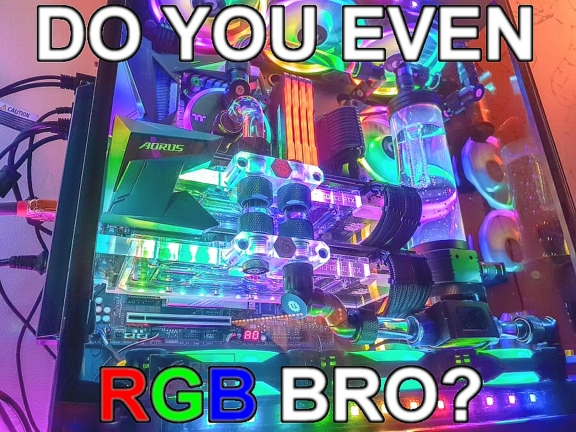
RGB lighting and the inability to shut up about what's inside it. Bonus points for quoting a 20 year old Yahtzee video.
Some of us PC guys still reject this. My main rig has no windows. You can see a little diffracted RGB out the back but that is it. I have it hooked up to and behind my TV. Kids rig is also hooked up to a TV but sadly the case I got for it didn't have a windowless option. I always view the lights as a distraction. Who wants a fucking carnival flashing off to the side while they browse the web or play a game?

The first time I had RGB on fans 20 or so years ago, I cut the wires. I thought back then the RGB stuff would die down. Now you see idiots trying to get the right looking GPU when GPUs are extremely hard to get. So they are favoring looks over ease of buying.
 
Mm, it has to let you run apps that aren't authorised by the Operating System maker on it. Windows and even Mac both let you do that, even though they'll complain about it.

I'm having a hard time coming up with a criteria that excludes phones. You can hook keyboards and mice up to your phone, and the iMac doesn't have a separate display :pie_thinking:.
 
Last edited:
But there are actual budget PCs that can't run PC games, and there are things like android phones that can run PC games.

So you'd be making PCs not PCs and phones into PCs.
The exceptions don't really change the rules.

Consoles don't play PC games and PC can only play console games through emulation and/or modification.
 
Open h/w and s/w environment.
Ability to choose and swap h/w as I like and install s/w which I want however I want.
If something isn't there - it's not a PC but some sort of a closed down device mimicking it.
 
Most members on this forum seems to think that if you can install Steam on any given machine that makes it a PC.
 
In my book, if I have full freedom over hardware, accessories, software, and where I get them and I'm not stuck in a walled garden where I can't do anything except take it or leave it and on top of that get ripped off for online play.
 
x86 hardware platform with open software capabilities.
A x86 based modern console you can jailbreak becomes a PC, because it was one before being locked down by Sony/MS.
 
I think what Helix is doing is giving people a PC with Xbox branded accessories that follow the console tradition of giving people a way to buy themselves out of having to figure out how to install drivers. For stuff like storage expansion you could buy the Xbox branded drive for 2.5x the going rate of SSDs and you won't have to potentially google a guide to format and initialize it.
If Helix will be a PC in disguise there's a still risk it's going to be getting the same Windows 11 updates and random features will stop working, forcing users to troubleshoot to get it working again. Didn't we already have a news or two about people getting their Xbox Ally ROG's bricked from Windows updates?

And the shitty updates are just one potential problem. One of the 'quirks' of PC gaming is that you constantly have to find the best GPU drivers for the games you're playing. Old drivers may cause problems with new games and vice versa.
 
Last edited:
My point of view, and I insist it is purely personal, is the following :

If the device is wasting my time, then it's a fu**ing PC.

Reminder of the video-game console experience : put your game, turn the console on, play. Time spent : 5 seconds max (boot up screen or whatever logo).

This makes recent consoles such as the Series and PS PCs because of installs. The Switch and Switch 2 are not PCs yet, you can have this experience with many games, but Game Key Cards have definitely changed this for the worst.
 
Last edited:
If it's locked down it's a different story but the need to be able to change parts makes less sense imo. If a mini ITX is running standard Windows and standard PC programs, would you not call that a PC? What about a laptop?

For me it's about what you can run natively. The box can look any way imaginable.

If it can run a standard console OS and native console games with special hardware not available on PC, then it's definitely a console.

If it can run standard Windows and native PC programs without any strange extra conversation hurdles, then it's a PC.

If it can run both console and PC stuff natively, then it's a hybrid.

I was thinking more of the definition of PC being a "personal computer" and you having a choice over the components to some degree as opposed to it being one specific set of configurations for consoles. I do agree overall that it's the software that matters most.

In the context of the mini ITX, of course that is a PC even though parts are less common. You can still pop in and interchange CPU, GPU, RAM, etc. There are some configurations that have an integrated CPU or RAM, which can't be swapped from the motherboard, but you could throw in a different mini ITX motherboard and still run the same OS and play the same games. Similar case with laptops, although Macs are again a weird edge case.

Consoles on the other hand, that's not possible. Consoles only support one hardware configuration so you can't use a different motherboard or APU, a replacement needs to be exactly the same kind. You can jailbreak them and run PC-like software on them, but usually you can't run a full desktop OS or PC games due to the custom hardware.
 
I was thinking more of the definition of PC being a "personal computer" and you having a choice over the components to some degree as opposed to it being one specific set of configurations for consoles. I do agree overall that it's the software that matters most.

In the context of the mini ITX, of course that is a PC even though parts are less common. You can still pop in and interchange CPU, GPU, RAM, etc. There are some configurations that have an integrated CPU or RAM, which can't be swapped from the motherboard, but you could throw in a different mini ITX motherboard and still run the same OS and play the same games. Similar case with laptops, although Macs are again a weird edge case.

Consoles on the other hand, that's not possible. Consoles only support one hardware configuration so you can't use a different motherboard or APU, a replacement needs to be exactly the same kind. You can jailbreak them and run PC-like software on them, but usually you can't run a full desktop OS or PC games due to the custom hardware.
I don't think you can swap the CPU/GPU/MB on a mini ASUS PC, NUC. It's a very similar scenario to how it is on consoles. I expect the same on Steam Machine.
But you still run standard Windows, or Linux if you want, and standard PC programs. That to me is where the PC definition sits.
 
A computer whose hardware can be customized in any way you like (as long as you can afford the components), and you have the freedom to make modifications in most of your games or applications.
 
I have a PC that is already XBOX.

SFF + XBOX mode + 99% gaming + XBOX controller = console for me

So, it depends on the usage.
 
Last edited:
Is it a piece of hardware on which I can install anything I want with no restrictions? It's a PC.

Is it a piece of hardware on which a single corporation controls what I can and cannot install and run and do? It is not a PC.
 
I mean the definition of PC is Personal Computer which a Mac obviously is. If we're going my "slang" or whatever you want to call it then sure.

To me, a "personal computer" doesn't limit you to what you can do with it. That doesn't apply to Macs. You can't buy a Macbook and install Linux or Windows on it unless Apple says you can.

Not saying you have to agree with it, but that's how I see it.

Some peeeps said the following:


And i would argue some of those even prefer mac over windows for that. I guess there isnt one clear definition after all.

I guess I'd need want to know what we call a computer where the owner has complete freedom over what is installed, at every level if not "PC". That is a distinct category that not all computers fall under. Mac, consoles, chromebooks, etc. I can draw a line between those and what I am talking about when I refer to PC and it makes perfect sense in my mind.
 
Last edited:
To me, a "personal computer" doesn't limit you to what you can do with it. That doesn't apply to Macs. You can't buy a Macbook and install Linux or Windows on it unless Apple says you can.

I'm not sure if it's still possible today, but a friend of mine did that for one of our profs about 15 years ago. Said it was a total headache, tho.

I guess I'd need want to know what we call a computer where the owner has complete freedom over what is installed, at every level if not "PC". That is a distinct category that not all computers fall under. Mac, consoles, chromebooks, etc. I can draw a line between those and what I am talking about when I refer to PC and it makes perfect sense in my mind.

Are we just talking about software, or do you mean on a hardware level too?
 
I'm not sure if it's still possible today, but a friend of mine did that for one of our profs about 15 years ago. Said it was a total headache, tho.

Probably had to break encryption to do it so yeah, I imagine it is a pain in the ass.

Are we just talking about software, or do you mean on a hardware level too?

Mainly software. Hardware is going to vary because some devices have components integrated into the motherboard. Laptops are good examples. Other than that, the simplest test is can I flash the bios myself without breaking some encryption. That's a PC.
 
If Helix will be a PC in disguise there's a still risk it's going to be getting the same Windows 11 updates and random features will stop working, forcing users to troubleshoot to get it working again. Didn't we already have a news or two about people getting their Xbox Ally ROG's bricked from Windows updates?

And the shitty updates are just one potential problem. One of the 'quirks' of PC gaming is that you constantly have to find the best GPU drivers for the games you're playing. Old drivers may cause problems with new games and vice versa.
Constantly??? I did this maybe 2 times in decades of PC gaming. :unsure:

My point of view, and I insist it is purely personal, is the following :

If the device is wasting my time, then it's a fu**ing PC.

Reminder of the video-game console experience : put your game, turn the console on, play. Time spent : 5 seconds max (boot up screen or whatever logo).

This makes recent consoles such as the Series and PS PCs because of installs. The Switch and Switch 2 are not PCs yet, you can have this experience with many games, but Game Key Cards have definitely changed this for the worst.
How it waste more my time than insane long loading screens consoles love to have???
 
How it waste more my time t
Consoles and games I play barely have any load times. And PC also had loading times, SSD changed the situation for both PC and consoles. PC historically had more loadings than consoles, installs, several floppies or discs, updates etc...
 
Last edited:
Consoles and games I play barely have any load times. And PC also had loading times, SSD changed the situation for both PC and consoles. PC historically had more loadings than consoles, installs, several floppies or discs, updates etc...
The games you play barely tell all the story about console games. PC loading times are almost all the time magnitudes faster than console loading times including in HDD era times and install times were a few minutes only while, for examples, installing PS3 and PS4 games are almost an insult to the player time and every time when you die on a Witcher 3 is ~ a minute loading. 🤦‍♂️
 
Last edited:
The games you play barely tell all the story about console games. PC loading times are almost all the time magnitudes faster than console loading times including in HDD era times and install times were a few minutes only while, for examples, installing PS3 and PS4 games are almost an insult to the player time and every time when you die on a Witcher 3 is ~ a minute loading. 🤦‍♂️
Next time try to actually read entirely what I write before answering then. What you describe is exactly what I consider a PC experience, so if you use your brain for a sec, you will understand that I consider PS3 and PS4 a PC experience. It was written explicitly in my post, that you probably didn't even take the time to read fully before answering.

This makes recent consoles such as the Series and PS PCs because of installs. The Switch and Switch 2 are not PCs yet, you can have this experience with many games, but Game Key Cards have definitely changed this for the worst.
 
Last edited:
Next time try to actually read entirely what I write before answering then. What you describe is exactly what I consider a PC experience, so if you use your brain for a sec, you will understand that I consider PS3 and PS4 a PC experience. It was written explicitly in my post, that you probably didn't even take the time to read fully before answering.
I read and the bolded tells me all I need to know about your "arguments" and makes me smile.
 
Top Bottom