• Hey Guest. Check out your NeoGAF Wrapped 2025 results here!

US Federal Government Shutdown | Shutdown Shutdown, Debt Ceiling Raised

Status
Not open for further replies.
love it


I'm surprised Republicans(tea party) don't just...keep the shutdown for as long as possible to really go with how they think the government is bad. Let's see how the American people actually react to their true beliefs.

err, I think that's what they're trying to do...maybe. Tea Party seems to have a new goal every other day.
 
welp, i'm convinced

definitely not voting for obama in 2016

The crazy caucus on the right says Obama will be dictator by 2015 anyway.

To be fair, I remember fearing the same about Clinton in the 90s. That's what life in the echo chamber does to you. Fortunately, Limbaugh's run-in with pill addiction opened my eyes and loosened the grip a bit.
 
You mean the panic in 1837? because that had nothing to do with the gold standard. As with any panic since the dawn of banking, it was the result of speculative lending backed by very little reserves (specie at the time). History is actually a lot more interesting when you further read about New York banks sabotaging the new competitors to the west (NY bank reserves were heading west), causing a recession. But that's for another thread.

You said:

" but you never had full blown depressions that began as soon as money-printing central banks started popping up around the world."

That wasn't around in 1837 (yes I made a typo). You are now moving goalposts which is standard fare when your obviously false claims are challenged.

If you want to go way back and to argue the merits of feudalism with these economic papers, go right ahead. We can instead start with when banks were given free reign to issue currency, the advent of banks financing and instigating wars (and debt), or perhaps at the advent of central banks. You'll see a clear pattern of cause and effect... little of which had to do with maintaining proper assets backing money.

But the cause and effect clearly shows that with fiat and central banking we've had less depressions, recessions, and more economic stability. All this gobbledygook you keep repeating is just confirmation bias.

I'm assuming that your first paragraph here comes from your own misunderstanding of the basic math referenced in your second paragraph, and what inflation (loss of purchasing power) implies. Let's look at your "coefficient of variation" as being the end-all-be-all metric for instability.

Inflation is not the loss of purchasing power. It is a rise in prices. Start with a faulty assumption and you'll end up with the wrong conclusion.

The only people who believe that definition are the gold buggers (straight from Mises, most likely) despite it being rejected the world over.

For the period of 1894-1904 [gold standard], the mean inflation rate was 0.36 and the standard deviation was 2.1, which gives a coefficient of variation of 5.8;

So after this ten year period, prices varied +/- 2.1% each year from the average of 0.36% (ZOMG), and ultimately increased 3.66% over that period. Had real wages remained stagnant (how they are now), the people would have lost 3.66% of purchasing power through inflation. But holy crap that coefficient of 2.1 divided by 0.36 sure is high!!

And again, you demonstrated you have no idea what standard deviation means. I suggest you take a statistics class sometime.

Standard deviation is NOT the size of the variation, it is the average distance from the mean. The whole point of using covariance of variation is to explain how representative the standard deviation actually is. You scoff at it because you do not understand it.

And yeah, that number being higher DOES matter. The whole point is volatility. So year 1 it inflates by 1%. Year 2 it deflates by 6%. Year 3 it inflates by 5%. This shit isn't good for people, the economy, or anyone. The problem is it is volatile and unpredictable and subject to shocks (like shortages).

It is much healthier to have higher average inflation that is much more predictable and less volatile. When you have such a low inflation number per year and such a high standard deviation in relation to the value of the mean, it means there's either lots of negative numbers or a really big negative number. Which means deflation. And deflation is generally very bad. The reason the inflation of gold is so low is not because of consistently low inflation but because it constantly deflates. This is a bad thing. A very bad thing. It's precisely why there are so many depressions and recessions associated with gold.

But gold buggers only look at the total long term trend and don't understand this basic concept of money. What matters most is general stability and predictability in the short run, not the long run.

in the most volatile decade of the more recent period, 1946-1956, the mean inflation rate was 4.0, the standard deviation was 5.7, and the coefficient of variation was 1.42.

In this period, prices ended up 48% higher!!! imagine stagnant wages and losing almost half of your purchasing power in 10 years!!! (nevermind... it's not hard to imagine, since it has happened in the last 30 years). But rest assured, your metric of instability (5.7 divided by 4) clearly shows that this situation is more optimal. Again, that analysis is stretching it.

Who cares if prices are 48% higher? The context around it is all the actually matters.

This is another thing gold buggers don't get. Prices are irrelevant without context. What matters is overall purchasing power. If I earn $50k and spend $1k on a TV or if I earn $100k and spend $2k on the same TV makes no difference.

Pretty soon you'll cite the value of the dollar today vs 1913 and then I'll ask you if you want to get in a time machine and go back to 1913 and earn the average salary and live in that time versus ours (ignoring the fruits of technology). You're answer will be an resounding "no," because your purchasing power is still higher today (by about 7 times!) compared to what it would be back then despite the loss in value of the dollar due to inflation.


The argument that you refuse to see, and that has been the undoing of sovereign nations, is the manipulation of the money supply. It has been done to finance wars, pay debts, and at the behest of powerful bankers. What we have today is a confluence of all three, except that the money supply is unhinged in our fiat system (therefore the collapses are of a global nature).

We're only a few posts away from the j00s are behind it all! Keep it coming!
 
You said:

" but you never had full blown depressions that began as soon as money-printing central banks started popping up around the world."

That wasn't around in 1837 (yes I made a typo). You are now moving goalposts which is standard fare when your obviously false claims are challenged.

We were actually past our second attempt at a central bank by 1837, which Andrew Jackson refused to renew the charter years prior.

But the cause and effect clearly shows that with fiat and central banking we've had less depressions, recessions, and more economic stability. All this gobbledygook you keep repeating is just confirmation bias.

At what point does a never-ending sequence of global booms and busts since the 1970's stop being confirmation bias for me, and evidence to the contrary for you? We'll wait for the next one coming I guess.

Inflation is not the loss of purchasing power. It is a rise in prices. Start with a faulty assumption and you'll end up with the wrong conclusion.

The concept is very easy to understand actually. If you were making $40k per year in 1979, you could afford 10 cars that were priced at $4,000. Because of inflation (more dollars chasing the basket of goods), and your salary is $40,000, that same car would cost you closer to $30k (hence we now rely on debt to live our lives). I'm using 1979 for a reason, and that's because the actual purchasing power (real wages) of the middle class in this country has actually declined since then - thanks to inflation.

And again, you demonstrated you have no idea what standard deviation means. I suggest you take a statistics class sometime.

Standard deviation is NOT the size of the variation, it is the average distance from the mean. The whole point of using covariance of variation is to explain how representative the standard deviation actually is. You scoff at it because you do not understand it.

You contradict yourself here. First you claim it is not the size of the variation from the mean, and then you say it is the average distance from the mean (same thing). No need to cover how to apply standard deviation to a mean, but the fact remains that the covariance of variation means NOTHING in terms of formulating inflation expectations (which I also agree are important). When your average inflation is 0.1-0.36% per year for decades, and absolute % change based on a 2.1% std dev is negligible, compared to what we see under fiat systems (think 30% inflation in months or even days).

It is much healthier to have higher average inflation that is much more predictable and less volatile. When you have such a low inflation number per year and such a high standard deviation in relation to the value of the mean, it means there's either lots of negative numbers or a really big negative number.

Correction: all that standard deviation means is that under a normal distribution assumption, 68% of observations will be between -2.1% + 0.36% and 0.36% + 2.1%. I don't know where you are getting your lots of negatives, or your really big negatives. What people could in fact count on, was despite normal cycles in the economy (yes those include deflationary periods), they did not have to worry about the rampant inflation that would soon follow every chapter of money printing throughout history.

But gold buggers only look at the total long term trend and don't understand this basic concept of money. What matters most is general stability and predictability in the short run, not the long run.

Again, the supply of money under any real asset regime would be stable, so no instability comes from there. I will once again bring up Keynes (because he is often misused to support your erroneous banker-developed views that "inflation = good", "deflation = bad"), to say that he correctly pointed out that uncertainty in an economy can come from exogenous events (natural disasters, political risk, wars, etc), AND from speculation on the future yields of enterprises. It is because banks printing money get into a speculative frenzy based on forecasts that one day don't pan out... that we have booms and busts.

Who cares if prices are 48% higher? The context around it is all the actually matters.

This is another thing gold buggers don't get. Prices are irrelevant without context. What matters is overall purchasing power. If I earn $50k and spend $1k on a TV or if I earn $100k and spend $2k on the same TV makes no difference.

Except in our real world, your inflationary fiat system, your purchasing power has actually DECLINED since the 1970's, which explains why you have to get into debt to maintain your standard of living. The effects of inflation are VERY real for students going to college, people seeking health care in this country, or an economy that relies on consumer and government debt... because revenues have not kept pace. It's a tax. It is wealth being distributed from the perishable "middle-income worker" to the owners of the inflation-hedged assets and debt. I'm glad you are cheerleading the effort on.
 
What's he saying?
Oh he some low level Obama lacky on that he could run over. Guy was telling the truth that to fix this, all they needed to do in the house was bring a clean CR up to end this. Hannty said, well they keep passing bills, Reid just needs to pass it, or they want to fund VA stuff because OMG I love the troops! Hannty then called him dense for saying all they needed was to bring a vote for a Clean CR.
 
We were actually past our second attempt at a central bank by 1837, which Andrew Jackson refused to renew the charter years prior.

That bank had nothing to do with what you said:

"but you never had full blown depressions that began as soon as money-printing central banks started popping up around the world."

Keep moving that goalpost, though.

And we can go further back. Holland had a depression in the 1600s, for example.

At what point does a never-ending sequence of global booms and busts since the 1970's stop being confirmation bias for me, and evidence to the contrary for you? We'll wait for the next one coming I guess.

The booms and busts goes back thousands of years. The thing that changed with fiat is their frequency and general severity. The The Post-GD era was calmer than any previous era and the GD wouldn't have been as bad if people didn't idiotically believe in gold.

Booms and busts are what will always happen in an economy. Why? because humans are irrational. You mises folks seem to believe humans are perfect which is laughable.

The concept is very easy to understand actually. If you were making $40k per year in 1979, you could afford 10 cars that were priced at $4,000. Because of inflation (more dollars chasing the basket of goods), and your salary is $40,000, that same car would cost you closer to $30k (hence we now rely on debt to live our lives). I'm using 1979 for a reason, and that's because the actual purchasing power (real wages) of the middle class in this country has actually declined since then - thanks to inflation.

If prices go up, wages will follow. Somebody making $40k in 1979 is not still making $40k for the same job, on average (there will be some industries where technology fuck people over, of course). I

For example, a pediatrician today makes more than one in 1979. You keep wages perfectly sticky is an absurd thing. I should also point out you're ignoring hedonistic changes with such analysis (as well as real compensation).

The loss of purchasing power in the middle class is not a result of inflation. Inflation has been LOWER in the last 6 years than any previous 6 year stretch and yet their purchasing power has eroded more. It has nothing to do with inflation and everything to do with union busting, minimum wage policy, tax policy, etc. It has everything to do with out politics and how we've reconfigured the economy to benefit mostly at the top 1% at the expense of everyone else and has fuck all to do with inflation.

If we were on the gold standard and had the same policies, everything would be the same except we'd have more recessions and instability. The MC would still be losing purchasing power.

You clearly don't understand the concept of purchasing power.


You contradict yourself here. First you claim it is not the size of the variation from the mean, and then you say it is the average distance from the mean (same thing).

*facepalm* the word "average" makes a big difference.

No need to cover how to apply standard deviation to a mean, but the fact remains that the covariance of variation means NOTHING in terms of formulating inflation expectations (which I also agree are important). When your average inflation is 0.1-0.36% per year for decades, and absolute % change based on a 2.1% std dev is negligible, compared to what we see under fiat systems (think 30% inflation in months or even days).

It is not negligible when you are having massive swings between deflation to inflation! The closer an inflation rate is to 0, the more important each increase in the standard deviation becomes.

It is anything but negligible. It is massive.

Correction: all that standard deviation means is that under a normal distribution assumption, 68% of observations will be between -2.1% + 0.36% and 0.36% + 2.1%. I don't know where you are getting your lots of negatives, or your really big negatives. What people could in fact count on, was despite normal cycles in the economy (yes those include deflationary periods), they did not have to worry about the rampant inflation that would soon follow every chapter of money printing throughout history.

bringing up a normal distribution makes no sense here, we're not looking at probabilities or forecasting. But we're talking context. Going from inflation to deflation matters A LOT. An inflation rate of 5% with a SD of 2% is much better than an inflation rate of 0% and a SD of 2%. Deflation has different negative effects on the economy.

it's like how in physics the same numbers might not have a big deal but in chemistry the numbers matter a fucking ton because you're talking about a smaller scale. Similar concept here. The lower the inflation, the more important the variance.

Furthermore, yearly inflation rates for gold don't tell the whole story because it was very volatile from a month and even weekly basis at times. It would inflate or deflate in double digits.


Again, the supply of money under any real asset regime would be stable, so no instability comes from there.

For one, you cannot guarantee a stable supply of money. For another, if the supply of money doesn't keep up with population, what then?


I will once again bring up Keynes (because he is often misused to support your erroneous banker-developed views that "inflation = good", "deflation = bad"), to say that he correctly pointed out that uncertainty in an economy can come from exogenous events (natural disasters, political risk, wars, etc), AND from speculation on the future yields of enterprises. It is because banks printing money get into a speculative frenzy based on forecasts that one day don't pan out... that we have booms and busts.

I have still never mentioned Keynes other than to point out I have no mentioned Keynes. Why do you keep bringing him up!?

And we've had booms and busts since forever so your argument makes no sense. I don't disagree that those things you list help cause booms and busts but booms and busts happen for numerous reasons.

One big reason why we have booms is because people are stupid and irrational. Nothing will change that.


Except in our real world, your inflationary fiat system, your purchasing power has actually DECLINED since the 1970's, which explains why you have to get into debt to maintain your standard of living. The effects of inflation are VERY real for students going to college, people seeking health care in this country, or an economy that relies on consumer and government debt... because revenues have not kept pace. It's a tax. It is wealth being distributed from the perishable "middle-income worker" to the owners of the inflation-hedged assets and debt. I'm glad you are cheerleading the effort on.

And this has happened as inflation growth has slowed down which violates you hypothesis. Since inflation has been lower than it has been in a long time, we should be seeing a slowing down of the loss of purchasing power but instead we see the opposite!

You can't explain this at all, of course. Our decline in purchasing power has to do with other things unrelated to inflation. Hell, the biggest dip happened under deflation!

I should also point out your analysis only focuses on the US and ignores other nations whose middle class hasn't declined in purchasing power since the 70s but have seen similar inflation rates to the US.

As I said, you suffer from confirmation bias. A heavy dose of it.

 
I was reading on CNN that the house GOP might roll out a bill for a short term debt ceiling increase WITHOUT immediately providing funding to end the shutdown. How does that even work?
 
I was reading on CNN that the house GOP might roll out a bill for a short term debt ceiling increase WITHOUT immediately providing funding to end the shutdown. How does that even work?

They're separate issues. It strikes me as kind of a dumb idea, since presumably they will eventually have to open up the government again, but if the goal is to make life as hard as possible for the GOP without actually forcing a default, that would be a reasonable way to go.
 
They're separate issues. It strikes me as kind of a dumb idea, since presumably they will eventually have to open up the government again, but if the goal is to make life as hard as possible for the GOP without actually forcing a default, that would be a reasonable way to go.

Yea, reading the article again, it looks like a way to get Obama to the negotiating table without the republicans giving up leverage. It...actually seems kinda fair? Though maybe that's just fatigue over this whole thing.

One thing that concerns me is if Reid tries to shelve this bill if it passes on the senate side. If that happens, I guarantee there won't be enough votes for the dischrage petition this Saturday, as it'll just upset and unify the GOP further.
 
That bank had nothing to do with what you said:

"but you never had full blown depressions that began as soon as money-printing central banks started popping up around the world."

Keep moving that goalpost, though.

And we can go further back. Holland had a depression in the 1600s, for example.

That bank had nothing to do with it, but the hundreds of banks that sprung up and resorted to printing their own bank notes based on speculative lending... THAT had everything to do with that crisis (not gold). With Holland in the 1600's, you had the first stock market, when pieces of paper with no inherent value were traded in a speculative bubble. Starting to see a pattern?

The booms and busts goes back thousands of years. The thing that changed with fiat is their frequency and general severity. The The Post-GD era was calmer than any previous era and the GD wouldn't have been as bad if people didn't idiotically believe in gold.

Booms and busts are what will always happen in an economy. Why? because humans are irrational. You mises folks seem to believe humans are perfect which is laughable.

Thank you for partially agreeing with me, that under our current system, booms and busts are more frequent, and more severe. The true test for the system was not a gold-like exchange regime that lasted until 1971, but the aftermath. Any chart will show the ballooning of debt, inflation, and the flatness of wages. It worked out well for the bankers. I agree with you 100% that humans are irrational. What I argue with a commodity-based currency is to put a leash or discipline to that irrationality. You are arguing that there should be no limit as to how much play money these irrational people should have. It's the recipe for all major boom and bust cycles.

The loss of purchasing power in the middle class is not a result of inflation. Inflation has been LOWER in the last 6 years than any previous 6 year stretch and yet their purchasing power has eroded more. It has nothing to do with inflation and everything to do with union busting, minimum wage policy, tax policy, etc. It has everything to do with out politics and how we've reconfigured the economy to benefit mostly at the top 1% at the expense of everyone else and has fuck all to do with inflation.

You have done a good job at saying why wages have not gone up at the same level as prices... but this would not be an issue had it not been for (DUH) prices increasing faster than what we can afford. In an environment where incomes continue to go down (less hours worked for less wages), it is no surprise that we have seen this in the last 6 years. Instead, the Fed is more blatant about their redistribution of wealth with QE. Money printing has lead to the inflation of financial asset prices, while money velocity has plunged (because banks rather play in the markets than circulate that money). So you see... what we have is a new massive amount of future inflation (or taxes to deal with increasing debt service) that we'll have to deal with. I wouldn't latch on to your theory of stability just yet.

It is not negligible when you are having massive swings between deflation to inflation! The closer an inflation rate is to 0, the more important each increase in the standard deviation becomes.

It is anything but negligible. It is massive.

In the context of economics, I'm sure consumers and producers can deal with a product fluctuating between 100, 102, and 98... with a long-term average of staying at 100. Your unhinged money printing alternative doesn't enjoy the same level of predictability.

bringing up a normal distribution makes no sense here, we're not looking at probabilities or forecasting.

Just an FYI, almost the entire world of predictive statistics when applied to finance and economics relies on the assumptions of normal distributions. Any mention of volatility in asset prices or expected inflation levels will likely rely on that assumption. THAT is the context that shows you are wrong. Absolute levels of inflation matter more than what your coefficient will ever tell you in physics or chemistry.

For one, you cannot guarantee a stable supply of money. For another, if the supply of money doesn't keep up with population, what then?

*GASP* prices and interest rates change accordingly. Life and the economic cycle go on.

As I said, you suffer from confirmation bias. A heavy dose of it.
I know... heavy evidence supporting my bias... that should be a hint.
 
Yea, reading the article again, it looks like a way to get Obama to the negotiating table without the republicans giving up leverage. It...actually seems kinda fair? Though maybe that's just fatigue over this whole thing.

One thing that concerns me is if Reid tries to shelve this bill if it passes on the senate side. If that happens, I guarantee there won't be enough votes for the dischrage petition this Saturday, as it'll just upset and unify the GOP further.

In his press conference Obama said he would agree to a short term debt ceiling increase but he's not going to negotiate until the government is reopened. I don't see a reason why the senate wouldn't go along with it
 
In his press conference Obama said he would agree to a short term debt ceiling increase but he's not going to negotiate until the government is reopened. I don't see a reason why the senate wouldn't go along with it

But see, there's the rub. The little detail about the government not necessarily being reopened right away during this short term increase.
 
The republicans are desperately searching for any route towards a resolution that doesn't make them look like complete fools or "the bad guys". I think if there is a clean dept ceiling bill passed in the house Obama and senate dems should accept it. The problem is that republicans may feel that with the dept ceiling raised, the crisis will have passed and they can continue to keep the federal government shut down.
 
The republicans are desperately searching for any route towards a resolution that doesn't make them look like complete fools or "the bad guys". I think if there is a clean dept ceiling bill passed in the house Obama and senate dems should accept it. The problem is that republicans may feel that with the dept ceiling raised, the crisis will have passed and they can continue to keep the federal government shut down.
Let them. Every second they keep this bullshit going, the people blame them more. Kicking and screaming their way to obscurity.
 
Words can't describe how disturbed I am by this situation. I never thought anybody would be so hellbent against the idea of Healthcare reform. I really hope everybody who's upset about this remembers the bullshit that caused it to happen.
 
Fuck that, I'd like a paycheck sometime in the inevitable future.

Do you live in a community that is trying to help people out who may have a miss a payday or two? I am in Georgia so you know Federal workers are CRIMINALS around here but I have heard that some places are providing help/ not penalizing late bills and stuff if you contact them.
 
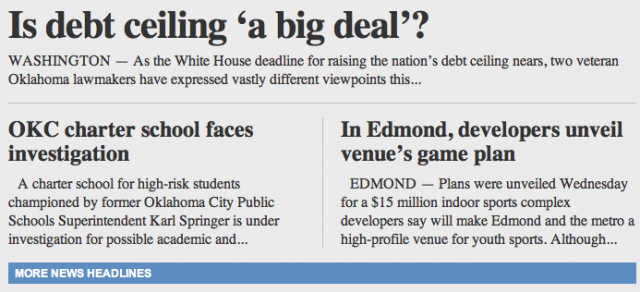
The top headline in my local newspaper, the Oklahoman:

ScreenShot2013-10-10at80936AM_zps8a56c22e.png


Le sigh.
 
Words can't describe how disturbed I am by this situation. I never thought anybody would be so hellbent against the idea of Healthcare reform. I really hope everybody who's upset about this remembers the bullshit that caused it to happen.
The electorate has a short and foggy memory, but this one is going to stick for a while. You can't have your party set a new all-time low for approval without the reason why getting through some skulls.
 
Yea, reading the article again, it looks like a way to get Obama to the negotiating table without the republicans giving up leverage. It...actually seems kinda fair? Though maybe that's just fatigue over this whole thing.

One thing that concerns me is if Reid tries to shelve this bill if it passes on the senate side. If that happens, I guarantee there won't be enough votes for the dischrage petition this Saturday, as it'll just upset and unify the GOP further.

Why do people keep saying "negotiating table"? There is NOTHING to negotiate. There is a law in place, one that was further legitimized in the Supreme Court. There is nothing to negotiate.

If they don't like the bill, they need to go through the established processes to get it off the books. Just like every single other law that's been put into effect for the past two hundred years.

And yes, Reid should outright reject the "partial" debt compromise. They shut the government down. They can't pick and choose only funding what they think will help them politically. It's all or nothing. Shit or get off the toilet.

"Negotiation table". Jesus.
 
Fuck that, I'd like a paycheck sometime in the inevitable future.

Yeah, wife is a 17 year govt contractor with the DoD, just found out the company that currently holds their contract has a clause built in so they don't have to provide back pay in the event of govt closure, so the sooner this shit is done, the better.
 
Yeah, wife is a 17 year govt contractor with the DoD, just found out the company that currently holds their contract has a clause built in so they don't have to provide back pay in the event of govt closure, so the sooner this shit is done, the better.

Your wife won't fall under the back pay issue that just passed congress?
 
Your wife won't fall under the back pay issue that just passed congress?

Not if the company she's contracted through decides not to pay it, no. She's been told by a few people they have it worded in their contract with the Fed so that they're not required to.

Won't know for sure until she's actually back at work, but it doesn't sound promising.
 
Hahahaha at that proposal, holy shit, they are fucking dumb.

Under the plan, the Treasury Department wouldn’t be able to use so-called extraordinary measures to further extend borrowing authority, creating a hard six-week limit, said two aides requesting anonymity to discuss the proposal.

"Ok we agree to lose now, if you agree to lose forever after."

Obama should tell them to fuck off. This debt limit is no different than the others, no need for special treatment.
 
Hahahaha at that proposal, holy shit, they are fucking dumb.


"Ok we agree to lose now, if you agree to lose forever after."

They're essentially saying "If you agree to this temporary fix, we'll try to take away the fix you could use to sidestep having to agree to a 6-week extension"

They have no fucking cards left in their deck to play and it's soooo fucking obvious
 
Fucking seriously? I know to many people whose livelihoods are hanging on the edge of a cliff, due to this bullshit. >:|

It feels like, if this was Europe, you would have heard about people rioting and shit like that, by this point in the game.

Is there really no loophole Obama can abuse to stop this carnival of horror?
 
They really want people to sit on their money the week before thanksgiving?

lololololol

Calling it now, smug press conference announcing a deal right before Thanksgiving full of stupid soundbytes like "we are all THANKFUL that Obama decided to negotiate" or some shit like that.

I like my federal job. I work hard at it and I feel proud to serve the public, but damnit I feel like such a pawn right now.
 
Not if the company she's contracted through decides not to pay it, no. She's been told by a few people they have it worded in their contract with the Fed so that they're not required to.

Won't know for sure until she's actually back at work, but it doesn't sound promising.

I would advise to get a lawyer to look over her contract as soon as this ends just to be safe.
 
Status
Not open for further replies.
Top Bottom