
Insecure PS4 fanboys happened.
Figures. I'm looking forward to playing this once I get a wireless controller for my PC.
Insecure PS4 fanboys happened.

SSR isn't baked, it's still real time.
No my friend , SSR is not REAL TIME. It is an APPROXIMATIVE approach to get reflections. When sth is approximative it means IT IS NOT REAL TIME.. Just like how AO is just an approximation of how shades will look like in areas that are hard to reach by light.
WTF, sorry, I miswrote it. MGS2 DID HAVE mirror reflections. PFFFF Staying awake late makes me ramble.
Well about puddle reflections in MGS2. I dont know if I can find pics. I played it and I witnessed it many times. Go play it if you have it.
Edit: I couldn't find puddle reflections on the internet , but you can see it in the first Tanker chapter outisde when it is raining. I found this (not a puddle), but enemies can still spot you due to your reflections on the ground:
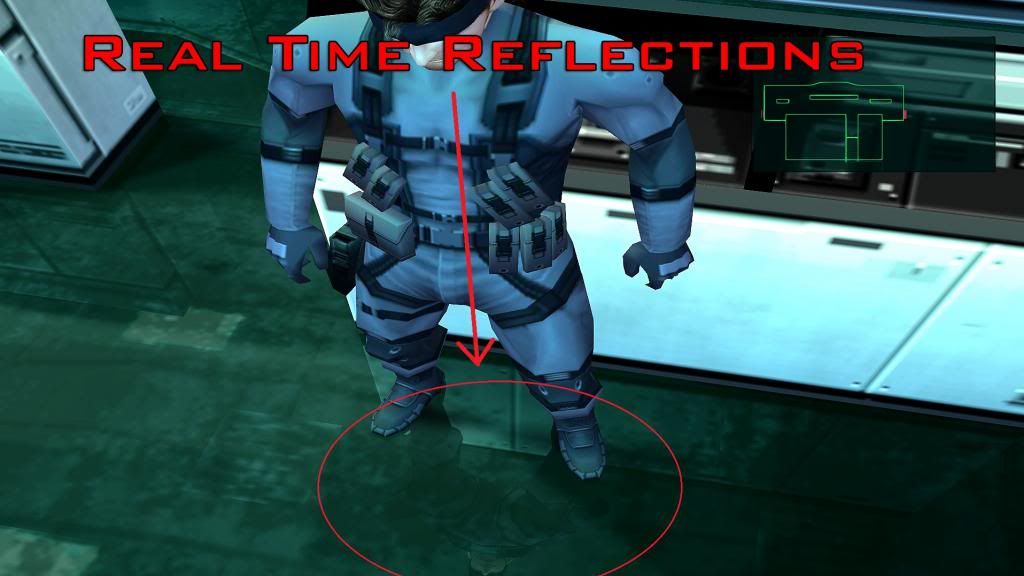
Puddles are more interesting though since sometimes you can't see your reflection in your angle of camera while enemies can see you there if the angle match their POV. It gave many WTF moments. That is why it would hvae been wiser to include gameplay elements to the puddles reflections added now in GZ otherwise they are just here to make pretty.
Just because something isn't part of an elaborate GI solution doesnt mean it isn't real time. SSR and SSAO are calculated dynamically each fame, its certainly wrong to call them baked.
You do know the pic of snake in the tanker above is him just re-drawn underneath the floor. If you have the MGS2 document disc you can freely move throughout the game and see it yourself.
That goes for all 'reflections' in MGS2. It's just the geometry redrawn in lower detail through a transparent texture.
When I say that, because they don't have direct connected calculations ot the light sources, but instead they give approximative results of what the AO and reflections could look like. So they are after effects injected later and aren't caused by the behaviour of the light soucre. Just like how static or stationary GI are done, They aren't dynamic, but they give results much betetr looking than the dynamic solutions. Dynamic solutions are very automatic, a moving GI source creates indrectly lit areas and shadows, AO locations and real time reflections so normally and moving the source just moves it the efecets it creates in real time without the need to correct them later with otehr solution since the calculations are directly tied to the source and interact with it. Sadly dynamic solutions now are really limited since they have limited diffuse directions per voxel space or limited bounces or so, that is why more static methods incorporated can give better results. So tech wise , real time reflections is more impressive, but in terms of general look (for the time being ) SSR may look better. I hope I explained it well. I talked about about dynamic GI solutions in a detailed post in
"Assassin's Creed Unity -- The graphics "leap" we've all been waiting for." thread.
Yes, I discussed that in the previous page.

You have seriously misunderstood what real-time means.No my friend , SSR is not REAL TIME. It is an APPROXIMATIVE approach to get reflections. When sth is approximative it means IT IS NOT REAL TIME.. Just like how AO is just an approximation of how shades will look like in areas that are hard to reach by light. So it is an after effect added to give the illusion of the result approximatively imagined from non dynamic GI sources. The only way to get real time AO and reflections is when to have real time dynamic GI solutions because the real time dynamic GI lights create the real time reflections and just not inject them like an after effect to correct the falws of the approximative solution. This is explained here in Nvidia VXGI tech ): http://www.geforce.com/hardware/technology/vxgi/technology
Watch the museum video here: https://developer.nvidia.com/gi-works to see Nvidia tech guy showing real time reflections results only possible now thanks to the dynamic GI solution VXGI.
and In Tomorrow Children which uses another approach to dynamic GI (that I explained in another thread) : http://goo.gl/rq9xAu
"The Tomorrow Children uses a new lighting technology named Cascaded Voxel Cone Ray Tracing, which allows to simulate lighting in real time, and uses actual real reflections, and not screen space reflections like most games."
With dynamic GI you have real time shadows and AO and reflections aas a result automatically. With static or stationary GI solutions (baked GI) , you have to add extra correction mehtods to to simulate approximative results of AO and reflections and some of them are HBAO+ and SSR (baked AO and reflections).
And I explained with an example with my previous post. If for example the puddle had time based physics and the rain could create flake in real time, reflections will be created in real time (and vice versa) if the games used a dynamic GI solution but SSR won't do that cus it is pre-defined and doesn't use real time calculations.
Looks exactly the same to me...
You have seriously misunderstood what real-time means.
Real-time is doing stuff on the fly. (and doing stuff on the fly means dynamic) Baking means AO, general lighting or reflections are pre-rendered.
Unreal 3/4 have both baked into texture (lightmass) and real-time lighting solutions. SSAO is real time, when you move objects it changes accordingly. SSR is real-time - it captures moving objects. Sphere/cube mapping is not real time, static objects show up, but nothing really moves.
All current real-time graphics techniques are approximations. You need path tracing or well configured ray tracer for fully accurate lighting with all features (caustics, refraction, GI, SSS, accurate soft shadows and more - they're all automatic there).

Some posts in here melt my brains....
Glad to see the PC version having noticeable differences outside of framerates and resolution. Cant wait to play it

Here's a very good forum post about SSR: http://www.crydev.net/viewtopic.php?p=800381&sid=ada86a66083e3c4261e314ab0749fbb0#p800381Yes, I miswrote it again. Maybe I confounded the use of words and you misinterpreted me. I meant that those techniques aren't automatic like the one you get with dynamic solutions. NVM, It is so late here so you know who it works
Here's a very good forum post about SSR: http://www.crydev.net/viewtopic.php?p=800381&sid=ada86a66083e3c4261e314ab0749fbb0#p800381
And Gamasutra article: http://www.gamasutra.com/blogs/Bart...609/The_future_of_screenspace_reflections.php
But you still didn't understand the meaning of on the fly which you counfounded with with dynamic. On the fly it means "automatic" where the source generates all the results automatically with no extra work needed from the devs. Also those tech still need to be built within the engine before getting the final rendred display while more automatic on the fly solution like the one from advanced tech. with "on the fly, automatic" solutions, you just drop the source and it does everything to the scene without anything needed to be done later, hell it can be even a component of the gameplay. It seems you didn't read or watch the videos I showed you where he talks abiout real dynamic reflections created using dynamic GI solutions like VXGI and The Tomorrow chidlren tech . There is just a use of words problem. The old techniques can get you realtime [/B ]results like reflections but not actual real reflections coming from ray-traced based solutions. So they are different
http://en.m.wiktionary.org/wiki/on_the_flyThe software program has a table of values for some results, but calculates others on the fly.
well it technically does for resolutionBut it doesn't!
Nah, I've read about it and checked the presentation out before. I also follow UE4 forum thread about it like you do. Not sure what it has to do with "on the fly".
On the fly is same as real-time in my context. It can also mean your automatic because they are words that also fits your context. I don't understand why you want to disagree with me so much here.
Dictionary has just an example I wanted:
http://en.m.wiktionary.org/wiki/on_the_fly
I'll pm you response later. I want to sleep too.with on the fly I meant that the devs have no bneed to do extra efforts for it, they just throw a tool or solution and it does do all the rest by itself. I explained sth like that in another thread. So you think the VXGI reaflections are the same as SSR? for example I explained that dynamic GI of the Tomorow children is not as automatic as the VXGI one since to use 3D textures to store data would mean that the developers would have to generate the textures, mostly by hand, prior to importing the models or assets into the game engine for their method of voxel cone tracing to work. Whereas in Nvidia's approach, the voxels are generated on the fly thanks to the voxel octree hierachy that Q-Games tried but found very slow so they opted for 3D textures, so no extra work by the artists, saving time and possibly money. They are both dynamic GI solutions using path tracing, but one is automatic on the fly (VXGI) while the otehr needs extra intervention. Yet, the devs of Tomorrow Children could add extra features like 16 diffused directions per voxel with 3 bounces with 3 types of AA while the VXGI has only few diffused directions with only one bounce. So tech wise , VXGI is more impressive since it gives automatic on the fly results with no extra efforts while the tomorow children tech looks better in the final result and eye-candy wise (VXGI could go to to The Tomorrow Children level but it will needs excessive amount of power to do that on the fly). The same can be said about SSR and the real actual reflections you get from VXGI where SSR will look crisper and with less artifacts compared to VXGI real automatic on the fly reflections. If you think that SSR is the same as reflections created on the fly by VXGI (the same is goes for SSAO and the AO created by VXGI), then you need to check that with Nvidia and everyone developing newer dynamic techs.
i think i will stick my feet in the dirt here and predict this will not be the case.Honestly aside from the minor texture and model improvements + better AA I don't see much of a difference at all. For all we know those draw distance improvements could wind up in The Phantom Pain for the PS4 because of the FOX Engine optimization.
Honestly aside from the minor texture and model improvements + better AA I don't see much of a difference at all. For all we know those draw distance improvements could wind up in The Phantom Pain for the PS4 because of the FOX Engine optimization.
Does the PC version have tessellation included?
wow. at this point i feel like i'll be turning on my ps4 like only one month every year lol.
Marginal difference at best.
Agreed. The PS4's supercharged architecture and 8 GBs of GDDR5 are really shining through here. The PS4 version is actually better for the stealthy gameplay the series is known for because all the lights are turned off, allowing Snake to brave the shadows and take out his opponents.

Agreed. The PS4's supercharged architecture and 8 GBs of GDDR5 are really shining through here. The PS4 version is actually better for the stealthy gameplay the series is known for because all the lights are turned off, allowing Snake to brave the shadows and take out his opponents.
Agreed. The PS4's supercharged architecture and 8 GBs of GDDR5 are really shining through here. The PS4 version is actually better for the stealthy gameplay the series is known for because all the lights are turned off, allowing Snake to brave the shadows and take out his opponents.

I own a ps4 and I'm very happy to see the pc version have more bells and whistle. There should be no parity. Why should PS4 be penalized by a console and why should the pc be stifled by consoles.
The PS4 version looks great compared to the PC. Going to pre-order soon, I have a couple C notes worth of PSN credits waiting to be spent.
Marginal difference at best.

Holy shit, that's huge. Was not expecting that.

