Traditional + Digital Art Self Study |OT| Wanna Start Art?
Introduction:
Welcome to the NeoGAF Art Tutorials Thread! If you are going in this thread, we hope that at least we help you inspire to take up art, either as a hobby or as a profession! I will tell you now, it will take time to learn the skills needed, but its worth it, even as a hobby! But even with that, our goal is to provide you the necessary nudges in the right direction to learn quicker and see immediate results.
Just to take note, this OP will be continually updated with more helpful resources, corrections or things to add on as we continually level up as artists ourselves. As an artist, we have to have a thirst for continuous knowledge and improvement, and we want you to have the same attitude too!
Thread Objectives:
We hope in this thread, we continually provide you with:
1. Introduction you to the Art Supplies you might need.
2. Introduce Art Fundamentals and Roadmaps in a structured way, enabling you to self study.
3. Refer you to Tutorials/Books/Classes/References/Etc that will help you in a particular material
4. Help you get through Art Block
5. Encourage one another!
6. Maybe, just maybe, befriend someone in the art/videogame industry and land a job! (And if necessary, help you of building portfolios, after all, we're on GAF).
So lets get started!
I. Basics and Art Materials
A. Talent?
First of all, let me address this myth
Being good at art IS NOT TALENT!
Being able to draw is relatively the same as learning to write, or playing a musical instrument, or even being good at games, in a sense that its something that you have to practice and sharpen. Drawing IS A SKILL, and you can only be as good as the amount of time you put at it learning and doing.
"But why does other people grasp it quicker than me?" you ask. Its because some people already develop those foundational knowledge and skills even before they are drawing. What I mean is those people have understanding of many concepts like how light works, how shapes works and many other things. It just happen that they want to apply things they already know and understood on the canvas. They are already started learning before they realized. In a sense, they really started waaay earlier than you think lol.
This shouldnt discourage you, because those knowledge and skill can be acquired by you too! When knowledge is partnered with work ethic, you can see immediate results that will surprise yourself! Yes it can be tough on the road but the rewards is enormous that you open a new world of possibilities.
So yes, do not worry about having that talent or not. What you just need to keep in mind throughout learning art (or even about learning anything) is knowledge and willpower should go hand in hand. It will be hard to improve (its even counterproductive) to draw and draw and draw countlessly without any knowledge, direction or guidance. At the same time its also as equally as bad to just read stuff without practicing.
B. Traditional Drawing Tools and Skills
Now to get started. To draw, you actually need your tools (hur). Whats good thing about it is to start traditionally, you do not really need to buy expensive tools (yet). Getting your regular #2 (HB) pencils, paper and eraser can do the job. But let me tell you this now that you can be limited at times. It doesnt mean that you can buy your way to improvement, it just means that there are times that some tools will help you do some things faster/more efficient.
Personally, I would recommend buying first a kneaded eraser. Not only this eraser is cheap, it also last waaaay long and you can shape it to whatever you like. This will be handy when erasing small details. At the price, its a must.
The other drawing tools IMO are optional, like straightedges, circle/ellipse templates, sweeps, compasses, and equal spacing divider. Most of these things seemed really essential, but its waaaaay more important to develop the skill of
DRAWING USING YOUR ELBOWS AND SHOULDERS
than to rely on these tools every time. Through practice, you can draw straight lines, organic curve lines, and perfect circles and ellipses if you get the habit of using you elbows and shoulders instead of your wrists. This is one of the most important foundational skills to have and you will use it from drawing, for both traditional and digital.
Other Helpful Links About Supplies:
Proko
https://www.youtube.com/watch?v=D_W9sZ8S7RM
https://www.youtube.com/watch?v=FoyaGaFajSU
C. Notes about Digital
Now if you have some money to spare, you might be thinking about going digital. After all, digital have apparently larger potential than drawing things traditionally. I will not deny that, but first you need to take note that even if the tools are way more powerful, it doesnt make you a better artist. You might be surprised that digital drawing can be just as frustrating to learn at times. Not only that it feels like using a completely different medium that require different sets of skills, but you also have to develop different hand-eye coordination since when you draw, you are looking at the monitor instead of the tablet itself.
Im not discouraging going to digital, Im just saying you will also need to practice to get better at it. This is why many modern artists still teach traditional because you still need those basic fundamentals with you, so if whenever you want to go to digital, you already have the things you mostly need. You can still invest on your drawing tablet, just dont forget to buy your sketchbook too!
Now, if you are really going for digital, heres a
Deviantart Guide to buying a Wacom Tablet . I personally recommend Intuos Pro Medium for starters. Not only it forces me to learn because of the price

, but its big enough for me to still draw using my elbow. Not only that, it saves money in the long run since its a quality high end tablet, saving me money for future upgrades.
For software, Photoshop and Painter are always a given, especially Painter, as its brushes are more powerful and more organic, making the transition to digital easier, and the color triangle, which IMO is something that any digital painting software should have. Photoshop is used more for editing and special effects.
When starting, what you need to take note that is very important is:
1. Calibrating your tablet. You want your tablet to be scale to real proportions as possible. One way to check is to put a circle-shaped object in your tablet and trace over it. If it draws a perfect circle, you're good.
2. Keep your workspace as similar as when you are drawing traditionally. You want to transfer as much muscle memory and skill you earned drawing traditionally to digital drawing to make it easier to transition.
These 2 are very important because you want the skills and muscle memory you gained from drawing traditionally to transfer directly to digital. These will ensure that you will have the most smooth transition you can have.
II. Building your Knowledge
Now, you have your tools ready, lets get drawing! Now where do we start?
First, before we start drawing, lets lay out a checklist of what to learn. Almost all of these topics are used on every division of art, no matter what medium you are using. As long as you know these fundamental knowledge, its just a matter of practicing the skill needed for the given medium that you have. All of these topics are so broad that it will feel like you need to take a semester or two to learn them all, and a lifetime to put them on practice. I wont lie, its probably true.
As ArtGerm told us, we should treat art as a lifestyle. Whether you are doing art as a hobby or for living, we should always be committed to it. But at the same time, once you have it, you have it for life! Its not gonna go away from you.
So if it gets intimidating, dont worry, take it one small step at a time. You cannot eat a whole elephant in one sitting. Nor learn to play an instrument overnight. Be patient young one.
A. Some Math and Physics Stuff!
First of all, we need to remember that our goal when drawing or painting is to put a 3D object into a 2D surface. A 2D plane do not have depth as a dimension, so we have to make the ILLUSION OF DEPTH in our drawings.
To understand and apply these, we need to learn some concepts that can be mathematically and physically involved. But even with that, dont be scared. Math is everyones best friend. Forget the suffering you have on your geometry teacher teaching you stuff that seems like it doesnt apply. Well, I said forget the suffering, not the topic itself lol. We will use those concepts and apply them in art! Keep using them as guides until the concept is well ingrained to a point that you can eyeball them!
P.S. if you are a bit well versed in Math, you can use these concepts with the numbers involved and make easy shortcuts and workflow in digital art!
1. Perspective
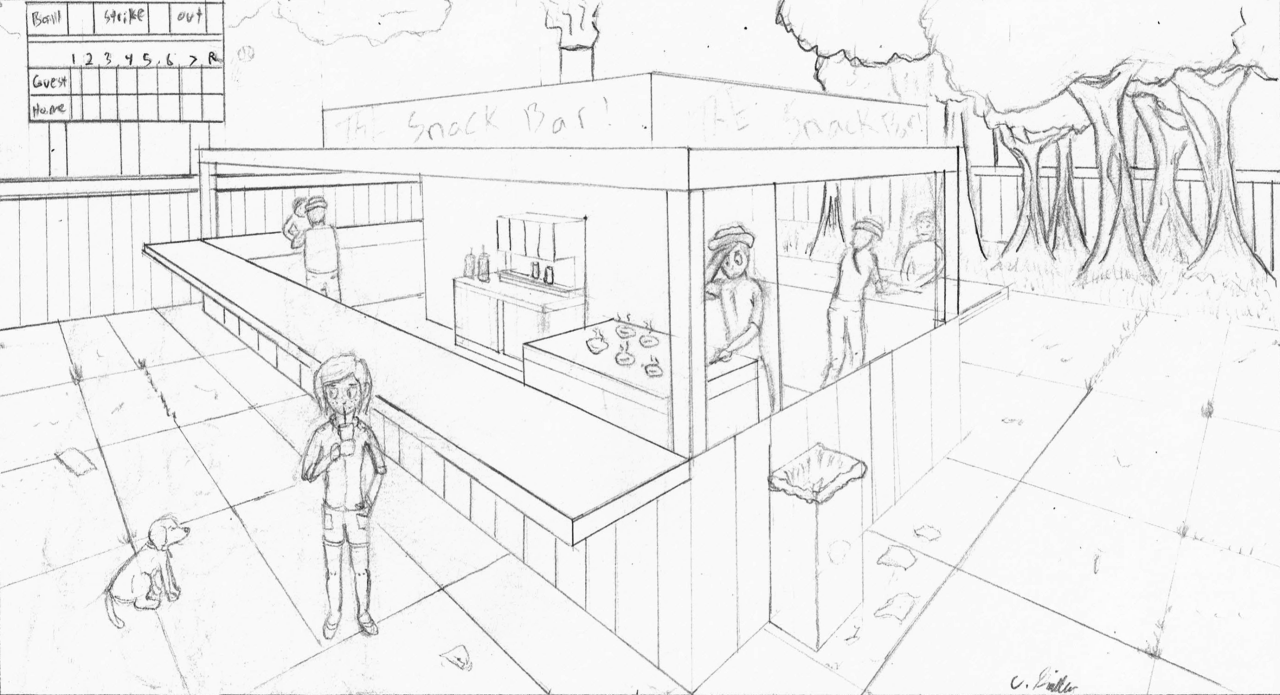
Perspective Drawing is created to make the illusion of depth using shape manipulation. It uses this basic concept that EVERYTHING THAT IS CLOSER LOOKS BIGGER and EVERYTHING THAT IS FARTHER LOOKS SMALLER. Pretty basic concept, but the applications of it booms out into a bigger subject. Understanding them gives you massive perks later on when you draw the figure especially when you deal with foreshortening.
Expected Topics include:
Rectilinear: 1,2 and 3 Point Perspective
Creating 3D Shapes on Perspective
Curvilinear Perspective
Recommended Books and Resources:
Sucessful Drawing
How to Draw
2. Color Theory
Along with perspective, we also manipulate color to make illusion of depth. But before we utilize color, we need to understand color itself. First, there are 3 primary dimensions of color. Hue, Value/Lightness/Luminousity and Chroma. There are also Relative Brightness and Saturation, which is completely different than Lightness and Chroma color space wise but it is up to you to study the difference lol.
Whats important about seeing color as a colorspace/function of 3 variables is that you can use them to give illusion of depth via form principle and athmospheric perspective. Form principle is the concept of a OBJECT GETTING BRIGHTER WHEN LIT AND DARKER WHEN ON SHADOW, and Athmospheric Perspective is the idea of a OBJECTS COLOR LOSING SATURATION AND SHIFTING HUES WITH DISTANCE AND LIGHT INVOLVED.
When starting, there will be much emphasis on Form Principle, as you will learn later, proper values will have a more impactful effect on your drawings compared to color.
Expected Topics Include:
Color Spaces
Form Principle
Additive and Subtractive Coloring
Color Key
Athmospheric Perspective
Subsurface Scattering
Contrast
many more!
Recommended Books and Resources:
Color and Light
How to Render
huevaluechroma.com
B. The Human Figure
I can safely assume that most of us who want to learn how to draw started because we want to draw a particular character/s. So we will help you do that! Drawing the Human Figure can look intimidating, but with the right knowledge and obtained skill as a foundation, it can be done by anyone, including you!
1. Portrait Drawing (Drawing the Head)
People say that the how you draw the face oftentimes can make or break your illustration, and that is mostly true. We recognize a person over another through his face, and see what they feels with their expression. Because of this, drawing the Human Head beautifully is of utmost importance when drawing.
When learning to draw the human head, it is important to have the skill of simplifying it first into basic shapes, a spherical mass for the cranium and a box shape for the jaw. Simplifying the head will allow you to look at the drawing on a larger scale, measure the proportions right, use perspective properly, and shade/render them accordingly.
Expected Topics Include:
Mass Conception of the Head
Head Proportions
Drawing Facial Features
Drawing Hair
Facial Anatomy + Expressions
Recommended Books and Resources:
Drawing the Head and the Hands
Figure Drawing Design and Invention
Artist Guide on Facial Expressions
Proko Portrait Drawing Fundamentals
2. Figure Drawing (Drawing the Body)
Drawing the Human Figure can be intimidating at first because of its complexity, but once you have the skill of simplifying each part first into basic shapes, the challenge becomes much easier, approachable and achievable.
You might be sick of hearing this at this point but it is of utmost importance of having the skill of seeing objects into simplified shapes (mass conception). This will be the constant theme in learning how to draw, as it allows you to tackle a seemingly complex object into something more manageable. This skill will be used not only for the human figure but to any object imaginable, both organic and mechanical.
Expected Topics Include:
Gesture
Mannequinization
Body Proportions
Measurement
Applying Perspective to Figure
Shading/Coloring the Figure
Recommended Books and Resources:
Figure Drawing for All its Worth
Vilppu Drawing Manual: Figure
Figure Drawing Design and Invention
3. Human Anatomy (for Artists)
We cannot draw what we do not know, so its pretty much important to know the things we are drawing or else we will end up drawing something that isnt up to par with our vision.
This is why we need to learn anatomy, as it will give us a reference on our designs. Knowing Anatomy will help us figure out whatever we did right/wrong in our figure, and helps us draw from imagination.
Expected Topics Include:
Human Skeletal System
More Extentive Landmarks of the Body
Origin and Insertion of Superficial and some Deep Muscles
Fat Pads
Recommended Books and Resources:
Simblet
Goldfinger
ImagineFX
Anatomy for Sculptors
4. Drapery
After all this time, we are only drawing naked people, and at some point, we gotta clothe them right? Using the foundations built with figure drawing and anatomy, we can study drapery and how drapes interact with the underlying shapes of the figure.
Expected Topics Include:
Stretch and Compress
Anatomy of Folds
Fold Types
Garments
Movement
Recommended Books and Resources:
Cliff Young
Drawing People
Of course, various Fashion, Historical, Cultural and Modern Clothing References.
C. Many Other things
When you finish the fundamental subjects above, you can now confidently go to the venture that you want! As you become fundamentally solid skill, mindset and knowledge wise, it will be a smoother transition to whatever art department you want to venture. You might venture with many of them depending on your project or tastes, and its okay. We should be lifelong learners anyway!
1. Traditional Painting with different mediums
When learning drawing, you are trained to emphasize shapes and values first, and thats for a reason. Once you get that basics down, the usual next step is to go to learn painting and dealing with color, and with that, possibilities explode that it can be overwhelming if you do not have the basics down. With painting, you will extensively use your color theory along with other things previously learned when drawing. You will also get familiarized with different paint mediums (primarily acrylics, oils and watercolor) and learn skills like paint mixing.
2. Animal Drawing
Of course, not everytime we will draw a human. There will be times where we will draw our animal companions alongside our figure, or even human/animal hybrids. If you are well versed with the skills and knowledge gained with Drawing the Human Figure and Human Anatomy, learning to draw animals gets easier, as you apply the same principle of simplifying the animal figure with basic shapes, and the anatomy of animals can be surprisingly related to the human anatomy!
3. Vehicle Designs and Architecture
Not everything you will draw and paint will be organic, especially when you are doing sci-fi. You will oftentimes draw buildings and cars, ships, planes, and even robots. Practicing drawing these will gain you extensive drafting skills and good sense of design. These will put your perspective skills to the test!
4. Fashion
Its good to learn to draw clothed people, but it will be more appealing to draw people in better looking clothes. This will apply many skills you gained in figure drawing (including gesture and drapery, and to some extent, hairstyles). All the options you have are infinite! From old times to modern fashion, from each country with different cultures and fashion, you can study them and make inspired characters with dazzling design!
5. Landscape Art
Many people love Landscape Painting, as there is nothing more relaxing than going to a place and painting nature. When doing Landscape Painting, you can create settings that set moods like peacefulness, colorfulness, dullness or gloom. Creating those settings are important even if you are not a full pledge landscape artist!
6. General Science for Artists
When you want to venture into animation, its important to learn a little bit of Physics to have a reference of what works in reality. Having that reference/guide of what happens for real will enable us to have a parameter when exaggerating. We can make movements stick to realistic or we can go Dragon Ball Z if we like depending on what do we want to portray. Even if you are not animating, its still a good thing to study Physics to make dynamic and moving poses believable.
Expected Topics Include:
More Extensive Color Theory
Mechanics (Movement)
Illusions
Recommended Books and Resources:
7. 2D Animation
Now, as you have the proper knowledge of movement, the problem comes in on how will it be expressed in a 2D medium. With animating, you will learn the concept of animation through rapid succession of drawings called frames. And you will learn efficient ways to draw dynamic movement, from key frames and in betweens.
8. Comics and Manga
Of course, each of us want to draw on a particular style. Some will want to draw Comics, and some will want to draw Manga. Despite that, its still important to draw realistic at first so we will have a good reference (The real world). When we have that reference, we will be able to decipher what looks believable and why is it believable. With that foundational knowledge, we can see that each style (whether its cartoons, caricatures, comics or manga) is just a stylized version of what we see in reality, and it will enable us to make sound judgments when drawing. When we get that foundation, we can easily go to a favored style quite easily.
Aside from stylization, if you plan to actually make strips, you need to learn proper organization and composition of your strips and speech balloons, planning your setting, and general writing skills, among with other things, with the goal of readability, beauty, storytelling and expression in mind.
Recommended Books and Resources:
9. 3D Modeling/Sculpting
Cause why not? The 3D medium is general have great advantages in animation and film over 2D animation, but it also requires different physical skillset. Dont let the skillset requirement stop you from learning it! 3D Art can also be used to enhance your 2D drawings and illustrations! Yes, 3D software requires different physical skillset compared to drawing, but the foundational skills is still there, like mass conception, color theory, and anatomy. 2D and 3D as a medium have advantages and disadvantages, and its good to diversify our skillset!
Expected Topics Include:
3D Modeling
Texturing
Rigging
Recommended Books and Resources:
III. Resources!
A. Video Tutorials/Livestreams
B. Books
C. Art Models
Posting Guidelines
Because of the Nature of the Materials itself, it can be avoidable to have links that are NSFW. This is why it's important to mark whatever nude or glamour related links as NSFW and decribe fully what's in the link.