Oculus Rift - Dev Kit Discussion [Orders Arriving]

Anaglyph and adjustable field of view. But how would you craft? Is the resolution low enough that you could float the HUD for crafting/inventory in the centre of the screen, or would you need some kind of virtual crafting table?


Good point. I'm sure they could render the crafting menu in a way that's comfortable (in terms of "distance") but the resolution might make it difficult to implement.

I'm reeeaaally excited to get my devkit but I'm really worried about the low res screen significantly detracting from the experience. Just hoping it's not as bad as I think and maybe I'll be pleasantly surprised.
 
I'm very hyped now. If supports is really that amazing, I'm going to grab a consumer version in a heartbeat.
 
https://developer.oculusvr.com/forums/viewtopic.php?p=1144

Hey everyone,

To clarify all this:

Those slides were from our business/vision presentation at Nvidia's GTC conference. The information from that presentation (dates, concepts, projections, etc...) represent our vision, ideas, and on-going research/exploration. None of it should be considered fact, though we'd love to have that projected revenue!

A lot of people have been asking about the rendering of the headset in particular. That's one of many concepts of what the consumer version of the Rift might look like, but we haven't finalized anything for the consumer version yet. We're still in the drawing/concept stage.

Sorry for any confusion this may have caused! We have a lot of exciting projects underway to make Oculus virtual reality more compelling. More official information will be revealed when it's nailed down.

Shameless plug: If you're interested in working with us to make this vision a reality, email us at careers@oculusvr.com!

Thanks again,

-- Nate
nmitchell
 Team Oculus

No direct mention of this second developer kit.
 
Good point. I'm sure they could render the crafting menu in a way that's comfortable (in terms of "distance") but the resolution might make it difficult to implement.

I'm reeeaaally excited to get my devkit but I'm really worried about the low res screen significantly detracting from the experience. Just hoping it's not as bad as I think and maybe I'll be pleasantly surprised.

stereo 3D minecraft is awesome (check out 'MessiahAndrw's Renderer Wrapper'), but my 3DTV has quite a lot of ghosting, so fingers crossed for it on the rift.
 

Via that video (which is amazing, in that it totally solves two of the biggest problems with the Rift right now even though the solutions still aren't perfect), I found this video about an homemade omnidirectional treadmill prototype that is being made by some company. There;s gonna be a Kickstarter for it soon.

http://www.youtube.com/watch?v=FxwknXZ_fR0

Might not catch on as much as the Rift did, but it's really cool that the future described in the novel Ready Player One is pretty much becoming reality. Now we only need a revamp of the powerglove and the game Destiny to be as ambitious as it claims to be + have support for all this VR-stuff.
 
Well he's not actually involved much with Minecraft development these days, so we should be grateful that he intends to personally look into OR support for it. It's top of my list for things I'd like to try out with the dev kit so I can't wait; although my dev kit is probably months away sadly.

I know that, I just think it's iffy how he makes it seems like Minecraft having Occulus support hangs in the balance of him 'taking a shot at it'.
 
https://developer.oculusvr.com/forums/viewtopic.php?p=1144


No direct mention of this second developer kit.

Actually more optimistic about this now. If they're not locked into a firm date for the second kit, maybe it does mean they're hoping to get the final resolution (1080p... even if it has to be in 7 inch form right now) and motion tracking.

Obviously a 1080p panel would be out the window until Google finally announces the new 1080p Nexus 7 (and the market starts getting flooded with available purchasing options). So they'd definitely need to be in a holding pattern until the dominoes start falling.
 
Got a chance to try it for about an hour yesterday. It was quite impressive, but also quite limited, the resolution really does look low.

The most impressive thing is how you can sit in place and just move your head around to watch the scene you're in. That kind of experience is spot-on almost (minus the LCD blurring). Problem start when you start moving. It's extremely easy to get dizzy and nauseous from just simply moving around. Strafing is bad, and moving your head in one direction while rotating the view in the other direction is total disaster which should be avoided as much as possible.
 
I thought the Razer Hydra was supposed to be backordered by a few weeks, but I think my order only went in a couple of days ago and it's now shipped, yay.

I still need to build a huge new computer by the time the Rift gets here, though...the 680 sounds like a powerful card, but it's hard for me to justify $500 on a card. I spent far too much, like $300+, on a single 5850 last time I upgraded, and now people consider the 5850 to be trash or whatever. =P
 
I thought the Razer Hydra was supposed to be backordered by a few weeks, but I think my order only went in a couple of days ago and it's now shipped, yay.

I still need to build a huge new computer by the time the Rift gets here, though...the 680 sounds like a powerful card, but it's hard for me to justify $500 on a card. I spent far too much, like $300+, on a single 5850 last time I upgraded, and now people consider the 5850 to be trash or whatever. =P

Get 7870, or if you have more money, find a good deal for 7970 with 1000+ mhz clock.
 
Get 7870, or if you have more money, find a good deal for 7970 with 1000+ mhz clock.
The one thing I've decided next time I build a computer or get a new graphics card is that I'm going nVidia. I don't care how good the AMD performance may be, and I've had a 4850 and 5850 for the last 5 years or so -- game support and driver issues and better features on nVidia seem to be par for the course. I don't like PhysX but that's also something I couldn't typically have. Maybe I'll regret it, but I'm going to at least try an nVidia card to see how the experience goes. =P

I'm also avoiding SLI since that seems to be a very common area for bugs or lack of support to show up.
 
The one thing I've decided next time I build a computer or get a new graphics card is that I'm going nVidia. I don't care how good the AMD performance may be, and I've had a 4850 and 5850 for the last 5 years or so -- game support and driver issues and better features on nVidia seem to be par for the course. I don't like PhysX but that's also something I couldn't typically have. Maybe I'll regret it, but I'm going to at least try an nVidia card to see how the experience goes. =P

I'm also avoiding SLI since that seems to be a very common area for bugs or lack of support to show up.

Really isn't a whole lot of difference between a 670 and 680. If money is an issue, don't waste it on a 680.

And if you think 300 dollars is too much, even the 660ti is a damn fine card (although it may or may not have issues with extreme supersampling).
 
Ghosting doesn't exist when you have one discrete display for each eye.

I know, thats one reason I'm looking forward to the rift. I had a HMZ-t1 for a short while and it was very impressive. But my 3DTV is less impressive (still fun to play with though)
 
Hey Die, while we are at it, what's the fastest passive cooled card? ATI or
nVidia doesn't matter.

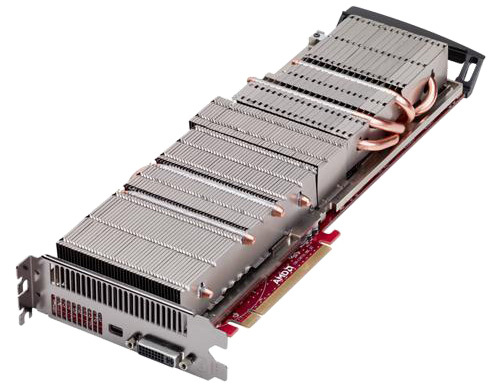
Fastest passive is AMD Radeon Sky 900, professional grade GPU that costs 1-2K bucks [price is not confirmed, but it should be cheaper than Nvidia professional cards]. Its a dual 7950 with 6GB DDR5 and 480GB/s of bandwith. :D
radeon-sky-900jaaye.jpg


As for normal cards... i think there is few 7770 or 78xx models out there. Not sure. if you have space in your case, you can buy custom passive coolers. Even maybe for gtx680
https://www.google.com/search?num=1...urce=og&sa=N&tab=wi&ei=_YM3UK6lEIf2sgb75oG4AQ
 
Given that Oculus just had a presentation with Team Green, I'd probably lean toward Nvidia for an Oculus-focused rig.

With the somewhat obscure tweaks that are suggested to reduce latency on the Rift (example: This PA Report article suggests forcing games to buffer less frames), I would not be shocked to see a partnership develop. Nobody's going to want to tell consumers to muck about in advanced settings; the endgame is probably a "VR Mode" that gets invoked by video card drivers when the Rift is activated and does all the tweaking for you.
 
I know, thats one reason I'm looking forward to the rift. I had a HMZ-t1 for a short while and it was very impressive. But my 3DTV is less impressive (still fun to play with though)
Rift however has *MASSIVE* LCD motion ghosting. It's part of the technical problems that plague the thing, unfortunatelly. Even the smaller head movements result in in pretty bad picture blurring.

Technical negatives: Pixels size / big screen door effect / LCD motion blurring
Other negatives: Motion sickeness when you move around while you body stands still

Technical negatives should all be solvable pretty soon, but motion sickness part is really big problem and I just don't know how many people will be willing to put up with it. It's a problem that doesn't really seem solvable as it probably comes from your inner ear not detecting any physical motion, while your whole field of view moves. The best you can do to prevent this is just move forward and rotate your whole body to steer, so it feels like you're in the car, but even then there's no sense of acceleration / deceleration so even that feels sort of 'wrong'.
 
I'm really curious if I'll experience any motion sickness with the Rift. I've never ever had any game-induced motion sickness, regardless of game, FoV, or playing with 3D vision for 7 hours. Anyway, the inner ear disconnect is technically solvable with galvanic vestibular stimulation. We'll get there.

Fastest passive is AMD Radeon Sky 900, professional grade GPU that costs 1-2K bucks [price is not confirmed, but it should be cheaper than Nvidia professional cards]. Its a dual 7950 with 6GB DDR5 and 480GB/s of bandwith. :D
radeon-sky-900jaaye.jpg
That's not a passively cooled card, that's a card without a fan because the server rack it will be put into has enough of them :P
 
Rift however has *MASSIVE* LCD motion ghosting. It's part of the technical problems that plague the thing, unfortunatelly. Even the smaller head movements result in in pretty bad picture blurring.

Technical negatives: Pixels size / big screen door effect / LCD motion blurring
Other negatives: Motion sickeness when you move around while you body stands still

Technical negatives should all be solvable pretty soon, but motion sickness part is really big problem and I just don't know how many people will be willing to put up with it. It's a problem that doesn't really seem solvable as it probably comes from your inner ear not detecting any physical motion, while your whole field of view moves. The best you can do to prevent this is just move forward and rotate your whole body to steer, so it feels like you're in the car, but even then tehre's no sense of acceleration / decelleration so even that feels sort of 'wrong'.


blurring doesn't sound good - the panel is supposed to be better than the previous one too.

Big pixels I can live with.

the motion thing is the most interesting thing for me. How to move in a game where you're clearly not physically moving.
 
blurring doesn't sound good - the panel is supposed to be better than the previous one too.

Big pixels I can live with.

the motion thing is the most interesting thing for me. How to move in a game where you're clearly not physically moving.
Trust me, blurring is pretty bad. Big pixels also sounds better than it really is. There's huge visible screen door between them, and it also makes the whole picture blurrier than you'd expect.

However, when you sit in place and look around, you can kind of forget about those problems, and it really feels like you're sitting in some different, albeit a bit crappy looking place.
 
Fastest passive is AMD Radeon Sky 900, professional grade GPU that costs 1-2K bucks [price is not confirmed, but it should be cheaper than Nvidia professional cards]. Its a dual 7950 with 6GB DDR5 and 480GB/s of bandwith. :D
radeon-sky-900jaaye.jpg
Oh lol!

As for normal cards... i think there is few 7770 or 78xx models out there. Not sure. if you have space in your case, you can buy custom passive coolers. Even maybe for gtx680
https://www.google.com/search?num=1...urce=og&sa=N&tab=wi&ei=_YM3UK6lEIf2sgb75oG4AQ
Will have a look. Thanks.
 
I don't think you really need some crazy card for this at all. We were able to run TF2 in OR mode at solid 60FPS on some office computer here that definitely doesn't have crazy GPU.

All you need is to get it working at 1280x800, anything above that doesn't do any good. I tried rendering the demo scene with the house and garden in 1920x1080, and I really couldn't see any difference whatsoever. Any kind of antialiasing you get from this is going to be lost with how blurry the picture appears anyway due to screen door.
 
Technical negatives should all be solvable pretty soon, but motion sickness part is really big problem and I just don't know how many people will be willing to put up with it.

The technical details of this are a bit beyond me (something to do with your brain not being entirely fooled because of the delay of moving your head vs. the view updating) but my understanding is that several people (John Carmack being one of them) thinks reducing head-tracking latency is going to go a long way toward solving the motion sickness problem.

I don't think you really need some crazy card for this at all. We were able to run TF2 in OR mode at solid 60FPS on some office computer here that definitely doesn't have crazy GPU.

All you need is to get it working at 1280x800, anything above that doesn't do any good. I tried rendering the demo scene with the house and garden in 1920x1080, and I really couldn't see any difference whatsoever. Any kind of antialiasing you get from this is going to be lost with how blurry the picture appears anyway due to screen door.

I think a lot of people are trying to plan for the future (more demanding games + expected 1080p of consumer model) but I don't know how wise this is. A lot can happen between now and the launch of the consumer product. At the very least, I'd see what the first wave of indie games and driver hackery does, see what benefits and drawbacks occur with various hardware setups.

Edit: As a totally feasible example, when latency testers start shipping people are going to inevitably start comparing video card models and the tweaks they afford. What if it turns out ATI or Nvidia hold a huge performance advantage in this area? You are not going to want to find out you picked the wrong team after dropping 500+ on a card.
 
I don't think you really need some crazy card for this at all. We were able to run TF2 in OR mode at solid 60FPS on some office computer here that definitely doesn't have crazy GPU.
To be fair, TF2 is probably one of the least demanding modern games, and it has native support. Playing a more demanding game, and potentially with modded support, will be a different ballgame in terms of performance.
 
To be fair, TF2 is probably one of the least demanding modern games, and it has native support. Playing a more demanding game, and potentially with modded support, will be a different ballgame in terms of performance.

yeah. framerate costs in 3D can be pretty high from experience.
 
Rift however has *MASSIVE* LCD motion ghosting. It's part of the technical problems that plague the thing, unfortunatelly. Even the smaller head movements result in in pretty bad picture blurring.

Technical negatives: Pixels size / big screen door effect / LCD motion blurring
Other negatives: Motion sickeness when you move around while you body stands still

Technical negatives should all be solvable pretty soon, but motion sickness part is really big problem and I just don't know how many people will be willing to put up with it. It's a problem that doesn't really seem solvable as it probably comes from your inner ear not detecting any physical motion, while your whole field of view moves. The best you can do to prevent this is just move forward and rotate your whole body to steer, so it feels like you're in the car, but even then there's no sense of acceleration / deceleration so even that feels sort of 'wrong'.

It's definitely inner ear/brain related. I remember people were having this complaint with even the HMZ-T1. Although, personally, I could torture test myself with impunity. Whipping my head around never bothered me. Of course, I didn't really find the thing immersive, either, so it's not like I ever believed I was there. I was always aware I had this thing strapped to my head and was looking through a tunnel at a screen with the FOV of my desktop monitor. So maybe that's why my brain didn't object.

I think this is why people like Abrash and Carmack harp so much on motion latency. And how VR motion would benefit immensely from 120hz refresh rates. It all comes back to removing the barriers that cause the brain to yell "bullshit".
 
Really isn't a whole lot of difference between a 670 and 680. If money is an issue, don't waste it on a 680.

And if you think 300 dollars is too much, even the 660ti is a damn fine card (although it may or may not have issues with extreme supersampling).
Thanks for the feedback, people. $300 for a GPU is on the expensive side in my opinion, but not unreasonable if it's high end that might last for 2-3 years. $600 for a GPU is a bit steep in my opinion, however. :P

I tried looking for the 680 and 670, and as far as I could tell newegg doesn't even SELL the 670 anymore. Anyway, I can take this sort of thing to the build your own PC thread when I start putting things together.

Ghosting doesn't exist when you have one discrete display for each eye.
What was causing the reticule ghosting in that camera-filmed TF2 video? Was it purely a camera artifact, and direct feed TF2 with the Rift doesn't have it any sort of ghosting?
 
What was causing the reticule ghosting in that camera-filmed TF2 video? Was it purely a camera artifact, and direct feed TF2 with the Rift doesn't have it any sort of ghosting?

It doesn't have crosstalk ghosting is what I think people are talking about.

The screen itself, however, is an old POS that apparently has lots of ghosting for everything. But that's not related to 3D crosstalk.
 
It's definitely inner ear/brain related. I remember people were having this complaint with even the HMZ-T1. Although, personally, I could torture test myself with impunity. Whipping my head around never bothered me. Of course, I didn't really find the thing immersive, either, so it's not like I ever believed I was there. I was always aware I had this thing strapped to my head and was looking through a tunnel at a screen with the FOV of my desktop monitor. So maybe that's why my brain didn't object.

I think this is why people like Abrash and Carmack harp so much on motion latency. And how VR motion would benefit immensely from 120hz refresh rates. It all comes back to removing the barriers that cause the brain to yell "bullshit".

Regardless of the refresh rate - if your eyes see you moving and your inner ear doesn't feel the same motion, you'll have potential issues
 
The technical details of this are a bit beyond me (something to do with your brain not being entirely fooled because of the delay of moving your head vs. the view updating) but my understanding is that several people (John Carmack being one of them) thinks reducing head-tracking latency is going to go a long way toward solving the motion sickness problem.
You will see actually, this is the one thing that OR has successfully solved. They are using predictive head tracking, so when your head starts moving around They initially predict and speed up the direction of movement for that brief moment where there would otherwise be lag. In the Unity demo that ships with the device, you can disable this predictive behaviour, and see that without it, there's lag. With it enabled, the problem is as good as gone though. This makes for a very acceptable experience when you're just sitting in place and looking around.

However:
Regardless of the refresh rate - if your eyes see you moving and your inner ear doesn't feel the same motion, you'll have potential issues
This is the problem. It's completely related to what you see to be moving vs. your inner ear reporting that no movement of the body is happening. Refresh rate is not a probem on Rift at all. In fact, the LCD they use blurs a lot already at 60FPS, so having it at 120FPS wouldn't help at all.

This is disconcerting as every single person in the office who tried this reported varying levels of motion sickness after just a minute or so of using it. The guy who owns it played TF2 on and off for about an hour, and then had to lay down for while before he felt he was ready to drive home. He's the kind of person who plays FPS games non-stop btw, and has no problem with motion sickness from them whatsoever.

I can pretty much guarantee that just turning your head to the left while at the same time moving the view to the right would make anyone dizzy within seconds.
 
I've played TF2 with mine for an hour+ at a time a few times over the weekend and I didn't have any motion sickness or negative effects of any kind. My wife lasted like 30 seconds in the Tuscany demo before she had to take it off, though.
 
Regardless of the refresh rate - if your eyes see you moving and your inner ear doesn't feel the same motion, you'll have potential issues

You will see actually, this is the one thing that OR has successfully solved. They are using predictive head tracking, so when your head starts moving around They initially predict and speed up the direction of movement for that brief moment where there would otherwise be lag. In the Unity demo that ships with the device, you can disable this predictive behaviour, and see that without it, there's lag. With it enabled, the problem is as good as gone though. This makes for a very acceptable experience when you're just sitting in place and looking around.

However:

This is the problem. It's completely related to what you see to be moving vs. your inner ear reporting that no movement of the body is happening. Refresh rate is not a probem on Rift at all. In fact, the LCD they use blurs a lot already at 60FPS, so having it at 120FPS wouldn't help at all.

This is disconcerting as every single person in the office who tried this reported varying levels of motion sickness after just a minute or so of using it. The guy who owns it played TF2 on and off for about an hour, and then had to lay down for while before he felt he was ready to drive home. He's the kind of person who plays FPS games non-stop btw, and has no problem with motion sickness from them whatsoever.

I can pretty much guarantee that just turning your head to the left while at the same time moving the view to the right would make anyone dizzy within seconds.

In hindsight, I did make kind of a disjointed point. The point was simply that you must have accurate motion. When your head moves, the screen must move with it (this says nothing of the problem of looking one way and flicking the controller the other way).

And in that regard, even 50 ms is too much to be completely believable. At this stage this is the least of the Rift's problems, but from a long term position, motion latency is incredibly important to VR becoming viable and accepted for long term use. For achieving sub-20ms motion latency, which seems to be the minimum for ideals, 120hz is a part of the long term solution.

I was talking more long term. Obviously Rift is just the first step and a dev kit. It's not close to solving those and has more immediate issues.
 
Are there any advantages to the Oculus' method of doing 3D with one big screen and optics as opposed to two smaller screens like the HMZ-T1? Just curious as to what this might mean for future models.
 
Are there any advantages to the Oculus' method of doing 3D with one big screen and optics as opposed to two smaller screens like the HMZ-T1? Just curious as to what this might mean for future models.

The FOV and the recent availability of cheap, high-res panels for cell phones and tablets are the two big ones I think.
 
Got a chance to try it..

..quite limited...

..the resolution really does look low..


..Problem start when you start moving. ..

..Strafing is bad..

..moving your head in one direction while rotating the view in the other direction is total disaster which should be avoided as much as possible.....

In summary this sounds dreadful.
 
With the OR screen being shared/split, is there a chance your right eye will inadvertently see the edge of the left eye image and vice versa?
 
In summary this sounds dreadful.

Well, half of that summary might be personal deficiencies (no offense) It seems that it might be something that would take time to get acclimated to. I know the article about valve implementing it in team fortress 2 said that some people would get sick and it would take them time to get used to it.
 
Well, half of that summary might be personal deficiencies (no offense) It seems that it might be something that would take time to get acclimated to. I know the article about valve implementing it in team fortress 2 said that some people would get sick and it would take them time to get used to it.
Ten or so people in the office tried it replicating my experience pretty much verbatim. If there was anyone who felt differently about it, I'd say that for sure. I do think it gets better with using it more however. There was someone posting above how he didn't have much problem with it.

Problem is, the fact that these issues happen means that you just can't expect true, natural virtual experience out of this, no matter how much the technology improves. Not if you want to zip around in your games, anyway. The most you can hope for is to get used to something that never feels quite natural.
 
Ten or so people in the office tried it replicating my experience pretty much verbatim. If there was anyone who felt differently about it, I'd say that for sure. I do think it gets better with using it more however. There was someone posting above how he didn't have much problem with it.

Problem is, the fact that these issues happen means that you just can't expect true, natural virtual experience out of this, no matter how much the technology improves. Not if you want to zip around in your games, anyway. The most you can hope for is to get used to something that never feels quite natural.

As Palmer says, we're at Day Zero.

A first step towards that issue is probably just disabling camera movements. If you disable left/right controller movement, that would go a long way towards that particular issue. Controller allows you to move forward/back, and everything else is controlled by head movement. That and better motion, better latency, and screens that don't smear will go a long way towards addressing things.

I'm certainly not discouraged by anything I've read here, but I've also never believed this would be a superior option to my 120hz 3D monitor I'm currently using. At least until, at the very minimum, the first consumer device was ready.

I think this was the biggest problem with people posting all those positive first impressions. A five minute, controlled demo can absolutely wow. And blow people away with a glimpse of the future. But this thing has always been just a dev tool so that actual developers would have something to test things with.
 
So far today, the Tuscany demo just makes (nearly) everyone sick, very quickly.

TF2, though, has seen a lot more success. Definitely start with that. It reaffirmed my wavering faith. =)
 
Problem is, the fact that these issues happen means that you just can't expect true, natural virtual experience out of this, no matter how much the technology improves.
Galvanic vestibular stimulation.

I've played TF2 with mine for an hour+ at a time a few times over the weekend and I didn't have any motion sickness or negative effects of any kind. My wife lasted like 30 seconds in the Tuscany demo before she had to take it off, though.
Yeah, I'd expect this to differ greatly from person to person. Palmer said he can use it for hours without negative effects.
 
Top Bottom