
You are using an out of date browser. It may not display this or other websites correctly.
You should upgrade or use an alternative browser.
You should upgrade or use an alternative browser.
The "Impossible" Engine is real, NASA says so!
- Thread starter Cragvis
- Start date
- Status
- Not open for further replies.
Where we're going...we won't need eyes to see!

Moar!!1

unholyrevenger72
Banned
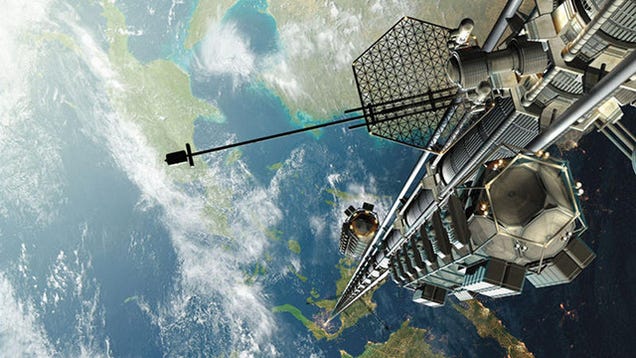
The Impossible Engine is fine and Dandy, but the only way to make space exploration a financially viable thing is by making it cheap to get into orbit. So get crackin on the space elevators
unholyrevenger72
Banned
So imagine if this scales? Even faster speeds?
ehh, more like better acceleration.
Quoted from the internetz:
Nasa scientists talking about this:
http://forum.nasaspaceflight.com/index.php?topic=36313.0
I'm not sleeping tonight lol
EDIT: as i read about it this is just impossible. It would give infinite energy and violate the relativity as there would be a preferential frame.
Their current belief is that the thruster 'pushes' against a 'quantum' particle plasma - those quantum particles getting in and out of existence, a closed object would still be able to produce thrust (the particle ceasing to exist before hitting anything else in the engine which could result in a reverse reaction) now, to get proof of that and prove those theories, that's another problem
Nasa scientists talking about this:
http://forum.nasaspaceflight.com/index.php?topic=36313.0
I'm not sleeping tonight lol
EDIT: as i read about it this is just impossible. It would give infinite energy and violate the relativity as there would be a preferential frame.
ThoseDeafMutes
Member
The Impossible Engine is fine and Dandy, but the only way to make space exploration a financially viable thing is by making it cheap to get into orbit. So get crackin on the space elevators
http://i.kinja-img.com/gawker-media/image/upload/s--g3a_UZVx--/c_fit,fl_progressive,q_80,w_636/18enfuwsagjl5jpg.jpg[img][/QUOTE]
Space elevator may never be viable. I would be piggybacking off military laser research to do a feasibility study on laser ablative propulsion for both orbit-to-orbit and surface-to-orbit transfers.
Also, nuclear verne gun for massive, non-delicate cargo transfers. Basically you get a large underground cavern, fill it with water, build a barrel up to the surface, and set off a nuclear weapon in the water. You wind up with the world's largest steam propulsion system capable of launching objects of enormous mass.

 . If a comet or whatever hits that thing..
 Icyflamez96
Member
I'm happy seeing this thread bumped.
Exciting times.
Yeah I could have sworn if this topic were bumped, it'd be bad news...
Okay, so I'm no physics major. Can you break it down and tell me what speed 1 KG of matter could be accelerated with the thrust you quoted.
Also, does this engine appear to be scalable? Can larger ones that draw more power be built and producer greater speeds? If a ship with this engine was built and powered by the smallest nuclear reactor we can build, how fast could it potentially go? I'm thinking of something around the size of a Seawolf-class nuclear submarine.
That's not a thrust, that's thrust per unit power. But theoretically, with a kilowatt (1000 J/s) even over a day, a ship could reach some pretty insane speeds, around 34 km/s. Over 44 days it could accelerate to ~ 1500 km/s, or .5% the speed of light.
Of course, those were just some quick calculations. The actual calculations are not that simple, and the ship wouldn't be nearly that light. Hell the actual machine would probably weigh more than that.
So does the thrust increase infinitely with scale?
I don't think thrust can ever increase infinitely. As you approach the speed of light you start to gain less and less thrust each time.
Uncle_Classy
Member
Reading about this thing is hell of exciting and really makes me hope that I'm living in the time when humanity is on the precipice of some major space faring revolution. Hopefully something actually comes of this technologically and theoretically.
D
Deleted member 80556
Unconfirmed Member
That seems to have been addressed in this recent test:
Oh my God, what to feel, WHAT TO FEEL?!
I need more information, and I need it now, I'm feeling the hype! So why would NASA be on blackout about this, when they only had like 5 people working on this? Where do we even get the information that China is working hard on this? ineedthereceipts.gif
The Impossible Engine is fine and Dandy, but the only way to make space exploration a financially viable thing is by making it cheap to get into orbit. So get crackin on the space elevators
http://i.kinja-img.com/gawker-media/image/upload/s--g3a_UZVx--/c_fit,fl_progressive,q_80,w_636/18enfuwsagjl5jpg.jp g[/im g][/QUOTE]
Not with our carbon fiber technology according to Elon Musk.
So why exactly would this make a trip to Mars so fast?
It wouldn't, this is just one of the technologies factions within NASA are using to try and sabotage any realistic Mars mission because there isn't actually any political will within NASA to do a Mars mission in the first place. We could do the mars mission today(well ~10 years prep time) with chemical or nuclear propulsion, but there are people who either don't want to do it, or are more interested in justifying their research budgets than they are in actually doing anything interesting.
It's just like VASIMIR, except at least VASIMIR could theoretically provide for faster mars transit times if you assume the power source and the rest of the spacecraft is effectively massless. In the real world with real technologies that we currently have, the power source for a VASIMIR drive would be so massive that it completely negates any advantage it would have over chemical rockets.
If this drive is actually verified and confirmed to work, it seems more useful for more long distance journeys than it would be for a Mars mission, but it's hard to tell as we don't even have a theoretical explanation for the observed effect, much less and actual idea as to the kind of engineering that would be required to scale this up into something useful.
All of these propulsion research projects are worth doing, because they are useful for things like deep space probes and they may discover things that we can't predict, but by trying to tie their propulsion systems into a potential Mars mission they basically ensure that it will never happen.
If we want to go to Mars, we should go to Mars, not wait around for some new technology that may never pan out.
Oh my God, what to feel, WHAT TO FEEL?!
I need more information, and I need it now, I'm feeling the hype! So why would NASA be on blackout about this, when they only had like 5 people working on this? Where do we even get the information that China is working hard on this? ineedthereceipts.gif
Not with our carbon fiber technology according to Elon Musk.
According to everyone who knows anything about carbon fiber, you mean. At minimum a space elevator will require the ability to produce flawless graphene ribbons or carbon nanotubes in large scale. That material should be theoretically strong enough, but we obviously lack the technology to manufacture it in the quantities required, much less to be able to make it on site in space.
Even if we had the material though, it is not entirely settled that a space elevator would be the best use for it, as compared to a mag lev launch loop or a skyhook or some other system that would require much smaller orbital masses(making them more affordable and less potential for catastrophic accidents).
A space elevator on the moon or Mars would be an excellent first step though because of the lower gravity. IIRC a space elevator could be done on the Moon with commercially available kevlar today, if we really wanted to.

Melon Husk
Member
9 months to Saturn? Well alright then. You'd still need to send a 2MW nuclear reactor up from Earth, and the EMDrive wouldn't help with that at all. Edit: Oh, I like the solar sail design.
Space elevators ARE crock
The best of luck to Sonny White!
Space elevators ARE crock
without materials we can't make yet.
The best of luck to Sonny White!
hipbabboom
Huh? What did I say? Did I screw up again? :(
Also, nuclear verne gun for massive, non-delicate cargo transfers. Basically you get a large underground cavern, fill it with water, build a barrel up to the surface, and set off a nuclear weapon in the water. You wind up with the world's largest steam propulsion system capable of launching objects of enormous mass.
Literally everything about this idea sounds insane

Pie and Beans
Look for me on the local news, I'll be the guy arrested for trying to burn down a Nintendo exec's house.
Aliens/time travellers have simply deemed us okay to travel further in the next ten years and so have unlocked the next layer of physics we can now access and manipulate.

Damerman
Member
lmao... thats really imaginative.Also, nuclear verne gun for massive, non-delicate cargo transfers. Basically you get a large underground cavern, fill it with water, build a barrel up to the surface, and set off a nuclear weapon in the water. You wind up with the world's largest steam propulsion system capable of launching objects of enormous mass.
Damerman
Member
So if they build this thing in space and it works would people be okay using it as a means of conveyance without fully understanding why it works?
shit, i would...it doesn't stop people from continuing research on it.
D
Deleted member 80556
Unconfirmed Member
According to everyone who knows anything about carbon fiber, you mean. At minimum a space elevator will require the ability to produce flawless graphene ribbons or carbon nanotubes in large scale. That material should be theoretically strong enough, but we obviously lack the technology to manufacture it in the quantities required, much less to be able to make it on site in space.
Even if we had the material though, it is not entirely settled that a space elevator would be the best use for it, as compared to a mag lev launch loop or a skyhook or some other system that would require much smaller orbital masses(making them more affordable and less potential for catastrophic accidents).
A space elevator on the moon or Mars would be an excellent first step though because of the lower gravity. IIRC a space elevator could be done on the Moon with commercially available kevlar today, if we really wanted to.
Oh yeah, absolutely. I don't even want to imagine the magnitude of a catastrophe involving a space elevator on Earth. Would probably cripple the space industry for many years in the minds of the general population, I think.
Also, I feel kind of lectured on something I already knew hahaha. I was mentioning Musk as someone that people immediately identify heh.
The Shogun
Banned
How freaky would it be if we end up building a large version of this that works flawlessly and we still didn't know why the hell it worked.
Like we are flying around something in space and don't actually know how we are doing it.
Like we are flying around something in space and don't actually know how we are doing it.
Oh yeah, absolutely. I don't even want to imagine the magnitude of a catastrophe involving a space elevator on Earth. Would probably cripple the space industry for many years in the minds of the general population, I think.
Also, I feel kind of lectured on something I already knew hahaha. I was mentioning Musk as someone that people immediately identify heh.
Yeah, I wasn't trying to lecture anyone, just noting that it's a scientific fact that carbon fiber is about an order of magnitude away from being strong enough for a space elevator, and for clarity I didn't want anyone to think that it was just some guy(who has vested interests)'s opinion.
I think we should definitely be already doing regular Mars missions with the goal of permanent colonization within the next 50 years, and we should be using the systems developed for that to have a permanent station on the moon from which we can experiment with things like space elevators and skyhooks in a lower gravity setting, so we would be ready when the materials are developed that are strong enough for earth gravity. We could be doing all of these things with current technology with only a modest(less than 50%) increase in the current NASA budget. Could do it within the current budget if there was the political will required to focus everyone on the task instead of everyone trying to justify their own pet projects.

Trickster
Member
This has probably been asked and answered, but it is a long damn thread.
If this works, is this engine transferable to trains, plane and automobiles or does this work only in space?
From my understanding the thrust you get from this is absolutely miniscule, so friction of really any kind would render it totally useless. The reason it could potentially be used for space travel is because space is a vacum with nothing to slow you down, so even a miniscule amount of thrust will be able to accelerate you.
Damerman
Member
Thats what im trying to figure out. I watched a presentation by Shawyer on the emdrive and he proclaims that it can do vtol from the surface of the earth to outer space. He said that this is how surface to surface travel would work: take off vertically to outer space and then travel to where you want to land from space and land vertically. It confused because i was wondering why we cant just fly within earths gravitational pull.This has probably been asked and answered, but it is a long damn thread.
If this works, is this engine transferable to trains, plane and automobiles or does this work only in space?
Now im reading about how nasa is making this work in a vacume.
Thats what im trying to figure out. I watched a presentation by Shawyer on the emdrive and he proclaims that it can do vtol from the surface of the earth to outer space. He said that this is how surface to surface travel would work: take off vertically to outer space and then travel to where you want to land from space and land vertically. It confused because i was wondering why we cant just fly within earths gravitational pull.
Now im reading about how nasa is making this work in a vacume.
The theory is that future generations of this technology will utilize superconductors which would be able to generate significantly more thrust and may eventually be able to be used within the atmosphere. At this point it's all just hypotheticals.
Is this how the Event Horizon is created?
That would be a Einstein Rosen Bridge.
The theory is that future generations of this technology will utilize superconductors which would be able to generate significantly more thrust and may eventually be able to be used within the atmosphere. At this point it's all just hypotheticals.
So, the cars of the future will be hover cars with a superconductor and an EmEngine strapped onto it? Sweet.
foxuzamaki
Doesn't read OPs, especially not his own
Time relative to people on earth or passengers on a space craft moving near the speed of light?
Time relative to people on earth. How long before we really can start exploring the universe more than our own solar system.
Poodlestrike
Banned
Can we all just agree that having NASA even remotely working on something called a "Quantum Vacuum Plasma Thruster" is probably one of the coolest things you've ever heard?
So damn cool.
I also owe Star Trek writers an apology. Yesterday's technobabble is tomorrow's technology.
ThoseDeafMutes
Member
Literally everything about this idea sounds insane
lmao... thats really imaginative.
It's fucking insane. Yet there are no obvious reasons it couldn't work, other than it seeming like some kind of lunacy at first glance. People did some preliminary calculations, and a single ten mengatonne bomb would propel 280,000 tonnes into orbit. You can obviously go smaller than this, with KT yield devices.
To give a sense of scale, ol' Nyrath has the following to say:
I say "sails into orbit", but of course it is more like "slammed by thousands of gs of acceleration", so this has to be unmanned (any human beings on board would instantly be converted into a thin layer of bloody chunky salsa covering the deck plates). But 280,000 tons? That's about one thousand International Space Stations, an entire Space Elevator (see below), an entire Lunar colony, an orbital fuel depot that would make future NASA missions ten times cheaper, a space station the size of the one in the movie 2001 A Space Odyssey, or about one-tenth of a ecologically clean 1.5 terawatt solar power station.
So, so far, this is holding up to scrutiny?
For reals?
As far as I can tell the new news here is that the same guy and the same apparatus that got the thread started in the first place did another experiment except this time in a vacuum. So I wouldn't really call it "holding up to scrutiny". Pretty much all of the same reasons to be skeptical still apply, and this isn't a new, independent replication.
It's fucking insane. Yet there are no obvious reasons it couldn't work, other than it seeming like some kind of lunacy at first glance. People did some preliminary calculations, and a single ten mengatonne bomb would propel 280,000 tonnes into orbit. You can obviously go smaller than this, with KT yield devices.
To give a sense of scale, ol' Nyrath has the following to say:
Of course, the reality is until with have a significant population of spacefaring humans, we really have no need to relocate that much mass from earth to orbit, so it's kind of a chicken or egg thing. I can see the technique being more useful for potential asteroid mining operations though. A small nuke in the right place at the right time can direct a M-type asteroid worth trillions of dollars right into earth orbit. That is what I call return on investment.
I'm filing this with Rossi until some more rigorous and completely detached tests can be performed. I hate hearing "only one problem with the tests" and that problem ends up being the crux of the issue (ie. Vacuum for the Emdrive, Rossi being involved in independent testing of his cold fusion device.)
ThoseDeafMutes
Member
Of course, the reality is until with have a significant population of spacefaring humans, we really have no need to relocate that much mass from earth to orbit, so it's kind of a chicken or egg thing. I can see the technique being more useful for potential asteroid mining operations though. A small nuke in the right place at the right time can direct a M-type asteroid worth trillions of dollars right into earth orbit. That is what I call return on investment.
We have no need of 280,000 tonnes of cargo in orbit at the moment, but a smaller scale version would absolutely have applicability to current needs. Even if only used once or twice, getting thousands of tonnes into orbit is the kind of thing that can kick-start space infrastructure projects.
Elfforkusu
Member
One more variable down, though.As far as I can tell the new news here is that the same guy and the same apparatus that got the thread started in the first place did another experiment except this time in a vacuum. So I wouldn't really call it "holding up to scrutiny". Pretty much all of the same reasons to be skeptical still apply, and this isn't a new, independent replication.
Next: do a test outside earth's magnetic field!
superdeluxe
Member
So how close to being possible is this impossible engine? 50/50 this works out?
We have no need of 280,000 tonnes of cargo in orbit at the moment, but a smaller scale version would absolutely have applicability to current needs. Even if only used once or twice, getting thousands of tonnes into orbit is the kind of thing that can kick-start space infrastructure projects.
There are two problems with that idea. Nuclear contamination and being able to set off a nuke without causing an international incident.
I'm pretty sure if we tell everyone we're doing it, it'll be okay. We used to test nukes all the time. This is for SCIENCE.There are two problems with that idea. Nuclear contamination and being able to set off a nuke without causing an international incident.
So why exactly would this make a trip to Mars so fast?
Constant propulsion slowly but surely accelerating you to high speeds. Engine sounds like quackery though.
- Status
- Not open for further replies.