The "Impossible" Engine is real, NASA says so!

Status
Not open for further replies.
I don't think thrust can ever increase infinitely. As you approach the speed of light you start to gain less and less thrust each time.

It only looks that way to an external observer due to time dilation. The perspective of the passengers on the ship has a more direct effect on their age and fuel expenditure, and in their view they can continue to accelerate linearly. Factor in length contraction and they can travel even farther in the same amount of their own time.

Aside from the enormous energy cost, you can't do this indefinitely because time dilation will make the universe age more and more quickly compared to the passengers on the ship. You can never reach the speed of light because the closer you get, the faster you approach the end of the universe.

If I could pick any mode of death, that would be it.
 
So what's the numbers of reaching another star, like say:

Kepler-62 - 1,200 ly
Kepler-186 - 149 ly
Kepler-438 - 470 ly

Using the quantum engine stuff?
Assume other technology that exist currently (be it nuclear or whatever)
 
So basically if this technology allows for infinite movement, that should translate to infinite heat and electricity, no? Since movement can be converted to heat or electricity.

For those trips taking hundreds of years it would keep the multiple generations in light and warm. For Earth, why not beam some of those spoils back down from space.

This unlock seems a bit early for our tech level.
 
This unlock seems a bit early for our tech level.

"Our civilization is producing infinite energy with our 320,274,540 population. Now thats efficiency!!"

wOAsSey.jpg
 
So basically if this technology allows for infinite movement, that should translate to infinite heat and electricity, no? Since movement can be converted to heat or electricity.

For those trips taking hundreds of years it would keep the multiple generations in light and warm. For Earth, why not beam some of those spoils back down from space.

This unlock seems a bit early for our tech level.

You still need energy to accelerate, you just don't need to use burn fuel. It's not a perpetual motion machine.

It currently consumes electricity to generate thrust, trying to reconvert that to electricity would be a net loss. It's not generating any additional energy.
 
So what's the numbers of reaching another star, like say:

Kepler-62 - 1,200 ly
Kepler-186 - 149 ly
Kepler-438 - 470 ly

Using the quantum engine stuff?
Assume other technology that exist currently (be it nuclear or whatever)

We'll never reach those. I mean this engine doesn't give us light speed movement. And the nearest one on your list is still 149 LY away.
 
I'm sorry if this has been mentioned before, but am I reading this right? Was this not tested in a vacuum? So how do we know this would generate any thrust in space?
 
So why exactly would this make a trip to Mars so fast?

Being able to eliminate reaction mass from rocketry would be a massive game changer. Can achieve greater delta-v than potentially WRT chem rockets.

So what's the numbers of reaching another star, like say:

Kepler-62 - 1,200 ly
Kepler-186 - 149 ly
Kepler-438 - 470 ly

Using the quantum engine stuff?
Assume other technology that exist currently (be it nuclear or whatever)

Lets throw out a generous 1KN thrust that is constant pushing a 1000 Kg probe.
a= 1m/s^2
To achieve V=0.5c it takes ~4.76 years, will have traveled 1.19 lys in that time. Maintaining that blistering speed, only about 296 more years after that to reach Kepler-186!
 
You still need energy to accelerate, you just don't need to use burn fuel. It's not a perpetual motion machine.

It currently consumes electricity to generate thrust, trying to reconvert that to electricity would be a net loss. It's not generating any additional energy.

it is producing energy: because over a certain speed, it is adding energy (in the form of the whole vehicle going even faster) more quickly than it is consuming it. If the accelerative force is constant.

If the motion could be converted back to electricity, it would be more than you input. And that is why it has people confounded.
 
You still need energy to accelerate, you just don't need to use burn fuel. It's not a perpetual motion machine.

It currently consumes electricity to generate thrust, trying to reconvert that to electricity would be a net loss. It's not generating any additional energy.

No the problem is that if you have massless propulsion you either:

- create infinite energy and mass from nothing

or

- violate the relativity principle because of the existence of at-rest frame

Let me be more clear.

Imagine this thing work, and create about 1 N of thrust for each 50 kW into it. Now, put this in a spaceship, and start accellerating, while incredibly slowly but accellerating constantly. Since kinetic energy is not linear but the square power, at a point you'll give more energy to the moving mass than you're imputing in in eletric energy:

since K = 1/2 mv^2

And we're giving a constant A = N/m

there come a point where K-K0 = 1/2 mv^2 - 1/2mv0^2 = deltaE
with deltaE > 50kW

Congratulation, you've just invented a machine that create energy from nothing. This is all way sub-relativistic, so there's no change in inertial mass either.

But wait, you argue that the machine get less efficient as the machine goes faster? That can't be because from the point of view of the drive, it's always at rest. As such, the machine feeling a different total thrust while moving faster is impossible because it would violate relativity, as in there would be different apparently inertial frames where physical laws act differently.

The "solution" that is proposed to this is a sort of derivation from mach principle: what happen when you create thrust using this method is that you're actually using the gravitational universal potential and pushing yourself against it, actually moving the universe to the opposite side. In short, the universe has a preferential frame, the quantum vacuum, and all you're actually doing is actually pushing against the universe using virtual positrons-electrons pairs momentum to do so.

This sound all cool until you realize that this has even greater implications: we're already in motion in respect to the universe frame, so in theory you could just create a rocket that is moving at a negative velocity in respect to the universal frame. It's just a matter of choosing the right direction. And what happen to this rocket if you put a EMdrive on it? It absorb energy from the vacuum (or the universe if you prefer) and create it here. Even worse, this mean that you can even create negative and positive energy, it's just a matter of choosing a frame of reference.

In short if this is true it either:

- create infinite energy and matter from the vacuum, violating energy conservation, and momentum conservation

- create infinite energy and matter taking it from the rest of the universe (conservate total energy and mass), violating locality and momentum conservation

There's no way it actually work like it does now. If it does, i expect this work only on earth because of the possibility of pushing against earth static EM field, which would not violate energy and momentum conservation but would still be pretty cool.

 
Being able to eliminate reaction mass from rocketry would be a massive game changer. Can achieve greater delta-v than potentially WRT chem rockets.


Lets throw out a generous 1KN thrust that is constant pushing a 1000 Kg probe.
a= 1m/s^2
To achieve V=0.5c it takes ~4.76 years, will have traveled 1.19 lys in that time. Maintaining that blistering speed, only about 296 more years after that to reach Kepler-186!
That's not too bad actually, for travel to a whole other star.
Obviously something you'd need deep freeze hibernation or multi-gen starships for, but it's doable.
 

Hm, interesting. I haven't had time to look at the specifics of how this works, I should have done my research before commenting. I assumed that the other poster misunderstood the lack of fuel requirements, I didn't realize the alleged properties of this engine were so unusual.
 
Also, nuclear verne gun for massive, non-delicate cargo transfers. Basically you get a large underground cavern, fill it with water, build a barrel up to the surface, and set off a nuclear weapon in the water. You wind up with the world's largest steam propulsion system capable of launching objects of enormous mass.

Then, once in space, you can unleash the atomic bombed powered Project Orion drive (yes named after me ;p).
 
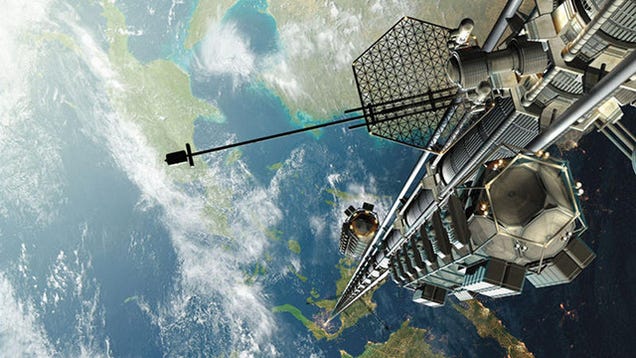
The Impossible Engine is fine and Dandy, but the only way to make space exploration a financially viable thing is by making it cheap to get into orbit. So get crackin on the space elevators
18enfuwsagjl5jpg.jpg

Obayashi want to have one constracted by 2050. Let's hope that the challenges with graphene and all that jazz is overcome so that I can have my graphene capacitors and space elevators.
 
Then, once in space, you can unleash the atomic bombed powered Project Orion drive (yes named after me ;p).

Regrettably, the orion drive's high thrust and low specific impulse (compared to nuclear electric drives etc) means that the most effective context for using it is... to escape atmosphere. Which is exactly the place we'd never be allowed to use it :P
 
Oh, so it's just the same group again with a new result on the same apparatus and still no independent confirmation? What's the big deal then? This force is still far from being confirmed to be unexplainable by current theories.

While it would indeed be great and interesting if true, my money is on the effect being something utterly simple that has been overlooked when building the experiment. Like a Lorentz-force due to earth's magnetic field and some unaccounted current (After all they are pumping kW of electric energy through this thing).
 
No the problem is that if you have massless propulsion you either:

- create infinite energy and mass from nothing

or

- violate the relativity principle because of the existence of at-rest frame

Let me be more clear.

Imagine this thing work, and create about 1 N of thrust for each 50 kW into it. Now, put this in a spaceship, and start accellerating, while incredibly slowly but accellerating constantly. Since kinetic energy is not linear but the square power, at a point you'll give more energy to the moving mass than you're imputing in in eletric energy:

since K = 1/2 mv^2

And we're giving a constant A = N/m

there come a point where K-K0 = 1/2 mv^2 - 1/2mv0^2 = deltaE
with deltaE > 50kW

Congratulation, you've just invented a machine that create energy from nothing. This is all way sub-relativistic, so there's no change in inertial mass either.

But wait, you argue that the machine get less efficient as the machine goes faster? That can't be because from the point of view of the drive, it's always at rest.

I disagree with the argument. It seems to me that the same argument will apply to a standard fuel propelled rocket. You are consuming a fixed amount amount of energy per second, and fixed acceleration. There is no contradiction because the rocket also loses mass, so the total increase in kinetic energy will never be more than the input.

the same argument also applies for 'massless' propulsion. The rocket, by consuming energy, also loses mass due to mass energy equivalence. You are assuming that this loss in apparent mass cannot counter balance the increase in velocity to make sure conservation of energy is preserved.
 
I disagree with the argument. It seems to me that the same argument will apply to a standard fuel propelled rocket. You are consuming a fixed amount amount of energy per second, and fixed acceleration. There is no contradiction because the rocket also loses mass, so the total increase in kinetic energy will never be more than the input.

the same argument also applies for 'massless' propulsion. The rocket, by consuming energy, also loses mass due to mass energy equivalence. You are assuming that this loss in apparent mass cannot counter balance the increase in velocity to make sure conservation of energy is preserved.

The problem is that the loss of mass would be a fixed quantity too because your engine work at the assumption that 50KW = 1 N of thrust, while the increase of kinetic energy increase with speed, even if the system is still at rest in its reference frame. So there's always a speed where the energy lost is less than the energy produced since one change linearly and the other with the square power.
 
The problem is that the loss of mass would be a fixed quantity too because your engine work at the assumption that 50KW = 1 N of thrust, while the increase of kinetic energy increase with speed, even if the system is still at rest in its reference frame. So there's always a speed where the energy lost is less than the energy produced since one change linearly and the other with the square power.


You forget the mass lost is travelling with the ship. The rate of loss of mass is constant in the proper frame, but to an outside observer this mass that is lost is travelling at a velocity v together with the ship. The ship therefore loses energy quadratically with velocity increase because of the mass lost. This is sufficient to counterbalance the rate of increase of energy due to thrust.

You have to make a distinction between the energy used by the engine which is in the proper frame, and the actual energy lost as seen by an outside observer seeing an accelerating ship.
 
I disagree with the argument. It seems to me that the same argument will apply to a standard fuel propelled rocket. You are consuming a fixed amount amount of energy per second, and fixed acceleration. There is no contradiction because the rocket also loses mass, so the total increase in kinetic energy will never be more than the input.

the same argument also applies for 'massless' propulsion. The rocket, by consuming energy, also loses mass due to mass energy equivalence. You are assuming that this loss in apparent mass cannot counter balance the increase in velocity to make sure conservation of energy is preserved.
My gut raised a similar question. In the perfectly classical normal case of a rocket, after using the engine, the kinetic energy of the rocket plus the kinetic energy of the reaction material is increased by the amount of energy you just used to push things, assuming a "perfect efficiency" rocket. So the system energy doesn't change. This ability to account for a big difference in rocket KE with a big difference in reaction material KE when at high speeds falls apart when there's no reaction material.

But...

You forget the mass lost is travelling with the ship. The rate of loss of mass is constant in the proper frame, but to an outside observer this mass that is lost is travelling at a velocity v together with the ship. The ship therefore loses energy quadratically with velocity increase because of the mass lost. This is sufficient to counterbalance the rate of increase of energy due to thrust.

You have to make a distinction between the energy used by the engine which is in the proper frame, and the actual energy lost by an outside observer seeing an accelerating ship.
...Hmm.

Edit: Just to set my mind at ease, I did some plugging and chugging with basic SR formulas. Hypothetical case: 1kg object can perfectly convert itself to KE, and will do so over the course of 1 second, so rest mass is (1-t). Used the basic KE relationship KE=m((1/sqrt(1-v^2))-1) to get an expression for velocity of an object with mass (1-t) and KE (t). Plugged that into the expression for the KE of an object with m=(1-t). The result was, sure enough, KE=t (at least for t from 0 to 1, outside of that the question is bullshlapskie). So the overall system energy was constant, RESTMASS+KE = (1-t)+t = 1.
 
You forget the mass lost is travelling with the ship. The rate of loss of mass is constant in the proper frame, but to an outside observer this mass that is lost is travelling at a velocity v together with the ship. The ship therefore loses energy quadratically with velocity increase because of the mass lost. This is sufficient to counterbalance the rate of increase of energy due to thrust.

You have to make a distinction between the energy used by the engine which is in the proper frame, and the actual energy lost as seen by an outside observer seeing an accelerating ship.

So let's suppose 5 GW for 100N of thrust. A perfectly efficient nuclear reactor which convert mass at a 1% rate create this energy. Let's say the fuel is 1Kg and the weight of the ship is 1 ton.

At start we have:

E=mc^2 in both reference frames

The engine can produce a total of 9*10^14 J, which power a 5 GW engine for 1.8 *10^8 seconds. 100 N of thrust on a mass of 1 ton generate a constant accelleration of 0,1 m/s^2. That multiplied for the time for a non-relativistic approximation: 1.8 *10^7 m/s, or 18000 Km/s. So we're working with way sub-relativistic speeds and the effects of mass variance in reference frame is order of magnitudes smaller than the mass.

From an observer from earth the observed mass is not 1 ton anymore but has lost 10 grams of weight or 9*10^14 J of energy. The kinetic energy of the ship at the end is, non-relativistically since we're at an insignificant fraction of c:

E=1/2mv^2 = 1.62 *10^17 J

3 orders of magnitude greaters than the energy mass lost from the pov of the earth observer. This approximation should have less than 1% difference from real energy-mass results since we're working with speeds that are less than 0.1c (6% c max speed tbe).

From the observer in the ship nothing has changed and the mass-energy of the system is still 1ton *c^2.

Sadly i'm not versed in GR and i can't verify such a calculation in that frame. However, given that we work in extremely sub-luminal context, the calculations for kinetic energy and lost mass shouldn't change signficantly (again, at 10% the speed of light, the variations are of the order of 1%, at 6%, less than 0.3% difference). In short, relativistic effects of mass variations are still insignificant compared to the hypotetical absurd creation of kinetic energy that such a system would entail. If a thrust can be created without reaction mass, you're essentially stealing energy from the universe to move, there's no way around it. Momentum could still be conserved, but energy wouldn't be in a local sense. That, or ether exist.

I'd like if someone could point out the fault in my reasoning.
 
I disagree with the argument. It seems to me that the same argument will apply to a standard fuel propelled rocket. You are consuming a fixed amount amount of energy per second, and fixed acceleration. There is no contradiction because the rocket also loses mass, so the total increase in kinetic energy will never be more than the input.

the same argument also applies for 'massless' propulsion. The rocket, by consuming energy, also loses mass due to mass energy equivalence. You are assuming that this loss in apparent mass cannot counter balance the increase in velocity to make sure conservation of energy is preserved.

We're assuming constant thrust per energy spent, not constant acceleration. The acceleration would be inversely proportional to the decreasing rest mass. The reason a rocket doesn't work that way is because it obeys conservation of momentum, which causes thrust to decrease at higher velocities.

A simpler way to see why a reactionless drive like that violates energy conservation is the opposite thought experiment:
Pick a universe where only this engine exists, and choose an intertial frame in which it's moving with a speed v and has kinetic energy mv^2 / 2. Let the ship accelerate in the opposite direction until it comes to a stop. By your own argument the ship decreases its rest mass to accelerate, so now it has rest mass m' < m and zero kinetic energy. Because there's no reaction mass, nothing containing energy leaves the ship and the energy has simply vanished.
 
We're assuming constant thrust per energy spent, not constant acceleration. The acceleration would be inversely proportional to the decreasing rest mass. The reason a rocket doesn't work that way is because it obeys conservation of momentum, which causes thrust to decrease at higher velocities.

A simpler way to see why a reactionless drive like that violates energy conservation is the opposite thought experiment:
Pick a universe where only this engine exists, and choose an intertial frame in which it's moving with a speed v and has kinetic energy mv^2 / 2. Let the ship accelerate in the opposite direction until it comes to a stop. By your own argument the ship decreases its rest mass to accelerate, so now it has rest mass m' < m and zero kinetic energy. Because there's no reaction mass, nothing containing energy leaves the ship and the energy has simply vanished.

I'd argue that doesn't make sense because of mach principle : inertial mass and motion don't make sense in an empty universe.

EDIT: to clarify i'm not saying don't make sense in an absolute sense, but that if we accept a framework where a massless propulsion exist, it probably mean that it work in using some derivation of the Mach principle.
 
We're assuming constant thrust per energy spent, not constant acceleration. The acceleration would be inversely proportional to the decreasing rest mass. The reason a rocket doesn't work that way is because it obeys conservation of momentum, which causes thrust to decrease at higher velocities.

A simpler way to see why a reactionless drive like that violates energy conservation is the opposite thought experiment:
Pick a universe where only this engine exists, and choose an intertial frame in which it's moving with a speed v and has kinetic energy mv^2 / 2. Let the ship accelerate in the opposite direction until it comes to a stop. By your own argument the ship decreases its rest mass to accelerate, so now it has rest mass m' < m and zero kinetic energy. Because there's no reaction mass, nothing containing energy leaves the ship and the energy has simply vanished.

I dont get you argument that nothing containing energy leaves the ship. An easy way out of this is the following . You can simply radiate heat outwards. Because radiation in all directions induces no net acceleration on the ship, it is not a propellant and does not contribute to the deceleration of the ship. This will explain the decreased rest mass of the ship. The fact that the engine produces heat coincides neatly with the 2nd law of thermodynamics.

also,an argument based on acceleration will work for thrust as well. Thrust just induces time dependent acceleration, and you can always slice the time interval thin enough such that over each infinitesimally small time interval, acceleration is constant. Thats fundamental calculus. So i believe my arguments still make sense.
 
I dont get you argument that nothing containing energy leaves the ship. An easy way out of this is the following . You can simply radiate heat outwards. Because radiation in all directions induces no net acceleration on the ship, it is not a propellant and does not contribute to the deceleration of the ship.

also,an argument based on acceleration will work for thrust as well. Thrust just induces time dependent acceleration, and you can always slice the time interval thin enough such that over each infinitesimally small time interval, acceleration is constant. Thats fundamental calculus.

So if i'm understanding this correctly, you're saying that the energy giving thrust are photons that the ship irradiate? Photons thrusters at perfect efficiency can give out only 300 MW/N. The proposed thrusters discussed here give 50 uN for 50 W or 1 MW/N, 300 times as much. Simple radiation from the craft can't give that much thrust.
 
So let's suppose 5 GW for 100N of thrust. A perfectly efficient nuclear reactor which convert mass at a 1% rate create this energy. Let's say the fuel is 1Kg and the weight of the ship is 1 ton.

At start we have:

E=mc^2 in both reference frames

The engine can produce a total of 9*10^14 J, which power a 5 GW engine for 1.8 *10^8 seconds. 100 N of thrust on a mass of 1 ton generate a constant accelleration of 0,1 m/s^2. That multiplied for the time for a non-relativistic approximation: 1.8 *10^7 m/s, or 18000 Km/s. So we're working with way sub-relativistic speeds and the effects of mass variance in reference frame is order of magnitudes smaller than the mass.

From an observer from earth the observed mass is not 1 ton anymore but has lost 10 grams of weight or 9*10^14 J of energy. The kinetic energy of the ship at the end is, non-relativistically since we're at an insignificant fraction of c:

E=1/2mv^2 = 1.62 *10^17 J

3 orders of magnitude greaters than the energy mass lost from the pov of the earth observer. This approximation should have less than 1% difference from real energy-mass results since we're working with speeds that are less than 0.1c (6% c max speed tbe).

From the observer in the ship nothing has changed and the mass-energy of the system is still 1ton *c^2.

Sadly i'm not versed in GR and i can't verify such a calculation in that frame. However, given that we work in extremely sub-luminal context, the calculations for kinetic energy and lost mass shouldn't change signficantly (again, at 10% the speed of light, the variations are of the order of 1%, at 6%, less than 0.3% difference). In short, relativistic effects of mass variations are still insignificant compared to the hypotetical absurd creation of kinetic energy that such a system would entail. If a thrust can be created without reaction mass, you're essentially stealing energy from the universe to move, there's no way around it. Momentum could still be conserved, but energy wouldn't be in a local sense. That, or ether exist.

I'd like if someone could point out the fault in my reasoning.


Hmm. You probably right then. The numbers dont add up. In that case, yea, there is a contradiction. Good to learn something.
 
The problem is that the loss of mass would be a fixed quantity too because your engine work at the assumption that 50KW = 1 N of thrust, while the increase of kinetic energy increase with speed, even if the system is still at rest in its reference frame. So there's always a speed where the energy lost is less than the energy produced since one change linearly and the other with the square power.

I'm not sure that is the case if the mass of the ship changes due to energy loss. The kinetic energy only scales with t^2 if acceleration is constant. However, since thrust is constant, acceleration is a function of mass: a = T/m

If mass is constant, the velocity would simply be a*t, but mass decreases with time as you consume the stored energy since electromagnetic energy (E_em) increases the inertia, a contribution represented by the electromagnetic mass term (m_e = (4/3) * E_em / c^2) that gives a total mass of m = mO + (4/3) * E_em / c^2

If we assume constant thrust, the applied power (P) is also constant so the stored electromagnetic energy decreases linearly from the initial value: E_em = E_em(0) - P*t

This would mean that mass is actually: m(t) = m0 + (4/3) * (E_em(0) - P*t) / c^2

Integrating a = T / m(t) using substitution (if someone could check this, that would be great) gave me the following expression, using C = (3/4)*c^2 for clarity: v = (-C*T/P) * ln( C*m0 + E_em(0) - P*t)

This would mean that velocity is logarithmic with time, not linear, and the kinetic energy is proportional to the square of ln(const*m(t)).

If anyone spots any mistakes, please let me know, this was just a hasty calculation I did during my lunch break. However, I would expect the logarithmic time dependence to be correct even if there are errors since a rocket burning fuel has also has a velocity that scales with the natural logarithm of the mass. When accounting for the mass being lost due to energy expenditure, I would expect the velocity to scale similarly to a rocket losing mass from burning fuel.
 
Status
Not open for further replies.
Top Bottom