• Hey Guest. Check out your NeoGAF Wrapped 2025 results here!

AMD’s Next-Gen RDNA 5 “Radeon” Gaming GPUs Could Pack Over 12K Cores, 128 Cores Per Compute Unit

tusharngf

Member
AMD-RDNA-5-Radeon-Gaming-GPUs-Cores-F-gigapixel-low_res-scale-4_00x-Custom-1456x817.jpg


New details surrounding AMD's next-gen RDNA 5 "Radeon" gaming GPUs suggest a total of 128 cores per compute unit & over 12K on the top die.

AMD's RDNA 5 "Radeon" Gaming GPUs Rumored To Pack 128 Cores Per Compute Units, Over 12K Cores For The Flagship Configuration

According to the latest information posted by Chiphell's forum member, ZhanZhongHao, it looks like AMD's RDNA 5 GPUs will feature a total of 128 cores per compute unit. This is a drastic increase versus the existing RDNA 4 GPUs, which feature a total of 64 cores per compute unit.

As per the previous details, AMD is expected to launch at least four GPU die configurations based on its RDNA 5 graphics architecture. These will be featured within the Radeon and Radeon PRO families. These include a top-tier die with 96 compute units, a mid-tier die with 40 compute units, a low-end die with 24 compute units, and an entry-level die with just 12 compute units.

AMD-RDNA-5-Radeon-Gaming-GPUs-Cores.png


Based on the 128 cores per compute unit configuration, we should be looking at the following core counts for each respective die:

  • RDNA 5 Top Die: 96 CUs / 12,288 Cores
  • RDNA 5 Mid Die: 40 CUs / 5,120 Cores
  • RDNA 5 Low Die: 24 CUs / 3,072 Cores
  • RDNA 5 Entry Die: 12 CUs / 1,536 Cores
Currently, the AMD RDNA 4 GPUs come in two dies: the Navi 48 and Navi 44. The top Navi 48 GPU die packs up to 64 compute units and scales down to 48 compute units. The Navi 44 GPU, which is the entry-level SKU, features a total of 32 compute units and scales down to 28 compute units.

AMD made a lot of changes with its market positioning of the RDNA 4 series. The lineup only offered two dies, and went with a monolithic route, which made it more economical to manufacture, resulting in better supply than the prior RDNA 3 generation, which had some issues keeping up with supply in the early months due to its chiplet nature. Going with chiplets did have benefits from an economic point of view, but also required advanced packaging, which led to slight manufacturing delays.

Meanwhile, the RDNA 5 GPU architecture & lineup looks very similar to AMD's RDNA 2 generation, which also featured a total of four dies, scaling from 80 CUs down to 16 CUs. In a sense, RDNA 5 will be doubling the core count of Navi 31, which was the last flagship GPU with 6144 cores. This will also be a 3x increase versus the Navi 48 (RDNA 4) GPU.

Full article: https://wccftech.com/amd-next-gen-r...ck-over-12k-cores-128-cores-per-compute-unit/
 
Is this good? I want to be able to buy something that runs modern games at 4K60 without framegen or upscaling from an internal resolution of 1080p (1440p is okay I guess) for under £1000.

Are those days forever gone?
 
Is this good? I want to be able to buy something that runs modern games at 4K60 without framegen or upscaling from an internal resolution of 1080p (1440p is okay I guess) for under £1000.

Are those days forever gone?

Should be very good, yeah.

Probably 2027...
 
AMD-RDNA-5-Radeon-Gaming-GPUs-Cores-F-gigapixel-low_res-scale-4_00x-Custom-1456x817.jpg


New details surrounding AMD's next-gen RDNA 5 "Radeon" gaming GPUs suggest a total of 128 cores per compute unit & over 12K on the top die.

AMD's RDNA 5 "Radeon" Gaming GPUs Rumored To Pack 128 Cores Per Compute Units, Over 12K Cores For The Flagship Configuration

According to the latest information posted by Chiphell's forum member, ZhanZhongHao, it looks like AMD's RDNA 5 GPUs will feature a total of 128 cores per compute unit. This is a drastic increase versus the existing RDNA 4 GPUs, which feature a total of 64 cores per compute unit.

As per the previous details, AMD is expected to launch at least four GPU die configurations based on its RDNA 5 graphics architecture. These will be featured within the Radeon and Radeon PRO families. These include a top-tier die with 96 compute units, a mid-tier die with 40 compute units, a low-end die with 24 compute units, and an entry-level die with just 12 compute units.

AMD-RDNA-5-Radeon-Gaming-GPUs-Cores.png


Based on the 128 cores per compute unit configuration, we should be looking at the following core counts for each respective die:

  • RDNA 5 Top Die: 96 CUs / 12,288 Cores
  • RDNA 5 Mid Die: 40 CUs / 5,120 Cores
  • RDNA 5 Low Die: 24 CUs / 3,072 Cores
  • RDNA 5 Entry Die: 12 CUs / 1,536 Cores
Currently, the AMD RDNA 4 GPUs come in two dies: the Navi 48 and Navi 44. The top Navi 48 GPU die packs up to 64 compute units and scales down to 48 compute units. The Navi 44 GPU, which is the entry-level SKU, features a total of 32 compute units and scales down to 28 compute units.

AMD made a lot of changes with its market positioning of the RDNA 4 series. The lineup only offered two dies, and went with a monolithic route, which made it more economical to manufacture, resulting in better supply than the prior RDNA 3 generation, which had some issues keeping up with supply in the early months due to its chiplet nature. Going with chiplets did have benefits from an economic point of view, but also required advanced packaging, which led to slight manufacturing delays.

Meanwhile, the RDNA 5 GPU architecture & lineup looks very similar to AMD's RDNA 2 generation, which also featured a total of four dies, scaling from 80 CUs down to 16 CUs. In a sense, RDNA 5 will be doubling the core count of Navi 31, which was the last flagship GPU with 6144 cores. This will also be a 3x increase versus the Navi 48 (RDNA 4) GPU.

Full article: https://wccftech.com/amd-next-gen-r...ck-over-12k-cores-128-cores-per-compute-unit/
I hope there is somthing between the 96 and 40 CU cards, maybe a 60 or 72 CU card.
 
Is this good?
The big one has the same numbers of cores as the GB202 chip used by the 5090. Obviously it's "good".

Problem is that the chip is, if I understood Kepler correctly, in the same size class as the GB202. I.e. it's huuuge. Built on a node that is really expensive.

So we are probably looking at a $1500-$2000 card here.
 
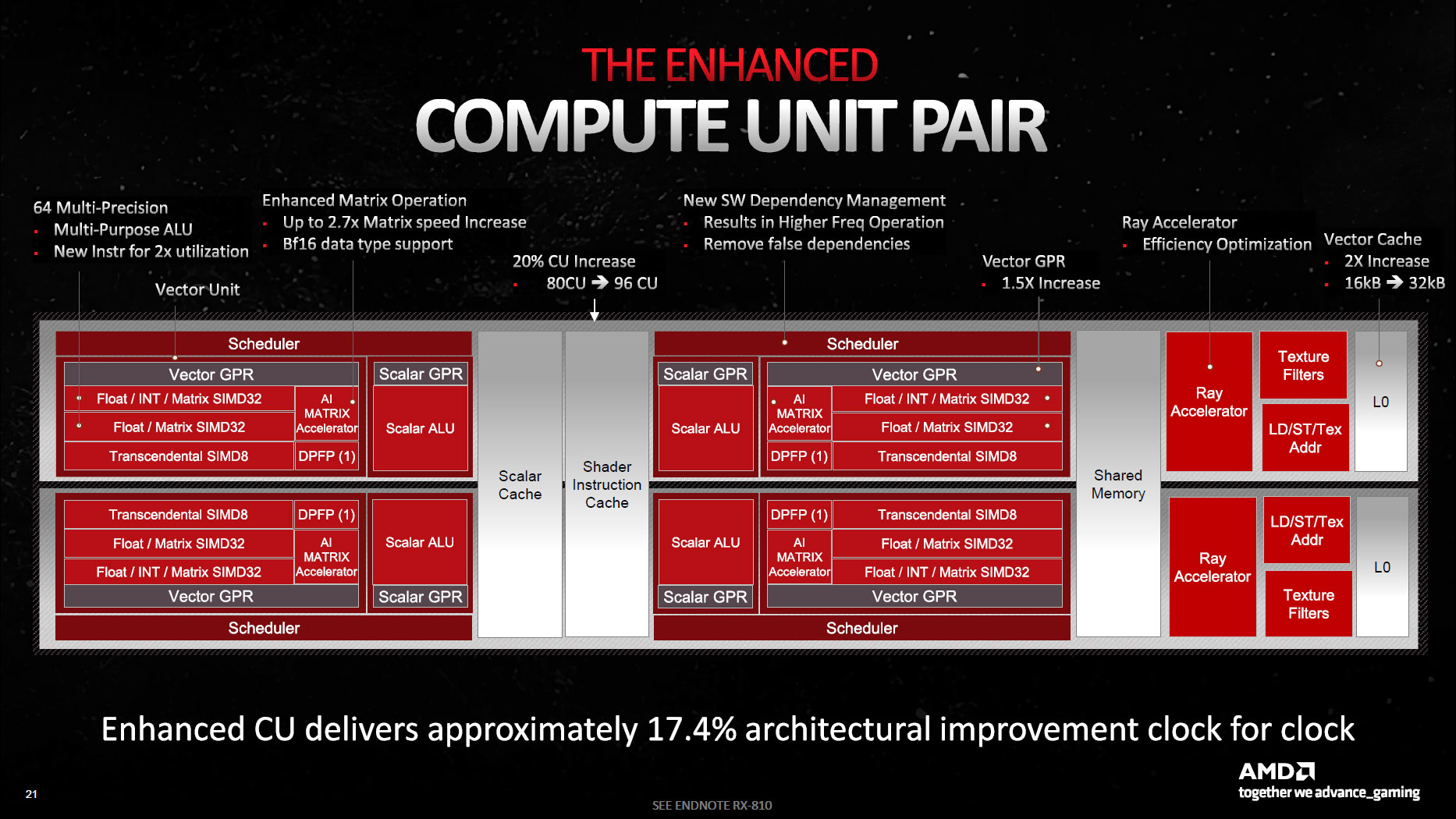
This might explain why Sony has allegedly gone with between 40 and 48 CU's on the PS6, as it seemed like a downgrade from the PS5 Pro but the nature of the CU's will take a significant change and upgrade over previous architectures it seems.
 
This might explain why Sony has allegedly gone with between 40 and 48 CU's on the PS6, as it seemed like a downgrade from the PS5 Pro but the nature of the CU's will take a significant change and upgrade over previous architectures it seems.
You mean between 20 and 24 RDNA5 CUs?
Basically the "Low die" (aka AT3) in the OP.

Or do you think that the PS6 will match or even be slightly above the "Mid die" (AT2)?
 
Last edited:
You mean between 20 and 24 RDNA5 CUs?
Basically the "Low die" (aka AT3) in the OP.

Or do you think that the PS6 will match or even be slightly above the "Mid die" (AT2)?
For them to achieve a meaningful upgrade over the PS5 and Pro it'll have to be around the 40+ CU mark, and it'll be an equivalent of almost doubling CU's over the PS5, as 40 CU on RDNA 5 would equal 80 CU on RDNA 2 given the doubling of cores per CU.

Just speculation though.
 
I still believe this is a major confusion.

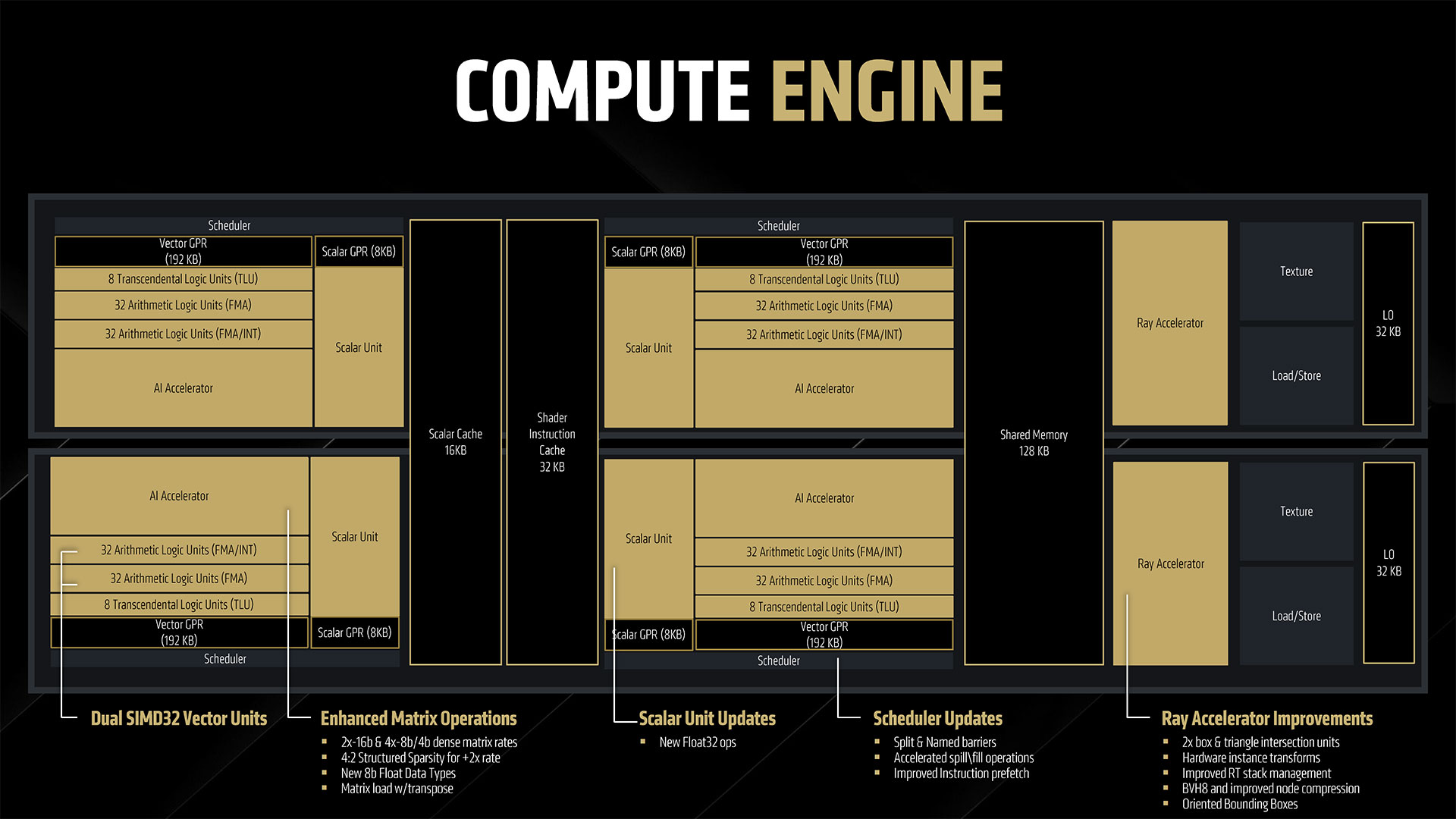
They are basing this information on changes happening with GFX12.5 (CDNA5), which is meant for HPC / AI / data center compute.

For example, it drops WGP mode and only supports CU mode. RDNA4 supports both.

For the 128 cores (Stream Processors), that was a thing since RDNA3.
Gdek4wsdWizEdBfv.jpg

dXhGIPDGBYioOVyk.jpg


You can see the CU already have 128 cores (4 × 32 = 128)

GFX12.5 (CDNA5) fixed dual-issue making the 128 core more visible for compute task.
Wave32 モードのみをサポートし、LDS を 320KiB 持つ GFX1250
Relaxed Restrictions on VOPD Instructions
Dual issue (VOPD instructions), supported since RDNA 3, allows two VOPD instructions to be executed simultaneously. However, several requirements must be met for proper functioning.

This requirement has been relaxed on the gfx1250, allowing VOPD instructions to be executed correctly even if they are in the same VGPR bank.


GFX12.5 (CDNA5) doesn't support Ray Tracing either.
LLVM に gfx1250 が "仮に" 追加される ――Wave32 に対応して MFMA 系命令をサポートしない CDNA APU? [追記修正]
Even as an RDNA-based architecture, the gfx1250 does not have feature flags indicating support for image instructions or ray tracing-related instructions.


It's clear these leaks are mixing up what is happening with GFX12.5 and thinking these changes will apply to RDNA5. No way RDNA5 drops RT support.
 
Last edited:
My last Radeon was the 9700PRO, I gave up on ATI/AMD but hopefully this will make me switch like I did with CPUs.
 
For them to achieve a meaningful upgrade over the PS5 and Pro it'll have to be around the 40+ CU mark, and it'll be an equivalent of almost doubling CU's over the PS5, as 40 CU on RDNA 5 would equal 80 CU on RDNA 2 given the doubling of cores per CU.

Just speculation though.
That would mean that the PS6 will have more cores than whats rumored for Magnus/NextBox.

I doubt that (cus I doubt MS will be able, or even want to, compete with Sony in terms of price).
 
There will be something between 5120 and 12000 they can't be so stupid with no mid-high gpus.
 
Last edited:
That would mean that the PS6 will have more cores than whats rumored for Magnus/NextBox.

I doubt that (cus I doubt MS will be able, or even want to, compete with Sony in terms of
That would mean that the PS6 will have more cores than whats rumored for Magnus/NextBox.

I doubt that (cus I doubt MS will be able, or even want to, compete with Sony in terms of price).
Twould mean double the cores of magnus aswell? Magnus will share the same RDNA gfx
 
Twould mean double the cores of magnus aswell? Magnus will share the same RDNA gfx
Yeah, let's double them and...*poff* there goes the price tag that the masses can accept! ;)

(that 72 number is taken from MLiD - and he counts CUs the old way, i.e they are already doubled)
 
Yeah, let's double them and...*poff* there goes the price tag that the masses can accept! ;)

(that 72 number is taken from MLiD - and he counts CUs the old way, i.e they are already doubled)
F it, let's double it again. 144 CU Magnus counting the MLID way.

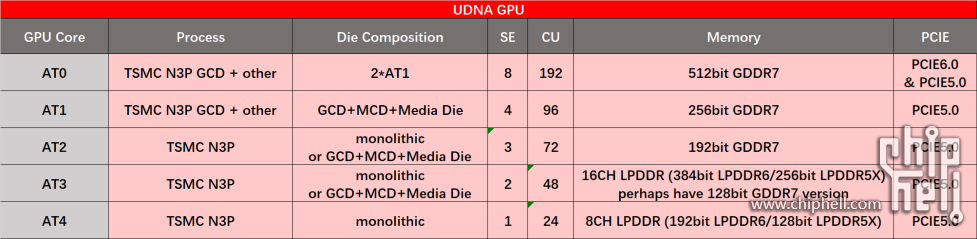
This is all getting too confusing now. The chart is also missing AT1 and AT2. So Magnus being AT2, cannot be same as 40 CU AT0.
 
F it, let's double it again. 144 CU Magnus counting the MLID way.

This is all getting too confusing now. The chart is also missing AT1 and AT2. So Magnus being AT2, cannot be same as 40 CU AT0.
AT1 has always been missing.

Mid die = AT2 = Magnus GPU = 40 RDNA5 CU = 80 Old CU
 
Last edited:
AT1 has always been missing.

Mid die = AT2 = Magnus GPU = 40 RDNA5 CU = 80 Old CU
But this chart refers to the 40 CU RDNA5 as AT0, unless that's a typo.

I can see AT1 being 72 CUs. And if Magnus is the CPU SOC technically, then it could be paired up with any GPU die.

Magnus with AT4 - Xbox Laptops and Xbox Handhelds

Magnus with AT3 - Lower SKU Xbox Console and mini PCs

Magnus with AT2 - Main Xbox Consoles and Xbox PCs

Magnus with AT1 - Elite Xbox Consoles and PCs

Magnus with AT0 - Overkill Xbox PCs

So where will the PS6 fit in? AT3? Or somewhere between AT3 and AT2.
 
Last edited:
The big one has the same numbers of cores as the GB202 chip used by the 5090. Obviously it's "good".

Problem is that the chip is, if I understood Kepler correctly, in the same size class as the GB202. I.e. it's huuuge. Built on a node that is really expensive.

So we are probably looking at a $1500-$2000 card here.

credit-card.gif
 
Ahm, which chart are you talking about?


My guess would be AT3-like with GDDR7 MC.
That one.


If the PS6 has 30 RDNA5 CUs, it could fit nicely with the PS5 Pro 60 CUs.
 
My last Radeon was the 9700PRO, I gave up on ATI/AMD but hopefully this will make me switch like I did with CPUs.

Not trying to be rude if you haven't given them a chance since a 9700pro you are sticking with Nvidia out of familiarity. You've missed out on multiple cards that were better than Nvidia cards at a cheaper price and no drivers have not been an issue in forever... 4000/5000 series, 7950/7970... 290/290X... 6000 series and now 9000 series.

If you only buy flagships, sure, Nvidia has been dominant for a while since Vega (though the 6900XT / 6950XT did very well vs the 3090)
 
Last edited:
If so, then that rumoured 40CU (if true) is a lot more impressive. Even if it's just 36 active, then it'd still be the equivalent of the ~72CU region I expected; or 27-32 Single Issue TF.
 
Yeah? AT0 with 96 RDNA5 CUs.
And the other AT0 is obviously a typo, should be AT2.


Yes but no likely though since PS always has a "PC twin" on terms of CU count.
Though this is speculation from ChipHell based on MLiD, this makes the most sense.
Ud47k7nvwgeZbzJC.png
udMOVBHGSYtQ3yFL.png


Even Kepler is not to sure about the CU being equal to WGPs.
 
Last edited:
Though this is speculation from ChipHell based on MLiD, this makes the most sense.
Ud47k7nvwgeZbzJC.png
udMOVBHGSYtQ3yFL.png


Even Kepler is not to sure about the CU being equal to WGPs.

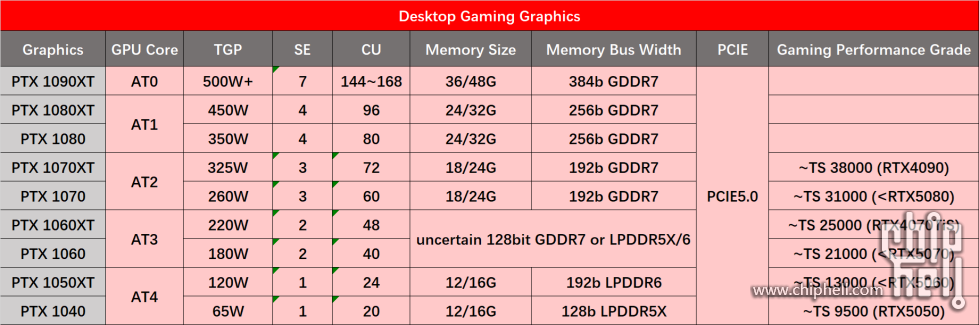
Wait, is that chart implying the AT0 die with 192 CUs would have huge chunk of CUs disabled when used in final product?

Going from 192 CUs to 144-168 would be 12.5-25% CUs disabled.

I can see them disabling CUs for the various PC, Laptop, Handheld configurations though, so the rest makes sense.
 
Wait, is that chart implying the AT0 die with 192 CUs would have huge chunk of CUs disabled when used in final product?

Going from 192 CUs to 144-168 would be 12.5-25% CUs disabled.

I can see them disabling CUs for the various PC, Laptop, Handheld configurations though, so the rest makes sense.
The full die is rumored to be used for data center.
 
The full die is rumored to be used for data center.
Ahhh ok, now it makes sense. I wonder if they could use two Magnus CPU SOCs paired up with AT0 dies in the Azure datacenters for next gen xCloud server blades. It's similar to how Nvidia designs their GFN SuperPods. They split their enterprise GPUs into 4080 or 5080 equivalents.

Might be more efficient and less costly this way, split the AT0 into running two Xbox Magnus AT2 profiles, and the modularity makes it easy to replace components that break.
 
Last edited:
Ahhh ok, now it makes sense. I wonder if they could use two Magnus CPU SOCs paired up with AT0 dies in the Azure datacenters for next gen xCloud server blades. It's similar to how Nvidia designs their GFN SuperPods.

Might be more efficient and less costly this way, split the AT0 into running two Xbox Magnus AT2 profiles, and the modularity makes it easy to replace components that break.
The guys over at AnandTech forum does say AT0 is for cloud gaming.
 
Not trying to be rude if you haven't given them a chance since a 9700pro you are sticking with Nvidia out of familiarity. You've missed out on multiple cards that were better than Nvidia cards at a cheaper price and no drivers have not been an issue in forever... 4000/5000 series, 7950/7970... 290/290X... 6000 series and now 9000 series.

If you only buy flagships, sure, Nvidia has been dominant for a while since Vega (though the 6900XT / 6950XT did very well vs the 3090)

You have a good point about Nvidia familiarity but if AMD really challenged the high-end then I would switch without issue.

FSR4 is a good start.
 
Top Bottom