in the 20% time Google gives its employees. Here he is talking about how the dreaded "fragmentation" problem iPhone fans constantly berate Android for... isn't affecting him at all.
I'm lucky enough to have occasional access to lots of different Android devices via my work. The whole point of the Android approach to apps is that you can write an app on one device (or even an emulator) and deploy it across everything. In my case, that's been pretty true. I've tried Replica Island on the following devices:
- Google Nexus One
- Verizon Droid by Motorola
- HTC Magic (The myTouch in the US, HT-03A here in Japan)
- HTC Dream (The G1)
- Samsung Behold II
- Samsung Galaxy
- HTC Hero
- HTC Tattoo
- LG Eve
- ODROID
- Covia SmartQ5
- Android for x86
The cool thing is,
Replica Island ran on all of them without complaint. That's not to say it was playable on all of them--the Covia SmartQ5, for example, has no keyboard, trackball, or even orientation sensors, and you have to use a stylus on the screen (it also has no GPU so the game runs extremely slowly). And some devices (like the LG Eve) have directional pads that are really poor for games. I ran the game under Android for x86 via virtualization, and while it worked it was slow enough that I have new respect for the Android emulator.
But the game runs, pretty much error free, on every single Android device I've tested it on.
I don't have regular access to all this hardware to test on, so when a phone comes my way I jump on it, install the game, and try it out. Excepting basic support for multiple screen sizes and input systems, I don't have any device-specific code. I developed Replica Island almost entirely on Dream and Magic devices; it's built for a trackball and touch screen. I've added support for directional pads as well, which covers almost all of the phones on the market. The game runs at a nice frame rate on the Dream/Magic hardware, and it's very smooth on faster devices like the Nexus One and Droid. But that's it--no special case code for any particular device anywhere. Cool!
You might be interested in which of these devices plays Replica Island the best. The answer might surprise you. Wait for it... ok, it's the ODROID.
Yeah, seriously.
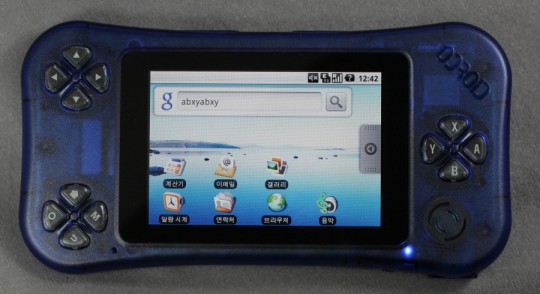
What the heck is the ODROID? Well, it's an Android device (not a phone) sold by a South Korean company called
Hardkernel. Actually, the consumer version isn't even for sale yet, but you can buy test hardware for nebulous "development purposes" on their web site. The
Wonderswan ODROID runs Android 1.5 (sounds like they will have a 2.0 update soon), has an HVGA screen, a Samsung CPU at 833mhz, a touch screen, orientation sensors, and all the other standard stuff. What sets it apart is the game-focused form factor, a real directional pad, and four face buttons. The thing is clearly designed for games.
My ODROID arrived in the mail yesterday, direct from South Korea.
It's clearly prototype hardware; the thing is made out of light plastic and looks fairly cheap. There's a very strange power button that doubles as a hold switch and screen orientation switch, and I keep accidentally hitting the capacitive volume controls where I expect shoulder buttons to be. The directional pad is actually pretty bad compared to what you'd find on gaming hardware like the Nintendo DS or Playstation Portable, but it's better than your average phone. The thing can talk to adb, it came with an SD card already installed, and supporting the A/B/X/Y buttons is trivially easy (they just map to regular keyboard events).
But the reason that the ODROID is the best device for playing Replica Island isn't just because of the game-like form factor and controls.
Unlike most other Android devices, the ODROID is a combination of fast CPU and medium resolution screen. The devices with larger screens tend to be fill-rate bound; though the Nexus One and Droid have extremely capable CPUs and GPUs,
the high resolution screens on those devices work against them when it comes to games (it's almost impossible to break 30 fps on those devices via the GPU, though they can crunch really complex scenes at that speed without breaking a sweat). On the other hand, the Magic/Dream class of devices have the same HVGA resolution, but tend to be CPU bound--rendering is fast but I spend quite a lot of time running the game simulation.
The ODROID has neither problem--its CPU is pretty fast and its GPU has no problem filling the HVGA display. As a result, Replica Island is silky smooth on the ODROD--a constant, reliable 60fps.
Add that to the game-ready control scheme and you have a pretty great game experience.
That's part of what's so awesome about the run-everywhere Android approach.
Replica Island works on all Android devices, pretty much by default. It's fun to play (well, I think it's pretty cool) on most average phones. But when some crazy company wants to make some crazy device that's good at one thing, they can do so without requiring any changes to the applications themselves. In this case, the ODROID is a surprisingly solid game device, at least for games like mine (though other games, particularly 3D games with complex scenes, are probably faster on devices like the Nexus One).
And supporting it costs me literally nothing; I just loaded it up and it worked. That's pretty neat.



 i hope is not an long wait though..


 Unfortunately unless you root the Nook you'd never know it was running Android...