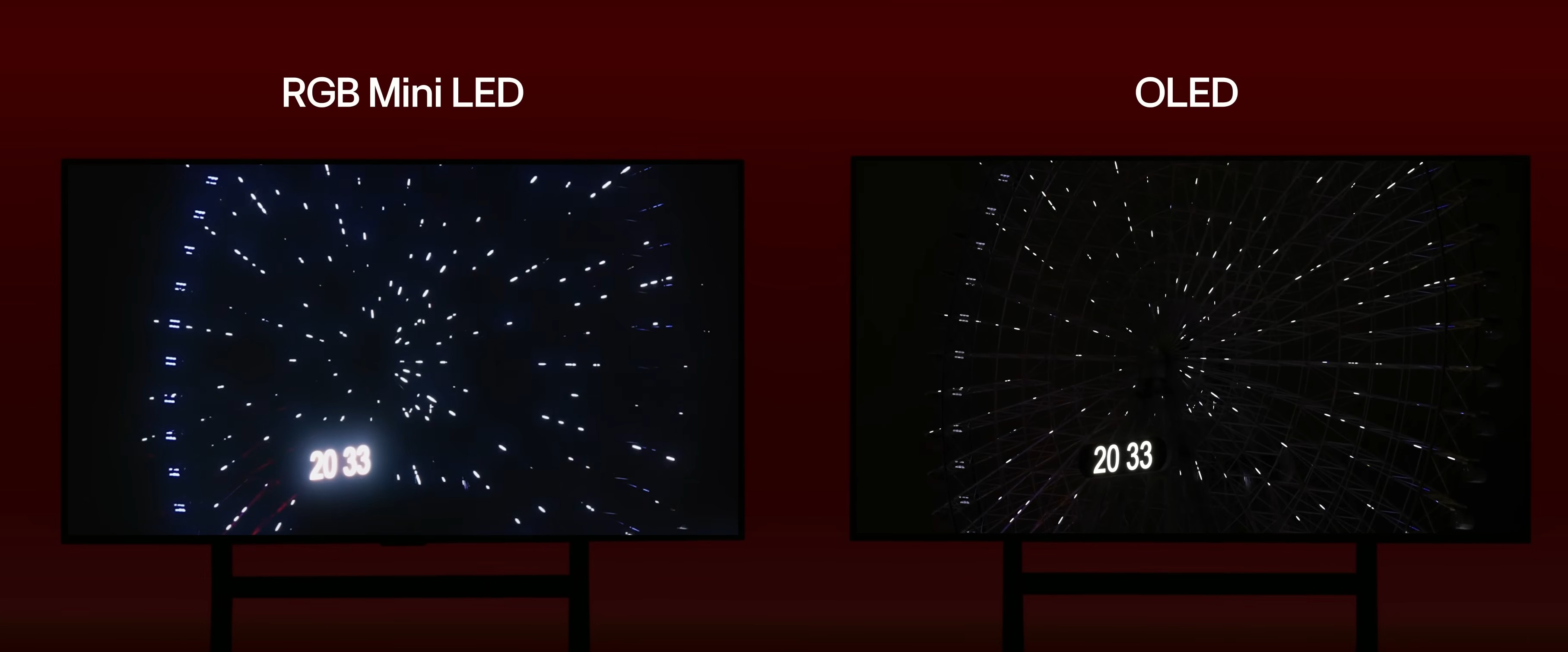
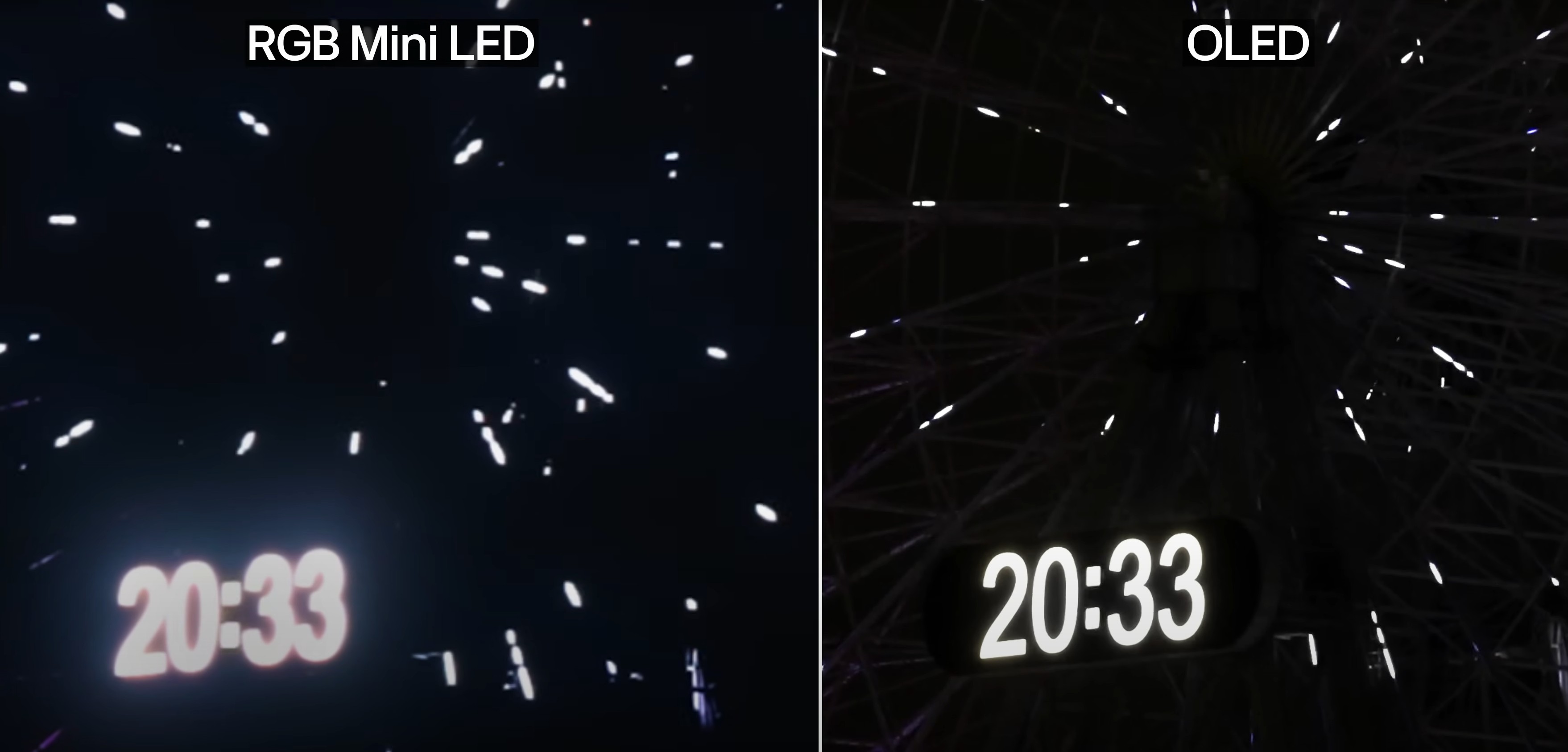
LG shitposting about RGB Mini LED

Interested Saturday Night Live GIF by HULU
 
Six years ago, I was in the market to replace my Sony Bravia that went out and I was looking at an OLED. I bought an LG OLED, brought it home and realized my living space is too bright. I was excited when I heard about these micro LEDs when they were talking about them around that time. It amazes me that they're still not out.

I'm sure the newer OLED TVs are brighter than the old one that I purchased and I'm hoping when I'm due for another one I will be able to pick up something better
 
The price to pay for the higher color volume of LCDs. :messenger_winking_tongue:

To be fair, high(er) end LCDs don't bloom that bad though.
hq720.jpg

Imax+enhanced.jpg

Personally I can't stand blooming, I had led tv with local dimming zones and returned it after 1 week - I think my previous VA with no dimming zones produced better results. OLED is not perfect but it has many advantages.

SINQGG6zD4aPucck.jpg
dLzRPR3NZvk8d6MG.jpg
 
Personally I can't stand blooming, I had led tv with local dimming zones and returned it after 1 week - I think my previous VA with no dimming zones produced better results. OLED is not perfect but it has many advantages.

SINQGG6zD4aPucck.jpg
dLzRPR3NZvk8d6MG.jpg

LCD Blooming is really hard to go back to after OLED. When E7 had terrible image retention, I replaced it with a X950G and it took a long while to adjust. And as upset as I was when my dog knocked that TV over, I was also happy and bought a C1 (which also has image retention issues, sadly, just far less noticeable than my E7 so I'm going to ride this one into the ground).
 
OLED tvs are better than LCDs in longevity aspect:


People should actually look closer at their OLEDs.

First one I had developed huge amounts of dead pixels in the corners within a year. LG replaced it with a newer model, which has also developed huge amounts of dead pixels in the corners. That's with 2000 hours of use.

It's not an insolated problem either.
 
LG Display is a different entity than LG Electronics in the sense that they have different overall goals, thats why LGD puts out this video trashing RGB MiniLED while LGE releases the same thing under a different name: Micro RGB TV

They're doing this because Hisense (and TCL as well I think?) have chosen to use the name "RGB MiniLED" for the technology.

Which tbf is a more accurate name for it, "Micro" should be reserved for true LED displays like Sonys Crystal LED (Formerly CLEDIS).

Its all confusing and stupid, which is the TV industry in a nutshell. Samsung (and others in the consortium) managed to make people think that a QLED is a different panel type vs. an "LED" TV.

Just like was done with LCD TV > LED TV when backlights went from CCFLs to LEDs.

Everything that's not called an "OLED TV" is an LCD panel with different backlights, coatings of said backlight and/or quantum dot enhancement films in the panel stack.
 
Last edited:
Personally I can't stand blooming, I had led tv with local dimming zones and returned it after 1 week - I think my previous VA with no dimming zones produced better results. OLED is not perfect but it has many advantages.

SINQGG6zD4aPucck.jpg
dLzRPR3NZvk8d6MG.jpg
And I hate the dimming on OLEDs compared to QLEDs. Ultimately I can deal with some blooming in starfield like scenes in return for the higher brightness and color volume of LCDs.

article-5.jpg

maxresdefault.jpg
 
People should actually look closer at their OLEDs.

First one I had developed huge amounts of dead pixels in the corners within a year. LG replaced it with a newer model, which has also developed huge amounts of dead pixels in the corners. That's with 2000 hours of use.

It's not an insolated problem either.

They were talking about full panel defects mostly, when some of your LEDs die you can loose whole parts of image. In the end oleds are more likely to still work after many years vs. LCDs with super complicated backlight systems. Of course OLED wouldn't have the same picture quality it had day one.

And I hate the dimming on OLEDs compared to QLEDs. Ultimately I can deal with some blooming in starfield like scenes in return for the higher brightness and color volume of LCDs.

article-5.jpg

maxresdefault.jpg

Qd-OLEDs have great BT2020 cover. In the end it's all about personal needs, if you have a lot of natural light and love brightness - you don't buy OLED. If you like watching stuff in darker rooms (or at night) OLED is much better suited for that.
 
I wasn't in the OLED ride or die camp as it has flaws but the latest generation Tandem OLEDs seem like a good fixture as it's both brighter and has less burn in potential.
 
Does Mini LED suffer from the same inverse coronas / inverse ghosting that QLEDs suffer from? I've have three different QLEDs and they all had that problem when gaming. It's what forced me into the LG OLED camp in the first place.
 
Last edited:
It's just more individual backlights which is fine both forms of displays have pros and cons. LCDs have there place, for bright rooms and general work monitors. Gaming is pretty much under oled right now.
 
LG are desperate cause they know OLED has reached an evolutionary dead end and is losing ground to miniLED which is seeing crazy improvements every year.

LCD is not a replacement for OLED, even the newest models still have the same problems that tvs had 20 years ago (but of course much less apparent). And first gen of RGB mini LEDs doesn't look impressive at all (worse than normal mini LEDs in some aspects). LCDs just got brighter and brighter in recent years (oleds as well).

True replacement for OLEDs is mico led or something like Qdel.
 
Does Mini LED suffer from the same inverse coronas / inverse ghosting that QLEDs suffer from? I've have three different QLEDs and they all had that problem when gaming. It's what forced me into the LG OLED camp in the first place.
Inverse ghosting is a function of overdrive and it's why a lot of high end gaming computer monitors let you adjust overdrive manually. Too bad TV's typically don't let you adjust this, especially considering the amount of panel-to-panel variation that exists on modern flat panel displays
 
Yeah im not falling for the mini-led, rgb mini-led, micro rgb hype they've been trying to push for next year lately.
...

Are we ever gonna have monitors with true blacks / infinite contrast, and no burn-in?
Maybe QDEL? If that ever becomes a thing tv wise.

EDIT: This is outside of Micro-led of course.
 
Last edited:
Too bad LG OLEDs start to fall apart within a couple of years.

At this point I'd buy literally anything other than a OLED panel manufactured by LG.
Have had my LG OLED for over 6 years now and the thing is still going strong. No burn in and still looks amazing. No idea what you are talking about here.


At the same time, LG announces new RGB Micro* LED TV

*fucking confusing, but is the same thing as RGB Mini LED, it is not Micro LED


This seems like a private fight between two closely related companies leaking out into the public. LG Display must be pissed at LG Electronics, but this is like cutting off your nose to spite your face.

Edit: I just realized this is a four-part series! Burning bridges with your closest partner is certainly a choice.
 
Last edited:
LG are desperate cause they know OLED has reached an evolutionary dead end and is losing ground to miniLED which is seeing crazy improvements every year.
Doubts. We just had huge brightness improvements this gen on all oled variants. The vast majority of content isn't mastered beyond 1000 nits anyway. Even mid tier oleds are bright enough these days. I can't go back to lcd smearing and blooming. Mini LEDs can get brighter in bigger window sizes but that's mostly useless unless you're watching YouTube ai slop.
 
Have had my LG OLED for over 6 years now and the thing is still going strong. No burn in and still looks amazing. No idea what you are talking about here.

Huh. Someone better tell my E9 that, as it's still going extremely strong.

I'm not at home to take pictures of my C3 with 2000 hours, but I gladly will when I get home.

From normal viewing distance most people wouldn't even notice it, but if you actually get up close and look it's extremely common. A quick Google search will show you plenty of people with the problem.

UQIOnjG033NANFQg.jpeg


This is about how bad my C2 was, and now my C3 isn't far from it.
 
I'm not at home to take pictures of my C3 with 2000 hours, but I gladly will when I get home.

From normal viewing distance most people wouldn't even notice it, but if you actually get up close and look it's extremely common. A quick Google search will show you plenty of people with the problem.

UQIOnjG033NANFQg.jpeg


This is about how bad my C2 was, and now my C3 isn't far from it.

millions of sets sold - handful of internet comments != 'extremely common'
 
They really need to move foward the microLED because this year the showcase was awful.

Lets hope for a better presentation of microLED at CES 2026.
 
I'm not at home to take pictures of my C3 with 2000 hours, but I gladly will when I get home.

From normal viewing distance most people wouldn't even notice it, but if you actually get up close and look it's extremely common. A quick Google search will show you plenty of people with the problem.

UQIOnjG033NANFQg.jpeg


This is about how bad my C2 was, and now my C3 isn't far from it.
I guarantee people on this forum have it and don't even realize it.
I have this same issue on my 2020 version. Started a couple years ago but still love the tv. It is used 100% as my pc monitor.
 
I'm not at home to take pictures of my C3 with 2000 hours, but I gladly will when I get home.

From normal viewing distance most people wouldn't even notice it, but if you actually get up close and look it's extremely common. A quick Google search will show you plenty of people with the problem.

UQIOnjG033NANFQg.jpeg


This is about how bad my C2 was, and now my C3 isn't far from it.

I have this same issue on my 2020 version. Started a couple years ago but still love the tv. It is used 100% as my pc monitor.

My friend's LG C9 has this issue, ton of pixels dead mainly at the top and bottom of the screen and what's funny he didn't even notice it. It's not visible when watching letterboxed movies and from a larger distance just looks like the edges of the screen aren't straight.

But this isn't OLED technology issue, just some manufacturing defect. QD-OLED is already 3 or 4 years on the market and I've seen zero reports of something similar. Whether LG fixed it or not on newest panels is unknown.
 
Last edited:
My friend's LG C9 has this issue, ton of pixels dead mainly at the top and bottom of the screen and what's funny he didn't even notice it. It's not visible when watching letterboxed movies and from a larger distance just looks like the edges of the screen aren't straight.

Exact problem I had. 90% of the time I'm either watching letter boxed movies, 4:3 retro stuff, or a PC game from a regular viewing distance. I happened to be watching something in 16:9 and the bottom corners didn't meet at a 90° angle so I got up and looked closer.

After getting the replacement I knew to watch for it, and sure it enough happened again.
 
This is such horse shit.

My C9 is still kicking fine. My C2 is fine. My C5 is running just fine

Yeah my CX still going strong with no dead pixels anywhere on the edges (I WOULD notice it, super OCD about shit like that) with no burn in. Probably more likely to see burn in in the next few years rather than dead pixels.
 
Top Bottom