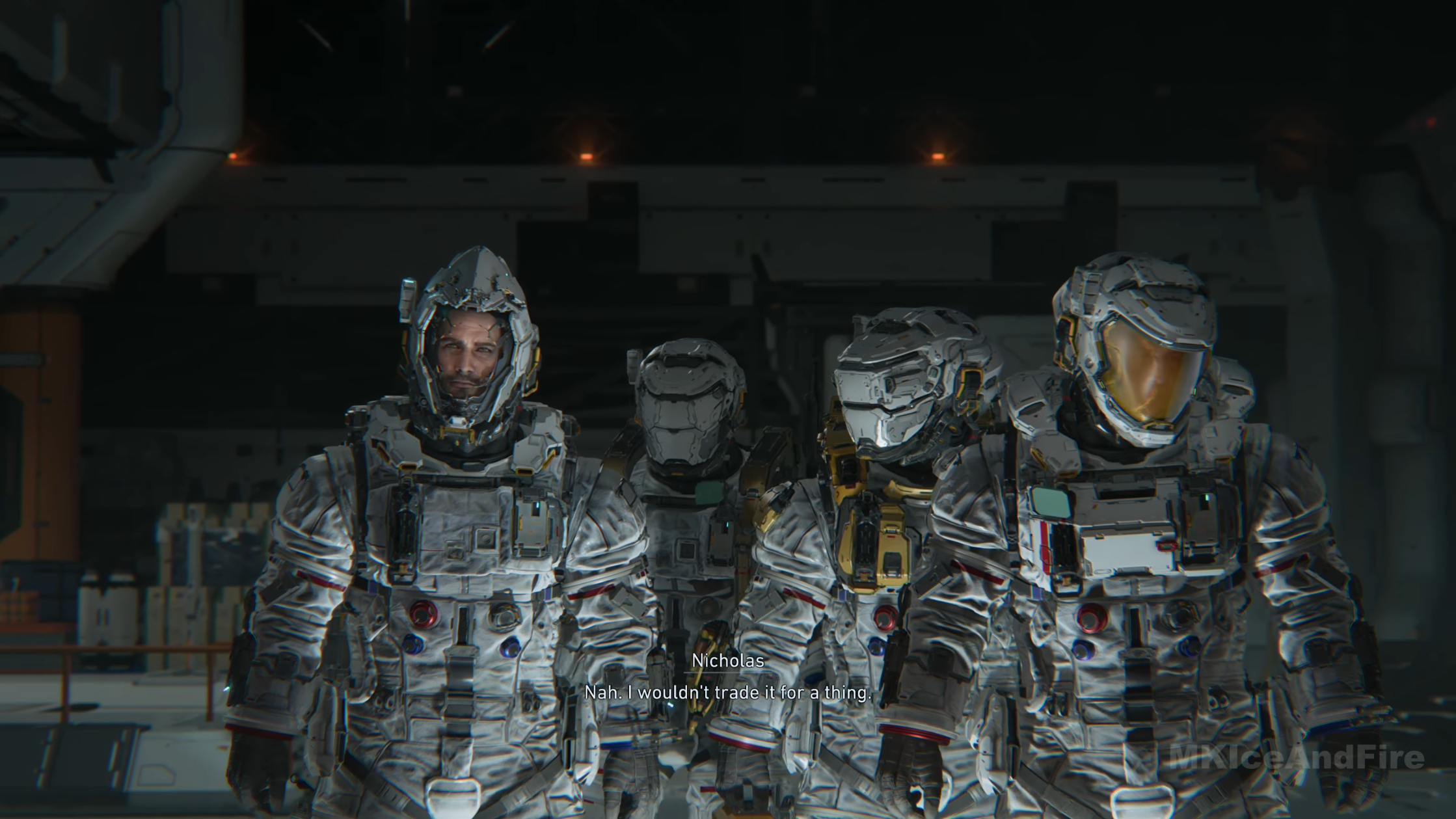
Concept
Lots of similar concepts with sci-fi and sci-fi-organics-merging. Puzzles, a smart little fella good with tech as your over-the-shoulder companion, collectables + scanning for them. Laser sections, turret sections, little side-paths.
I'd say combat wasn't similar, and I liked both of their combat systems. Both have reasonable amounts of depth to them.
Combat
Very different style. I won't say much here because there is no need for a direct comparison. However I'll make a point on how SB brings itself together better, as I feel like SB made better use of its own systems.
Pragmata feels great when challenged by multiple bots and dodging around last second, doing well in a confined space etc., but overall it just doesn't do that enough. It doesn't force you to engage with the game's mechanics all that much beyond the basic level. For example, you can basically beat any boss however you want regardless of choice of weaponry, without breaking a sweat. SB has a higher skill floor where it expects you to learn to 'git gud' to some degree. You can still mitigate difficulty by using heart pumps for revives, but on a base level it expects you to engage with its systems more thoroughly. You can tell this is the case because Pragmata itself, with its challenges, forces you to do exactly that. I wish the game itself was designed more in a way that made you think about what you are doing and how you are fighting more. The bosses in Pragmata are just kinda.. there. As dramatic set pieces to beat. I feel that was a missed opportunity. I get it's supposed to be very beatable but a slightly higher difficulty and more tight design would have helped for the Normal mode too. The same goes for the hacking, they already have cool modifiers with the jamming, the hacking-shields of some enemies, and the 'laser dodging' in the fight with Eight. They could have done more with that. They know how to do it. It seem they deliberately chose not to, which is a shame.
Level Design
Pragmata is mostly corridors with the same level design language employed in most places. Gameplay wise the areas are all pretty much the same.
Level design wise Stellar Blade wins hands down. Both have great art, but design wise Pragmata was the same thing over and over again for the most part. Sorta narrow spaces. Just 1-2 exceptions and even these are just connecting corridors. Stellar Blade has these as well, but it has a good mixture of narrow, confined spaces and actually large open areas, but also very vertical areas that felt very different to traverse and explore. There was more diversity in those environments that went beyond art, they informed gameplay and vibes, either explicitly (in the 2 underground dungeons where your sword is disabled it's suddenly a horror-game) or implicitly (climbing up the Orbital Elevator was more of an experience in SB in itself, just the traversal and its visuals). In Pragmata, these variations were a lot more subtle, or smaller.
Gameplay wise, Pragmata has neat moon/low-grav mechanics, a worm in the ground in one section that you want to avoid, and movement-wise the jumping and thrusting was fine, even if sluggish (that's okay and intentional in my book, going for a different feel). It used it well in some sections of the game. Stellar Blade has actual climbing beyond jumping, wall running, rails to balance and hang from, quicksand, the hypertube surfing, the covert container section with turrets one-shotting you and more. Both have laser sections, but Stellar Blade's felt more 'designed' in terms of puzzle usage (when to avoid, when to dodge, when to hang) etc.
The same can be said for the turret sections. Pragmata has a turret-type enemy that is employed at a couple points that makes you avoid some missiles from afar, and getting there to destroy it is not always trivial. But in the end, it's mostly a normal enemy. When you throw a statis net at it it's pretty much disabled which allows you to get close enough to hack and destroy. It's a slight modification of other enemies.
With some of the design of some sections, it felt like both were shooting for similar things, breaking up monotony by introducing new variants in gameplay, be it traversal-related, dodging or hiding from obstacles/bullets etc., but it feels Stellar Blade was more thorough with it.
Puzzles
Pragmata mainly stays around simple switch-based puzzle. Turn thing on. Turn thing off. The hacking is engaging but the actual puzzles are quite simple. There isn't much to think about.
The level design for both games lets you 'puzzle for a bit' as you need to figure out a path to get where you want to go. Some hidden entrance or so.
There is some element of obstacle course solving in Pragmatabut as mentioned in level design, there isn't that much to it.
Although I will say, some of the challenges can be read as puzzles as well, and those are great. To get a perfect, on many of them you really need to choose the right strategy, it's not a matter of "just aiming well" or similar. You gotta lock-in and figure out what the best choice is, and then execute it flawlessly. In that sense of the word, Pragmatahas some great puzzles although contained within the challenge simulations.
SB is pretty light on puzzles as well in terms of difficulty, but has a wider variety of mechanics to engage with. Pushing/pulling boxes, adding up numbers, actual math quizzes, laser-redirection, climbing, obstacle courses.
Story
Story-wise both are pretty meh, but I'd say Stellar Blade's setting is more unique and leaves a lot more room to be explored, its universe is grander. This isn't necessarily good or bad, not every game needs a part 2 or 3, but it does make a difference within the single game you are playing when it feels like there is more at play and things to unravel beyond a basic premise of "bad corp doing bad experiments, let's save the world" that Pragmata is doing essentially.
Pragmata has better characterization, you feel for Hugh and Diana, whereas SB characters, while there are more and there is more variety, they are pretty cardboard in comparison. SB has better lore for their characters, but the characters are presented in a less engaging manner compared to PRAGMATA, which focuses on parenthood and emotion. SB paints a bigger picture and lets even side quest characters come together, the multiple endings add intrigue to the lore.
I'll say SB left a bigger impact on me and more of a wish for a sequel of sorts, but PRAGMATA's ending was great in its own right. A simple, but compelling, end.
Pacing towards the end
Plot wise both are quite weak, but as the story nears its conclusion, both try to ramp up both storytelling and gameplay.
Pragmata does a couple more hologram conversations and data pads towards the end, until the big finale happens.
Stellar Blade got great pacing towards the end, ramping up in difficulty and boss encounters and interesting environments.
Pragmata does similar things by introducing more corrupted bots but falls a bit flat in comparison, the bots aren't much of a threat in comparison to their regular counterparts.
Stellar Blade has more cut scenes and more things 'happening' towards the end, both before and beyond their respective Orbital Elevator sections.
Ramping up, both of them do the thing where organic matter fuses with inorganic matter. Both of them come from different directions, but the type of enemy you fight towards the end is "corrupted fleshy machinery".
Environment-wise, SB had the Democrawler and the Demogorgon as their equivalent bosses. But the Democrawler had fantastic music, getting there was an event in itself; it felt like it had great build up and it just kept on going from there. Not to mention there were more unique boss fights before that too with Belial and Karakuri, and more challenging boss fights after with 2x Raven and the final fight with 2 different bosses). As PRAGMATA ramped up its story, the amount of hologram conversations and data pads increased, and more corrupted enemies appeared. But they weren't particularly challenging so it didn't feel like like much of a ramp up gameplay-wise.
Orbital Elevator
When I noticed that both games pretty much have the Orbital Elevator as the 'final area', and how both of them played out almost the same way, I was a bit baffled, it felt too similar to be a coincidence. Sure, SB has more content beyond that but it doesn't really introduce new areas after that.
It's kind of the 'point of no return' for both games. You fight a big boss in both of them, only for a big corrupted disgusting thing that is a threat to humanity to appear on the elevator. In both, you use a rail gun to finish off your enemy with a couple of shots. Gameplay is minimal but interactive for both. The last massive shot is enabled through your over-the-shoulder-companion that is good at hacking/assisting with tech.
Both deplete energy sources supposedly. SB is continuing on for a bit, introducing some more characters and bosses and story after, Pragmata wraps it up here.
Pragmata didn't really have you climb the elevator yourself. The elevator was more of a set piece where the finale played out than an environment you were exploring.
The scale of it was more impressive in SB because the elevator was actually used in multiple ways. First off, you approach it from afar, and it had been mentioned early on in the game as well. But approaching it from afar means, here, that you actually navigate from way-outside it with some nature around, to the industrial complex around it that you have to infiltrate and survive. You physically enter the elevator yourself. New enemies, new lore, new environment. You climb up broken parts of it, you even climb up outside of it. You enter a personnel elevator where you can watch the earth moving up. Both try to go for this kind of spectacle with the Orbital Elevator at the end, but only SB makes the place feel impressive really.