• Hey Guest. Check out your NeoGAF Wrapped 2025 results here!

Rambus XDR2 - possible Playstation4 memory - upto 3 TBytes/sec bandwidth ?

xexex

Banned
http://www.tomshardware.com/hardnews/20050707_104509.html


XDR2 to quintuple memory data transfer speeds by 2007

By Scott Fulton

July 7, 2005 - 10:45 EST

Los Altos (CA) - "Parallelism" is the keyword underscoring several semiconductor architectures this decade. Now it's the turn of the memory: Rambus announced the availability of "micro-threading" for XDR2 memory, the company's next generation memory technology. Memory clock speeds will catapult to 8 GHz, up from a current maximum of 4.8 GHz of XDR1.

"The bandwidth requirements of game platforms and graphical applications have been growing exponentially," Steven Woo, Rambus' senior principal engineer at Rambus, told Tom's Hardware Guide. "About every five or six years, it goes up by a factor of 10. PlayStation 3, for example, will have a memory bandwidth capability of 50 GByte per second." If this trend continues, projected Woo, a theoretical 2010 model "PlayStation 4" could require ten times the memory bandwidth as next year's PlayStation 3. A statistical projection made in 2004 by NVIDIA's Vice President of Technical Marketing, Tony Tamasi-- cited by Woo--anticipates that a top-of-the-line 3D game could conceivably require memory bandwidth of 3 TByte per second.


To begin addressing this staggering upward slope to which NVIDIA and others are pointing, Rambus unveiled XDR2, with a range of added and enhanced technologies, including the company's new simultaneous data throughput concept, micro-threading.

As Woo demonstrated exclusively for Tom's Hardware Guide, micro-threading was designed to address a growing problem brought on by the very 10x bandwidth factor that's revolutionizing the memory industry today: a growing mismatch between the memory interface frequency and the core signaling rate. As interfaces such as Rambus' XIO core for XDR increase in speed, while at the same time core signaling rates increase by a lesser rate or not at all, the amount of data that a controller must fetch for each clock cycle rises proportionately with the gap between these two speeds. A feature that was already integrated in first generation XDR coordinates memory interface frequency and the core signaling rate.

Another problem in modern memory technologies is the increasing byte-size of data pieces that can be accessed. This loss of "granularity" actually results in performance degradation, especially with graphics cards that require rapid access to smaller and smaller triangles to achieve true high-definition rendering. Micro-threading addresses this problem, stated Woo, first by recognizing that DRAM technology divides banks of data elements into halves or quadrants, and next by developing a technique by which those quadrants can be addressed both independently and simultaneously. No bandwidth is lost, but access granularity is theoretically divided by four, at the expense of a "small" increase to the number of commands required to access data within the independent quadrants, according to a Rambus white paper.

The payoff may come in the form of capabilities for future graphics cards to establish very deep, very narrow look-ahead pipelines for very small triangles, which could lead to another huge performance boost for scene rendering. "Those pipelines are so incredibly deep," said Woo, "that you have lots of visibility way ahead of time as to where the triangles are, and where they're going to be accessed from."

Also included in the XDR2 technology package will be an enhancement to the FlexPhase timing system Rambus introduced in first-generation XDR. Typical motherboard routing involves the careful placement of traces that may take serpentine paths all over the board, just to ensure that they end up the same length, so that signals arrive between components at the same time. FlexPhase eliminates the need for serpentine routing, stated Woo, through the inclusion of offset logic for every wire on the controller. "We go through a calibration sequence that says, 'How far ahead of this other signal does this particular signal need to be launched, in order to guarantee they hit the DRAM at the same time?' [Our] procedure figures out how much delay you need to add to each wire." A converse procedure is applied, said Woo, for data transmitted from the DRAM back to the controller.

If licensing negotiations for XDR2 technology were to begin now, Rambus' announcement states, the technology could conceivably be shipping in products by 2007. The company's XDR technology is currently licensed by Toshiba, Elpida, IBM, and Samsung. Offering what could be construed as an olive branch to the computer industry, Rambus officials have told Tom's Hardware Guide that micro-threading alone could conceivably be licensed as a DRAM technology in and of itself, although no formal plans to do so have been announced. Rambus' attempt at restoring its reputation among both its clients and the general public, as quickly as XDR2's promised transfer speed acceleration, will be very interesting to watch.


holy shit, I bet developers cannot wait to get their ever-greedy hands on that much memory bandwidth in Playstation4 :D

I could see PS4 getting ~250 GB/sec main memory bandwidth and upto ~3 TB/sec of combine / aggrigate inter-CPU+ inter-GPU bandwidth.

remember that the Sony GSCube of 2000 had like 750 GB ( about 3/4 of a TB) graphics bandwidth from 32 MB eDRAM @ 48 GB/sec * 32
 
Oh for fuck's sake can't these dipshits even wait until the next generation starts?
 
So what does more memory bandwidth buy you when making games?


Let me put it another way...

The early PS3 stuff we are seeing now are running on, IIRC a slower CELL dev station but with, I believe, an AGP bus, which has a small fraction the memory bandwidth of FlexIO in PS3....

So what would, say, a 10X jump in memory bandwidth (say, the diff between current PS3 dev kits and the final kit due in December) allow you....

More polys?

Better texture detail?

Better Image Quality?

All of the above??
 
I don't think PS3 has enough memory bandwidth. what with it's 128-bit memory bus from RSX to GDDR3. it seems to be almost the same configuration and bandwidth as Xbox360.

the article says PS3 has 50 GB/sec bandwidth but I think that's a bit of a mistake.

PS3 bandwidths:
22.4 GB/sec (RSX to GDDR3)
25.6 GB/sec (CELL to Rambus XDR)
35 GB sec (CELL to RSX)

and you cannot add these all together. edit: edit apparently you *can* add 2 of them together.

anyway, I hope PS4 has a massive increase in bandwidth over PS3. more than PS2 to PS3, and more like PS1 to PS2 which was awesome.


bandwidth is essential for everything in graphics, as well as other non-graphics related things...
 
Something better will be out by then. But hopefully memory speeds do start reaching that level in a couple years. Memory is a major bottleneck for keeping these processors fed. PEACE.
 
Pimpwerx said:
Something better will be out by then. But hopefully memory speeds do start reaching that level in a couple years. Memory is a major bottleneck for keeping these processors fed. PEACE.


true. agreed.
 
xexex said:
I don't think PS3 has enough memory bandwidth. what with it's 128-bit memory bus from RSX to GDDR3. it seems to be almost the same configuration and bandwidth as Xbox360.

the article says PS3 has 50 GB/sec bandwidth but I think that's a bit of a mistake.

PS3 bandwidths:
22.4 GB/sec (RSX to GDDR3)
25.6 GB/sec (CELL to Rambus XDR)
35 GB sec (CELL to RSX)

and you cannot add these all together.

anyway, I hope PS4 has a massive increase in bandwidth over PS3. more than PS2 to PS3, and more like PS1 to PS2 which was awesome.


bandwidth is essential for everything in graphics, as well as other non-graphics related things...
You can add them together since both pools are accessible by both chips, and thus it's possible for RSX to pull an aggregate 35+22.4=57.4GB/s if it's just working with the SPE/PPE. That's the whole point really. It's 48GB/s if reading/writing to XDR. PEACE.
 
Pimpwerx said:
You can add them together since both pools are accessible by both chips, and thus it's possible for RSX to pull an aggregate 35+22.4=57.4GB/s if it's just working with the SPE/PPE. That's the whole point really. It's 48GB/s if reading/writing to XDR. PEACE.


I stand corrected then :)
 
xexex said:
I don't think PS3 has enough memory bandwidth. what with it's 128-bit memory bus from RSX to GDDR3. it seems to be almost the same configuration and bandwidth as Xbox360.

the article says PS3 has 50 GB/sec bandwidth but I think that's a bit of a mistake.

PS3 bandwidths:
22.4 GB/sec (RSX to GDDR3)
25.6 GB/sec (CELL to Rambus XDR)
35 GB sec (CELL to RSX)

and you cannot add these all together.

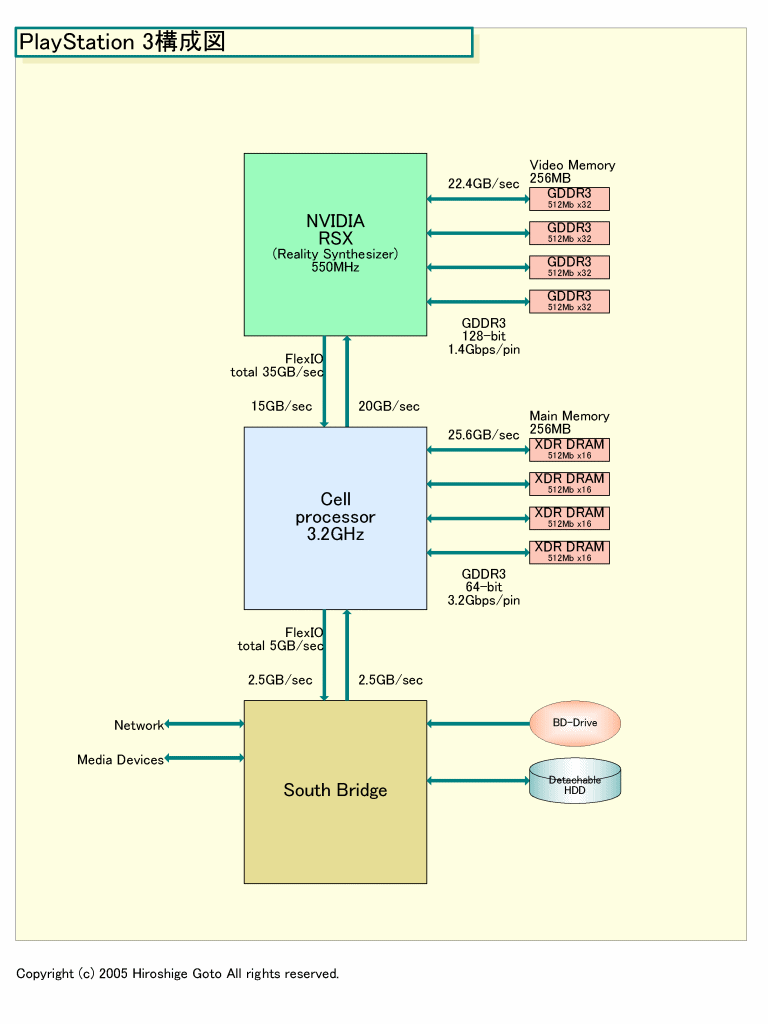
Yeah, but does CELL/RSX only access memory serially?
Cant they access GDDR3/XR DRAM at the same time?

kaigai_6a.gif


If so, then some of that bandwidth *can* be combined (I am not saying everything, though)

Pimpwerx said:
You can add them together since both pools are accessible by both chips, and thus it's possible for RSX to pull an aggregate 35+22.4=57.4GB/s if it's just working with the SPE/PPE. That's the whole point really. It's 48GB/s if reading/writing to XDR. PEACE.


EDIT: ah yes....thanx Pimpwerx :)
 
And so it begins...

Next week, Iwata reveals clue about Revolution 2 - Codename Veronica - "It will not be a console, nor will it be not a console. It will exist in a state of temporal flux. You will buy it because of this."
 
BirdySky said:
And so it begins...

Next week, Iwata reveals clue about Revolution 2 - Codename Veronica - "It will be not be a console, nor will it be not a console. It will exist in a state of temporal flux. You will buy it because of this."

:lol :lol
 
BirdySky said:
And so it begins...

Next week, Iwata reveals clue about Revolution 2 - Codename Veronica - "It will be not be a console, nor will it be not a console. It will exist in a state of temporal flux. You will buy it because of this."
:lol :lol
 
So we have the 1st gen "Shreck" Cell dev kits(2.4Ghz CELL + 256MB XR DRAM+GF 6800U SLI) and we are now on the 2nd gen "Evaluation" PS3 kits......these also run at 2.4Ghz, but have double the Ram (512MB XR DRAM) and probably have GF 7800 GTXs in them too....

I guess the magic question is do they have FlexIO yet or are they still limited to the AGP/PCI-E bus??

One thing is for sure, the PS3 Reference Tool(3.2Ghz CELL+512MB XR DRAM+RSX+BD drive+HDD) shipping in December should be quite a bit more powerfull than anything we have seen on PS3 so far...
 
I seriously doubt this type of memory will be around 5 years from now. I'm surprised Rambus even got XDR into the PS3. They're always coming out with ridiculously fast memory at stratospheric prices leading to no one using it. Anyone remember RDRAM? I got 2x256 of that stuff in my current computer. It's fast, but the cost of 512MB of the stuff is almost as high as the 2GB of DDR (which is even faster) I just bought for my new rig. Considering how fast Rambus went from RD800 to RDWhateverTheHellThey'reAtNow to XDR to XDR2, they'll probably be on something like WTFXDR3 by 2010 running at quantum speeds. And it'll only cost $299...per MB.
 
CaptainSimian said:
I seriously doubt this type of memory will be around 5 years from now.

yeah you're probably right about that. in my original post and thread-title, i should have seperated XDR2 from what PS4 will have, which should be even greater in bandwidth.


btw guys, its interesting to learn the names of these PS3 dev-kits :)
 
Kleegamefan said:
I guess the magic question is do they have FlexIO yet or are they still limited to the AGP/PCI-E bus??

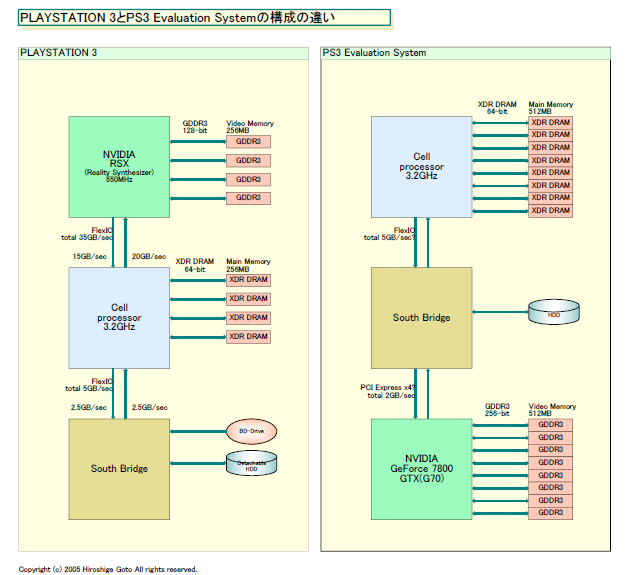
They're still on the PCI-E bus, according to PC Watch Impress it's PCI-E 4x:

kaigai02l.gif


(This diagram compares the final setup to the current setup in the second evaluation system. Note the Cell speed is still 2.4Ghz, though)

Kleegamefan said:
One thing is for sure, the PS3 Reference Tool(3.2Ghz CELL+512MB XR DRAM+RSX+BD drive+HDD) shipping in December should be quite a bit more powerfull than anything we have seen on PS3 so far...

Yeah, PC Watch Impress kind of talks about this in their article..one of the key characteristics is still missing, and once it's in it may change how devs approach the system beyond the first generation of games. That's also the reason the G70 in the kit has 512MB of memory, since it cannot access main memory in the same way RSX will be able to.
 
Top Bottom