
-
Hey Guest. Check out your NeoGAF Wrapped 2025 results here!
You are using an out of date browser. It may not display this or other websites correctly.
You should upgrade or use an alternative browser.
You should upgrade or use an alternative browser.
Take that Seattle; CA rep wants $26/h minimum wage
- Thread starter Marty Chinn
- Start date
- Status
- Not open for further replies.
lol, this guy just tried to imply that the poor's spending made up 85% of GDP. Have fun with thatExcept then tend to lump 95%,of their income back into local economies as spending on goods and services. You know, 85% of US GDP.
Personally I say "job creators" are useless. We've given them massive tax breaks, government welfare, and deregulation and all they've done is reduce the number of good paying jobs while increasing profit margins. Profit are then dumped into low interest savings and not spent in capital improvements.
Supply follows demand, always have. Mythical job creators taking their ball and going home is a bug ch of malarky, as someone is always going to meet demand. Black markets and drug markets prove it, where demand produces job creators and jobs.
see, these are the kind of statements I have a problem with. The idea that burger flippers are the backbone to our country. No, they really aren't. The country doesn't need them. Janitors and burger flippers are easily replaceable because anyone can do that kind of work. And immigration as a cheap source of labor makes them even less vital.Oh wow.
Yeah I get keeping the minimum wage increases consistent with inflation, but $26 an hour?
At such a high price, I'm starting to side with the profit-maximizing institutions / Republicans on this one. That's just flat-out anti-business.
Minimum wage workers and near-minimum wage workers are the backbone of our country. While they may be sub-human to you, they're vitally important to maintaining the status quo. Everybody has a role in this country...don't belittle jobs just because you may feel that you're superior to it.
You could even argue that they are harmful to status quo. Many of their jobs are easily mechanized, or will be. We employ them because they are cheap, almost as a charity. But they can be replaced.
I'd love it if some pundit on TV spewed some of the condescending bullshit Manarola has, concerning minimum wage employees. Just sit back and watch the explosions.
Sadly there's legions of minimum wage holders and fixed income retirees on medicare and SS that would rally to defend that comment.
Never underestimate the ability of tribalism to create cognitive dissonance
As for $25/hr, as long as it was phased in over a number of years it wouldn't be a big deal. Inflation would reduce its quite a bit.
I don't think anyone is stupid enough to enact these things over night, as it would create a shock.
eBay Huckster
Member
lol, this guy just tried to imply that the poor's spending made up 85% of GDP. Have fun with that
i'm pretty sure that guy just tried to imply overall spending made up 85% of GDP, which is significantly less wacky as a statement
but, y'know, keep fucking this "poor people are literally subhuman scum" chicken, i get the feeling it's going to end well
Why hasn't he been banned yet? That's all I want to know. I'm all for reasonable discourse. But belittling someone's value as a living breathing human is way worse than I have seen people banned for.
And for the record. If minimum wage kept up with inflation it would be around $19-$20 nationwide so this number in California isn't surprising. Unfortunately it hasn't. So such a sudden shock would definitely hurt businesses since they were created in such an economy with suppressed wages.
What we need to do is work hard to formulate a system of gradual increases where in a few generations our children's children will at least grow up in a world with a living minimum wage.
And for the record. If minimum wage kept up with inflation it would be around $19-$20 nationwide so this number in California isn't surprising. Unfortunately it hasn't. So such a sudden shock would definitely hurt businesses since they were created in such an economy with suppressed wages.
What we need to do is work hard to formulate a system of gradual increases where in a few generations our children's children will at least grow up in a world with a living minimum wage.
A less wacky statement that has no bearing on anything we are discussing. Unless you see it as a trick to imply something. Which it wasi'm pretty sure that guy just tried to imply overall spending made up 85% of GDP, which is significantly less wacky as a statement
but, y'know, keep fucking this "poor people are literally subhuman scum" chicken, i get the feeling it's going to end well
eBay Huckster
Member
A less wacky statement that has no bearing on anything we are discussing. Unless you see at as a trick to imply something. Which it was
you know what else has no bearing on anything that we're discussing?
your personal opinion of whether "people who've been making minimum wage for X years" is a group unworthy of anything above subsistence-level struggling, unless you see it as a trick to derail a thread
ElectricBlue187
Member
In places like Hawaii or San Francisico where there are basically only rich people allowed, a high minimum wage makes a lot of sense, elsewhere it would likely cause higher prices and poverty for those just barely hanging on to the middle class.
How is that any different from your personal opinion that they should be making more? Its all subjective.you know what else has no bearing on anything that we're discussing?
your personal opinion of whether "people who've been making minimum wage for X years" is a group unworthy of anything above subsistence-level struggling, unless you see it as a trick to derail a thread
Aquamarine
Member
see, these are the kind of statements I have a problem with. The idea that burger flippers are the backbone to our country. No, they really aren't. The country doesn't need them. Janitors and burger flippers are easily replaceable because anyone can do that kind of work. And immigration as a cheap source of labor makes them even less vital.
You could even argue that they are harmful to status quo. Many of their jobs are easily mechanized, or will be. We employ them because they are cheap, almost as a charity. But they can be replaced.
Mechanization is a long-term, often non-viable technology. Until then, businesses require a certain level of employment for optimal profit-maximizing functioning. While the actual workers might be somewhat expendable, the fact that companies need these workers indicates they are necessary to maintain our status quo. They are not employed "out of charity," but out of necessity. Like janitors who maintain cleanliness in businesses.
In places like Hawaii or San Francisico where there are basically only rich people allowed, a high minimum wage makes a lot of sense, elsewhere it would likely cause higher prices and poverty for those just barely hanging on to the middle class.
Why? Economics isn't zero sum. If it is, Houston we have a problem.
Mechanization is a long-term, often non-viable technology. Until then, businesses require a certain level of employment for optimal profit-maximizing functioning. While the actual workers might be somewhat expendable, the fact that companies need these workers indicates they are necessary to maintain our status quo. They are not employed "out of charity," but out of necessity. Like Janitors who maintain cleanliness in businesses.
I bet a $26 minimum wage would make mechanization a lot more viable.
lol, this guy just tried to imply that the poor's spending made up 85% of GDP. Have fun with that
Go take a economics course and get back to me. 85%+ of GDP is spending on goods and services. You get a much larger multiplier from poorer people as well, because they tend to spend the bulk of their income on goods and services, not savings or investment.
As a group the middle class is the largest driver of demand. Unfortuantly over the past 30 years they're moving into poverty and have less purchasing power.
ElectricBlue187
Member
Why? Economics isn't zero sum. If it is, Houston we have a problem.
I'll start by saying that the federal minimum wage is too low and it ought to be tied to inflation but crazy high minimum wages north of $20 will not be beneficial to poorer areas where most people are living paycheck to paycheck. People in those areas are very sensitive to price increases and shareholders aren't going to eat the increased price of wages, consumers will.
I have an economics degree buddy. Not that this really means anything. Show me some numbers if you want to go that route. Your 85% figure doesn't mean anything unless you can break it down by income quintile. And that only matters for the purposes of cyclical policy.Go take a economics course and get back to me. 85%+ of GDP is spending on goods and services. You get a much larger multiplier from poorer people as well, because they tend to spend the bulk of their income on goods and services, not savings or investment.
As a group the middle class is the largest driver of demand. Unfortuantly over the past 30 years they're moving into poverty and have less purchasing power.
eBay Huckster
Member
How is that any different from your personal opinion that they should be making more? Its all subjective.
how is an opinion that "we should do X thing that raises the income level of a currently marginalized group because it'll be economically beneficial on the whole" different from an opinion that "we shouldn't do X thing because ROBOTS and also fuck the poor, if they really wanted to make more than MW they'd try harder"?
i don't know, you tell me.
Lol, four pages and nobody has actually quantified what this beneficial effect is on the rest of us. I'm not saying it doesn't exist. Its probably a lot smaller than you think.how is an opinion that "we should do X thing that raises the income level of a currently marginalized group because it'll be economically beneficial on the whole" different from an opinion that "we shouldn't do X thing because ROBOTS and also fuck the poor, if they really wanted to make more than MW they'd try harder"?
i don't know, you tell me.
People who are at or near the minimum wage perform menial tasks - little better than what trained monkeys can do - and contribute little to our overall economic situation. They are not a big concern.
When I'm not working on commissioned real estate, I write contracts helping people find homes, getting them approved, and building up their credit. I also create marketing materials and keep an office going on my own. I make less than $9 an hour for this. Do I contribute little to the economy?
Aquamarine
Member
I bet a $26 minimum wage would make mechanization a lot more viable.
Can't disagree with you there. $26 minimum wage in 2014 is way too high. Maybe a gradual implementation would work with $26 as the eventual goal over a period of years, but the sticker shock from $8 -> $26 would definitely hurt many local businesses and cause panic throughout the state.
Random Painted HIghway
Member
Looking forward to a 30$ Big Mac.
OG_Original Gamer
Member
Why is raising prices such a perplexing concept? I mean if the minimum wage is increased, the people can pay more.
When I'm not working on commissioned real estate, I write contracts helping people find homes, getting them approved, and building up their credit. I also create marketing materials and keep an office going on my own. I make less than $9 an hour for this. Do I contribute little to the economy?
If you are doing that much I would say the 9 per hour is your problem and not society's.
Why is raising prices such a perplexing concept? I mean if the minimum wage is increased, the people can pay more.
And then a cyclical inflationary effect occurs.
And then a cyclical inflationary effect occurs.
And then we have $100 tacos.
Random Painted HIghway
Member
Why is raising prices such a perplexing concept? I mean if the minimum wage is increased, the people can pay more.
If you're getting a higher pay only to be able to buy the same goods at higher prices, then nothing has fundamentally changed.
And then we have $100 tacos.
And then wages go up because standards of living go up. And then wages go up because standards of living go up. And then wages go up because standards of living go up. And then wages go up because standards of living go up. And then wages go up because standards of living go up. And then wages go up because standards of living go up. <cont.>
Random Painted HIghway
Member
And then wages go up because standards of living go up. And then wages go up because standards of living go up. And then wages go up because standards of living go up. And then wages go up because standards of living go up. And then wages go up because standards of living go up. And then wages go up because standards of living go up.
I was living in Moscow in 1998 when the currency had 3 0's lopped off. Quite a weird time with a thousand double note and a one double note I my wallet simultaneously.
Orbis Tabula
Member
Lol, four pages and nobody has actually quantified what this beneficial effect is on the rest of us. I'm not saying it doesn't exist. Its probably a lot smaller than you think.
Some support the idea of poor people making more money, despite that fact that there may be no tangible effect on the income of the "rest of us." Because it's a fucking decent thing to do.
Some support the idea of poor people making more money, despite that fact that there may be no tangible effect on the income of the "rest of us." Because it's a fucking decent thing to do.
The problem is that then all the businesses have to increase their prices as well, thereby negating the effects of the raise in minimum wage.
Quota jobs can be negated by adding a few dollars to the cost of each item, but other jobs aren't so easy.
In theory, if big business would take a pay cut it would work. In practice, it would destroy small businesses.
Random Painted HIghway
Member
Some support the idea of poor people making more money, despite that fact that there may be no tangible effect on the income of the "rest of us." Because it's a fucking decent thing to do.
Where do you think the money for this comes from? What do you expect to happen to the people that are making above minimum wage now?
Orbis Tabula
Member
The problem is that then all the businesses have to increase their prices as well, thereby negating the effects of the raise in minimum wage.
Quota jobs can be negated by adding a few dollars to the cost of each item, but other jobs aren't so easy.
In theory, if big business would take a pay cut it would work. In practice, it would destroy small businesses.
Really? So every minimum wage increases is followed by a 1:1 increase in the cost of goods? I wasn't aware.
And then wages go up because standards of living go up. And then wages go up because standards of living go up. And then wages go up because standards of living go up. And then wages go up because standards of living go up. And then wages go up because standards of living go up. And then wages go up because standards of living go up.
And then what happens?!?!?! The suspense is killing me.
And then what happens?!?!?! The suspense is killing me.
Apologies. I've amended the post.

eBay Huckster
Member
Lol, four pages and nobody has actually quantified what this beneficial effect is on the rest of us. I'm not saying it doesn't exist. Its probably a lot smaller than you think.
four (three) pages and no one has actually quantified what "wage floor increase > the resultant price increase" means for total household income (for the minimum-wage increases to which that situation applies)? that's pretty Weird. you'd think someone would've articulated that by now.
I'll start by saying that the federal minimum wage is too low and it ought to be tied to inflation but crazy high minimum wages north of $20 will not be beneficial to poorer areas where most people are living paycheck to paycheck. People in those areas are very sensitive to price increases and shareholders aren't going to eat the increased price of wages, consumers will.
Why wouldn't they? If they don't decrease the margins and eat it they open themselves up to competition that will run on much slimmer margins and undercut them on price. Exactly what drives innovation and competition.
That is unless most industry is already monopolistic in function, and if that's a case we're not really that into capitalism. Otherwise they have no choice.
Business and Wallstreet has a wired fetish currently for ever increasing profit margins, but that's not sustainable, and I'd argue were already seeing the downsides of it. Long term growth (over short term margins) is the answer, but we don't seem to want to invest in it. Unless you're Amazon shareholders, where its no profits and all growth.
Housing costs need to go down. Minimum wage does not need to go up (this much).
Any time you bring something down in a economy, that's a recession and devaluation. You Never want that to happen. It's exactly what almost put us through a second great depression.
Prices need to become more affordable, but it needs to be done through wages catching up and through supply constraints being lessened through building in high demand areas.
Stagnant wages and NIMBY / terrible local zoning has caused quite a housing shortage in population centers in a lot of states. The rent is too damn high, but rent control or devaluing assets isn't the answer and only creates more shortages / hardship.
The problem is that then all the businesses have to increase their prices as well, thereby negating the effects of the raise in minimum wage.
Quota jobs can be negated by adding a few dollars to the cost of each item, but other jobs aren't so easy.
In theory, if big business would take a pay cut it would work. In practice, it would destroy small businesses.
If only there was something on the balance sheet that could absorb increase in opperating cost without the need to raise prices.
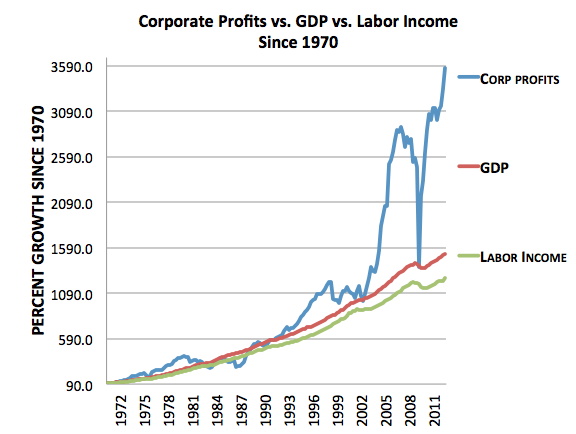
As said above; if the industries don't operate as monopoly's then they have and will compete to fill the demand for their goods and services. That means they'll be hesitant to raise prices when someone else can swoop in and undercut them with slimmer profit margins who is willing to take that deal for business.
Another way to look at it is for the last 20 years increases historically increases in wages have instead been funneled to shareholders as cost savings. That not sustainable on a economy wide scale when you realize you still need your (and others) employees to turn around and buy the things you sell. You're pushing short term, zero sum accounting for long term stability and growth.
Anyways, another thing to keep in mind is employers like Walmart and McD's recently have been handing their new hires welfare application with their employment packages. So The government and taxpayers are actually supplementing these corporations low wages with welfare and the EITC. I don't buy the argument that we should kick those poor, working people off government assistance instead of forcing those companies to play fair and pay them a living wage so their working employees don't need welfare assistance. If the economy becomes a race to the bottom, it will eat itself. We do this capitalism thing after all because supposedly it's the best system for creating progress, wealth, and leading to the purist of life, liberty and happiness for the greatest number of people.
If it's only to make a few powerful and rich, as the standards of living decrease for more and more people.... well I don't think the founders would be ok with that.

TheLaughingStock
Member
And the empirical evidence doesn't really support it. Because if it did, we'd see stronger evidence of employment increases after a minimum wage hike. But the evidence is mixed, at best.
The empirical evidence isn't there for the dynamic monopsony model? Labor can in general outlast capital in a showdown? It's like stepping into the twilight zone.
- Status
- Not open for further replies.