
I am sad to say that I NEVER, EVER, EVER got to experience R-Type in the arcade, as it was meant to be played, properly. I never saw it, much less played it. not in medium-to-large arcades, not in bars, not in convenience stores, donut shops, laundry mat...etc...these smaller places are often said to be where R-Type machines would be found..... I was always looking for Altered Beast or AfterBurner or Operation Wolf. but if I had seen R-Type I would've played it. So my early experience with R-Type was on the Master System and later, the TurboGrafx16. I did not get to play the arcade until MAME in 2000. in 2003 I was lucky to find Playstation both R-Types and R-Type Delta at Music Recyclery in Gurnee Mills in Illinois.
-
Hey Guest. Check out your NeoGAF Wrapped 2025 results here!
You are using an out of date browser. It may not display this or other websites correctly.
You should upgrade or use an alternative browser.
You should upgrade or use an alternative browser.
The Irem Appreciation Thread (56k am cry)
- Thread starter chespace
- Start date
The Guardian Legend - the game was actually developed by Compile, who made kickass shooters, then went striaght up making Puyo Puyo games and then finally hit bankruptcy.
Didn't a fair portion of Compile end up at Psikyo or Eighting/Raizing? Compile totally ruled the SCHMUP scene back in the day.
Yep, Aicom (who made Pulstar) was formed from former IREM staff. SNK aborbed them I think before Blazing Star was made internally.Shinobi said:BTW, did the Irem guys have anything to do with Pulstar on the Neo Geo? I heard years ago that they did (and the design seemed similiar enough), but I've never been completely certain about it.
Interesting, Nazca (of Metal Slug fame) was also made of former IREM staff and SNK absorbed them too (before MS2 iirc).
zettai zatsumei toshi = disaster report.djtiesto said:And ZZT2?? When I think of ZZT I think of the old Epic Megagames ANSI graphics video game maker that people like me and Chris Kohler made some stuff for. Don't know what that has to do with IREM.
Father_Brain
Banned
Go Go Ackman! said:Is geo storm / gunforce 2 emulated?
Yep. It runs just fine on MAME; actually, there aren't many 2D games that don't.
BTW, Irem trivia: the only home version of Dragon Breed was released on Commodore 64. And on another note, I'm annoyed by arcade games that don't let you pay your way through. Guess I'm just weaksauce, though.
sriyantra said:Delta - never played it because I was turned off by the blocky polys. R-Type, for me, was always about incredibly detailed bitmaps. But if it's really that good, I'm keen to check it out. How easy is this to find on ebay?
Final - this was actually much better than I expected and had some really nice R-Typey shading in places and impressive detail. Didn't go beyond level 3- is it worth it? And Eidos' whole Fresh Games packaging annoyed me intensely. If these are supposed to be games catering for the passionate hardcore, why does that logo so utterly arse? People, honestly.
1). Delta Delta Delta Delta. It took me a while to get used to a porygonal Bydo Empire, especially the first level which looked at the time more like Einhander than an R-Type game. But starting from the second level, and especially the third, Delta was a 3D realization of Irem's attention to visual detail. Play the third level again... towards the beginning, as the walking techno-mammoth boss stomps forth, you can see the ice beneath its feet cracking, building collapsing in the background, snow particles everywhere, and even the pinkish-red reflection of your Force pod. It mesmerized me at the time.
2). Ninja Spirit was a kick ass mutation of Legend of Kage. It was one of those seemingly easy yet graphically chaotic ultimately difficult games.
3). PhotoBoy looks fucking crazy. I need to check that out. In fact, I'm going to go do that after I play BuddyC on Twisted Metal PSP.
4). What does IREM stand for?
Father_Brain said:Yep. It runs just fine on MAME; actually, there aren't many 2D games that don't.
BTW, Irem trivia: the only home version of Dragon Breed was releasedon Commodore 64. And on another note, I'm annoyed by arcade games that don't let you pay your way through. Guess I'm just weaksauce, though.
That's slightly inaccurate. There was an Amiga rev, and I'd played it.
Innovations in Recreational Electronic Media, which I just found out thanks to one of the flyers in this thread. ^_^ That Vigilante art with the chick is amazing. So 80's, so awesome.Jeffahn said:Pop Quiz:
What does IREM stand for?
I'm glad the amazing Delta's getting recognition now. Back when Final first came out it seemed a lot of people were picking the wrong horse.
BenT said:Innovations in Recreational Electronic Media, which I just found out thanks to one of the flyers in this thread. ^_^ That Vigilante art with the chick is amazing. So 80's, so awesome.
I'm glad the amazing Delta's getting recognition now. Back when Final first came out it seemed a lot of people were picking the wrong horse.
I missed that on the poster. I actually remembered it as Indoor Recreational Electronic Media, but that's from a long while back.
Anyways, anyone remember...

...
Jeffahn said:I missed that on the poster. I actually remembered it as Indoor Recreational Electronic Media, but that's from a long while back.
Anyways, anyone remember...

...
The only version I've played of Mr. Heli was on the PCE, and it was great. Gotta love those slow ass homing missles. Reminds me of In The Hunt.
Chespace: I thought you might find this worth reading. nothing much, just a little bit on R-Type's history an Irem guy, Keith Masauda, talking about bringing R-type I and II to the Playstation
http://www.geocities.com/SiliconValley/9179/data/HTML/Rtypestory.html
http://www.geocities.com/SiliconValley/9179/data/HTML/Rtypestory.html
Released in the autumn of 1987, Irem's blaster was one of the early breed of games to utilise 16-bit coin-op technology - something immediately borne out by the sheer quality of its graphics. It was a coin-op which really stood out nestling, as it did amongst games with bland graphics adn similar themes. However, its visual sophistication was underpinned by a huge collection of ideas that would change the shoot 'em up for years to come. The quality that R-Type exuded proved to be a difficult task to emulate. R-Type had done everything perfectly, and the hordes of inferior, rival clones that appeared later, merely reinforced this. Even Irem struggled to match the quality of R-Type in its future incarnations. A cult was born, one that still bears fruit today.
Irem in creating R-Type had laid down the blueprint for shoot em up's, not just in graphical content but gameplay. R-Type presented the player with a unique (for the time) indestructable weapon - the force - which could be used to serve the R 9 in a multitude of ways. The seemingly basic process of blasting alien scum could now be carried out in many different ways, some putting your R 9 in extreme danger. A balance between attack and defence in utilising the force resulted in R-Type's levels becoming more than a collection of alien attack patterns. The gameplay possibilities were endless.
Julian Eggebrecht head of Factor 5, the team responsible for the Amiga conversion, commented 'I vividly remember the first time I played R-Type. It was a new kind of shoot 'em up with almost intellectual depth. I liked everything about it. I was also shocked by the amount of innovation and gameplay possibilities with the shield that I died a hundred times on the first level just trying to figure out different ways to play it. Also, graphically it was unusual because it was one of the first games to use pastel colours at a time when everyone else was using harsh greens and reds. It still holds up fantastically well compared to other shooters today.'
R-Type's success in the arcades meant that conversion to various home computers and consoles was a foregone conclusion. NEC's PC Engine (aka Turbografix 16) console that frst tok up the challenge. Fortunately for NEC (and thanks to the skillful conversion team at Hudson Soft), PC-E R-Type was virtually arcade perfect and was released on two seperate 'HuCards' - each containing four of the game's 8 levels. A code upon completeing card 1 allowed the player access to the later levels of card 2. In addition Hudson Soft added a boss at the end of level 6 not present in the arcade and no other home conversion featured this monster. It was a PC-E exclusive. R-Type not only boosted PC-E sales in its native Japan, but also ensured that many machines made their way over to these shores. In comparision the NES looked somewhat inferior. The grey import market was born.
Home versions soon followed, Spectrum, Amstrad, Atari ST and the Amiga. Bob, then a programmer for Catalyst coders, rembers fondly his time with R-Type, ' Catalyst Coders had a 3 game contract from Activision, R-Type, Time Scanner and another game. I'd just finished Rampage so I was asked which one I wanted to do. None of us knew what the games were so we all went down to an arcade in London to play them and when I saw R-Type I said 'I pity the poor sod who has to convert this on the Spectrum!'' Bob however decided to code the game with Activision publishing some copies with two level 7's and no level 8!!!
The Amiga version converted by Factor 5. Bob again 'R-Type on the Amiga was Rainbow Arts - if you recall Katakis was released and looked so much like R-Type that Activision threatened to sue. They ended up doing a deal with RA to produce the Amiga version and the C64 version in a short time (coz the C64 version was going nowhere and I belevie the Amiga version was going to be a port of the Atari ST version.'
That was 1988. A coin-op sequel arrived a year later in the form of R-Type II which appered on the SNES in the for of Super R-Type. ARC developments handled the Amiga version, while the final coin-op in the series, R-Type Leo, appeared a few years later to a decidedly lukwarm reception. It was also only released in Japan and resulted in the ending of Irem's coin-op development. Daytona USA and Ridge Racer ruled the roost and there was no place for shhot-em up's. A withdrawal from the console arena followed shortly afterwards, with Irem only returning briefly for the one-off release of R-Type III on the SNES in 1994.
Recently, however, Irem returned once more to the console market with the release of R-Types for the Sony Playstation. Irem Software Engineering was back. 'We were inundated with requests from fans of the game, so it seemed like a logical step to convert the games to the Playstation', revealed Irem's Keith Masauda. 'It was a difficult task despite the fact that the PSX hardware is better than the arcade board. We had to recode the games specifically for the machine, rather than running them under emulation (as is the case, for example, with Namco's Museum series) but its been worth it - the games have been translated perfectly.'
As a testament to its enduring appeal, it's extremely difficult to find fault with any aspect of Irem's original design in R-Type. It's one of those rare games that was virtually perfect from the outset, setting standards of excellence that no developer could hope to match. The graphics are sublime and amazingly detailed, even by today's standards, and the sound punchy and atmospheric. But it was the gameplay, packed with so many innovative ideas, that made it such a timeless concept - and one that has little in common with contemporary gaming design sensibilities. R-Type revolutionised the genere on so many levels it is difficult to list them all, but approaching the giant ship-which was stage 3-was a feeling filled with excitement and trepidation, feelings all to rarely replicated today.
'R-Type isn't so much a shoot 'em up as a memory test,' conceds self-confessed addict Fred Williams, lead programmer at Corrosive Software. 'But somehow it never got too samey. There are three heavy-alien-onslaught levels, three long corridor levels, and two odd ones, the alien mothership and the maze - and you have to memorize, really really well, two safe routes through all eight. One for when you are fully powered up, and another much harder one for when you lose all your weapons. As a result, R-Type was one of only two arcade machines I've put considerably more than a couple of quid into...'
R-Type stands up well against games of a similar genere, games produced as a result of Irem's genius. The PSX version -R-Types- has allowed a whole new set of gamers to try their hand as well ast their minds against the evil Bydo Empire. A feature on the cover of EDGE magazine showed the reverence to which these games are held. In releasing R-Type again, Irem has showed the lack of inovation demonstrated by many of todays games. In producing R-Type Delta Irem Software Engineering is back, back to show how blasters should be done. The only fly in the ointment is having the legacy of R-Type to live upto.
Hang on a minute! I recognise half of this text - it's taken verbatim from the Edge cover article that it later mentions! Cheeky basts!
See...
http://www.users.globalnet.co.uk/~bevhome/risforrtype.htm
See...
http://www.users.globalnet.co.uk/~bevhome/risforrtype.htm
MightyHedgehog
Member
fennec fox said:How did they get away with having you rescue Madonna (not just some girl named Madonna, but Madonna) in Vigilante?
Hehe...I remember thinking about that, myself. Too bad Vigilante was a cheap, but really cool-looking, update to the superior Kung Fu Master. Still have that sunset backdrop in the junkyard etched into my mind from staring at screens of the game in magazines before I actually got a chance to play it in an Alladin's Castle.
I am one of the Irem lovers. As Drohne said the R-Type series brought a lot of quality and polishement to the shootemup genre. I still remember the comparisons we did about Gradius 3 vs S-R-Type and how much better polished S-R-Type was. The music was sublime and so were the graphics.
My relation with Irem has been pretty rare because outside R-Type series and In The Hunt I haven't played a lot of their stuff. Weird...This makes one wonder how the hell can they still be alive...
My relation with Irem has been pretty rare because outside R-Type series and In The Hunt I haven't played a lot of their stuff. Weird...This makes one wonder how the hell can they still be alive...
EGM rumored in the form of a question in Gaming Gossip / Quarterman, that R-Type 2 was going to the Genesis. a little bit before it was confirmed for the Super Famicom. that was long before SFC R-Type 2 became Super R-Type.
I would've killed for a Genesis R-Type or R-Type 2.. the Master System R-Type was sooooooooo good for its day. I have the box sitting right next to me on my desk.
I would've killed for a Genesis R-Type or R-Type 2.. the Master System R-Type was sooooooooo good for its day. I have the box sitting right next to me on my desk.
Shinobi said:BTW, did the Irem guys have anything to do with Pulstar on the Neo Geo? I heard years ago that they did (and the design seemed similiar enough), but I've never been completely certain about it.
YES, i believe so
 almost without a doubt. 99% certain of it ex-Irem staff either formed Aicom or went to Aicom, to work on Pulstar, the unofficial 'R-Type 4'
---Shinobi and Chespace--for your reading enjoyment--- (lol) I'll just edit-in stuff that I find on this specific subject, as I find it. be it questions, answers, info, rumor, etc. regardless of if it is totally accurate or not.
http://groups-beta.google.com/group/rec.games.video.arcade/msg/51d60fa21956ab04?dmode=source
PULSTAR (aka R-TYPE 4)
http://www.the-nextlevel.com/board/showthread.php?t=22269
Some ex Irem staff left off to make Pulstar in 1996 didn't they? Aicom, the team behind it was around way before this all happened.
http://www.reacsons.com/arcadehits/rom.asp?zip=rtypeleo
http://www.arcade-history.com/history_database.php?page=detail&id=2143
TRIVIA
R-Type Leo was developed by Irem's internal group 'Nanao' (authors of te famous "Meikyuu Jima"); the original authors of R-Type's series went to 'Aicom' (bought by SNK) to develope "Pulstar".
http://groups-beta.google.com/group/rec.games.video.sony/msg/32c60929970fab86?dmode=source
Following the departure of the R-Type development team to new development house Aicom
http://www.classicgaming.com/shmups/xenocidefiles/neogeo.html
Pulstar Aicom Rumored ex-Irem members worked on this. Fantastic playability, and the best rendered graphics going!
http://212.67.202.83/~trina99/shmups/pulstars/pulstars.htm
I first heard of Pulstar in a magazine called EGM2 (Electronic Gaming Monthly), an American tips magazine packed full of excellent info on...well...games. Pulstar was in the news section labelled 'R-Type on the Neo-Geo'. Another R-Type clone made? One which was as good as the aforementioned? Maybe a good thing.
Other things borrowed from the other games include enemies (the snakes in the first level, and the big crab enemies - R-Type level 2), and level ideas (level three of Pulstar looks like level three of Salamander). Again Pulstar adds to these elements creating something completely new - like the jaws in R-Type...they close here! Little bits and bobs adds to the overall feel of the game. I really like this shmup just because it mixes all the best elements of the best shooters to make something just that little bit better. Its fun, frantic, and jaw-droppingly gorgeous, all in one.
http://212.67.202.83/~trina99/shmups/pulstar/pulstar.htm
Well, I've finally got my NeoGeo now, second hand, with a veritable pile of lovely games, and I'm irreedemably hooked! Best game of the pile has to be Aicom's Pulstar, and although I've only got a few tiny pics of it, I just had to put it up here. I don't know much about Aicom, (can't find their website) but I have a strong feeling that there are some Irem designers working there. Yes, you guessed it, shades of R-Type abound!
Pulstar doesn't so much pay homage to R-type, instead it has slept with it and left early in the morning. First glances will reveal many similar elements, the way the enemies move, the design of the bosses, and most obviously the powerup orb. After a few plays the subtle nuances will show themselves. Firstly, a few plays with the weapons system highlights what must be one of the best in recent years. You've got your normal shot, and pressing the fire button rapidly actually increases the firepower strength. It's a bit like Hypersports if you know what I mean! At full manic-button-pressing strength, if you have an orb, you can release it as an imploding smart bomb. Holding down the same button will release different bolt blast, depending on what type of powerup you have attached. Sundry other R-typisms are present, such as missiles, and above-and-below protectors, which can be fixed to shoot in certain directions. All in all a lovely system, the mastering of which is necessary to get through Pulstar.
http://www.geoshock.com/reviews/cw_pulstar/
Review : Pulstar : 1995 Aicom
Did someone mention R-Type?
Pulstar is definitely influenced by the great shooter and thats no bad thing, but it will also be judged by, and compared to the same great games standards. The game opens up with what looks like a pre-rendered logo of the design company Aicom, big clue to the games graphics!
definitely an R-Type clone.
Graphics
Another graphically impressive game to the NeoGeos name, although these are of a slightly different nature, here the designer has obviously gone for a rendered approach, which is nice, but not entirely correct for this game. With the low resolution the arcade and Neo display at, small sprites such as the ship look quite poor and dont reflect the rendered graphics of the game at all, the ship doesnt look bad it just doesnt quite fit in with the rest of the games later sprites. Its here with the lager sprites where the graphics really show themselves off, one of the first tasters of this is with the stage one boss which nicely morphs from gathered heaps of scraps into a nice err, thingy, the whole process is quite impressive and very fluid in the way its done.
I do feel some what conned by the graphics nemourus references to R-Type, if anyone can remember the pincers from the first level of R-type then theyre sure to get dejavu when playing the same stage of this game, unbelievable, oh and the same thing continues into the second and third etc!
Gameplay
As Ive said this game would inevitable be compared to R-Type, its basically a mirror copy of the game dammit. The weapons system is identical, with a few twists, but unfortunately these twists dont do enough to separate the games, infact with Pulstar theyre darn annoying. :O(
You start off with your lone ship, shoot a special craft to reveal a power up (same craft as R-Type incidentally) the power ups will have one of about 4 letters on it, getting an S gives you speed, grabbing a P gives you a new weapon. But wait Before youre handed a weapon you find a lovely shield bolted to the front of your ship, a la R-type, then its weapon time.
Youve got your usual arsenal including one of my favs from R-Type, the bouncing beam lasers. The strange thing is, with this weapon twist I was talking about you dont just press the fire button to see your new weapon, for some reason the game insists you power up by holding down the button and charging the beam, this really gets quite frustrating. It works but why bother, why not just stick to the same R-Type formula, and have fire as your new weapon and charge as a large bolt of plasma?
Ill tell you why, its because of the similarity, this game WOULD BE R-type with out this change. Ahh well enough rant, the game still plays well and hangs on the harder side of games playing.
Overall
Well to sum things up, if R-type is your thing and your not bothered with the constant reminders of the great classic then go for it, otherwise look for your shoot em up action somewhere else.
http://members.v3space.com/shooters/neogeo/juegosneogeo/pulstar/pulstaren.htm
.Pulstar is one of the biggest NeoGeo shooters. Graphics, animation and sound brought to the limits of the machine make this game an awesome audio-visual experience. The other surprising aspect is its great similitude with the classic R-Type, if Irem would have done this game and called R-Type X nobody would be surprised.
.
.
.
http://www.shootershrine.co.uk/arcade/arcade.htm
[^this one might be incorrect, untrue^]BLAZING STAR (MVS)/. sequel to Pulstar, coded by ex-irem staff and boy does it show. a fantastic shooter with some stunning 2d graphics and great music, this really is a fantastic game
.
.
.
.
http://groups-beta.google.com/group/rec.games.video.sega/msg/9aac0e5b55450c68?dmode=source
In the Hunt was an Irem game, one of if not the last shooter they made
before they ceased to exist. It's often claimed that some/all of the Irem
programmers went to Aicom and made Pulstar for SNK. IF that's true, maybe
there is some connection.
Both games certainly suffer from the coma-inducing "speed" factor...
http://groups-beta.google.com/group/rec.games.video.classic/msg/d4fd88e5be450fa9?dmode=source
In some form or another, there's an awesome NeoGeo shooter
(which looks like a pumped up R-Type) called Pulstar made by a
company called Aicom & SNK. From what I read here & there, I-REM
has something to do with Aicom (if it's they became Aicom, dunno)
http://groups-beta.google.com/group/rec.games.video.arcade/msg/f34cc605a379502e?dmode=source
Blazing Star is
a side-scroller by Yumekobo [a splinter
faction of Aicom] and the sequel to
Aicom's Pulstar [Aicom themselves were
a splinter faction of Irem, the creators
of R-Type, if I'm not mistaken].
-EX Andy
http://groups-beta.google.com/group....collecting/msg/a9e00a17cd06d38a?dmode=source
Some of the original IREM game developers went to AICOM --
makers of Pulstar on the Neo*Geo. And the others went to
NAZCA Corp -- makers of Metal Slug on the Neo*Geo.
http://groups-beta.google.com/group/comp.sys.ibm.pc.games.action/msg/26adf33e458a4b7b?dmode=source
And, in addition, Pulstar on the Neo-Geo (but not Blazing Star) was
done by the same team that did the R-Type games for Irem (Irem went belly up
for a while, and the employees formed a new company called Aicom who developed
a few games for SNK) Pulstar is basicly an unofficial sequel to R-Tyoe Leo.
http://groups-beta.google.com/group....collecting/msg/ae3288766223fbca?dmode=source
However, Irem's programmers
work for Aicom from what I've heard- they made the Neo-Geo game
Pulstar.)
http://groups.google.ca/groups?selm=7ea9ud$ib8$1@nnrp1.dejanews.com&output=gplain
(implying that Irem is Aicom)I would like to see what everyone's opinion about the best shooter publisher
is. Is it Konami? Technosoft? Irem/Aicom? Taito?
http://groups.google.ca/groups?selm=30d8ab98.2039773@daily-planet.execpc.com&output=gplain
Following the departure of the R-Type
development team to new development house Aicom, PlayStation developer Xing
Entertainment has taken a couple of Irem's older arcade properties and
translated them for Sony's 32-bit machine.
ahhh here's a big one
http://66.102.7.104/search?q=cache:...ersion/index.php/t18727.html+Irem+Aicom&hl=en
I just thought i'd drop in here for a second and bitch about something that's been pissing me off tonight.
Ok. There's this game called R-Type right and it totally rocks. Aside from being balls to the wall hard, that is. R-Type has had quite a few installments in the series. There's R-Type 1,2,3, Leo, Delta, and Final. Now at the same time there is also a spinoff game called Pulstar for the Neo Geo. Pulstar has a sequel called Blazing Star.
I actually played through both R-Type III and Pulstar again just yesterday. But i've been playing these games for YEARS. Anyway, there's a shitload of reviews on the internet for Pulstar and they never mention that Pulstar IS an R-Type game. They only say stuff like "Wow, this game really rips off R-Type" and "Hmm... well - it borrows very heavily from R-Type" and stuff like that. Who writes these frickin' reviews?!? You would have to be one dumb fucktard not to notice the fact that your piloting the SAME ship with the SAME power-ups, fighting the SAME enemies in the SAME playstyle, even listening to the SAME music and going through the EXACT SAME freakin' level on stage 6 that was in R-Type 1's stage 6. Not to mention the fact that that you have to fight the Cyst boss from R-Type as one of the last bosses forms.
What kind of new blood gamers are they getting to write these reviews? These little bastards probably didn't even play the game. As matter of fact they're probably all like 15 and haven't even been around long enough to see the R-Type series in it's hey-day.
Anyway - here's what is obviously throwing these tards off. R-Type is developed by a company called IREM. At one point in the mid nineties IREM went bankrupt and became a defunct company. Some of the members of the development team that made R-Type went to another company called AICOM - the company that developed Pulstar and it's psuedo-sequel Blazing Star. These guys all got together and said, "Hey - we own R-Type, we just don't own the name R-Type. Irem still has the rights to the name". So, with permission from the IREM guys they made R-Type 4 under a different name... Pulstar. Later on IREM got itself out of trouble somehow and now they are a big company again which is guess what - making R-Type games. R-Type Final just came out for the Playstation 2 a couple months ago.
You shouldn't write a review and give a rating about something you haven't even looked into. Now - this really AWESOME game is confused as a rip-off of R-Type by alot of people even though it actually IS an R-Type game. Ahh, jeez.
You people should be ashamed of yourselves! What would your mothers think!?!?!
*steps off soapbox*
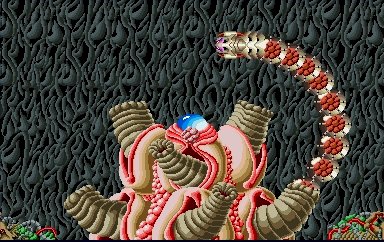

Looks like a big penis coming out of a big vagina, doesn't it? Those wacky japanese.
http://blazinglazers.gamersgraveyard.com/main_html/links.htm
The Unofficial R-Type Homepage
It even has news on Pulstar, a supposedly Irem-made game.
http://www.network54.com/Forum/message?forumid=121510&messageid=1001289707
Response to Blazing Star rox!
It's good, but not anywhere near as good as Pulstar.. It's supposed to be a "sequel", but it's pretty obvious that it wasn't designed by the ex-Irem staff that made Pulstar (Pulstar was made right after Irem went belly up, and they returned to Irem shortly after the company was ressurected - Blazing star was designed by a completely different team and it shows)
In fact, I'd say that Blazing Star is more of a step backwards that forwards.. Pulstar was really the unofficial "R-Type 4".. Blazing Star is more like Gradius than R-Type.
Pulstar was developed by Aicom, made up of ex Irem developers who really had r-type on the brain, as you said.
I LOVE them both! Pulstar really is pseudo-r-type 4. Almost as scary, almost as fancy (playwise), and I think even more "perfect" as far as pacing and overall speed and movement goes.
http://www.uvlist.com/gameinfo/5081
Pulstar (Palu Star)
FEEDBACK
published by AICOM
© 1996
game type: Shoot'em'up
System: Neo-Geo
Display:Raster
click to zoom
This was actually done by the same guys, who formely
worked at Irem and did THE shooter classic: R-Type
http://www.the-nextlevel.com/board/showthread.php?t=22269&page=2&pp=30
Firstly. Irem IS dead. The current Irem Software Engineering is not the same company. They just bought Irem's name and game copyrights. So Final and Delta have not *real* pedigree. Original authors of R-Type went to SNK to develope Neo-Geo's Pulstar under the Aicom label. Aicom was actually an old company (they were there in the 8-bit era), but it was bought by SNK which restructured it. It is said that part of the Pulstar / R-Type team worked in Pulstar's *sequel* Blazing Star.
http://www.the-nextlevel.com/board/showthread.php?t=22450&highlight=Recapitulador
It is known that some of the best Irem creators went to SNK. The authors of R-Type developed Aicom's Pulstar. Aicom was an old company bought by SNK. Why SNK did prefer to put the soon-to-be-defunct Aicom logo instead of the SNK one in this game is a mystery to me, but it validates my thesis: SNK loved to create new sub-companies and labels. The same goes for Nazca: formed up from Irem ex-members, it was a little SNK group which developed Metal Slug and Big Tournament Golf. Sure, they also developed Metal Slug 2, X and 3, but their name is not found in the copyrights. You even can't find it in the PS / SS Metal Slug ports.
http://www.neo-geo.com/forums/showthread.php?t=355&highlight=Aicom+R-Type+Irem
I was just looking at some Irem games and they share a big similarity to Neo games.
Take a look at this lot
cosmic cop 1991 - last resort 1992
gunforce 1991 gunforce 2 1994 In the Hunt 1993 - metal slug 1996
dream soccer 1994 - super sidekicks
ken-go 1991 - reminds me of a neo game title escapes me at the minute
major title 1990 major title 2 1992 - big tournament golf 1996
r-type 1987 - pulstar 1995
Someone mentioned that when Irem closed a load of people formed Nazca and some Aicom anyone got any info on this
http://www.neo-geo.com/forums/showthread.php?t=109818&highlight=Aicom+Irem
it's also a known fact that ex irem people made pulstar ( considering it's neo r-type and all )
http://www.neo-geo.com/forums/showthread.php?t=95273&highlight=Aicom+R-Type+Irem
You said it right there man. Pulstar = R-type. Aicom, the makers of Pulstar ARE Irem developers from what I've read.
http://www.neo-geo.com/forums/showthread.php?t=21202&highlight=Aicom+R-Type+Irem
IREM rocks almost as much as SNK. The team that put In the Hunt and Gunforce2 together must have been involved in development of the MS series imho.(there have been several threads on this topic) DONT TOUCH THAT DIAL. Especially if your receiving R-Type
Well ttooddddyy how many copies of Pulstar do you own? Of course as you must know that Aicom = Irem
http://www.neo-geo.com/forums/showthread.php?t=58877&highlight=Aicom+R-Type+Irem
R-Type - unofficial prequel to Pulstar?!
well, arguably yes. Team AICOM was formed by the ex-employees of IREM and so this game can be called a sequel.
WOW very interesting! I wondered what happened to IREM after all their shooters, (and them distributing Guardian Legend, from Compile ltd for NES) so Pulstar is a sequel. Makes sense since it runs like R-Type. Makes me respect Pulstar more, thanks!
http://www.neo-geo.com/forums/showthread.php?t=55643&highlight=Aicom+R-Type+Irem
I was wondering if anyone here has played Gunforce 2/ Geostorm, as it is a great game. It was made in 94 by Irem. I was wondering if talent from Irem ended up with SNK as the 2 games are very similar, and came out before Metal Slug did. The music sounds very familiar to the Slug series, as do alot of the soundeffects. In Geostorm you rescue women instead of Chuck Norris wannabes and the screen after you beat the stage is also all too similar. You also have the ability to drive a wide variety of vehicles. One cool feature is that your character has 2 weapons and can be rotated around. The explosions in this game remind me of the Slugs, alot of the vehicles/tanks have that kinda squished cartoony look to them as well. I'm not hating on the Slugs or anything, matter of fact I love'em to death but there's no denying Metal Slug was somewhat based off this game, I wish it would have come out for some home system or something. I thought the Slugs were so original but after playing this game I, kinda don't look at them quite the same if ya know what I mean.
I've never played this, but I'd have to respectfully contest your claim that it's "Metal Slug's ancestor" on the grounds that I've played Cyber-Lip. Though, I'm willing to allow that Cyber-Lip was this game's ancestor and this game was Metal Slug's ancestor, thereby making both parties happy (or equally pissed).
I believe that this topic has been discussed. Gunforce 2 (not the horror that was Gunforce) was developed by some of the same people that developed Metal Slug (I believe that it was Irem) and when they went out of business they went to work for SNK and lo and behold, we got Setal Slug. It was the same team that did In The Deep, too. Someone can probably add more detail to this than I...
To the dude that referenced "in the deep", its called "In the Hunt", but you are correct in that it was by Irem, and has the same graphical style as Gunforce 2 and therefore Mewtal Slug.
Its a great shooter thats also availablo on Saturn n PSX, and is basically Metal Slug, as a sidescrolling shooter underwater.
So some Irem guys made Metal Slug and then the other guys became AICOM and did Pulstar. Then the AICOM guys went back to being Irem and did R-Type Delta. Some crazy shizz.
The first two bosses in Gunforce 2 are funny in that they go all out to kill you. Both of them commit suicide trying to kill you just before there weapon blows up. The detail in this game is good having most of the scenery able to be destroyed. Also another game Irem put out in the art stylings of Metal Slug was Undercover Cops. More so in the color pallets used. Its a awsome side scrolling fighter.
Wow. So part of IREM became Nazca and the others became AICOM. All of this on Neo Hardware. Then for some reason IREM got back together. I will never figure that out.
http://www.neo-geo.com/forums/showthread.php?t=59107&page=2&pp=25&highlight=Aicom+R-Type+Irem
^this also might be totally false or partly false^I know Aicom went back to being IREM. They reunited to make R-Type Delta and are doing the port of R-Type 3 for GBA.
http://www.neo-geo.com/forums/showthread.php?t=47587&highlight=Aicom+R-Type+Irem
All right. I had always believed that Blazing Star was the sequel to Pulstar, which was a quazi-sequel to R-Type. I understand that Aicom, the team that developed Pulstar, was made up of former Irem employees. I am not sure where Yumekobo, the development house responsible for Blazing Star and Prehistoric Isle 2, comes in. Is there truly a relationship between Pulstar and Blazing Star, or is it only a coincidence that they both have "Star" in the title?
Pulstar and BlazingStar have the same script on the title screen. Also the ship of Pulstar (I think it's called Dino something) is available in BlazingStar.
BlazingStar is a modern shootemup (skill is only needed if you go for points), while Pulstar is damn hard to finish (which is much harder to design). It's obvious that the designers of Pulstar are more talented and spent more time in producing their game.
I like BlazingStar, I love Pulstar.
I believe that Blazing Star IS the sequel to Pulstar. Yumekobo just produced the sequel to it. Kinda like Contra and the other company picking it up and making a sequel to it.(Not the best example but you get my point.) Actually kinda like Metal Slug. Nazca made the first one and then SNK made the Sequels. I think Blazing Star sounds better than Pulstar 2:easier than the first one....
This just keeps getting more confusing for me. I eventually concluded that Aicom must have been either swallowed up by Yumekobo, of whom I had never previously to Blazing Star heard, or Aicom metamorphosed into Yumekobo. I think the two games are pseudo sequels or something, for the Pulstar ship & pilot being in Balzing Star.
In 1997, there was a game in development called Pulstar 2, re-named Pulstar Blast, with SNK claimed as the company responsible. The game got pushed into 1998, and I'm guessing that Blazing Star is the result, since I don't have enough documentation to track this fully, and there seems for the moment to be no other explanation. Kind of made me wonder about the relationship between SNK & Yumekobo (partial ownership?), also since Yumekobo was responsible for Prehistoric Isle 2, the original being by SNK, as well as some Pocket games by Yumekobo which I believe were of SNK/Nazca origin. Well, I don't think I've accomplished anything with this post, but perhaps someone else can enlighten us. They're both superb games, though I sort of like Pulstar more for the simple fact of being an atypical shooter with the checkpoint system.
Blazing Star is a follow up/side story to Pulstar the same way Waku Waku 7 is to Galaxy Fight or Contra Force to Contra. Aicom, Yumekobo, Garapagos (defunct?), and Nazca are extremely small second party companies that are pretty much programming teams within SNK, sort of like how 989 Studios, Psygnosis, etc. are all basically Sony inhouse developers.
The most obvious Pulstar/Blazing Star connection besides the original woman+ship being available should be how the first form of the final boss of Blazing Star shares the same look/pattern, music, and even the same hurt/attack voice sample as the first level boss from Pulstar.
Edit...
I think Aicom no longer exists and that they ARE Yumekobo now, but I'm not sure.
http://www.neo-geo.com/forums/showthread.php?t=56551&highlight=Aicom
There is a minute amount of flicker, maybe...
And there is slowdown.
But Irem, ahem Aicom did such a good job with the patterns and difficulty of everything, you won't care.
xexex note: whoa, yowza!As an aside, Medialand in Akihabara had a 'family tree' of R-Type for the launch of Final, and LEO was marked as a Side Story, and Pulstar was part of the main tree. Weird.
xexex note: wow if true! If true, I guess that means Aicom-SNK's Pulstar is closer to the original R-Type than Irem's own R-Type Leo
the non-Irem shmup Rayxanber II is incredibly frustrating.
is sub rebellion really work buying? i keep seeing it in my supermarket of all places, next to a bunch of shoddy 1st gen ps2 games...
if ZZT2 doesnt make it over here, i'll be importing. i suppose they may announce something come E3 since the game is supposedly due out 'summer' in japan
if ZZT2 doesnt make it over here, i'll be importing. i suppose they may announce something come E3 since the game is supposedly due out 'summer' in japan
cubicle47b
Member
Metalstorm's the shit. That's all I've got to add.
Holy shit, xexex. Thanks for all the research. That was a real eye-opener. It's great to finally connect the dots and and go "ah! that's why I've always had a hard-on for Pulstar, Metal Slug, and Last Resort!" It's amazing to think that the same group of people that had a hand in my gaming "awakening" spawned a whole litter of stuff that continued to influence me long after R-Type came out.
Hmm, I should track down Blazing Star. I don't think I've played it. What system is it for? Neo Geo?
Also, it's crazy to think that Irem Software Engineering has no real "pedigree," considering they literally made the definitive R-Type of the entire franchise (Delta). That's hot.
Hmm, I should track down Blazing Star. I don't think I've played it. What system is it for? Neo Geo?
Also, it's crazy to think that Irem Software Engineering has no real "pedigree," considering they literally made the definitive R-Type of the entire franchise (Delta). That's hot.

eso76
Member
The same goes for Nazca: formed up from Irem ex-members, it was a little SNK group which developed Metal Slug and Big Tournament Golf. Sure, they also developed Metal Slug 2, X and 3, but their name is not found in the copyrights. You even can't find it in the PS / SS Metal Slug ports.
HAH ! i was right ! : )
chespace said:Holy shit, xexex. Thanks for all the research. That was a real eye-opener. It's great to finally connect the dots and and go "ah! that's why I've always had a hard-on for Pulstar, Metal Slug, and Last Resort!" It's amazing to think that the same group of people that had a hand in my gaming "awakening" spawned a whole litter of stuff that continued to influence me long after R-Type came out.
Hmm, I should track down Blazing Star. I don't think I've played it. What system is it for? Neo Geo?
Also, it's crazy to think that Irem Software Engineering has no real "pedigree," considering they literally made the definitive R-Type of the entire franchise (Delta). That's hot.
you're most welcome chespace - it was very rewarding looking into this. I've known about the Irem-Pulstar connection for years, but until about a year ago or so, I had no idea that Last Resort was also probably done by ex-Irem folks. despite the similarities to R-Type, and more closely, to Gallop. I thought LR was an SNK-designed game, i mean really SNK itself and not just under SNK's name.
Yes and it's weird to know that Irem Software Engineering, thus Delta and Final, supposedly have no real original Irem "DNA" , whereas SNK-Aicom's Pulstar on NeoGeo, does have "Irem DNA" in it, as do other NeoGeo games.
man, I really need to play through PCE|TG16 and Arcade Ninja Spirit. never completed either.
Pulstar kicks fucking ass...another one of my top 10 of all time. Never got the attention it deserved.
Yes, Blazing Star is Neo-Geo...I was about to shell out big bucks for the cart years ago but was told it wasn't so hot. Still never seen it in the arcade :/
Last Resort might have been good had they cared about the difficulty, esp with two players. As is it's nice to look at as you fly thru it once only, imo.
Yes, Blazing Star is Neo-Geo...I was about to shell out big bucks for the cart years ago but was told it wasn't so hot. Still never seen it in the arcade :/
Last Resort might have been good had they cared about the difficulty, esp with two players. As is it's nice to look at as you fly thru it once only, imo.
BatmanX said:And what about this unforgettable arcade/pc engine classic?

Lovingly remembered. Great soundtrack and some well-paced action. Could never get past that one section.
...
blazing star is VERY different from pulstar/r-type(s). it's more of a manic horizontal shooter where your ship has massive fire power. pulstar/r-type on the other hand had the pre set resurrection points and levels you had to memorize to be able to get through.
but IMO blazing star is amazing in it's own way, i love it.
but IMO blazing star is amazing in it's own way, i love it.
i'd be very skeptical about these unsourced accounts of which developers ended up where. for one, blazing star isn't a pulstar sequel, and it's by a totally different developer (called yumekobo). it just has a similar graphics style and allows you to select the pulstar ship. i've been hearing for years that irem staff moved on to aicom and nazca. but i'm not sure it's true.
and strong resemblances from one game to another are no reason to assume that they share creators. sometimes developers just rip each other off. maybe the best example of this is the way psikyo's shooters utterly plagiarize videosystem's aerofighters games. a lot of people assumed that videosystem staff moved on to psikyo. but when someone actually looked through the credits, the two developers had no staff in common. and the timelines don't even work out. taito's gun frontier and raizing's battle garegga are a similar case.
and strong resemblances from one game to another are no reason to assume that they share creators. sometimes developers just rip each other off. maybe the best example of this is the way psikyo's shooters utterly plagiarize videosystem's aerofighters games. a lot of people assumed that videosystem staff moved on to psikyo. but when someone actually looked through the credits, the two developers had no staff in common. and the timelines don't even work out. taito's gun frontier and raizing's battle garegga are a similar case.
Damn this thread takes me back. I have only played like half of these titles though. I don't know what it was about R-Type, but the graphics in that game always used to blow me away. I vaguely remember some ad about the TG-16 being the first console powerful enough to bring it home arcade perfect and the TG-16 being 16bit so it could show like a billion colors next to like 64 from the NES.
The best part of 7-11 arcades was the Street Fighter craze for me.
The best part of 7-11 arcades was the Street Fighter craze for me.
MarkMacD said:Something else I thought was odd...I swore I read an interview with the producer of Final who had worked on plenty of previous R-Types....
well I suppose it might be very possible that one or more of the staff that worked on Final, also worked on R-Type, R-Type II, R-Type Leo, R-Type III, etc. but the main artists/programmers were almost certainly different. but that's not a definiitive answer, and I don't want to sound like I really know, because I don't.
bionic77 said:Damn this thread takes me back. I have only played like half of these titles though. I don't know what it was about R-Type, but the graphics in that game always used to blow me away. I vaguely remember some ad about the TG-16 being the first console powerful enough to bring it home arcade perfect and the TG-16 being 16bit so it could show like a billion colors next to like 64 from the NES.
The best part of 7-11 arcades was the Street Fighter craze for me.
Dude, I don't even know how I graduated high school... I spent most of my senior year (fall of 1990, spring of 1991) at Golfland or 7-11 playing Street Fighter 2. My Dhalsim had many people threatening my life.
rod furlong
Member
Hah, Dragon Breed is probably my personal all-time favorite arcade game. The first time you get the gold dragon and learn how to do that tail whip move...hell yeah.
And Disaster Report...hmmm...the game's aight but I tell you what, that strategy guide I wrote for it is poetry, I say. Amazon sales rank #1,989,739, bitches!
And Disaster Report...hmmm...the game's aight but I tell you what, that strategy guide I wrote for it is poetry, I say. Amazon sales rank #1,989,739, bitches!
hmmm, I found a post that actually *refutes* the Irem ===> Aicom connection
http://www.neo-geo.com/cgi-local/ultimatebb.cgi?ubb=get_topic;f=18;t=008476
I will use post for anything that refutes, denies, disputes, etc,
the Irem/Rtype ==> Aicom/Pulstar connection. the big post above will for what *supports* it.
http://www.neo-geo.com/cgi-local/ultimatebb.cgi?ubb=get_topic;f=18;t=008476
Aicom and Irem are not related. It's a rumor that has existed in the scene for a long time, but it's not really true. Aicom is really composed of ex-Tecmo and funded by Sammy (so may have had Sammy people). This is part of the reason why this was team that ported Viewpoint to Neo CD. Aicom later became Yumekobu (after recieving funds from SNK and Takara that is), which was later dissolved before SNK closed its doors.
I thught myself Aicom had some R-type programmers and engineers. Thus, if they were in the R-type(s), obviously they would have came from Irem. Strange story tough.
I will use post for anything that refutes, denies, disputes, etc,
the Irem/Rtype ==> Aicom/Pulstar connection. the big post above will for what *supports* it.
atomsk said:is sub rebellion really work buying? i keep seeing it in my supermarket of all places, next to a bunch of shoddy 1st gen ps2 games...
It's absolutely worth buying. It's like an underwater Warhawk.
Whimsical Phil
Ninja School will help you
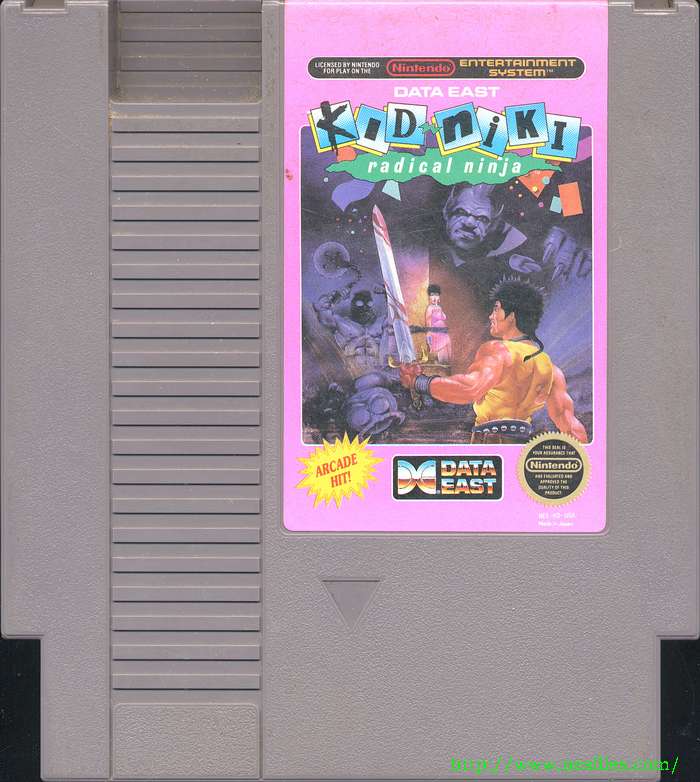
Where's the Kid Niki: Radical Ninja/Kaiketsu Yanchamaru love, dammit?!?!?


jarrod said:The first I heard of an Aicom/IREM connection was in the GameFan review of Pulstar fwiw, where it was said Aicom was formed from ex-IREM staff. If it's a rumor, it's been in effect since the game came out then.
Any more info about the Nazca/IREM relation btw?
Jarrod, that is the very same place that I first saw it also. but I do not think that ALL the posts regarding the Irem-Aicom connection stem from GameFan. I happen to believe it is true, and that GameFan just also reported it. If it is true, others would know about it as well, independantly, and regardless of GameFan's mentioning of it. Well, that is just my thinking on the subject anyway.
there are alots of posts about the Irem-Nazca relationship also-- I have just been targetting Irem R-Type-Aicom Pulstar for the most part. I will get around to the Nazca stuff sooner or later
p.s. there *is* a little bit of Irem-Nazca info/discussion mixed into that big post of mine in the middle of this page.edit: starting to add some Irem-Nazca stuff now...
http://www.neo-geo.com/forums/showthread.php?t=59981&highlight=Aicom
Metal Slug, ripoff of Gunforce2
In general the Mslug series stole heavily from gunforce2(1994). Can I get a witness? The music, jumping in armored vehicles, shoot hostages to set them free, I could go on. Let me know I'm not the only one here.
True. I have gunforce 2. Even the sound effects are the same. Similar gameplay, too, except you rescue female hostages instead of POWs.
I think it was essentially the same team though, so they aren't ripping anybody but themselves off, no?
Absolutly correct! They also worked on Undercover Cops, which is also a awesome game, and In the Hunt.
Well when IREM disbanded that they formed a couple different teams. NAZCA and then AICOM. Strangly enough they only made Neo Games and then reformed back into IREM a few years ago.
What's the timeline of this company, does anyone know? I noticed it said 'Nazca Corporation' on Metal Slug 1, I guess SNK bought the rights to Metal Slug and then Nazca went on to other projects. Here I always thought Nazca was an internal development house for SNK...
Definately from the same stable.
Irems Gunforce 2 (#1was shit imho) and In The Hunt (brilliant gameplay)
provided inspiration for the MS series and some of the irem production team members were later involved in MSlug development I beleive.
It stands out like dogs balls.
http://groups-beta.google.com/group....collecting/msg/c221cd8da977e290?dmode=source
DreamZ2048 May 7 1997,
Subject: What ever happened to IREM?
I always thought IREM made some awesome wild shooter games.
The folks must have had some wild imaginations!!
What ever happened to them? did they turn belly up?
Some of the original IREM game developers went to AICOM --
makers of Pulstar on the Neo*Geo. And the others went to
NAZCA Corp -- makers of Metal Slug on the Neo*Geo.
http://groups-beta.google.com/group/rec.games.video.sega/msg/06e84c1877161c51?dmode=source
Does anyone know if "In the Hunt" has anything to do with the Metal Slug
series? The art seems similar. I seem to recall that the Metal Slug team
was independent of SNK before being assimilated, did they previously do
In the Hunt?
MS1 was "Nazca" rather than SNK, wasn't it?
In the Hunt was an Irem game, one of if not the last shooter they made
before they ceased to exist. It's often claimed that some/all of the Irem
programmers went to Aicom and made Pulstar for SNK. IF that's true, maybe
there is some connection.
Another thought: Blazing Star was published by Yumekobo (not Aicom).
I wonder if Aicom was bought out?
The Metal Slug team (Nazca, now owned by SNK apparently) also did Neo
Turfmasters - one great golf game that deserves a sequel. In The Hunt
was from Irem before their brief "disappearance". During the
disappearance, Pulstar & Blazing Star were released as was Metal Slug.
Now I too am wondering if some Irem staff members had something to do
with Metal Slug.
http://groups-beta.google.com/group/rec.games.video.arcade/msg/284d05d2f8781196?dmode=source
I love this game on my Neo and I play it
virtually everyday. All hails Irem, huh, I mean all hails Nazca!
http://lists.dhp.com/neogeo/1999/Mar/1582.html
NAZCA QUESTIONS
Perhaps one of you NEO GEO fans can enlighten me on the following:
Is Nazca a subsidary of SNK of Japan or are they an independant company?
What games did Nazca program for the NEO GEO and on what corresponding
format(s)?
Did Nazca do any games outside of the NEO GEO stuff and if yes, which ones?
Is Nazca composed solely of industry starters or is their team made up
largely of coders from other companies?
*I ask that because their sprite artwork looks very similiar to IREM's and
AICOM's among others. Also, if I'm understanding correctly, AICOM is
composed of a number of ex-IREM coders.
Does Nazca have a website or are there any sites that have decent coverage
on them?
...ShinOken...
NAZCA QUESTIONS
Perhaps one of you NEO GEO fans can enlighten me on the following:
Is Nazca a subsidary of SNK of Japan or are they an independant company?
I think they *were* an independant company. Metal Slug 1 has a Nazca
copyright while MS2 has a SNK copyright. An they are both done by
the same people.
What games did Nazca program for the NEO GEO and on what corresponding
format(s)?
I know Metal Slug 1 and Neo Turf Masters. Any others?
Steffen
Jarrod, from what I've seen, Recapitulador aka Recap, seems to be the most informed source, if not one of the most, on all things Irem and SNK.