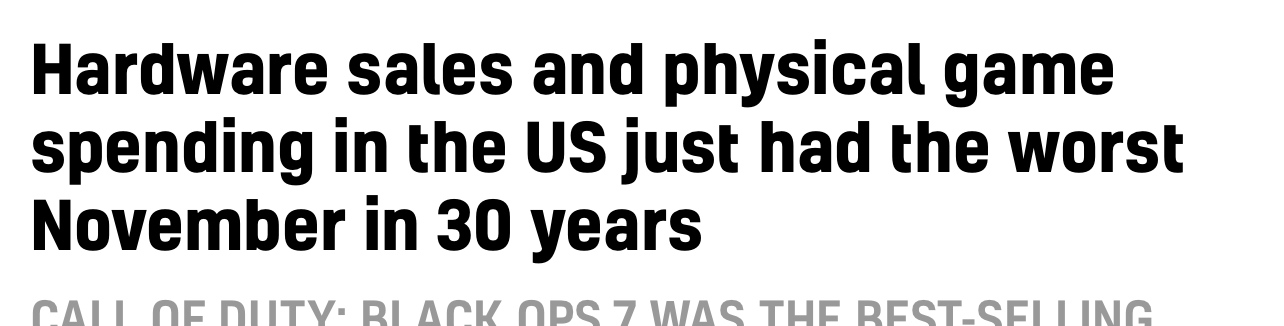
[Windows Central] No, it's not just Xbox - ALL video game console sales are massively down year-over-year

LectureMaster

Or is it just one of Adam's balls in my throat?

xwBa89Y5jsSNqk8cgT2X3T-970-80.jpg.webp


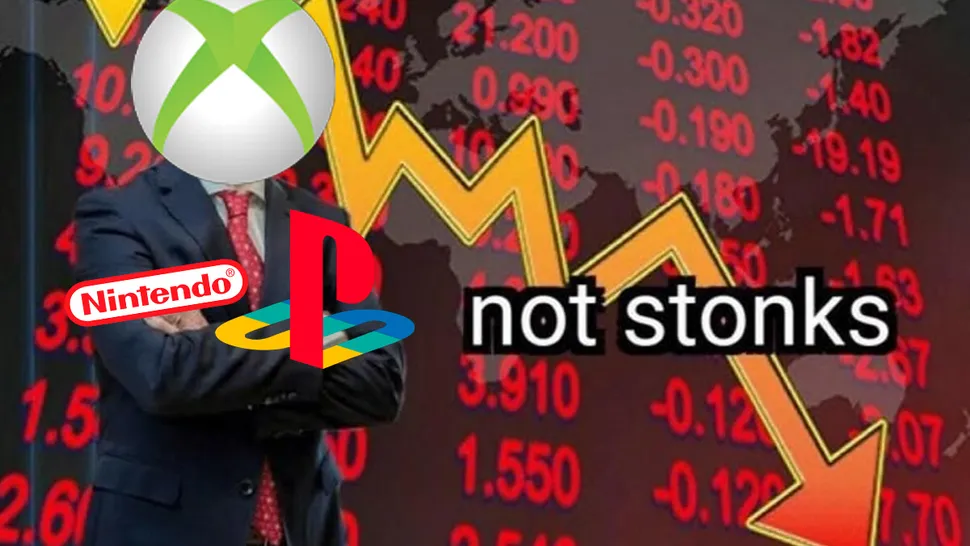
It is easy to point the finger at Xbox lately, and sometimes for good reason. Online discourse often centres on the brand. November 2025, however, tells a slightly different story, with data pointing to a market-wide downturn affecting every major console platform, not just Xbox.

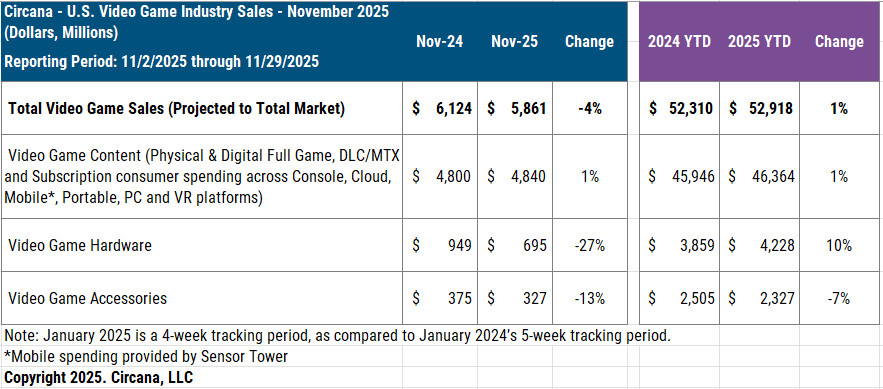
Circana, which regularly tracks and reports on industry sales, recently published figures showing total U.S. game spending fell 4% year over year to $5.9 billion. That decline spans hardware, software, and accessories, rather than being isolated to one segment.

While this data only reflects the U.S. market, the historical context is striking. November 2025 marked the worst November for U.S. hardware unit sales since 1995, an era dominated by systems like the PlayStation, Sega Saturn, and SNES, long before the modern console landscape took shape.

The data behind the downturn
Circana November 2025 chart

Circana November 2025 chart (Image credit: Circana)

According to Circana, hardware spending dropped 27% year over year to $695 million, with unit sales falling to 1.6 million. That makes November 2025 the weakest November for U.S. hardware unit sales since 1995.


Xbox Series hardware sales declined by 70% year over year, while PlayStation 5 sales fell by more than 40%. Combined Nintendo Switch and Switch 2 unit sales were down by around 10%, which stands out as relatively resilient by comparison.

Pricing appears to be a major factor. The average price of video game hardware reached $439 per unit in November, up 11% year over year, making consoles more expensive than ever during what is usually a peak buying period.

Xbox saw average price increases of over 30%, highlighting how higher entry costs can quickly suppress demand. The Switch 2, despite being the fastest-selling console in U.S. history, still saw its November unit sales trail the original Switch's first November, likely due to its higher price point and fewer meaningful discounts.


Software trends offer little comfort. Physical game sales fell 14% year over year, making November 2025 the worst November for physical software sales since 1995, even as subscription spending rose by 16%.

Call of Duty provides a clear example of the wider slowdown. Black Ops 7 topped the monthly charts, but full game dollar sales declined by a double-digit percentage compared to the prior year, showing that even the industry's biggest franchises are not immune.

Accessories followed the same downward trend. Spending in that category fell 13% year over year, reinforcing that consumers are pulling back across the entire ecosystem, not just on consoles themselves.


What's next for the gaming industry?

November may not be a one-off either. Circana notes that December and full-year data will be critical, but current trends already point to warning signs rather than a short-term blip.

It is no secret that hardware prices continue to rise, and the era of consoles becoming cheaper as a generation matures appears to be over. These pressures show little sign of easing, and rising RAM and storage costs could create further strain across the console industry. Alumni from PlayStation, Xbox, and others have cited everything from TikTok to evolving user habits for the decline in console sales, but PC gaming continues to dominate the conversation as well. The versatility of PC is why Microsoft is increasingly investing in its Xbox PC platform with devices like the Xbox Ally. But even PC isn't safe from these issues.

DRAM prices and NVME storage ballooning in price will hit PC builders too. Valve's own gaming PC could be holding out on revealing the price of the Steam Machine due to rising costs for memory. Recent reports suggest DDR5 RAM prices are set to increase further, with Samsung already reportedly doubling the price of their DDR5 RAM for suppliers. There are new rumors that NVIDIA is going to scale back its gaming products too.

If price continue to spike for these components, it's very likely that Xbox won't be the only high-end "premium" priced console next generation as Sony's stock of supplies can only last so long and as for how this will impact the Nintendo Switch 2, only time will tell.

It's hard to imagine the prices of these components not continue to increase, and therefore console prices paying the price. Especially as AI continues to consume every sector it even slightly touches as billion dollar companies, Microsoft included continue to throw money at what appears to be an infinitely deep hole with no end in sight.
 
Xbox are the truly screwed ones here. The least amount of consoles they've ever sold since entering the console market. Getting outsold by a Temu Kinect ripoff. That's a truly bad look.
 
Last edited:
Argument #1 is that these are broad trends. Xbox is affected first because they're in last place, but it's coming for all consoles. Declines in interest in younger generations, spiking hardware costs upending the traditional subsidization model, economic downturn.
Argument #2 is that Phil is a retard and 100% of all bad things in the industry are only Xbox related.

I for one am shocked, but it looks like the fanboy shitpost argument is looking less likely.
 
Argument #1 is that these are broad trends. Xbox is affected first because they're in last place, but it's coming for all consoles. Declines in interest in younger generations, spiking hardware costs upending the traditional subsidization model, economic downturn.
Argument #2 is that Phil is a retard and 100% of all bad things in the industry are only Xbox related.

I for one am shocked, but it looks like the fanboy shitpost argument is looking less likely.
The "engagement" metrics don't suggest a downturn in interest. People are more selective with their money given the economic environment, common sense.

And they're not going for Xbox.
 
Mega cope. LOL.

Sony and Nintendo are doing pretty damn well considering the economy.

If the market's down its due to Xbox flat-lining and MS' big service based push devaluing content in exactly the way some of us have been warning it would from day #1.
 
Last edited:
Windows central are just a website bought and paid for by microsoft. It's just propaganda and lies consistently in order to spin things microsofts way, because without the press passes and other goodies they get from microsoft, they'd be out of business and looking for new jobs.
 
Last edited:
How can NEX be down when they just released and outsold Xbox Series S & X?

Windows central are just a website bought and paid for by microsoft. It's just propaganda and lies consistently in order to spin things microsofts way, because without the press passes and other goodies they get from microsoft, they'd be out of business and looking for new jobs.

If it is, that's why those sort of things should be disclosed publicly by law IMHO. Same with the incessant astroturfing Microsoft claims they've stepped back from when really, all they did was end the Astroturfers Ambassador Program. That was merely one of many avenues they leveraged for astroturfing.

People like SoloKingRobert Florian Muller weren't part of the Ambassador Program officially, but were one of the absolute worst astroturfers for Microsoft during the ABK nonsense. Hoe's Hoeg's Law basically became another because he had family members (in-laws IIRC) working for Microsoft and stock investments as well, influencing his ABK "analysis".
 
Last edited:
How can NEX be down when they just released and outsold Xbox Series S & X?


If it is, that's why those sort of things should be disclosed publicly by law IMHO. Same with the incessant astroturfing Microsoft claims they've stepped back from when really, all they did was end the Astroturfers Ambassador Program. That was merely one of many avenues they leveraged for astroturfing.

People like SoloKingRobert Florian Muller weren't part of the Ambassador Program officially, but were one of the absolute worst astroturfers for Microsoft during the ABK nonsense. Hoe's Hoeg's Law basically became another because he had family members (in-laws IIRC) working for Microsoft and stock investments as well, influencing his ABK "analysis".

I think it should be disclosed by law as well. The astroturfing was awful at the beginning of the generation and it's still happening.


xwBa89Y5jsSNqk8cgT2X3T-970-80.jpg.webp


It is easy to point the finger at Xbox lately, and sometimes for good reason. Online discourse often centres on the brand. November 2025, however, tells a slightly different story, with data pointing to a market-wide downturn affecting every major console platform, not just Xbox.

Circana, which regularly tracks and reports on industry sales, recently published figures showing total U.S. game spending fell 4% year over year to $5.9 billion. That decline spans hardware, software, and accessories, rather than being isolated to one segment.

While this data only reflects the U.S. market, the historical context is striking. November 2025 marked the worst November for U.S. hardware unit sales since 1995, an era dominated by systems like the PlayStation, Sega Saturn, and SNES, long before the modern console landscape took shape.

The data behind the downturn

Circana November 2025 chart

Circana November 2025 chart (Image credit: Circana)

According to Circana, hardware spending dropped 27% year over year to $695 million, with unit sales falling to 1.6 million. That makes November 2025 the weakest November for U.S. hardware unit sales since 1995.


Xbox Series hardware sales declined by 70% year over year, while PlayStation 5 sales fell by more than 40%. Combined Nintendo Switch and Switch 2 unit sales were down by around 10%, which stands out as relatively resilient by comparison.

Pricing appears to be a major factor. The average price of video game hardware reached $439 per unit in November, up 11% year over year, making consoles more expensive than ever during what is usually a peak buying period.

Xbox saw average price increases of over 30%, highlighting how higher entry costs can quickly suppress demand. The Switch 2, despite being the fastest-selling console in U.S. history, still saw its November unit sales trail the original Switch's first November, likely due to its higher price point and fewer meaningful discounts.


Software trends offer little comfort. Physical game sales fell 14% year over year, making November 2025 the worst November for physical software sales since 1995, even as subscription spending rose by 16%.

Call of Duty provides a clear example of the wider slowdown. Black Ops 7 topped the monthly charts, but full game dollar sales declined by a double-digit percentage compared to the prior year, showing that even the industry's biggest franchises are not immune.

Accessories followed the same downward trend. Spending in that category fell 13% year over year, reinforcing that consumers are pulling back across the entire ecosystem, not just on consoles themselves.


What's next for the gaming industry?

November may not be a one-off either. Circana notes that December and full-year data will be critical, but current trends already point to warning signs rather than a short-term blip.

It is no secret that hardware prices continue to rise, and the era of consoles becoming cheaper as a generation matures appears to be over. These pressures show little sign of easing, and rising RAM and storage costs could create further strain across the console industry. Alumni from PlayStation, Xbox, and others have cited everything from TikTok to evolving user habits for the decline in console sales, but PC gaming continues to dominate the conversation as well. The versatility of PC is why Microsoft is increasingly investing in its Xbox PC platform with devices like the Xbox Ally. But even PC isn't safe from these issues.

DRAM prices and NVME storage ballooning in price will hit PC builders too. Valve's own gaming PC could be holding out on revealing the price of the Steam Machine due to rising costs for memory. Recent reports suggest DDR5 RAM prices are set to increase further, with Samsung already reportedly doubling the price of their DDR5 RAM for suppliers. There are new rumors that NVIDIA is going to scale back its gaming products too.

If price continue to spike for these components, it's very likely that Xbox won't be the only high-end "premium" priced console next generation as Sony's stock of supplies can only last so long and as for how this will impact the Nintendo Switch 2, only time will tell.

It's hard to imagine the prices of these components not continue to increase, and therefore console prices paying the price. Especially as AI continues to consume every sector it even slightly touches as billion dollar companies, Microsoft included continue to throw money at what appears to be an infinitely deep hole with no end in sight.


Jack Elliott Soccer GIF by Philadelphia Union


Some context is in 2009
Nintendo Ds 1.7m
Nintendo Wii 1.2m
360 819k
PS3 710k
PS2/PSP 490k.

Going back to 1995 though, the population of the US was about 70 million less than today but obviously a lot more phones and ipads about.

 
I don't think this will be Sony's last generation, but the next one will be complicated for them to maintain sales numbers, with a new generation that is much more tuned into mobile phones and PCs

I have a resistance to PC because I've ALWAYS played on consoles, and even so, Steam's aggressive sales are slowly making me migrate to it.

Besides the infinite backward compatibility and emulators.
And not having to pay to use my own internet.
 
Last edited:
Top Bottom