Combat:
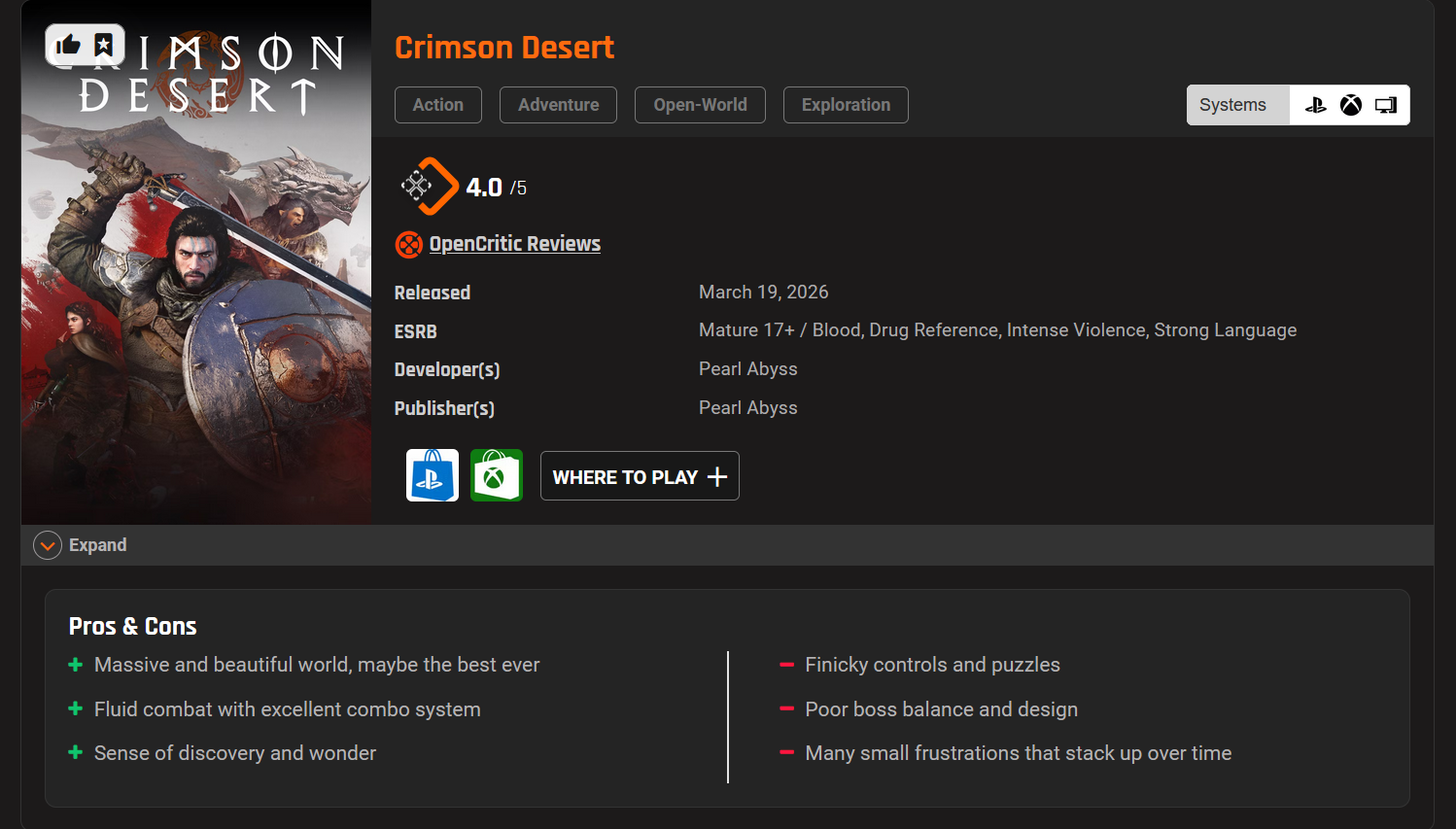
Combat in Crimson Desert is outstanding. I would not have waded through so many of the campaign's more frustrating sticking points if it wasn't for the fact that going into battle is pure fun. I played the entire game with a sword and a shield, which are Kliff's bread and butter. He has a range of moves, from the natural magic of Force Palm to the more grounded ability to dropkick his enemies off cliffs. Once the combos start to become natural, the combat is fluid and satisfying. It's the best I've ever experienced in an open-world game, and I'm not even sure the competition is close.
Bosses:
I struggled a lot with the boss fights in Crimson Desert. Not because they were difficult in the traditional sense, but due to the fact they often feel unfair. I've powered through Elden Ring multiple times, and even though it might sometimes take hours to defeat a boss or master its many machinations, its hardest encounters have nothing on how frustrating Crimson Desert's boss fights can feel. This is particularly an issue during the first few major bosses you encounter on the main quest and those towards the very end.
Since the early preview stages, I've shared this concern about the game's boss fights in general. One particular fight against the Staglord, which has been showcased several times now, has Kliff being thrown around with little means of fighting back. Sometimes it feels impossible to block, parry, or dodge in time. This results in a frustrating spiral where you are thrown around like a ragdoll, despite moments before slicing through thirty bandits with ease.
It's jarring and often immersion-breaking, and while you can eventually emerge victorious - I've worked my way through 30 of the game's 76 bosses in my 150 hours - it doesn't feel particularly rewarding. Not all bosses are built the same, however, and there are some truly fantastic boss fights here. Though some, particularly in the last chapter (oh my god), did almost do my head in.
Rather than mastering patterns and overcoming your opponent with skill, your best bet is to hunt deers for one hour, turn them all into Hearty Grilled Meat, and hope that you can heal your way through the damage by sheer attrition. When the advice is 'just heal', you know something isn't quite right.
Quests:
Many quests are very rudimentary, MMO-esque affairs. Go here, pick up an item, take it to another NPC. The style of quests are repeated in each of Pywel's five regions, and while they do have their own flavour and good mocap/voice acting for the NPCs, what you're doing never truly changes. The issue is that completing these quests is a requirement to enjoy the game, as inventory slots are earned by accomplishing such repetitive tasks. You can purchase small bags from various merchants, but these only reward a single inventory slot. Completing tasks for random villagers gives you three.
Unfortunately, it often feels like Crimson Desert does not respect your time. Take the Bounty missions, for example. These are dotted across the map, and you can get a good deal of silver for them, but you need to go to the location, pick up the target, and then carry them all the way back to the single jail in the region, which is sometimes a couple of thousand metres away. The entire time you're doing this, the person on the back of the horse repeats the same three voice lines over and over again. I did three of these missions and gave up.
End game:
Despite everything else I've mentioned in this review, by far my biggest issue with Crimson Desert is that even after dozens of hours of grinding, the game never delivers on its promise of the ultimate power fantasy. The final chapter is an utter slog, with bosses that are unintuitive and enemies that will beat the living hell out of you, even though Kliff at this point is an utter machine with highly-leveled gear and stats. Despite the beauty of Pywel, I unfortunately found the payoff for all that grinding through tedious puzzles and repetitive quests to be unrewarding.