• Hey Guest. Check out your NeoGAF Wrapped 2025 results here!

Monitoring the situation in Iran

If you mean 'many' in the 'more than one' sense, sure.

In the context of fighting a war, a handful of casualties per year is not 'many' from a national perspective. Germany probably lost 10x as many people to bee stings as it lost fighting in Afghanistan. I cannot imagine trying to tell the veterans of the -very much not hypothetical- wars which plagued Europe before Pax Americana that a few dozen or even a few hundred casualties over 20 years is now considered many. At a personal level the sacrifice is the same ofc.

As a broad assessment of NATO's enthusiasm in Afghanistan, President Trump's comments are accurate unfortunately. The attitude from many members -at a national level- was 'what is the bare minimum we can get away with here?' I do not believe President Trump's comments were meant as an indictment of the soldiers on an individual level, but of the lack of willingness of most NATO members to contribute beyond merely being present to being active. I consider this a fair observation, and his inference that the US cannot really rely upon NATO to be there if the US needed it to be correct. This conclusion will necessarily inform his policy elsewhere.

The price of admission for the bulk of Europe living under the security provided by the US since WW2 has been incredibly low. Surely the greatest deal in history when it comes to security enjoyed for the contribution required.

You are talking about hypothetical wars and hypothetical protection from USA - because none of that happened in history so far. "Greatest deal in history" was never tested by Europeans. As someone said before, creation of EU could have the exact same effect on peace in Europe as Uncle Sam watching, just being in the same alliance (NATO) also works pro peace - with or without fear of military intervention from USA. Nothing like that existed before WW2, and European countries were focused on rebuilding their economies after the war, not military conquest.

During the cold war it was in US interest to stop expansion of USSR but now? 50% chance (lower when Democrats were in power but still far from being sure) that Trump won't send troops if (for example) Baltic countries are attacked by Russia.
 
Last edited:
You are talking about hypothetical wars and hypothetical protection from USA - because none of that happened in history so far.
Sure, like we don't know that arresting a serial killer and putting him in prison for the rest of his life was what stopped him killing again, because who knows, maybe he would have just suddenly decided to stop of his own accord or he might have been hit by a bus the next day if we hadn't arrested him. We cannot prove this course of action prevented more killings, but any rational observer is likely to conclude that it did.

As someone said before, creation of EU could have the exact same effect on peace in Europe as Uncle Sam watching
I would pray this theory doesn't get put to the test any time soon. Not that it is likely to be, as the US will be unwilling to risk surrendering Europe to Russian control, or to risk Europe returning to its default state of nations with no shared loyalty fighting each other for supremacy. A bureaucratic body which seems to exist primarily to insist its member states allow their nations to be invaded and conquered is not going to be trusted to hold Europe together in a manner which is acceptable to the US.
 
As someone said before, creation of EU could have the exact same effect on peace in Europe as Uncle Sam watching,
Except the creation of EU (ECC) was only possible due to existence of USSR (common foe) and NATO. Without NATO you would have some european states forging better ties with USSR too. Historically - literally the previous century even - Europe has never been truly united. Only unifications that happened were under some military rule (conquest) and even those did not last that long. NATO allowed Europe to stop the "arms race" between each other and concentrate on their economies and welfare. But even now you have tensions between Germany and France, where France does not want Germany to become stronger, UK does not want Europe to become stronger, Germany does not want France to become stronger and want better ties with Italy, Hungary being pain in the ass etc. etc.

Europe constantly had wars between various states or rebellions within its border. Every 10, 20, 30 etc years before the Cold War. And then tensions even within EU are pretty visible across the same historical lines aka - Germany, France, UK. Even Austria-Hungary was partially a mess due to Hungary being constantly afraid to lose its influence (population etc). if Austria acted too close to the german federation.

During the cold war it was in US interest to stop expansion of USSR but now?
And Europe has been trading with Russia and propping up its military machine despite asking for protection from the same Russia. So does it need the protection then or not?
 
Last edited:
Except the creation of EU (ECC) was only possible due to existence of USSR (common foe) and NATO. Without NATO you would have some european states forging better ties with USSR too. Historically - literally the previous century even - Europe has never been truly united. Only unifications that happened were under some military rule (conquest) and even those did not last that long. NATO allowed Europe to stop the "arms race" between each other and concentrate on their economies and welfare. But even now you have tensions between Germany and France, where France does not want Germany to become stronger, UK does not want Europe to become stronger, Germany does not want France to become stronger and want better ties with Italy, Hungary being pain in the ass etc. etc.

Europe constantly had wars between various states or rebellions within its border. Every 10, 20, 30 etc years before the Cold War. And then tensions even within EU are pretty visible across the same historical lines aka - Germany, France, UK. Even Austria-Hungary was partially a mess due to Hungary being constantly afraid to lose its influence (population etc). if Austria acted too close to the german federation.

And Europe has been trading with Russia and propping up its military machine despite asking for protection from the same Russia. So does it need the protection then or not?

NATO was a direct response to the USSR.
But the EU started as the European Coal and Steel Community; ECSC. And it's founding members were Germany, Belgium, France, Italy and the Netherlands. It had nothing to do with a response to the USSR threat.
 
NATO was a direct response to the USSR.
But the EU started as the European Coal and Steel Community; ECSC. And it's founding members were Germany, Belgium, France, Italy and the Netherlands. It had nothing to do with a response to the USSR threat.
Yes it does because ECSC was only possible to create due to the idea that neither of those countries will go to war at each other any time soon. So there was no concern that "Germany will rise again", "France will try to rise again". NATO was created in 1949. It is similar to the Concert of Europe post Napoleonic wars, where - technically - Russia was a Gendarme of Europe at that time, but other bigger powers were keeping each other in check.

Europe has been pretty unstable region for generatons. Geography is destiny.
 
Last edited:
Yes it does because ECSC was only possible to create due to the idea that neither of those countries will go to war at each other any time soon. So there was no concern that "Germany will rise again", "France will try to rise again". NATO was created in 1949. It is similar to the Concert of Europe post Napoleonic wars, where - technically - Russia was a Gendarme of Europe at that time, but other bigger powers were keeping each other in check.

Europe has been pretty unstable region for generatons. Geography is destiny.

The ECSC was just an energy and material organization, when it started. It was successful enough that it expanded it's scope and it's membership. But it wasn't started to fight off the USSR threat.
Russia was never the Gendarme of Europe. In fact, Russia almost restated the war by making so many demands to receive more and more land. And Tsar Alexander I was absolutely impossible to deal with. A very erratic person, that followed a personal internal logic that made sense to no one.
 
Sure, like we don't know that arresting a serial killer and putting him in prison for the rest of his life was what stopped him killing again, because who knows, maybe he would have just suddenly decided to stop of his own accord or he might have been hit by a bus the next day if we hadn't arrested him. We cannot prove this course of action prevented more killings, but any rational observer is likely to conclude that it did.


I would pray this theory doesn't get put to the test any time soon. Not that it is likely to be, as the US will be unwilling to risk surrendering Europe to Russian control, or to risk Europe returning to its default state of nations with no shared loyalty fighting each other for supremacy. A bureaucratic body which seems to exist primarily to insist its member states allow their nations to be invaded and conquered is not going to be trusted to hold Europe together in a manner which is acceptable to the US.

Except the creation of EU (ECC) was only possible due to existence of USSR (common foe) and NATO. Without NATO you would have some european states forging better ties with USSR too. Historically - literally the previous century even - Europe has never been truly united. Only unifications that happened were under some military rule (conquest) and even those did not last that long. NATO allowed Europe to stop the "arms race" between each other and concentrate on their economies and welfare. But even now you have tensions between Germany and France, where France does not want Germany to become stronger, UK does not want Europe to become stronger, Germany does not want France to become stronger and want better ties with Italy, Hungary being pain in the ass etc. etc.

Europe constantly had wars between various states or rebellions within its border. Every 10, 20, 30 etc years before the Cold War. And then tensions even within EU are pretty visible across the same historical lines aka - Germany, France, UK. Even Austria-Hungary was partially a mess due to Hungary being constantly afraid to lose its influence (population etc). if Austria acted too close to the german federation.


And Europe has been trading with Russia and propping up its military machine despite asking for protection from the same Russia. So does it need the protection then or not?

Even if NATO wasn't created, Western Europe would be united against USSR... And destroyed countries weren't in any position to invade their neighbors.

World post WW2 is different than world pre WW2. What else happened after war besides creation of NATO and Warsaw Pact? Global trade became a thing, for Germany it makes much more sense to sell cars (and stuff) around the world than to conquer lands in Poland and France. It doesn't make sense anymore, global powers are mostly peaceful countries now - building their wealth on manufacturing, trade, natural resources and services.

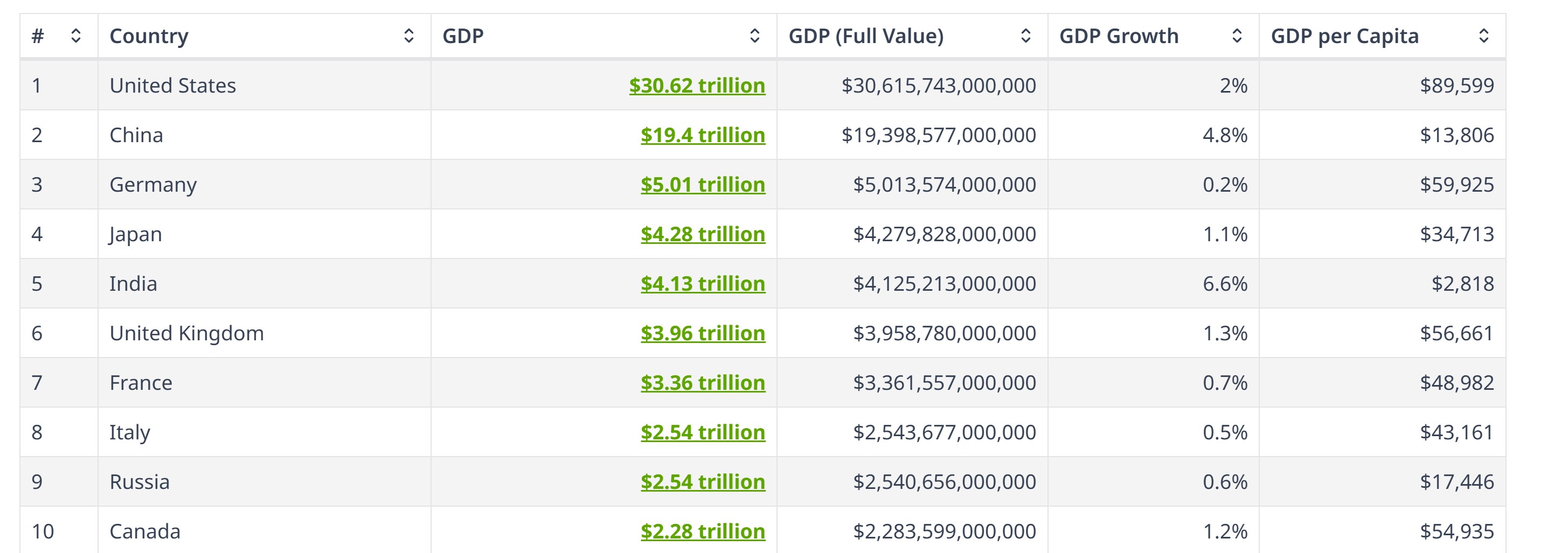
CDQosWLLsh9LUCku.jpg


On that list only Russia is a war mongering country (USA sometimes do that as well...) and most of that GDP was build on selling natural resources, not war with Ukraine. Russian way of thinking is not common anymore, waging wars is pretty stupid for your economy compared to peaceful ways of making money (not to mention destruction of infrastructure and human life).

And don't treat whole Europe as united when it comes to Russian stuff, Eastern part was talking about threat from USSR/Russia since 1989 (when they separated). Western Europe believed in "normal" Russia after Boris Yeltsin won the elections and at first didn't saw changes even when Putin was elected. Writing was on the wall but they wanted to ignore it and continued normal relations with Russia. While Putin in the meantime was preparing to invade its neighbors and resurrect "Russian Empire". But this changed and now Europe see Russia for what it is (existential threat) and prepare for something that might happen in the future...
 
And don't treat whole Europe as united when it comes to Russian stuff, Eastern part was talking about threat from USSR/Russia since 1989
I don't treat Europe as united, that the whole point. Europe is not united unlike what european federalist folks are saying and that's why I always push back against saying that Europe is united. It is not. Current situation is the exception due to factors like USSR and NATO.

The Eastern Europe has always been in conflict with Russia. For centuries. Aside being a battleground between various great powers (West vs Russia, North vs Russia), it experienced a lot of wars since old times. Kievan Rus vs Poland, Livonian War, Polish-Lithuanian-Teutonic War and so on. And that's without all the mess between PLC, the cossacks and the Ottoman Empire. Funny but the whole rise of Muscovy was due to a trade war that happened between the Hanseatic League and the Novgorod Republic, that weakened the Novgorod and allowed the Muscovy kingdom to devour it later.

It is a complicated but not a binary situation.

World post WW2 is different than world pre WW2. What else happened after war besides creation of NATO and Warsaw Pact? Global trade became a thing,
Global trade existed before. Before you just had multiple maritime powers that sometimes fought each other, but post WW2 the whole "safety of the seas" was maintained by USA (like the Great Britain before) as by and large the fleet of others was eliminated. A lot of conflicts and tensions between countries are due to trade routes and straits (like the whole situation with the Ottoman Empire blocking the trade routes forcing the age of discovery). And it has not changed - geography is destiny. We still have almost the same actors trading loyalties or controlling trade routes, forcing others to search alternatives and so on. It has always been the case. The scale has increased, but conceptually nothing has changed.
 
Last edited:
I don't treat Europe as united, that the whole point. Europe is not united unlike what european federalist folks are saying and that's why I always push back against saying that Europe is united. It is not. Current situation is the exception due to factors like USSR and NATO.

The Eastern Europe has always been in conflict with Russia. For centuries. Aside being a battleground between various great powers (West vs Russia, North vs Russia), it experienced a lot of wars since old times. Kievan Rus vs Poland, Livonian War, Polish-Lithuanian-Teutonic War and so on. And that's without all the mess between PLC, the cossacks and the Ottoman Empire. Funny but the whole rise of Muscovy was due to a trade war that happened between the Hanseatic League and the Novgorod Republic, that weakened the Novgorod and allowed the Muscovy kingdom to devour it later.

It is a complicated but not a binary situation.


Global trade existed before. Before you just had multiple maritime powers that sometimes fought each other, but post WW2 the whole "safety of the seas" was maintained by USA (like the Great Britain before) as by and large the fleet of others was eliminated. A lot of conflicts and tensions between countries are due to trade routes and straits (like the whole situation with the Ottoman Empire blocking the trade routes forcing the age of discovery). And it has not changed - geography is destiny. We still have almost the same actors trading loyalties or controlling trade routes, forcing others to search alternatives and so on. It has always been the case. The scale has increased, but conceptually nothing has changed.

Global trade post WW2 exploded and became more important to many countries than land conquests. USA and European countries would want clean and safe water passages regardless of NATO, USA was fighting Berber pirates in Mediterranean sea in 1801.

Russian people never had any resemblance of democratic rule (maybe for a few years with Boris Y.), they were always ruled by despots that had Imperial ambitions. This didn't change when USSR collapsed, but sadly many people in power (especially in Germany) were fooled by Putin (and his money).... And now we are in this fucked up situation...

And being angry about what EU did (or not did) when Russia attacked Georgia and then annexed Crimea (and attacked Ukraine in 2014) is perfectly valid. But what US presidents did about that? Obama and Trump (2016-2020) did very little about it despite USA signing Budapest memorandum.
 
Last edited:
Russian people never had any resemblance of democratic rule (maybe for a few years with Boris Y.), they were always ruled by despots that had Imperial ambitions. This didn't change when USSR collapsed, but sadly many people in power (especially in Germany) were fooled by Putin (and his money).... And now we are in this fucked up situation...
Democracy has nothing to do with it. Just because someone has a democracy, it does not mean they do not engage in the wars.

And being angry about what EU did (or not did) when Russia attacked Georgia and then annexed Crimea (and attacked Ukraine in 2014) is perfectly valid. But what US presidents did about that? Obama and Trump (2016-2020) did very little about it despite USA signing Budapest memorandum.
USA has no real leverage against Russia - they don't trade that much - and they could not apply sanctions properly because it creates trouble for Europe (like in case of Ukrainian war, they basically have no choice and Germany still was buying Russian gas and other things) with whole payment processing. Russia also used to be a part of chinese initiative due to their railway network. Europe was not willing to do anything and the most aggressive players - like UK and USA - could not do much either. Even when Trump put sanctions on Iran, Europe was trying to find a way to avoid them using some other payment systems or whatever they wanted to create at that time.

Europe is very vulnerable as most of the trade routes are coming from relatively unstable areas - Iran, Egypt, Turkey, Central Asia+Russia.
 
Last edited:
Top Bottom