• Hey Guest. Check out your NeoGAF Wrapped 2025 results here!

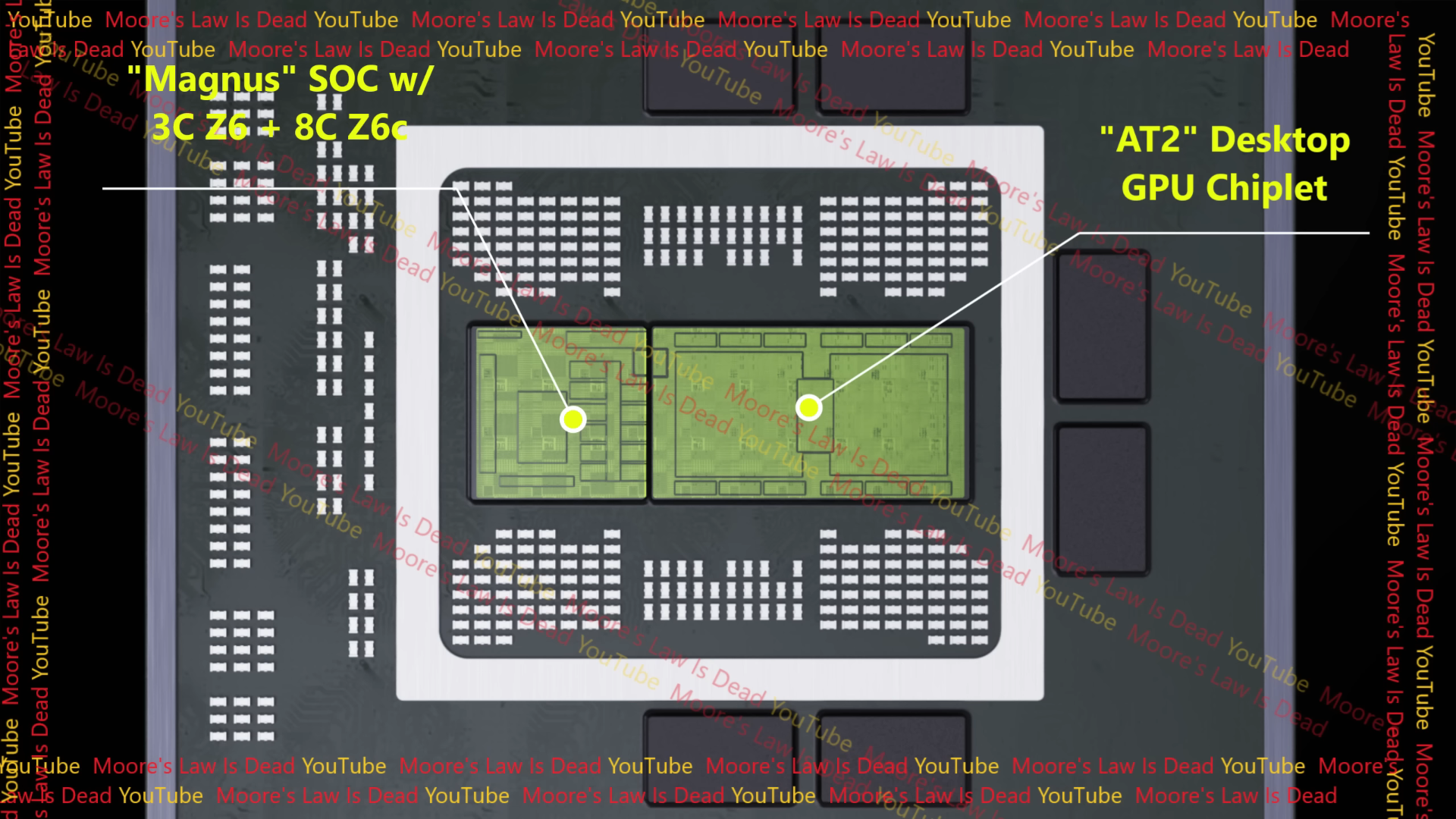
[MLiD] AMD Magnus APU Full Leak: RDNA 5, Zen 6, 110 TOPS NPU = XBOX Next-Gen Console!

If it's a pc, it will have to wait for the pc version, if it's not a pc, it will play the Series X version.
I can't imagine R* wasting time and resources to port and optimise a version of the game for a new console that will have a tiny install base because it is priced so high.
All 100% true but MS being MS they might through R* gobs of money for that optimization just for bragging rights but who knows
 
If it's a pc, it will have to wait for the pc version, if it's not a pc, it will play the Series X version.
I can't imagine R* wasting time and resources to port and optimise a version of the game for a new console that will have a tiny install base because it is priced so high.

if anything it will be a hybrid. both a console and a PC. that's not even a new concept, it was just never done in a proper way. both the PS2 and the PS3 were able to run Linux.
500px-Linux_for_PlayStation_2_box_art.svg.png


so it will probably have an Xbox mode and a PC mode. that's already half the case on current Xbox consoles after all. in Dev mode you can run PC programs by simply converting them to UWP. that's how there are so many homebrew "ports" on Series X and Xbox One that were brought over by usually a single guy, with barely any adjustments... if any at all.
 
I think if its fixed hardware and its running a console environment, using a specific API game design environment and not just a PC code base / Wiindows then its fundamentally a traditional console in my eyes. It could cost 2 grand and id still call it a console if it was running software for its dedicated hardware in a dedicated software environment, even if its windows derivative.

Does that make sense?

If it supports steam which the video and others are saying. It is very similar to windows handheld. So if some one has a game on steam they can play on PC, windows handheld or the new xbox. In a way they are just encouraging people to move over to steam.
 
They are charging $800 for a console that has been out for 5 years. How much do you think they are going to charge for this? l can almost guarantee the pricing will make it a novelty item that only the rich "not poor" assholes can afford it.
 
I think it's a difference of terminology. The die is the piece of silicon itself. The package is the finished unit with one or more dies. So Magnus is a single package with multiple dies.

My guess will be the same, it will be an evolution of strix halo APU for Series 2X. It was well received, well review, just too expensive for most use case.

Instead of amd experimenting solo, it is smarter to partnered with MS and existing AIBs, to design a product stack for the masses..

Makes no sense to create another pc ecosystem within the existing pc ecosystem. IF Amd needed 10m MOQ to start designing the handheld APU, an expensive Magnus-AT stack definitely wont sell.

It is cited this is the main cause of expecting Series 2X to be very expensive, i dont think so, MS will sell it at breakeven or a small profit. They wont subsidise it but they wont make something with insane BOM for the audience. $799-849, quote me!
 
Last edited:
Even that part I honestly don't quite understand after listening to the AMD announcement. Seems like the whole point of that new chip is BC, and it will be across multiple devices. I don't know!
The point is that Magnus is not exclusive to Microsoft, and that's done to better amortize the design cost. The PS5 is still a console despite the fact that AMD sells "Ryzen 4700S" to Chinese OEMs.
 
Well if its running exclusively PC games, I cannot call it a console no matter what brain gymnastics are made... this would be literally the "everything is a xbox" meme ... ..but if microsoft and third party releases games coded specific for the hardware (which I really doubt) than ok its a console hybrid or whatever...

And backward compatibility dosent count.

I agree. It needs to be what we would previously consider "console code" to be a console. If it's just pc code it's a pc.
 
They are charging $800 for a console that has been out for 5 years. How much do you think they are going to charge for this? l can almost guarantee the pricing will make it a novelty item that only the rich "not poor" assholes can afford it.
$800? The PS5 is $500 last I checked, and was a bit under that before the recent Tariffs.

The Pro is more expensive, but I'm pretty sure Sony is quite aware of what pricing the mass market will tolerate for a new generation.
 
Both are accurate
If the specs are finalised how does the new Amethyst talk features overlay the Xbox technical specs

The Amethyst video showed 4 WGPs per Neural Array, so can we concluded that the Shader Engine with 1x 8 WGPs - rather than the 3x9WGPS - is two 2 Neural arrays - assuming this APU has them? based on the AMD guy commenting and laughing about a cabling nightmare to array the whole GPU, and then showed at 2:41 in the video 4 WGPs randomly lighting up as pairs of CUs, suggesting an Array is 4 WGPs/8 CUs, meaning the 3x Shader Engines with 9 WGPs might not have that capability for wiring reasons, and if so, does that mean the 2 Shader Arrays per ShaderEngine should in fact be listed as Shader Arrays for that odd-one-out Shader Engine?

The info also leaves out Radiance Cores and their Neural Radiance Caches. Are these just undocumented in the leak but in the spec as additional hardware? Or not in the hardware spec and just async compute provided in software on the Shader Engines? Or is the 1x8 WGP Shader Engine actually wrongly labelled and should be listed as a Radiance Core?
 
I don't see how PS6 can match Magnus, it has fewer CPU cores, lower CPU frequency, fewer CUs, fewer ROPs, lower GPU frequency, less cache and memory bandwidth. It's not a huge difference but Magnus should have better performance in 100% of games unlike this gen where it's more of a 50/50.
I think it all comes down to how many Neural arrays, Radiance Cores(and Neural Radiance Caches per Core) and just how low a native resolution PS6 can target to leverage those specialized capabilities to have better path trace ray density, better denoising, lower processing latency for upscaling and better ML AI fusing, by having more address space by having more neural arrays, meaning more efficient utilisation of the TOPS.

This is the reason why I asked you the question before this one.
 
Last edited:


Chapters:
0:00 (NEW Leak) Pics of AMD's XBOX Magnus APU!
1:12 Cheap for PC, Expensive for Console
3:57 Why you should be excited for Next-Gen XBOX…
5:10 XBOX Magnus is NOT Cancelled!
9:14 RDNA 5 & XBOX's Cancelled Handheld APU
14:10 (NEW Leak) XBOX Magnus Specs & Release Date
20:25 XBOX Magnus Performance vs PlayStation 6
23:00 XBOX MUST DO THIS to Succeed Next-Gen!


Thanks to a certain fruit company, AMD's big APUs have found a business model that is targeted for business customers' use cases e.g. local desktop Large Language Model (LLM). Game consoles' big APUs wouldn't be alone when business's use cases join the big APU bandwagon.
 
The point is that Magnus is not exclusive to Microsoft, and that's done to better amortize the design cost. The PS5 is still a console despite the fact that AMD sells "Ryzen 4700S" to Chinese OEMs.
AMD/AsRock BC-250 SKU also recycles PS5's semi-failed yield APUs. Failed silicon still needs to be paid. Linux AMD GPU drivers identify the PS5 GPU as RDNA 1 since it's partially RDNA 2.
 
Last edited:
there was a big difference in capabilities between the PS4 and PS5. the SSD speeds and the RT acceleration alone created a clear divide.

PS5 and PS6 will have no such dividing factor. just one will be better at RT than the other. ML Reconstruction can be substituted with "dumb" reconstruction.

400p scaled to 1080p also looks awful. the target resolution is less important than the input resolution. generally, anything below 900p internal res is suboptimal already.

RX 9060 XT 16GB's 32 CU RDNA 4.0 performance results being similar to PS5 Pro's 60 CU RDNA 2/RDNA 3, shows RDNA 4.0's efficiency gains vs older RDNA 2 and RDNA 3.0.

RDNA 4.0 (GFX1200/GFX1201)CU's WMMA is backed by 2X texture sampling rate, dynamic register allocation, and improved real-time memory compression. Incoming Mi400 RDNA 4.5 (GFX1250) has WMMA FP4 and FP6 improvements.

AMD's BVH RT's data fetch is via the TMU I/O path, and it's twice the raw performance on RDNA 4 and RDNA 3.5 when compared to RDNA 3.0. NVIDIA SM's BVH RT's data fetch is separate from the TMU I/O path.
 
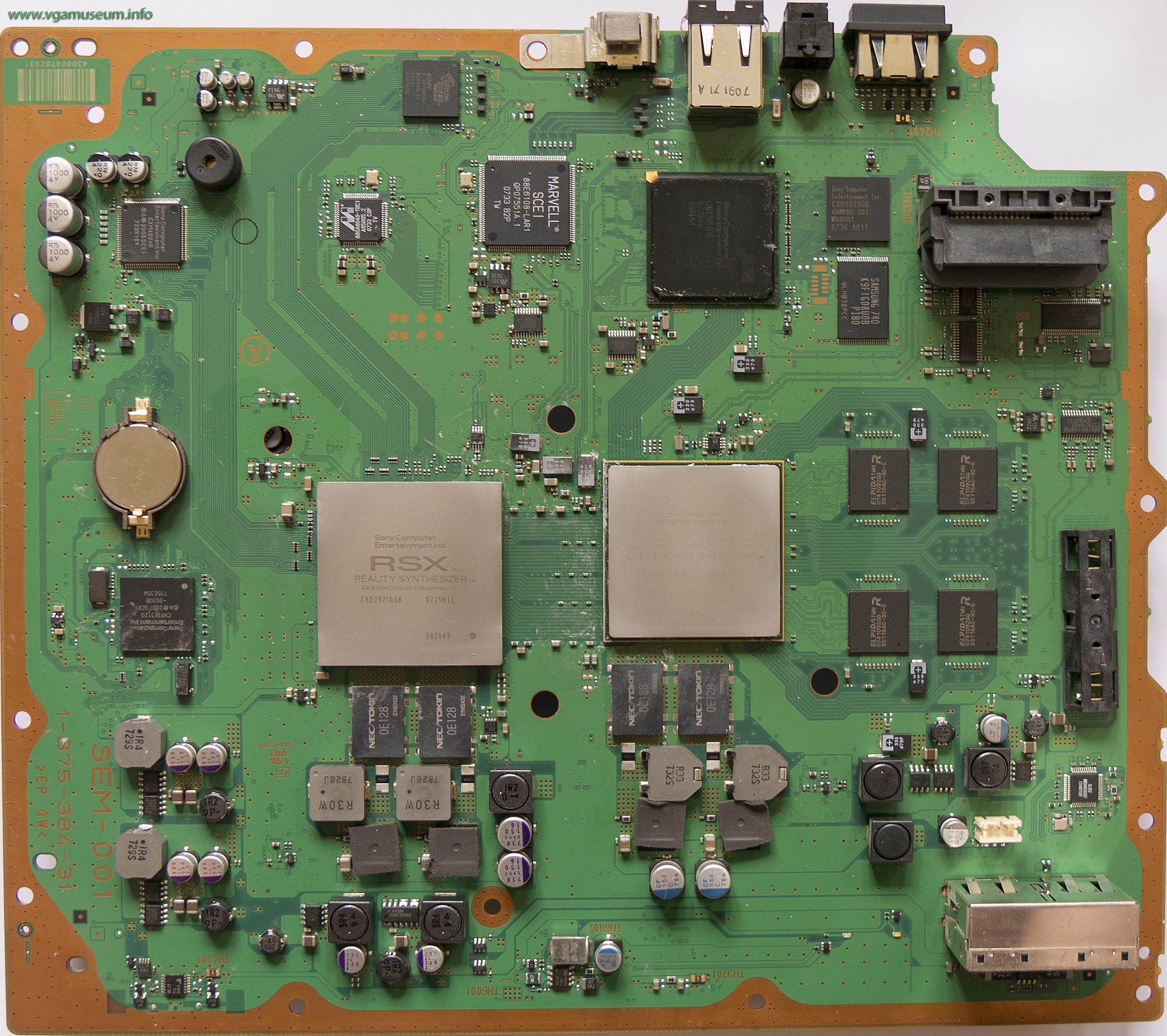
I bet magnus and its derivatives, and orion, all will be on the same single die, it can be stacked, tiles, fabric connected.

There is no way they will go back to PS360 design


ps3rsxboard.jpg
Xbox_360_revisions_xenon_motherboard.jpg
Refer to AMD's Strix Halo's MCM (multi-chip module) on a single APU package. Most Granite Ridge Ryzens on the AM5 platform are MCM APUs since they include a tiny RDNA 2 IGPU on the IOD (I/O die).

AMD's Strix Halo APU has two Granite Ridge CCDs with a big GPU IOD. Depending on the target market, both CCD and IOD can change scale.

For example,

Very compact Zen6 CCD with medium-large GPU IOD can target game consoles.

Fat Zen6 CCDs with very large GPU IOD can target server LLMs.

High-density compact Zen6 CCDs with very large GPU IOD can target server LLMs.

Fat Zen6 CCDs with medium-large GPU IOD can target business desktop/DTR laptop LLMs.

Fat Zen6 CCDs with small GPU IOD can target AM5 desktop platforms. Usually paired with a discrete GPU card.

Fat Zen6 CCDs with Epyc IOD can target traditional servers. Can be paired with discrete GPU cards.

High-density compact Zen6 CCDs with Epyc IOD can target traditional servers. Can be paired with discrete GPU cards.

All AMD SKUs can run FreeBSD, Linux, and Windows.


Zen 2 already has 3 grades from fat (PC desktop/server Zen 2), compact (e.g. PC mobile Zen 2s), and very compact (e.g. PS5's Zen 2).

Zen 5 already has 4 grades from fat (Granite Ridge Zen 5 with full-width AVX-512 hardware implementation), compact (Strix Point Zen 5), very compact (Strix Point's very compact Zen 5), and high-density compact (Zen 5 Turin Epyc with full-width AVX-512 hardware implementation).

Zen 6 generation has LP CPU cores i.e. AMD's #metoo Intel Luna Lake's LP CPU cores.

 
RX 9060 XT 16GB's 32 CU RDNA 4.0 performance results being similar to PS5 Pro's 60 CU RDNA 2/RDNA 3, shows RDNA 4.0's efficiency gains vs older RDNA 2 and RDNA 3.0.
Some of this is due to higher clocks - 9060XT boost is 3.1GHz vs Pro's 2.35GHz. This alone is about +30% or roughly equals to 40 CUs at Pro's clocks.

But comparing GPUs just by "CU" numbers is wrong by default since these are different, sometimes totally so.
9060XT is using a chip which is made of ~30Bln transistors.
If we compare that to RDNA2 family this would be more than what was used for 6900XT - 27Bln.
A 60 CU RDNA2 part will likely be at ~22Bln transistors - which is another 35% or so difference to 9060XT's 30Bln.

In the end the "efficiency gains" don't look as high if you take this into account, and it is worth remembering that at least a third of them are paid for in GPU complexity which means that you can't just extrapolate the performance of a 32 CU part into a 40/50/60 CU one as such part may end up being too big for a console SoC.
In other words, don't use "CUs" as if that's some fixed h/w metric. RDNA doesn't even have "CUs" per se.
 
Last edited:
The point is that Magnus is not exclusive to Microsoft, and that's done to better amortize the design cost. The PS5 is still a console despite the fact that AMD sells "Ryzen 4700S" to Chinese OEMs.
Hello KeplerL2 any word on:

Microsoft updating API's:
Direct X ultimate 13?!
Sampler Feed Back Streaming 2.0?
Some sort of Machine Learning, Ray tracing, Path tracing API that doesn't tank performance?

PS6 and Magnus resolving storage medium and space issues:
PCIE Gen 5.0 SSD specs of 20GB/sec - 30 GB/sec range? 1-2 TB+ size range?
Some sort of Optical Ultraviolet Disk Drive for games 200GB+?
Additional slots of saving and downloading games? MiniSSD? SD card slot? With storage size and read/write speeds similar to the main SSD?

I/O and connectivity:
PS6 and Magnus to have multiple USB 4.0 or USB 4.0 ver 2 of 40Gbps-80Gbps of connectivity for controllers and perhaps even eGPU expansion for Magnus?
HDMI 2.2?
5G connection for PS6 portable?
Wifi8?
Latest Version of Bluetooth (Version 6.0?)

Thank You for your insights!
 
Sarah Bond and Carl Ledbetter showed Good Morning America around the Xbox hardware labs .

"This is where we're prototyping the next-generation of Xbox."

 
Sarah Bond and Carl Ledbetter showed Good Morning America around the Xbox hardware labs .

"This is where we're prototyping the next-generation of Xbox."

I can't watch this until later. Is this confirming a possible actual Xbox handheld prototype? Very interesting.
 
I think it all comes down to how many Neural arrays, Radiance Cores(and Neural Radiance Caches per Core) and just how low a native resolution PS6 can target to leverage those specialized capabilities to have better path trace ray density, better denoising, lower processing latency for upscaling and better ML AI fusing, by having more address space by having more neural arrays, meaning more efficient utilisation of the TOPS.

This is the reason why I asked you the question before this one.
But all of those technologies and optimizations are also available to the Magnus, no? If so, it's going to outperform the PS6 by a decent margin, I mean, if you take the same hardware line with the same tech, the larger one is going to be faster. This isn't like the Xbox Series X, where there is a split memory scenario, slow vs fast clock speeds, etc Magnus is both faster clocked, has more cus, more bandwidth and memory, same arch optimizations, and has a higher clocked and more powerful CPU with more cores and a dedicated modest NPU on top. I'm struggling to see how you see the PS6 pulling some underdog miracle to punch beyond its weight at least from the info we've been given so far.
 
I can't watch this until later. Is this confirming a possible actual Xbox handheld prototype? Very interesting.
Here She seems to be referring to the XSeries successor.
But it's also true that in the MS-AMD announcement, she said: "Our next-generation hardware, including future Xbox consoles, on your TV and in your hands." That phrase suggests that an XBOX handheld is still in the works.... 🤷
 
Sarah Bond and Carl Ledbetter showed Good Morning America around the Xbox hardware labs .

"This is where we're prototyping the next-generation of Xbox."

Oh wow. First the Time Magazine award and now a 3-minute feature in GMA? The whole handheld market just got disrupted!
 
I can't watch this until later. Is this confirming a possible actual Xbox handheld prototype? Very interesting.
It doesn't confirm anything we don't already know. It's a dog and pony marketing fluff piece lined up for launch.

Having said that, I did learn they have a simulation room with airline seats so they can confirm you don't need 2 tickets to take your Ally X with you.
 
It doesn't confirm anything we don't already know. It's a dog and pony marketing fluff piece lined up for launch.

Having said that, I did learn they have a simulation room with airline seats so they can confirm you don't need 2 tickets to take your Ally X with you.

Dropping two edgy posts back to back may be a new record on this website.
 
Did Kepler confirmed this?
Yes


He also speculated on the potential of swapping out AT2 (the GPU chiplet) for a lower spec version, even though there is no evidence of such a thing so far:

If Magnus SoC can be paired with AT3 GMD then they could have a lower end SKU, but so far I have not seen any documentation suggesting that (and I don't think MLID mentioned that either).
 
But all of those technologies and optimizations are also available to the Magnus, no? If so, it's going to outperform the PS6 by a decent margin, I mean, if you take the same hardware line with the same tech, the larger one is going to be faster. This isn't like the Xbox Series X, where there is a split memory scenario, slow vs fast clock speeds, etc Magnus is both faster clocked, has more cus, more bandwidth and memory, same arch optimizations, and has a higher clocked and more powerful CPU with more cores and a dedicated modest NPU on top. I'm struggling to see how you see the PS6 pulling some underdog miracle to punch beyond its weight at least from the info we've been given so far.
That's why I was looking specifically at the specs and asking Kepler to confirm how the Amethyst reveal overlayed the info leak - that he and MILD have confirmed as final specs despite Amethyst still being theoretical simulations.

The oddities about the Xbox reveal specs compared to new Amethyst features IMO are:

192bit Memory Interface- if using Universal Compression beyond 2017 AMD patent for Delta Colour it feels like an unnecessary pre-Universal compression spec.

Asymmetric shader engine WGP counts, with 3 SEs with 9 WGPs each and two shader arrays each, and then one regular SE with two shaders arrays with 8WGPs - like the PS6 ones if inferring from the Amethyst video visualisations. Less SEs and shader arrays per WGPs, and 9 WGPs per SE doesn't seem compatible with the Neural Arrays in Amethyst video given the wiring demands and the visualisation showing 4 WGPs per Neural Array, like a similar setup to 4WGPs per regular shader Arrays, making it seem like Xbox might only have two neural arrays, looking very much like a retro fit to a RDNA4 architecture rather than a new balanced design.

The radiance cores were shown as 4 identical Blocks - like 4 reworked WGPs to be 4x Neural radiance caches - with a 5th block with the height of 2 of the other blocks and a width about one and half times those other block's widths to do the logic, ray traversal and control the radiance cores, and it was described as:

"a new dedicated hardware block designed for unified light transport"
"it handles ray tracing and path tracing in real-time"
"radiance cores take full control of ray traversal, one of the most compute heavy parts of the process"
"and that frees up the CPU for geometry and simulation, and lets the GPU focus on what it does best...shading and lighting"


Which going by the visuals and description suggest 8CUs in a chip will need sacrificed from a total count, which again doesn't seem like the Xbox has it based on 70CUs(=2x(3x9+8)) rumour and the beefy CPU cores like it was planning to do ray traversal on the CPU and maybe the 1x8WGP unit is actual 4 Neural Radiance Caches - that have R&D from a year earlier, prior to being part of the Radiance cores unit.

At the end of the day the AMD statement about Ray traversal cost is going to make the Radiance Cores and how many neural radiance caches in them critical to path tracing performance and quality, as it is one NRC per light source or reflector. The number of neural arrays is going to be critical to TOPs throughput, because the tiny L2 cache is going to be 9070XT good, but not neural array good for ML., so if the PS6 is designed with different counts of the new capabilities it will get owned on all cross gen games as-is, but it will still probably win against Xbox from a lower native on next-gen Path traced and ML upscaled if Xbox is still one foot in the 9070 camp and grafted on bits of Amethyst (IMO).
 
Last edited:
I wonder if Neural Arrays might be more of a flexible concept. With all of the CU ML units (WMMA Units + some limited INT8 on SIMD?) being connected within, say, each Shader Array (as well as some cross-SA communication via L2 and/or a dedicated bus) and that devs could choose how they're grouped within an SA for specific functions, or if using a more abstract approach (higher SDK level?), the divvying up of ML workloads can be handled at the system level with Neural Arrays adapting accordingly in real-time to try and maximise efficiency.

I presume though that something like Universal Compression will be a more automated, system level function and so perhaps we see some level of reservation in -- and fixing of -- Neural Arrays for stuff like that.
 
Last edited:
Yes, I assumed they would disable some CPU cores and clock lower if they used the Magnus CPU SOC for handhelds. Regardless, AT4 is pretty much for Laptops and Handhelds.

PS6 Canis has four Zen 6C CPU cores.
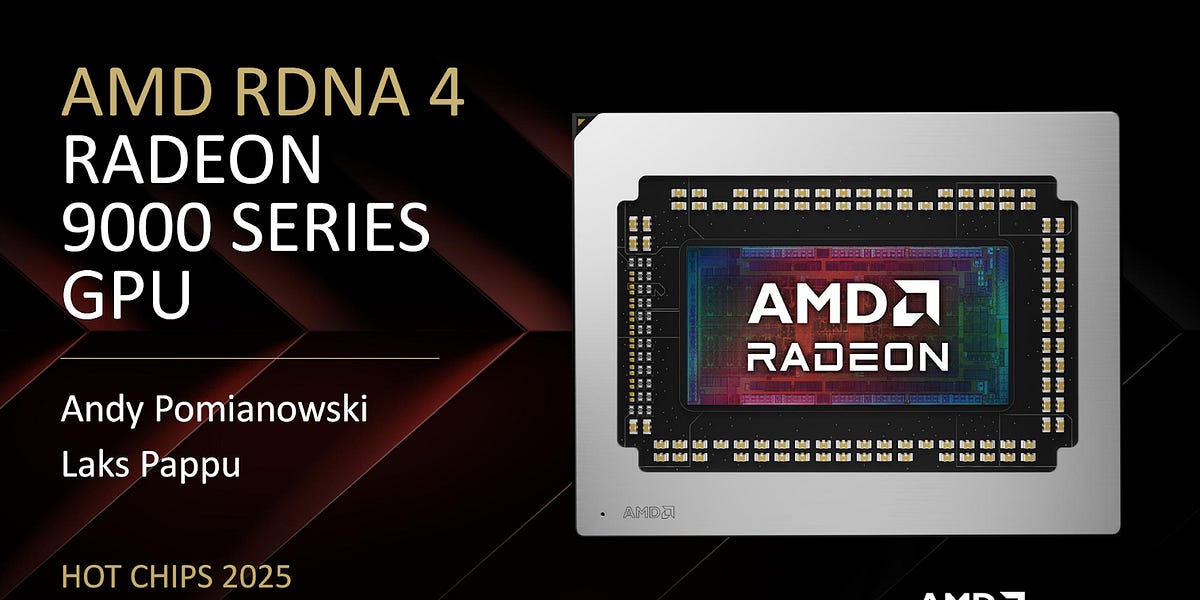
Xbox Ally X with the Z2X AI has 8 Zen 5 or Zen 5C cores. It has a 50 TOPS NPU. It's not that far off from the Magnus CPU. If Sony can disable a CPU core in the Orion, MS could probably disable at least one of the Zen 6 cores in Magnus if they were to use on handhelds.

I think MS will recommend Asus to make device slightly bigger for next gen handhelds, by doing 8" screen, so they have better room for cooling. Kepler stated that the handhelds would be using 28 Watts at least vs 15 Watts Canis.

GPD Win 5 shoved a 45-65 watt Laptop chip in their handheld. But that relies on external battery. Had they simply made device bigger, they likely could've kept both.

Also, not sure if Magnus has a Pluton security chip, probably does, that is probably what will ensure Console library BC and FC on devices with Magnus.
AMD's PC Zen 5 SKUs include Pluton, which includes the normal desktop Ryzen on the AM5 platform. Blame Intel for slowing down Pluton's deployment.

From https://learn.microsoft.com/en-us/w...ty/pluton/microsoft-pluton-security-processor

Microsoft Pluton is currently available on devices with AMD Ryzen® 6000, 7000, 8000, Ryzen AI and Qualcomm Snapdragon® 8cx Gen 3 and Snapdragon X series processors. Microsoft Pluton can be enabled on devices with Pluton capable processors running Windows 11, version 22H2 and later.

------------


Intel incorporated Pluton functionality into its Core Ultra 200V (Lunar Lake) series processors through its Partner Security Engine.
Some of this is due to higher clocks - 9060XT boost is 3.1GHz vs Pro's 2.35GHz. This alone is about +30% or roughly equals to 40 CUs at Pro's clocks.

But comparing GPUs just by "CU" numbers is wrong by default since these are different, sometimes totally so.
9060XT is using a chip which is made of ~30Bln transistors.
If we compare that to RDNA2 family this would be more than what was used for 6900XT - 27Bln.
A 60 CU RDNA2 part will likely be at ~22Bln transistors - which is another 35% or so difference to 9060XT's 30Bln.

In the end the "efficiency gains" don't look as high if you take this into account, and it is worth remembering that at least a third of them are paid for in GPU complexity which means that you can't just extrapolate the performance of a 32 CU part into a 40/50/60 CU one as such part may end up being too big for a console SoC.
In other words, don't use "CUs" as if that's some fixed h/w metric. RDNA doesn't even have "CUs" per se.

Reaching a higher clock speed is part of RDNA 4's design. Each RDNA 4 CU has double texture fetch. Steam processors don't include graphics load-store units.

The RX 9060 XT features a 32 MB L3 cache, which is still absent on the PS5 Pro's iGPU.

Both RX 9060 XT and PS5 Pro GPU have 4MB L2 cache. RX 9070 XT has 8MB L2 cache.


Both the RX 9060 XT and the PS5 Pro GPU have 64 ROPS.


RDNA 4 has 15 percent memory compression improvement and 25 percent fabric bandwidth reduction.
 
Last edited:
Reaching a higher clock speed is part of RDNA 4's design.
So? It's still a clock difference which you should account for when comparing "CU" vs "CU".

The RX 9060 XT features a 32 MB L3 cache, which is still absent on the PS5 Pro's iGPU.
And this cache plays a huge role in the bespoke "efficiency gains" which means that you should account for that as well when comparing "CU" vs "CU".

RDNA 4 has 15 percent memory compression improvement and 25 percent fabric bandwidth reduction.
As I've said the Pro's GPU is about 30% less complex than Navi 44 in 9060XT.
Performance estimates puts the Pro at about similar level, as well as on 7700XT or 4060Ti level or so.
"CU" numbers in such comparisons are irrelevant, the only thing which matters is perf/transistor.
 
So? It's still a clock difference which you should account for when comparing "CU" vs "CU".

And this cache plays a huge role in the bespoke "efficiency gains" which means that you should account for that as well when comparing "CU" vs "CU".
Wrong narrative.

1. RX 6700 (36 CU RDNA 2, 64 ROPS) has 80 MB L3 Infinity cache along with an external 160-bit bus, and its result is similar to PS5. A large infinity cache is the only workaround for a narrower external memory bus.

2. RDNA 4's higher clock speed is inherent in the newer ASIC design. You imposed the IPC argument, but my argument is the whole RDNA 4 improvement package.

3. RDNA 4 CU's double issue shader FLOPS improvement is backed by double texture sampling rates (I/O) and dynamic register allocation (reducing register stress). The new supporting I/O hardware is needed to feed RDNA 4 CU's increased texture rates, that is inherent with the newer RDNA 4 design. RDNA 3.0's double issue FLOPS improvement doesn't have per CU double texture sampling rates (I/O).

As I've said the Pro's GPU is about 30% less complex than Navi 44 in 9060XT.

Performance estimates puts the Pro at about similar level, as well as on 7700XT or 4060Ti level or so.
"CU" numbers in such comparisons are irrelevant, the only thing which matters is perf/transistor.
This topic is about the next-gen hardware, which includes new supporting I/O hardware that feeds the next-gen CUs. My RX 9060 XT RDNA 4 32 CU scale vs PS5 Pro RDNA 2/3 60 CU scale is just an improvement example via Digital Foundry comparison.

Next-gen hardware with higher transistor count comes with a higher density process node, which is part of the next-gen package.

Try again.
 
Last edited:
My RX 9060 XT RDNA 4 32 CU scale vs PS5 Pro RDNA 2/3 60 CU scale is just an improvement example via Digital Foundry comparison.
I've already told you twice why it's nowhere close to an "improvement" in terms which actually affect the design decisions for console APUs.
If you prefer to continue comparing the GPU h/w in "CU" numbers then that's up to you,
 
I've already told you twice why it's nowhere close to an "improvement" in terms which actually affect the design decisions for console APUs.
If you prefer to continue comparing the GPU h/w in "CU" numbers then that's up to you,
I told you that RDNA 4's CU scale includes extra hardware to feed it, i.e., it's inherent with RDNA 4's design. You are wrong with your artificial argument limitation..
 
I presume though that something like Universal Compression will be a more automated, system level function and so perhaps we see some level of reservation in -- and fixing of -- Neural Arrays for stuff like that.
I was under impression UC was an evolution of memory compressors (thus fixed circuits and - well in memory only and bandwidth not storage saving), not something that would use runtime compute, maybe I need to rewatch that interview.
More so because lossless compressors have very 'fixed' limitations (ie. laws of physics constraints) unlike the lossy stuff. Granted - you can do signal degradation ahead of lossless compressor but like any lossy methods that's stuff you really don't want to over-automate.

Also so far the bleeding edge of Neural compression* is subject to many complicated constraints of its own. If you want to actually outperform analytical methods, you need to combine at least 7 layers of texture detail, else it's capping out at the same limitations we've had in compression all along - ie. reaching 1bit/texel can be 'passable - but not great' and 0.5-1bits deteriorates into sludge that you just wouldn't use in production.

*I'm referencing NVidia's solution here of course.
 
I've found some info that this comes out to around 24 Tflops

This is going to cost 1,200$, be 3 years newer than the ps5 pro, and won't even be double the power of ps5 pro?

Console jumps have gotten much smaller, if only looking at Tflops consoles have seen a 6X increase for the past 3 gens now and this gen won't even be a 2X increase
 
Last edited:
What kinda Tflops we talking with this
Likely [GHz clock] x 68 x 128 no of Gflops
=> IF 2.5 Ghz clock = ~22K Gflops = ~22 TFlops

Non BS 32 bit TFlops, that is. If you want BS (dual issue) TFlops, multiply by 2.

Assuming 68 CUs is correct. But we don't know the clock frequency yet.

Clocks are heavily dependent on Wattage. Overall, Wattage is a much more interesting spec than some TFlops number...
 
Last edited:
This is going to cost 1,200$, be 3 years newer than the ps5 pro, and won't even be double the power of ps5 pro?
"wont even double", LOL.

if you were paying any attention, you would know that they no longer aim for extreme increases in raw power (because it costs $$$). Instead, other techniques (RT/ML stuff) have increased focus.
 
Last edited:
I've found some info that this comes out to around 24 Tflops

This is going to cost 1,200$, be 3 years newer than the ps5 pro, and won't even be double the power of ps5 pro?

Console jumps have gotten much smaller, if only looking at Tflops consoles have seen a 6X increase for the past 3 gens now and this gen won't even be a 2X increase

It will be a lot more powerful than the PS5 pro. You are just taking the TF numbers of the GPU and the Frequency and not taking into account improvements to the CPU side etc.
 
Top Bottom