• Hey Guest. Check out your NeoGAF Wrapped 2025 results here!

[MLiD] AMD Magnus APU Full Leak: RDNA 5, Zen 6, 110 TOPS NPU = XBOX Next-Gen Console!

50~60 depending on final clocks

Basically a 5080...

A console with the equivalent of a high range graphics card two years after it comes out is definitely better than what have seen in consoles. Usually it's a mid range a couple years after it comes out.
 
Last edited:
The only way Ms gets me back is with games. I play on high end PC so the specs of their next gen "console" are irrelevant.
 
Last edited:
50TF closed system, I'd better start saving because I'm going to want one of those. If any developer manages to lower the fps of 60 in this thing it's just going to be a matter of pure dedication and sadism. Looking at you, China.
Unreal Engine 6:

Revenge Of The Sith Prequel GIF
 
Don't forget guy K KeplerL2 said it's a guess. An educated one, but a guess nonetheless, so you don't have to run with that number. Prices can change on a dime.
 
That's a lot of GHz...

He's counting the half precision too though. Keep that in mind. That's FP16, instead of FP32 that PS5 and Xbox Series consoles use. If he wasn't, it'd be 25-30 TFs. But like he said half precision will start being a thing with next-gen, so it has to be accounted for in the total system power. How accurate and how much is used is still a mystery. It'd probably honestly "FEEL" like a console that has 35 to 40 TFs at the end of the day. Or 3.5 - 4 times stronger than the current PS5. And at least twice as strong as the PS5 Pro, but with even MORE advanced software on top of that.
 
He's counting the half precision too though. Keep that in mind. That's FP16, instead of FP32 that PS5 and Xbox Series consoles use. If he wasn't, it'd be 25-30 TFs. But like he said half precision will start being a thing with next-gen, so it has to be accounted for in the total system power. How accurate and how much is used is still a mystery. It'd probably honestly "FEEL" like a console that has 35 to 40 TFs at the end of the day. Or 3.5 - 4 times stronger than the current PS5. And at least twice as strong as the PS5 Pro, but with even MORE advanced software on top of that.
No I'm not, and dual-issue has nothing to do with half-precision.
 
He's counting the half precision too though. Keep that in mind. That's FP16, instead of FP32 that PS5 and Xbox Series consoles use. If he wasn't, it'd be 25-30 TFs. But like he said half precision will start being a thing with next-gen, so it has to be accounted for in the total system power. How accurate and how much is used is still a mystery. It'd probably honestly "FEEL" like a console that has 35 to 40 TFs at the end of the day. Or 3.5 - 4 times stronger than the current PS5. And at least twice as strong as the PS5 Pro, but with even MORE advanced software on top of that.

VOPD is not half precision.
 
He's counting the half precision too though. Keep that in mind. That's FP16, instead of FP32 that PS5 and Xbox Series consoles use. If he wasn't, it'd be 25-30 TFs. But like he said half precision will start being a thing with next-gen, so it has to be accounted for in the total system power. How accurate and how much is used is still a mystery. It'd probably honestly "FEEL" like a console that has 35 to 40 TFs at the end of the day. Or 3.5 - 4 times stronger than the current PS5. And at least twice as strong as the PS5 Pro, but with even MORE advanced software on top of that.
No Way Do Not Want GIF by Schitt's Creek
 
He's counting the half precision too though. Keep that in mind. That's FP16, instead of FP32 that PS5 and Xbox Series consoles use. If he wasn't, it'd be 25-30 TFs. But like he said half precision will start being a thing with next-gen, so it has to be accounted for in the total system power. How accurate and how much is used is still a mystery. It'd probably honestly "FEEL" like a console that has 35 to 40 TFs at the end of the day. Or 3.5 - 4 times stronger than the current PS5. And at least twice as strong as the PS5 Pro, but with even MORE advanced software on top of that.
No, we pretty much always use FP32 when talking about Floating Point performance on gaming GPUs. You're confusing the terms. FP16 and FP64 have been around for decades, but we pretty much never use them when generally talking about graphics performance.

What you're thinking about is VOPD which is a number that still refers to FP32 performance, but for gaming, it has been mostly meaningless, so we just ignore it and give the "regular" FP32 number that is more insightful in terms of what to expect.

You're mixing them up because using VOPD, the FP32 throughput is doubled, similar to how FP32 performance is double that of FP16 performance.

As winjer winjer said, FP16 has nothing to do with what we're talking about.

 
Last edited:
This thread continues to stay alive while the Xbox division is basically about to be killed off by MS....

Unbelievable
You're a sign of two things:

- That your need to talk about Xbox in every single thread, at all hours of the day, without a break, demonstrates that it's very much alive.

- The forum lacks administrators if they allow accounts like yours that contribute nothing or only hinder healthy discussions and threads like this.

But hey, Neogaf in its prime.
 
Didn't you say the clocks were already finalized though?

EDIT: May be I'm imagining it. I guess you said the specs were finalized and I assumed that includes clocks.
Clocks are only final after B0 hits, which is about a year from now
Any insight on how it will be used? And is it any different relative to Nvidia?
The problem with current dual-issue in RDNA3/4 is that there a lot of restrictions regarding VGPR bank usage which makes it almost impossible for VOPD to be used outside of code specifically optimized for it. The new implementation in RDNA5 removes almost all restrictions which means it can be used quite easily.
 
The problem with current dual-issue in RDNA3/4 is that there a lot of restrictions regarding VGPR bank usage which makes it almost impossible for VOPD to be used outside of code specifically optimized for it. The new implementation in RDNA5 removes almost all restrictions which means it can be used quite easily.
Interesting. How does that compare to Nvidia? Is dual issue unique to AMD?
 
Last edited:
FP32 Dual Issue, it seems. But 30TFlops is still "a lot of GHz".
Not really.

For example,
70 CU × 4 SIMD32 (Dual-Issue) × 32 FP32 × 2 MA × 3.4 Ghz = 60.92 TFlops or 30.46 TFlops without Dual-Issue.

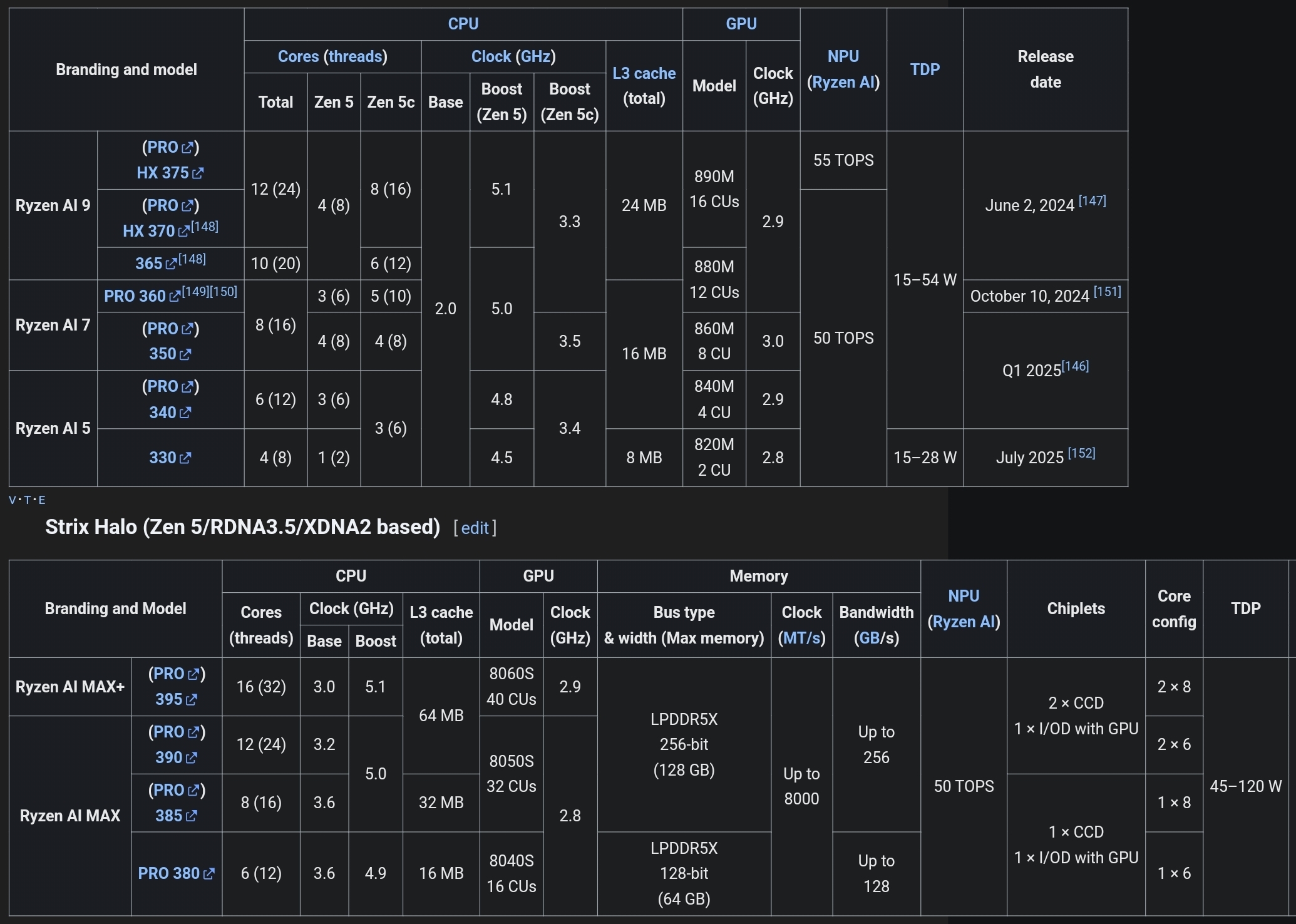
Here, the Ryzen AI Max+ Pro 395 with 40 RDNA3.5 CUs run @ 2.9 GHz with a 120W TDP.
uWxPlMcg4vJxvGbI.jpg


So Xbox Magnus clocked @ 3.4GHz with the reported 250-350W TDP is possible.
 
Last edited:
I am trying to figure out who buys this thing. If it really is going to cost 1200, people like me will just build a PC as we already do. I have too many devices as it is but don't mind the outlay on my PS5 Pro, switch 2 and PC as they offer different eco systems and different games in different rooms for me. I always get excited about new Xboxes but I always sell them as they are always the devices that get used the least (except X360 which was great).

I just can't fathom who will buy what is essentially a prebuilt ? I am already contemplating giving up game pass on my PC now the games are coming to PS5 and would rather wait and own games on steam.

Maybe its just me but I just think this is another colossal screw up from MS.
 
You're a sign of two things:

- That your need to talk about Xbox in every single thread, at all hours of the day, without a break, demonstrates that it's very much alive.

- The forum lacks administrators if they allow accounts like yours that contribute nothing or only hinder healthy discussions and threads like this.

But hey, Neogaf in its prime.
Xbox lives in his head 24/7
 
Not really.

For example,
70CU × 4SIMD32 (Dual-Issue) × 2MA × 3.4Ghz = 60.92 TFlops or 30.46 TFlops without Dual-Issue.

Here, the Ryzen AI Max+ Pro 395 with 40 RDNA3.5 CUs run @ 2.9 GHz with a 120W TDP.
uWxPlMcg4vJxvGbI.jpg


So Xbox Magnus clocked @ 3.4GHz with the reported 250-350W TDP is possible.
That sounds purty good. 3.4 ghz would be just the GPU right? The CPU in Series Consoles was roughly 3.6 ghz, that will likely go up to 4.5?
 
I am trying to figure out who buys this thing. If it really is going to cost 1200, people like me will just build a PC as we already do. I have too many devices as it is but don't mind the outlay on my PS5 Pro, switch 2 and PC as they offer different eco systems and different games in different rooms for me. I always get excited about new Xboxes but I always sell them as they are always the devices that get used the least (except X360 which was great).

I just can't fathom who will buy what is essentially a prebuilt ? I am already contemplating giving up game pass on my PC now the games are coming to PS5 and would rather wait and own games on steam.

Maybe its just me but I just think this is another colossal screw up from MS.

Don't worry, nobody is buying this thing so you are not alone...
 
Last edited:
They call them different things, but what they achieve in similar. In name, they are different, but in practice, not that much.
Actually they are very different in implementation, AMD's is limited by the complexity of VGPR operand fetch while NVIDIA's is limited by the number of execution lanes.
 
They call them different things, but what they achieve in similar. In name, they are different, but in practice, not that much.
Actually they are very different in implementation, AMD's is limited by the complexity of VGPR operand fetch while NVIDIA's is limited by the number of execution lanes.

What I'm hoping to get at is a meaningful comparison of effective raster performance.

If Magnus is 50-60 Tflops, with dual issue that is finally useful, where does that stand relative to a 5080's 56.2 Tflops? Is Nvidia's version of dual issue useful for gaming yet? If not, wouldn't that technically allow Magnus to punch even above 5080?

I guess we won't even know till real world benchmarking is done...
 
Last edited:
Actually they are very different in implementation, AMD's is limited by the complexity of VGPR operand fetch while NVIDIA's is limited by the number of execution lanes.
Uncertain about the implementation, but they aim to achieve the same or something similar, unless I misunderstood. For gaming at least, but so far, I don't think many if any game did anything with that.
 
Last edited:
What I'm hoping to get at is a meaningful comparison of effective raster performance.

If Magnus is 50-60 Tflops, with dual issue that is finally useful, where does that stand relative to a 5080's 56.2 Tflops? Is Nvidia's version of dual issue useful for gaming yet? If not, wouldn't that technically allow Magnus to punch even above 5080?

I guess we won't even know till real world benchmarking is done...
Difficult to estimate, but I think Magnus could be slightly faster than 5080.
Uncertain about the implementation, but they aim to achieve the same or something similar, unless I misunderstood. For gaming at least, but so far, I don't think many if any game did anything with that.
Yeah, it's a cheap (in terms of silicon area) way to get more performance.
 
Not really.

For example,
70CU × 4SIMD32 (Dual-Issue) × 2MA × 3.4Ghz = 60.92 TFlops or 30.46 TFlops without Dual-Issue.

Here, the Ryzen AI Max+ Pro 395 with 40 RDNA3.5 CUs run @ 2.9 GHz with a 120W TDP.
uWxPlMcg4vJxvGbI.jpg


So Xbox Magnus clocked @ 3.4GHz with the reported 250-350W TDP is possible.
Maybe. Specified numbers doesn't have to be close to real numbers.

But as for real numbers... Considering a 9060XT, 32 CUs, draws 180 Watts when the average clock is 3.2 GHz - the leap from RDNA4/N4P to RDNA5/N3P has to be very significant.
 
Last edited:
I'll be curious to see what Nvidia can pull out there bag for the 60 Series, Jensen knows they'll be coming up against RDNA 5 which from what we are hearing will be a relatively competitive architecture, and they'll also be coming up against the next generation of consoles.

The 30 Series which released against RDNA 2 and PS5/XBX was also a decent uplift both in performance and price so we'll see.
 
Difficult to estimate, but I think Magnus could be slightly faster than 5080.
From the Amethyst revealed tech AFAIK the full (RC) Radiance Core coordination logic can't be accelerated efficiently on current Nvidia GPUs, only the (NRC) Neural Radiance Cache algorithm can be accelerated on the tensor cores, so when making that estimate are you just looking at relative current spec efficiency and spec uplift in a AMD to Nvidia comparison, or are you going by AMD in house expected Amethyst performance savings too on PT?

My view is that the (RC) Radiance Cores - mostly their (NRC) Neural Radiance Cache feature - is going to be for PT what the zbuffer was for rasterization and am now anticipating hardware without the ability to accelerate NRCs and accelerate or brute force the RC coordinating work of casting, traversal and shading to be cut adrift when full next-gen games start releasing.
 
Very interesting talk you guys. Thanks Kepler as always. We have to remember he doesn't need to share anything with us, yet he's doing it :)

Magnus sounds incredible. Since it's in the 50-60TF range, I guess PS6 will be around 30 to 40.
 
No I'm not, and dual-issue has nothing to do with half-precision.

VOPD is not half precision.


No, we pretty much always use FP32 when talking about Floating Point performance on gaming GPUs. You're confusing the terms. FP16 and FP64 have been around for decades, but we pretty much never use them when generally talking about graphics performance.

What you're thinking about is VOPD which is a number that still refers to FP32 performance, but for gaming, it has been mostly meaningless, so we just ignore it and give the "regular" FP32 number that is more insightful in terms of what to expect.

You're mixing them up because using VOPD, the FP32 throughput is doubled, similar to how FP32 performance is double that of FP16 performance.

As winjer winjer said, FP16 has nothing to do with what we're talking about.

Thanks for the correction! This becomes more interesting then.
 
Where do the pc rumors come from then

"This week, Xbox announced it is actively building its next-generation lineup across console, handheld, PC, cloud, and accessories. As part of this, Xbox unveiled that it has entered into a strategic, multi-year partnership with AMD to co-engineer silicon across a portfolio of devices, including future first-party consoles and cloud."

They're doing BOTH Xbox PCs and Xbox Consoles.

Consoles will 100% be more locked down than the PCs.
 
Last edited:

"This week, Xbox announced it is actively building its next-generation lineup across console, handheld, PC, cloud, and accessories. As part of this, Xbox unveiled that it has entered into a strategic, multi-year partnership with AMD to co-engineer silicon across a portfolio of devices, including future first-party consoles and cloud."

They're doing BOTH Xbox PCs and Xbox Consoles.

Consoles will 100% be more locked down than the PCs.
Maybe a maguns console and magnus pc then? Or completely difference specs between each system, i figured magnus was the pc since it costs 1200
 
Where do the pc rumors come from then
All the information is actually all over the place. Best guess is it is Windows based, but things like Bios access etc or dual boot are total unknowns. It may well be that the 1st party version is locked down and OEM's are the only path to Linux on Magnus for instance. But perhaps in doing so you give up back compat. We will see. Actually a really good third party device without MS margin is pretty attractive to me if it can access the console like UI/UX/cutdown OS.

Current pricing on the the closest hardware out right now doesn't give me much hope though. They charge through the nose for it.
 
Last edited:
Very interesting talk you guys. Thanks Kepler as always. We have to remember he doesn't need to share anything with us, yet he's doing it :)

Magnus sounds incredible. Since it's in the 50-60TF range, I guess PS6 will be around 30 to 40.
Sony may clock higher than normal again.

For example, (just guess work)
56 CU × 4 SIMD32 × 32 FP32 × 2 MA × 3.6 GHz = 51.6 TFlops.

But I expect a 40-50 TF range.
 
Last edited:
Maybe a maguns console and magnus pc then? Or completely difference specs between each system, i figured magnus was the pc since it costs 1200
Magnus is dual purpose yes. But Magnus is just the CPU SOC with the media die and NPU. Theoretically it should be able to be paired up with any of the 5 AMD GPU dies.

AT0 - 192 CUs, this is supposedly for xCloud, and 6090 tier Discrete graphics card

AT1 - 96 CUs, possibly for Xbox PCs and 5090 tier (aka 6080 tier) Discrete graphics

AT2 - 68 CUs, this is the Xbox Console being discussed, and same APU will be used for Xbox PCs (5080) tier, might even be used for 6070 tier Discrete graphics

AT3 - 48 CUs, probably for mini PCs, powerful gaming laptops and/or S tier Console

AT4 - 24 CUs, for regular laptops and handhelds. Probably 12 and 24 CUs on the handheld SKUs.
 
Top Bottom